Lee Wochner: Writer. Director. Writing instructor. Thinker about things.


Blog

Why this post isn’t more cohesive

March 26th, 2009

If you guessed, “Because Lee had more dental work today,” you win. When will it end? Well, when is the apocalypse? Because I think I’m scheduled through the week after.

While we wait for me to re-gather my thoughts — tomorrow, or who knows when? — I did want to post something here before trundling off to bed with another glass of wine and a revolver. So here are a few topics I might have written about otherwise:

  • I was able to get tickets for TV On the Radio on April 14th at the Glass House in Pomona. It doesn’t make up for the toothaches or teethache or whatever. But it’s definitely something to live for. Last time I saw the band they were the worst live act I’ve seen since an overweight elderly “model” performed her special magic at a bachelor party in 1987. The recorded music of TV On the Radio is terrific, and I’m hoping they’ve improved on stage. (And that I never again see said “model.”)
  • Yesterday I went to a ceremony where 2,000 people were freshly minted as Americans. That I will be writing about. And supplying photographs of many people waving flags. I got choked up. A woman near me cried.
  • My wife got five roundtrip tickets from Burbank to New York so cheap I’m sure we’ll find out we have to serve drinks on the flight. (So yes, if you’re in New York, New Jersey, or Philadelphia, we’re coming to visit in June.)
  • I was asked to return as emcee for the 2nd (un)Annual BLLOTY Awards in the fall. Last time the honoree was Stephanie Miller and her cohorts. More to come.
  • Every time I go to the Magic Castle in Hollywood, I see someone notable in the audience. One time, shortly before a lion tried to “help Roy off the stage,” Siegfried and Roy sat down in the seats next to my wife and me (and she didn’t know who they were). This time, it was Lord British, recently returned from his trip to outer space aboard a Russian spacecraft, which cost him about $30 million more than my wife paid for those tickets. In the seeming eternity he stood behind me while we awaited entry to the Close-Up Gallery, seating 22, he recounted the entirety of gaming action to be found in Ultima I, Ultima II, Ultima III, Ultima IV, Ultima V, and all the other role-playing Ultima games that by their very name reduce the meaning of English language. (Although not so much as “Final Fantasy 13,” about which I said to my son, “When will we every truly reach the final fantasy, and how will we know? Will they call it Final Final Fantasy?”) British was loud and obnoxious and utterly oblivious to the narrow confines of the hallway in which he was bloviating. The moment the door to the show room opened, people scrambled for the furthest seat from him. In a room seating three rows totaling 22 people, there is no furthest seat. I am sorry that as a long-ago player of some of his games, I am partly responsible for engendering his self-entitlement. And that the Russians have perfected the return flight.

All for now. Off to get the wine and the gun.

Walken watchin’

March 24th, 2009

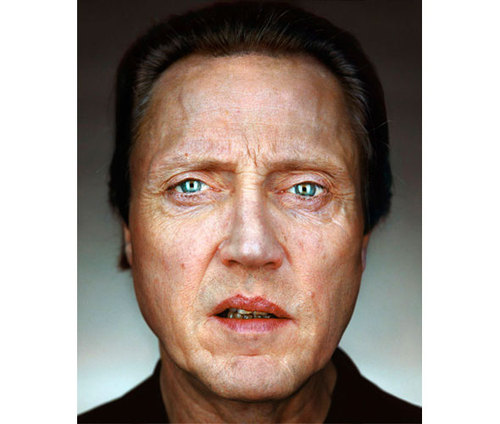
ms_walken_christopher_2000.jpg

Surely we can all agree that Christopher Walken bears watching. Even if we’re not always sure why. Walken is a wonderful dancer, and a magnetic actor, but he’s not always good. Walken’s oddly parsed delivery of even the most straightforward of lines is more affected than effective. Which puts him in company with… William Shatner.

(For a professional analysis of Shatner’s vocal rhythms, watch the video below. Note especially the next-to-last lesson therein: that Shatner, unlike almost any other humanoid, ends his sentences with a quick intake. Most of us do that first.)

The other night I watched “The Anderson Tapes” for the first time in 37 years. The last and only other time I saw it, I was nine years old and the guest of my parents. Yes, this was the first “adult” movie I saw, and it left an indelible impression. Perhaps partly because it featured Christopher Walken in his very first film role.

In “The Anderson Tapes,” Sean Connery puts together a group of fellow thieves and ex-cons to rob the entire contents of a luxury hotel. Watching this from the remove of adulthood, I have to wonder what misgivings my parents were having back in 1971 as we watched this together. The movie is filled with extreme violence (for the time), but more troubling for my mother, it’s rife with sexual situations and double entendres. Dyan Cannon bounces between the recently released Connery (who notes that with 10 years in prison he is desperately in need of release) and the wealthy slimeball who has been keeping her on the side. Martin Balsam is a flaming antiques dealer, complete with pompadour and cravat, who gets lucky when he discovers a designer of a similar persuasion upstairs in the hotel.

And then there’s Walken, who plays “The Kid.” He doesn’t have many lines, and he wears an odd hold-up mask for probably half of them. But everything he does in the movie bears watching. One scene in particular never left me. Late in the movie, he drives a panel van out from inside a Mayflower moving truck and away from the police, in an attempted getaway. He careens into a police car, his van twisting in midair and slamming onto its side. We get a shot of Walken’s dead body wrenched the wrong way inside, a gush of blood smeared down his face. This scene, viewed once, had stayed with me for nearly four decades. I remembered it as a much larger set piece; now I see that it is at most 10 seconds of footage. Is it the violence of the crash, so startling for its time but so quaint now, that stuck with me? Or is it that this was the culmination of Walken’s role, and I’d followed him throughout? Whichever (or both), he remains memorable.

Who played the suicidal brother of Annie Hall? Walken, in one of the most remembered scenes in a movie filled with them.

Walken is the star of the flat-out worst scene in “Pulp Fiction,” the rectum/watch scene, horribly over-written and badly paced and too long by half, but he almost makes it work nonetheless.

Who better — who other — than Walken would have been suited to play the deviant cosmopolitan who ensnares the unwitting tourists in “The Comfort of Strangers“? I saw this film in 1990 in the middle of the day in a cinema across from the Fox lot unfortunately in the same small audience as the actress perfectly cast as the stupid sister on “Family Ties.” Her obnoxious giggles and self-entitled post-adolescence abruptly halted when the themes of the film and especially the slippery disturbed portrayal by Walken swam into view. Only two other times has a movie so thoroughly worked me over that I left a theatre with such dread (“The French Lieutenant’s Woman” and, of course, “Eraserhead,” seen late at night deep in the woods at the Little Art Theatre in Port Republic, NJ).

Or look, don’t take my word for it. Here’s Henry Rollins on the genius of Christopher Walken:

Imagine my delight, then, unmitigated delight, in discovering Christopher Walken earlier tonight on Twitter. Even removed from any script or camera, he’s eminently watchable. Take these sample tweets:

“I do my best thinking in a barber’s chair. Sadly I do my worst remembering there too. Sure, I could take some notes but who does that?”

“A neighbor kid shows up from time to time dressed as Superman. I think it’s him anyway. Very difficult to say for sure without the glasses.”

“I am now invited to a dog wedding. I don’t have the words to make that stupider than it already sounds. They’re registered at Whiskers.”

“You know that Andy Dick and how he seemed funny until we noticed that he wasn’t? You’ll tell me when it’s time to stop, right?”

Each of these bears the ineffable wisdom of a zen koan. (I’m also relieved to see that someone of Walken’s odd taste and high bearing is also onto Andy Dick. Phew.)

If you aren’t Following Walken, you should. Yes, life is short, but Twitter is even shorter. So you do have the time.

Stop the presses

March 24th, 2009

 Another friend has let me know that his newspaper has let him go. I’m trying to think of what friends are still employed by newspapers, and no one is coming to mind. Will the last one out please turn off the printing presses?
The newspaper companies will tell you they’re getting slammed by technology — which is true — but it doesn’t answer two big questions:  1) where’s all the money from the 50+ years when their annual profits were double or quadruple almost any other industry; and 2) how is it that they’ve lost their companies to a guy named Craig working out of his house in San Francisco? I know I’ve already blogged about this, but these questions merit repeating. Newspaper owners (and publishers) have been remarkably old-fashioned, short-sighted, blinkered, greedy, and rapacious. The truly sad thing is that we count on newspapers for almost all the real reporting, but then again, look how well they handled that little thing in Iraq, and whatever that was that happened with economic, um, shifts. Good reporting. Thanks for the heads-up there.

My anger toward these people is clearly the anger of a wounded romantic:  someone who loves newspapers whose heart sinks further day by day while his blood pressure rises.

And no, I still haven’t been able to bring myself to cancel the Los Angeles Times. I know, I know, I promised. And no, I don’t want to help Sam Zell make his mortgage payments. My inaction is not about the Times; it’s about me. After 30+ years of reading newspapers (or writing for them), it’s a difficult relationship to end. Cue the song: “Never Can Say Goodbye.”

Making peace with evil so that we can feel better

March 22nd, 2009

Some of us are old-fashioned. We believe in something called evil. It goes by various terms, and sometimes it’s dressed up as mental illness, but in general it equates with people getting hurt in very bad ways and sometimes on a large scale and for generally no good reason or for reasons that could have been avoided.

Some of these are easily identified. Hitler = evil. That’s an easy one. Often it requires more thought, no matter what the scale. Dr. Jack Kevorkian — savior to the suffering, or someone who seeks to legitimize his personal thrill in ending a life? But in general, I think we could agree that an atrocity on the scale of killing billions of people in an effort to extinguish an entire race should rightly be seen as:  evil.

Except on “Battlestar Galactica,” where it appears to be God’s will. Or an unavoidable part of a natural cycle. Or something.

I watched the show’s finale last night and as much as one can be troubled by popular entertainment, I found it troubling. Troubling not just because the ending calls into question the entirety of the series’ supposed noble purpose, but also because it has been met with just unthinking universal acclaim, both in the mainstream media and on message boards.

On the macro level, Cylons and Humans reconcile, intermingle, and repopulate — and we are their offspring. But the way I understand the series, Cylons wiped out about a dozen planets full of humans, reducing the entire population to 39,000 that they ardently sought to wipe out.  Welcoming them with open arms to end a cycle of violence is akin to setting aside the morals of the enlightened to embrace the Nazis.

On the micro level, we have Gaius Baltar, an unrelentingly self-interested and self-serving race traitor who allows Caprica Six entree into the inner workings of human defense so that he can get laid. In the finale, we learn that Baltar was a poor lower-class farm boy who in adulthood strove to leave behind his past and who makes one — one — gallant effort, in joining a small firefight in the climactic battle scene. So, I guess, now that we understand the shame of his boyhood all is forgiven for those  billions who were murdered. (It’s interesting that the vice-president and a ship’s officer are court-martialed and executed by firing squad for leading an insurrection that kills a few dozen, while Baltar, the greatest mass murderer in history, is free to return to his roots.)

Dressed up as it is in the show’s liberal politics, where all can be forgiven if only we share our feelings, we are reassured at show’s end that all is according to God’s plan. Because of our bipolar nature — good/evil, Cylon/Human — we are forced to repeat this cycle until we decide to break it. Which would be fine — except we now learn that much of the action of the series has been guided by — wait for it — angels. The Caprica Six who has appeared to Baltar from episode one:  an angel. The Kara Thrace who returned from death? An angel. What I would ask is this — and I understand that these are age-old questions — what hope can humans have to break a cycle that is ordained by the almighty? If God wanted us to break a cycle of violence, well, why doesn’t He do it? Or, at the least, why doesn’t He simply stop sending angels and demons who keep us stuck in the groove  of this neverending cycle? Even more disturbing, if this is God’s plan, then how can we ascribe blame to Hitler, Stalin, Ted Bundy, Pol Pot, Genghis Khan, Vlad the Impaler, the architects of the Spanish Inquisition, Cheney, Bush? How can we judge against them, if they are part of a divine plan?

Questions of divinity and morality are only the most obvious disturbing element. The show has also been relentlessly anti-technology. For the record, technology is not evil in itself (although it can be used for evil purposes) and throughout human history has greatly improved the lives of billions. It seems foolish to have to say this, but in an age when people esteem mysticism (angels) and naturalism (chaos) over rational improvement, I suppose we should all of us take more time to stick up for civilization. In the series premiere, it was made clear that the Galactica survived only because as a museum piece it was not hooked up to Baltar’s integrated defense system. This is a favored trope of many a nostalgic Westerner:  that while your newfangled car’s computerized engine can be counted on to fail, that old rustbucket in the yard will always start right up. This is the kind of thinking that would have kept life nasty, brutish, and short. I make my living almost entirely through two devices, one called the phone, the other the computer; for much of human history I and everyone else would have been relegated to, paraphrasing Steinbeck, working in the dirt with a stick all day. Anyone who complains about office work hasn’t given it enough thought. The prehistoric alternative is hunting/gathering, and dying young from wild animal attack, other injuries and infectious diseases. If you are troubled by technology, then by all means, try the alternative.

(As a side note, this is why I so thoroughly enjoyed T.C. Boyle’s  “A Friend of the Earth.” The chapter where the Earth Firsters decide to live naked in the woods for 30 days is instructive. Any thoughts of sex or enjoyment or the wonders of nature fall away quickly when the imperative turns to finding another two-ounce lizard to eat raw. Boyle is no deluded fool, succored by indoor lighting while railing against the electric company.)

The organic alternative is where the Galactica’s various species — Human, Cylon, and hybrid — wind up. They redub Sol III as “Earth” and settle here, engendering the rest of  human history. In so doing, they reject cities and ships and weaving and printing and everything else manufactured from their past and go rustic. I watched this scene and asked the basic questions that the writers would rather you didn’t:  “What happens when those clothes fall apart?” “If they don’t build structures, how will they survive the cold and rain?” “What happens when the medicine runs out?” and on and on. Laura Roslin was already dying of cancer, but it seemed hard to believe that the first time someone had an infected cut they wouldn’t be sorry they’d destroyed all the penicillin. How many millions of lives has penicillin saved, and how many died in the past for want of it? These are the questions that are left utterly unasked, and they are the right ones.

In place of all these hard questions, precisely the sort of hard questions that inform global actions every day, questions of morality, and of choice, of individual responsibility, what we’re left with is the freefloating sentiment that mankind should just decide to get along together. Yes. I agree. Just as I wish that every board, panel, committee, and commission I have ever sat upon, or indeed every play-production group to which I have ever belonged, would just agree. But we don’t. We seem to have differing ideas. Individual ideas. And here’s the revelation:  Sometimes there’s a bad person involved. Someone who’s damaged or deranged, someone who is willfully malcontent, someone who enjoys actively undermining the efforts of others. Breaking bread with that person feeds him and leaves you with a bad taste in your mouth. Certainly at this point, we’ve learned that, haven’t we? Seventy years later, haven’t we learned the essential difference between Churchill and  Chamberlain, and why we’re all of us in Churchill’s debt? Surely this is something about which we can all say, “So say we all.”
Hey, kids! (Free) Comics!

March 20th, 2009

Say, when is Free Comic Book Day?

And what is it?

Here’s everything you need to know.

Set your calendar accordingly.

Further proof there is a God

March 19th, 2009

My friends and I were able to get a room for this  year’s Comic Con.

Last year they sold out in 9 minutes. This year it was just as harrowing, but three of us were working the phones and the online registration system. All seemed lost — until a celebratory cellphone call from good friend Paul Crist.

Phew!

The hottest ticket in town…

March 17th, 2009

… is one that gets you in to see President Obama while he’s here.

In all fairness, his predecessor was good at turning out a crowd too. Just two months ago, millions all across the nation gathered to watch him leave. It was a fine show.

How to defend yourself from knife or gun attack

March 16th, 2009

This brief instructional video will come in especially handy at local parks and McDonald’s Playlands.

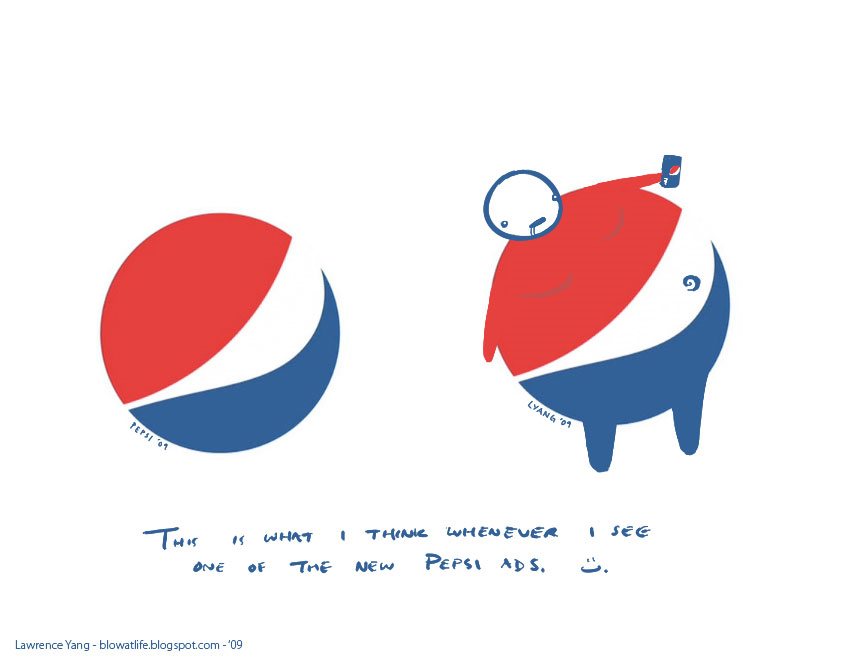
A response to the new Pepsi logo

March 16th, 2009

pepsilogo.jpg

Mitteleuropean pricing

March 15th, 2009

I’m just back from Otto’s Hungarian deli. I’ve been going there for years and years because Otto carries a spicy beer sausage that I enjoy and haven’t found elsewhere.

Otto is an elderly accordionist from the old country for whom pricing remains a matter of speculation. Today, for example, a $4.99 sausage and two 99¢ ice creams for my kids cost eleven bucks. I asked Otto for a breakdown on this charge, which led him to the subtotal of “about seven-fifty, and the rest is tax.” I know that California is in fiscal crisis, but I don’t believe state sales tax has gone up to 58%. Unlike me, I just paid it. That’s because last time I was there, Otto undercharged me by about five bucks and I couldn’t talk him out of it. I say “undercharged,” but that’s not accurate, because clearly pricing isn’t set. Perhaps pricing depends upon the level of admiration you express for polka music, unpronounceable beers, and packaged delicacies with no vowels on the label. Today he was screening a broadcast of Hungary’s national holiday — “Like Fourth of Ju-ly,” he said — and I complimented the aural beauty of the chorus and the imposing leadership of what I take to be Hungary’s present leader, a neatly dressed man in his 60’s whom the camera kept cutting away to, someone who serenely expressed his appreciation for all those young voices and the fittingness of whatever it is they were singing. Despite my praise, the sausage and the two ice creams were still eleven bucks. But it’s my belief that over the past 10  years, Otto’s pricing has balanced out. Once I stopped and got sandwiches for my business partner and myself and almost needed a bank loan. The next time it seemed he was paying me to take them. Whatever it actually costs, it’s always tasty.

I also find Otto himself to be interesting. In a Joyce Carol Oates story recently in the New Yorker (a story I stopped reading halfway through because life is short and it was dull) she describes a certain foreign-born type as “trying too hard.” I think that’s Otto, with his bad wisecracks that I can’t quite decipher and his countertop gimmicks, like the fake money and the singing plastic mechanical bird and the stacks and piles of dusty Hungarian tchotchkes, offset by a getup of shorts with suspenders, black dress shoes and white socks. There is something charming about all this, and there is something very friendly and personable about him that you find all too rarely. Little does Otto know his level of influence. When I was directing a play called “Grandma’s Christmas Goulash” by David Vegh (part of a show I conceived called “Hate for the Holidays” — just so you see where I’m coming from), the actor Richard Ruyle asked me where I thought he could pick up a Hungarian accent. I sent him do some business with Otto. I have no idea what he paid.

By the way, you’ll note that Otto will ship worldwide. He carries a fascinating array of meats, desserts, and, well, rubbing alcohol. (Perhaps the Hungarian kind burns deeper. Who knows?) Best to ignore the posted prices.