Lee Wochner: Writer. Director. Writing instructor. Thinker about things.


Blog

What we lose when we lose theatre people

March 31st, 2009

I’ve been talking here about my friends losing their newspaper jobs, and all of us losing newspapers. It now occurs to me that I should also note the theatres we’re losing and, more importantly, the theatre people:  the people who really are the theatre (not, to paraphrase Mike Daisey, the buildings in which they work). Because we just lost one of the best. Having been laid off by his theatre, he’s now leaving “the theatre.” When we had him here in L.A., the impact was immeasurable. This isn’t just Portland Center Stage’s loss, this is a loss for everyone who cares about new plays.

What we lose when we lose reporting

March 31st, 2009

“I’m not a journalist,” says the weepy Fox News host Glenn Beck in this video. “I’m just a guy that loves his country.”

I agree he’s not a journalist. No self-respecting journalist would cry these cued-up crocodile tears.

In this clip, you’ll see Tina Brown call Beck someone who is “in the mode of the great charlatan evangelists.” I think that’s about right. Many of those folks were taken as prophets of God — just as many of these entertainers are misunderstood as journalists.

Before the last newspaper folds, will any of them be able to make a profitable transition to the web? Because as bad as print reporting has been the past decade, with an overbearing curiosity about Britneys and Lindsays and little interest in corporate and government malfeasance and illegal wars, I shudder to consider how much worse we will be relying on the sort of boosterish hucksterism seen below.

Please watch.

Visit msnbc.com for Breaking News, World News, and News about the Economy

Today’s music video

March 30th, 2009

In honor of the mistreated guy at A.I.G., today’s music video is “March of Greed” by Pere Ubu, animated by the Brothers Quay.

(And why does the band Pere Ubu sing about “Pere Ubu”? Because the band is named after the character, and this video is taken from “Bring Me The Head Of Ubu Roi,” an adaptation of Alfred Jarry’s “Ubu Roi.” Which had better come to L.A., or I warn you, someone will pay the price.)

By the way, if you like the song — and who wouldn’t? — you can download it free here.

A bailout for the rest of us

March 30th, 2009

The other day I posted an email that’s been making the rounds that endorses giving all the Federal bailout money to, well, us (rather than banks, insurance companies, real-estate conglomerates, failed car companies, and that asshole from A.I.G. who thinks he’s being treated shabbily).  Someone has  now taken a stab at the math and his results are in:  Your personal bailout would amount to all of about $5100. Which makes sense when you think about it this way:  $18 billion to the folks who during escalating foreign-oil dependency came up with the Hummer, and just enough for each of us to buy a right quarter section of one of their vehicles.

Strange overtones

March 29th, 2009

byrneeno276.jpg

Brian Eno and David Byrne on their multi-decade collaboration, and why, for Eno, Frank Zappa provides an example of precisely what not to do in music.

Page (and stage) turners

March 29th, 2009

I’ll never forget the first time I started to read Frank Herbert’s “Dune,” in my late teens. Or the second time. Or the third time. Without finishing it. There had to be something to this book, its advocates were so legion, but whatever it was, I wasn’t finding it. Each time, I experienced the first 100 pages  as a cascade of names and items I couldn’t place or keep straight:  the Kwisatz Haderach, the Bene Gesserit, Feyd Rautha, various Atreides and Harkonnens, stillsuits, weirding modules, heighliners, and on and on. Now there’s a Wikipedia page covering just the technology. At the time, there was no such resource. There was just the lonely labor of trying again and again until something started to make sense. Three times, I bailed on this book, until finally one night, pruning in the tub, I made it past page 100 and actually got interested.

The other night my wife saw me hunkered down in front of the bookcase on my side of the bed, looking for the next novel to read. In general, I read two or three books (and multiple magazines) at the same time. I’m looking forward to finishing the history of Germany  under the Nazis (especially delightful because I know how it ends) and then returning to the account of Roman Empires, as well as finishing Julian Barnes’ meditation on death and that account of how censorship ended so many comic artists’ careers. But in the meantime, I was looking for a novel, having recently finished T.C. Boyle’s “A Friend of the Earth,” as noted here previously. My eye landed upon Cormac McCarthy’s border trilogy:  a one-volume compendium of “All the Pretty Horses,” “The Crossing,” and “Cities of the Plain.”

However overstylized his writing may be (or perhaps because of its trickery) I find McCarthy to be a wonderful writer. No matter his overuse of polysyndeton, he has a grasp of vocabulary and flow and scenic description that at times beggars belief. I get caught up and keep reading. In addition to “All the Pretty Horses,” I’ve read “No Country for Old Men” and “The Road,” and enjoyed them all immensely. But I got stopped cold about 160 pages into “The Crossing” by an endless monologue given by an old man unmoored from this life. This old man goes on about… something… for so long I felt trapped in purgatory with him. And finally freed myself by putting the book down. A quick check-in with my son revealed that, unprompted, he had stopped at precisely the same waystation. Neither of us knew what the old man was talking about, endlessly and with seemingly no purpose, and both of us had ditched.

But now I picked it back up and climbed into bed. Even if the plot didn’t advance — and clearly, that’s what I was missing, some action, some sense of forward movement, something that would pick me up and carry me along in the way that made “No Country for Old Men” utterly unputdownable — I figured I would find myself entranced again by some of the prose before quietly slipping off to sleep. Without the aid of a bookmark, I found where I had left off probably six months ago, near the terminus of the old man’s interminable monologue, and started up again. And then found myself reading for hours. Here’s what happens:  The existential treatise ends a mere page or so after I had quit, with the old man bidding our protagonist, 17-year-old Billy Parham, farewell. Billy rather speedily crosses the border from Mexico back into the U.S. (New Mexico; nice touch) and returns to his family’s ranch to discover that the ranch has been cleaned out and his parents murdered. He heads into town and gleans what information he can from the sheriff, then picks up his younger brother, who somehow escaped the onslaught, and returns with him to Mexico, where they seek their horses and, no doubt, the men responsible for the murders.

In other words, now the book is a page turner.

I related this to my son, getting up to the point of Billy’s return and what he finds, when my son called out, “Stop. Maybe now I want to finish reading it.” He’ll have to wait for me to finish it first.

Is all this a very long way of saying that story is important? Perhaps. Is it the most important element? Maybe not. I loved “The Incredibles” because I got so caught up in Mr. Incredible’s personal crisis (a hero forced to reject his heroism, and so subject to the predations of bureaucracy and the 9 to 5); by contrast I in no way care about Ginormica’s problem in “Monsters vs. Aliens” (a young woman supported in marrying the wrong man by her friends and family discovers her true family when she is imprisoned with friendly monsters, of which she now is one). (More about this later.) The key difference is not in the story elements, but in the thematic and character elements. But story is important, and it seems oddly irritating in 2009 to have to say this. It is especially irritating to have to say this with regard to the theatre, where somehow it has become laughable to suggest that we should care what happens, and that actions should have consequences, but here is Theresa Rebeck, in today’s LA Times, having to defend these notions for us. I have stood in her shoes too many times. It’s especially galling to have cut one’s teeth on Ionesco and Beckett and to have one’s view of theatre derided as “nostalgic.”

Audiences aren’t stupid and they don’t lie. With drama we can more easily fool ourselves, but comedy is the truest form because it exposes all falsehoods:  Either it is funny or it isn’t, and either the audience laughed or it didn’t.  It’s that simple. No, not all experiences are universal.  There were many who loved “Laughter on the 23rd Floor,” but if I never see another newish Neil Simon play it will be far too soon. (Seeing “The Dinner Party” was for me a singular event; it was the very evening in which I swore I would forever after more cautiously guard my time. This after two hours of feeling my life drain away.)  Every play is not for every body; but many new plays are for nobody — nobody except the people who make them. If the language poets killed poetry, I’m afraid their ilk have now turned their sights onto the stage. Twenty-five years ago, an undergrad professor told me that if poetry lost the educated, the enlightened, the readers, the people it already had and should have, then the fault lay with the poets. I think about that every time I come across a new poem utterly inflated with its own word play and cleverness but resolutely impregnable of meaning. But where I feel worst about this is in the theatre, when audiences are left cold by something obtuse that the playwright and the director are so unjustly proud of. The underlying purpose of all theatre must remain catharsis — that frisson of fellow-feeling, when the emotional brutality of the event whether comic or dramatic is brought upon us. When language is made pre-eminent over feeling, all we’re left with is puns.

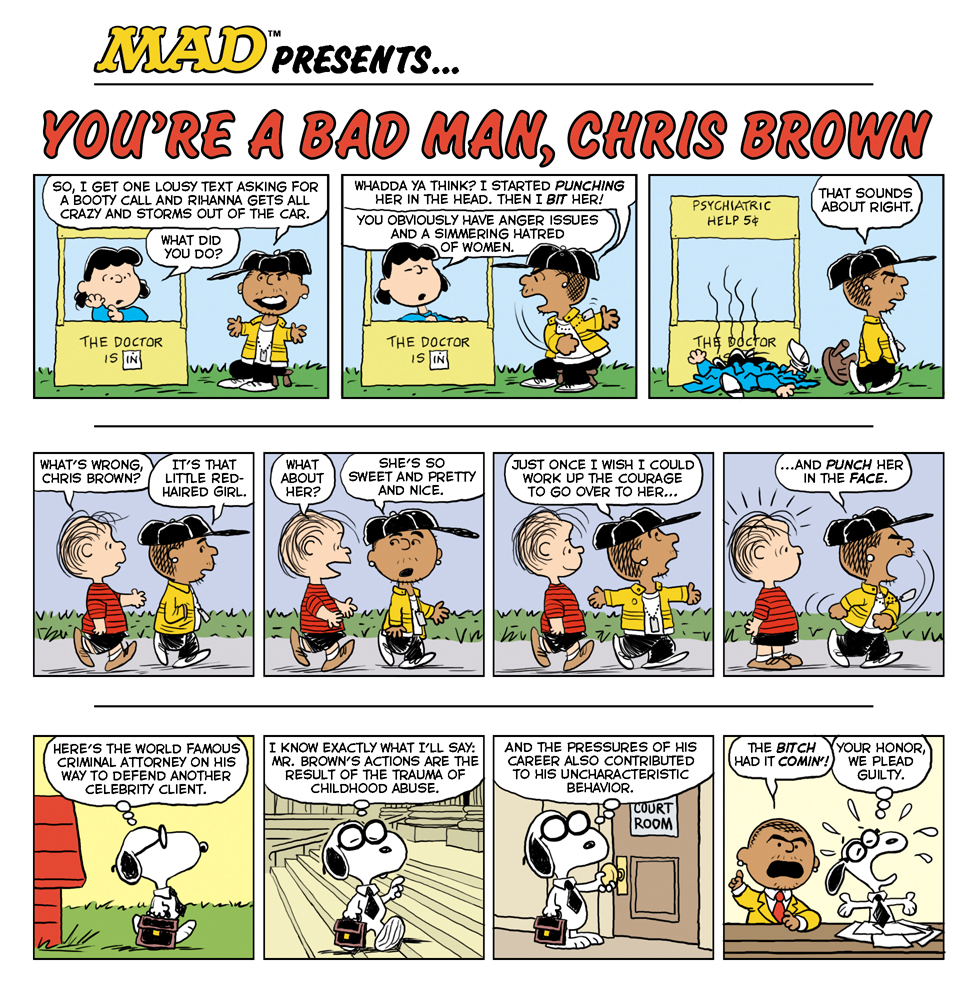
Crazy about Mad

March 28th, 2009

Ten years ago, an episode of “The Simpsons” had Bart sarcastically dissing Mad magazine, saying something like,  “Wow, that’s so funny.” The 10-year-old was too advanced for Mad‘s lame juvenile antics. I hadn’t looked at the magazine since the late 1970’s, and remembered feeling that way about it then. Any hint of the subversive was long gone.

But the last several years have brought about a Renaissance (even as the magazine’s circulation has dwindled, and its publication schedule reduced to quarterly). Whenever I’ve seen a new issue in the comics store, I’ve picked it up and gotten a few actual chuckles. (Without, I should note, buying it — hence the reduced publication frequency.) At last year’s San Diego Comic Con, DC inserted into attendees a convention-only special “Watchmen” issue of Mad. It was flat-out wonderful. Now that the magazines going to come out only four times a year, I’m wondering if I shouldn’t have been supporting it all along, even if only for my kids. (And isn’t that really why we do everything? “For the children?” Political campaigns, tirades about deficits and taxes, worker-safety laws, empty populism — it’s all always “for the children.” Because, I guess, the rest of us don’t matter.)

In any event, here’s something I just Stumbled across that shows again why recent Mad is so much fun.

chrisbrown_comics.jpg

More Watchmen not for watching

March 27th, 2009

Something I noted about the film version of “Watchmen” was that it was mostly faithful to the comic book — to its detriment. “Watchmen,” let’s remember, was not a “graphic novel” — it was a comic book, delivered in 12 serialized installments. As such, it made much of classic comic-book storytelling construction. Each issue had a strong set piece (Rorschach escaping prison; Nite Owl and Silk Spectre rescuing people from a fire; Dr. Manhattan and Silk Spectre debating mankind’s future) and a cliffhanger. By transliterating what worked so well in separate chapters released 30 days apart in a literary format, the film is saddled with a start-and-stop structure antithetical to action-adventure movies, which rely upon the classic Aristotleian structure of rising action and catharsis.

So: the comic book was great. The movie has some wonderful things in it (several of the performances, many of the special effects), and one major improvement: the ending. The ending in the comic book was an unintentional swipe from “The Outer Limits,” was utterly unconvincing in uniting humankind, and seemed only tangentially related to most of the comic’s main themes. The movie’s ending, by contrast, is far more plausible because everyone on Earth has already seen Dr. Manhattan’s power, and works better because it ties in with many other plot elements and themes (the ethical responsibilities of heroes; the moral ambivalence of vigilantism; the unintended side effects of employing great power, however well-intentioned). Ironically, against a backdrop the fanboy legion insisting upon apostolic faith to the source material, it is the element of greatest change that succeeds the most.

So then I wondered, what if they had really changed the comic book? Really done a different take on the material? Then I came across this, below, and was reminded of reading the Denny O’Neil issues-oriented era of “Justice League of America” comics, while seeing the antimatter universe version called “Super Friends” on my TV set on Saturdays.

Or, just send more to AIG

March 27th, 2009

(Thanks to Rich Roesberg for sending this in.)

This was an article from the St. Petersburg Times Newspaper on Sunday. The Business Section asked readers for ideas on “How Would You Fix the Economy?” I thought this was the BEST idea….. I think this guy nailed it…

Dear Mr. President,

Patriotic retirement: There’s about 40 million people over 50 in the work force, pay them $1 million apiece severance with the following stipulations:

  1. They leave their jobs. Forty million job openings – Unemployment fixed.
  2. They buy NEW American cars. Forty million cars ordered – Auto Industry fixed.
  3. They either buy a house/pay off their mortgage – Housing Crisis fixed.

Can’t get any easier than that!”

Non-news of the day

March 27th, 2009

The Senate Republican leader Mitch McConnell says that quote unquote president George W. Bush was “sort of a millstone around our necks.”

In the wide-ranging interview, he also says that he and the GOP are looking into allegations that the world is not flat and that there is this thing called “grabbity” that holds us all down.