Lee Wochner: Writer. Director. Writing instructor. Thinker about things.


Blog

Fun with the box office

February 28th, 2026
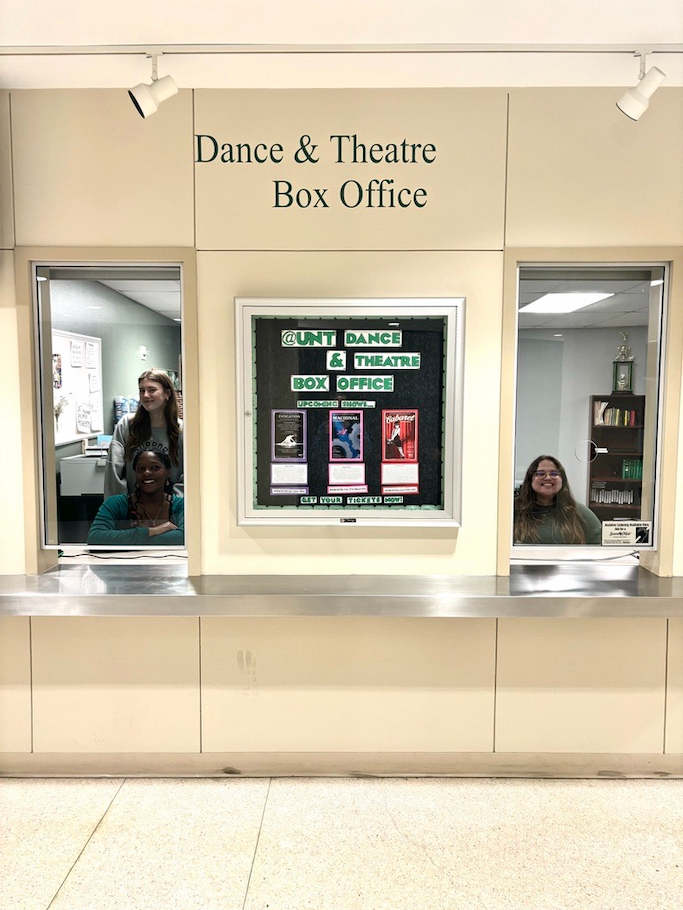
Yesterday I was in a meeting that got very technical between two other people, and therefore had nothing to do with me. So I decided to take care of something else on my to-do list:  buy tickets for a play my friend and fellow playwright David and I wanted to see on Sunday night. This would be a good time to do that, and I wanted to make sure to get it done, because the venue is about the size of a walk-in closet, and the show would sell out. While the others were figuring out the precise process they were going to take to handle the complicated technical thing, I opened up my laptop and went to the website of the theatre in question, pulled out my credit card, and then entered all the relevant information and hit purchase.

And then the screen froze.

To be exact, not my laptop screen. I still had full access to everything else. The payment-processing page of their website froze.

I waited and I waited some more, then finally I quit that browser. What else was there to do? Nothing.

Then three things happened: 

  1. I got a text from Amex saying that my credit card had been charged for $75.50 by the theatre in question. Great! The ticket sale went through.
  2. Then I got an automated email from the theatre’s payment processor saying, You abandoned your cart! Come back and purchase your tickets.
  3. I realized it would now be up to me to invest the time in straightening this out. Which is precisely the way of things now:  Commerce is made fast and easy; customer service is all on you personally.

Immediately, I checked the theatre’s Contact Us page to see whom I could call. Answer:  not really anyone. They don’t keep business hours. (Understandable for a small operation.)

Nexte thing:  see who I could email. Welp, I could email the box office, but the site states: “Please allow 24-48 hours for a response from our box office.” In which time the show would have sold out or have already ended.

But I took that chance and emailed the box office an image of my credit-card transaction clipped from my Amex transaction page and explained that their system had frozen but I was coming to the show, and then cc’d someone else listed on the site who seemed to be an administrator.

A few hours later I was surprised and delighted to get an email. What it said was, “It looks like your charge is pending. Would you like to pay at the door?”

Well, no. Because the charge wasn’t pending:  It had gone through. So I sent them another screenshot, this time of the payment having gone through.

I checked again later and saw that now they had credited back my charge. By this time, it was six in the evening and I was having drinks at a business event on a Hollywood rooftop. I thought, Well, that’s one way to resolve it, I’ll just go back to the site and buy the tickets again. I set my drink aside to do that and pulled out my phone to order, but now found that I could buy only one ticket. Why? Because, sure enough, the show is in demand and now there was only one ticket left.

The woman next to me, with whom I’d shared this whole story while awaiting my drink, saw this happen and said, “Why don’t you just buy that one ticket for yourself and tell your friend something happened and you can’t go?”

This is how, it seems, some people think and behave. It explains a lot.

Instead, I went ahead and bought two tickets for Sunday, and confirmed with David. I messaged him that we were on for the show, but now the tickets were for Sunday.

He later told me that his first text back to me had been in error:  When he said he was available, he’d meant to say Sunday. Not Friday.

Good thing I never got those tickets for Friday.
Curse of the writing class

February 27th, 2026

In the theatre as in life, bad work can help you learn to do good work.

DuoLingo reminds me of this all the time, when it responds to my somewhat inept efforts to learn French with a reassuring, “Even when you make mistakes, you’re still learning!”

In 36 years of teaching writing in one place or another, starting at writers conferences, then at different colleges and universities, then in my private playwriting workshop, I’ve advised people to see a lot of plays and to read a lot, because while you can learn a lot from good writing, you can learn a lot from bad writing too.

Recently, I got further verification that just because a well-known and celebrated writer has written something, that doesn’t mean it’s good.

Yes, we already knew this, right? F. Scott Fitzgerald, Tennessee Williams, Ray Bradbury, Pinter, Beckett, Edith Wharton, Hemingway — they all had good work but also middling or even bad work.  

I sure love “Tender is the Night” and “The Great Gatsby” and many of his short stories, but  Fitzgerald’s “Pat Hobby” stories are flat-out terrible — written as quickly and as plentifully as possible for ready cash. Years ago, when I was teaching graduate-level writing at the University of Southern California, I flat-out refused to teach from them when requested because I didn’t want students thinking I endorsed them. (And this, from a Fitzgerald fan.)

Harold Pinter was a certifiable genius, and I for sure certify him as such, but “No Man’s Land” is about nothing I can discern except Pinter writing a Pinteresque play that doesn’t actually say anything — it’s the sort of gamesmanship that Pinter had perfected 40 years earlier with “The Birthday Party,” but now made weary and pointless. The only upside:  I can say I saw it Christopher Plummer and Jason Robards perform those leads up close and personal in the 1994 off-Broadway revival.

I could go on in this vein, especially having seen so many David Mamet plays over the past 30 years, the pilot light having long ago gone out on the writer of “American Buffalo” and “Glengarry Glen Ross” and “Speed the Plow” and “Oleanna.” “The Old Neighborhood,” seen in New York in 1997, was so disastrous that I spent the viewing time admiring the lighting grid, and the aftershow reassuring two women on the sidewalk outside that, no, they were right and the New York Times was wrong, that it was indeed terrible.

I don’t expect any writer to do consistently great work. For every “Slaughterhouse Five” or “Cat’s Cradle,” there’s a “Slapstick” sitting in the oeuvre. Sometimes (usually) you can’t even tell if your own work is good or bad — that’s what we have audiences and critics for, and even they don’t know. As a teacher, I just try not to be the person who would have laughed “Waiting for Godot” out of the room, or, God forbid, anything by the completely brilliant Eugene Ionesco.

Which brings to mind this:  If you don’t take chances, you don’t grow as an artist. So I applaud writers who take chances. For this reason, I try to be generous about Nathaniel Hawthorne’s execrable children’s stories. Just one of my poor kids had to suffer through these before I realized my mistake. Maybe the author of “The Scarlet Letter” wasn’t the best choice for children’s literature.

This brings us to “Curse of the Starving Class,” a Sam Shepard play I’d never seen before. I’m an admirer of much of Shepard’s work; since the beginning, I’ve taught from “True West,” which features probably the best first line of any play ever (“So, Mom took off to Alaska, huh?”), providing a wealth of exposition while not sound at all expositional. (At one point, I diagnosed 13 different things that simple line tells us about the situation.) “Buried Child” may be an even better play, with a central metaphor that digs deep. I also like some of Shepard’s essays and short stories, and if he’d written a cook book, I’d probably have read that, too.

“Curse of the Starving Class,” meanwhile, seems like an early draft of later plays in which themes related to disaffected and aimless lower-class white people with few options are better explored. It isn’t stylized enough to be outlandishly comic or bizarre, and its premises, setups and outcomes are so paper thin that we can’t emotionally commit to the theoretical plight of any of the characters. When the underage girl tells us she was let out of the local jail because she flirted with the sheriff, or when a man signs a sheet of paper and thereby loses possession of a house it isn’t clear he owns, we just aren’t sure what universe we’re living in. And, when Act One is largely told with just four characters, but by the end of Act Two there are 11, several of them with just one brief appearance or merely a few lines, we have to wonder whether Act Two wasn’t written in a drunken burst over a single night.

I admire the pluck of the community producers who put this on; judging from the program, the young actor playing the girl made a case for the play and was thrilled when it was chosen. Playwrights need their plays to be produced — even from the grave, I like to think. Two of the actors were working pros, and that showed, and most weren’t, and that showed too. But through all that, you could still hear the play and the main problem:  no focus, no overarching theme, not enough of a comedy or a drama, or even a queasy feeling, just living or dying on discrete moments.

So, what can we learn from this example of bad work?

(And, yes, the play in its day won an Obie for Best Play. But that doesn’t mean they’re right.)

We who write plays can learn this:

Seeing a bad play can help us re-evaluate our own work that we’ve struggled and sweated over and say, You know what? It’s good enough:  Send it out.

After all, this got produced.

Naive?

January 6th, 2026

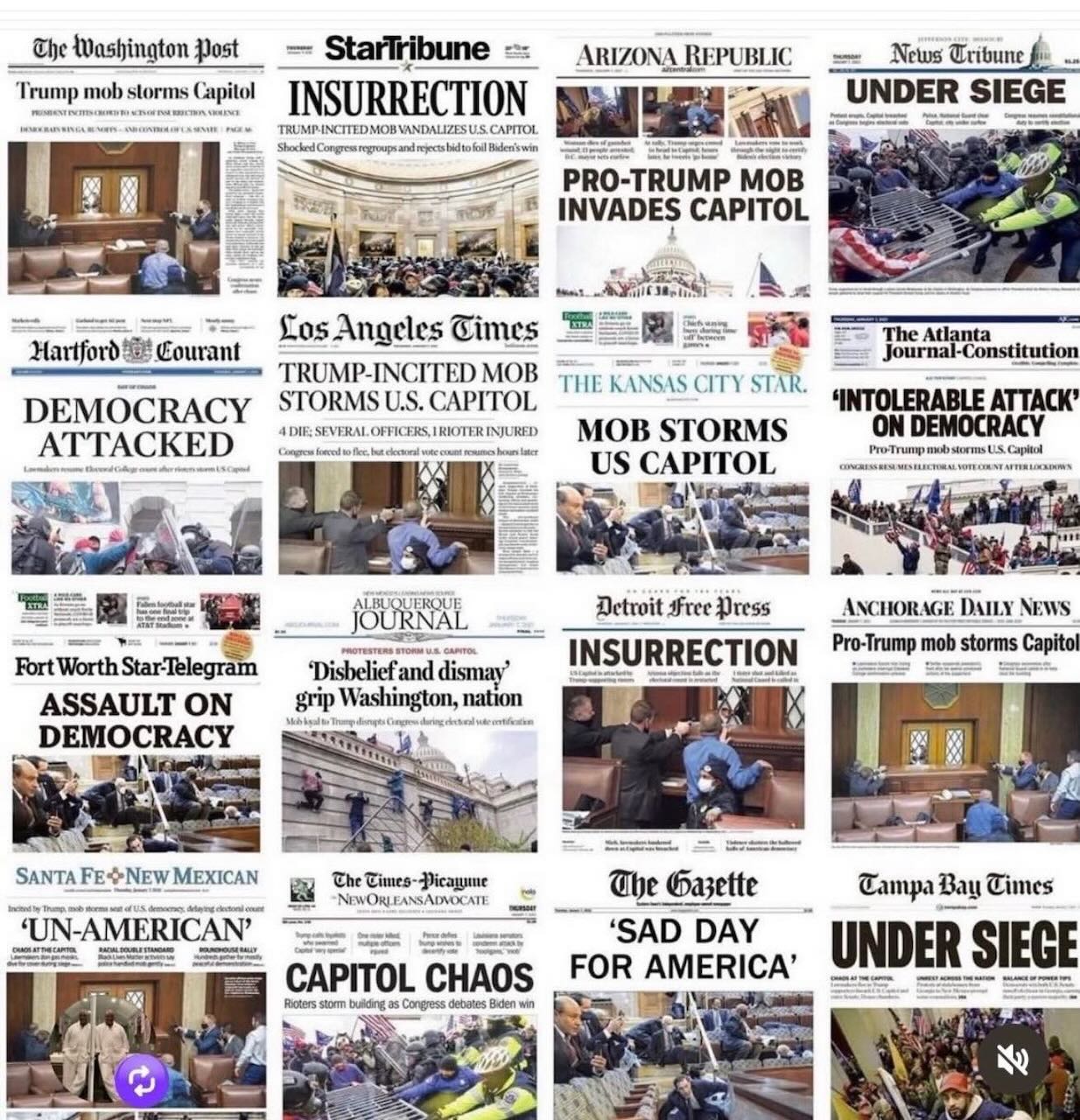
Five years ago today, on January 6, 2021, I was on the phone with my friend Bruce while we both marveled over what was happening outside the United States Capitol Building:  It was under attack by thousands of armed belligerents working to support Donald Trump’s spurious claim that the 2020 Presidential election.

(For the record:  The election was not stolen, supported both by the facts of the matter and by Trump’s lifelong pattern of pathological lying.)

Bruce was upset — couldn’t believe what he was watching unfold in real time — but I was buoyant.

“This is great!” I said. “Now it’s all out in the open. Now no one can deny the truth about Trump. This will be IT for him!”

As further details came out — of officers assaulted and terribly wounded or killed, of members of Congress hiding in terror, of rampaging lunatics smashing doors and windows and shitting on the desk of the Speaker of the House, of rioters calling for the Vice President to be hanged — I felt secure that this would be the end of Trump and his movement.

I guess I was naive.

Because now, five years later, one of the worst people on the planet is right back in the White House. And I don’t need to catalog everything he’s done in just the one year he’s been back. We all already know. It’s well-documented.

How did this happen?

Well, for one thing, the then-Majority Leader of the U.S. Senate, Mitch McConnell, known for deploring Donald Trump, nevertheless voted to acquit him  in the impeachment trial that soon followed. McConnell, by the way, excoriated Trump for January 6, and called Trump’s actions a “disgraceful dereliction of duty.” But, he said, he couldn’t vote to convict Trump because of “constitutional concerns.”

I wonder how he’s feeling about the Constitution today.

McConnell thought Trump would just slink into a hidey hole in Mar-A-Lago, and perhaps he could have… except another GOP leader, then-House Speaker Kevin McCarthy went to visit Trump and bent the knee, because he needed more support from MAGA-aligned Republicans in the House. This was only three weeks after the riot Trump staged. Trump, always alert to an opportunity, took a photo with McCarthy and sent it out, displaying for all that he still had the loyalty of Republicans in power, and instantly dubbed McCarthy “my Kevin” – because, of course, he owned him. Real profiles in courage.

Looking back, I should have expected it. Because even though these men loathed Trump and eagerly awaited the day he’d be finished, they each put their own self-interest first and they underestimated the ravenous need of Donald Trump to always “win,” even when, and especially when, everyone else loses.

I was naïve, and so were they, and so was Attorney General Merrick Garland, who played nice, and so was everyone else who thought that the usual rules applied.

And so here we are.

I share this history lesson because even though you and I know it’s true, the White House rolled out a new website today that completely mischaracterizes what happened. And by “mischaracterizes,” I mean “it lies.” Now, somehow, in their Orwellian version, law enforcement instigated the riot in which they themselves were attacked, and Nancy Pelosi, who was desperately trying not to get killed by rioters looking for her, is to blame as well.

All of this is patently false, just as everything put out by Big Brother’s totalitarian Party governing Oceania is a web of lies.

But:

The people trapped in Oceania didn’t have the Internet. And thus far, governments in our world have done an incomplete job of keeping everything off the internet. There’s always the Dark Web, and VPNs, and other ways around governmental road blocks — at least for now.

So, just as I told my kids in 2000 that the presidential election had been stolen from Al Gore, I’m doing my part to be part of a movement that says that Donald Trump’s claims about the 2020 election and his valorization of rioters attacking our capitol (rioters, it turns out, whose expenses his campaign paid so that they’d show up and riot) are lies. And if enough of us won’t swallow the lies — if enough of us keep spreading the truth — then we can put an end to this.

Unless, once again, I’m being naïve.

Remembrances of 2025

December 31st, 2025

In January, I was in Costa Rica with my lovely fiancée while massive fires were burning down whole sections of Los Angeles. By the time we returned, the smoke had cleared. The growing impact of climate change made me appreciate Costa Rica’s strong environmental protections all the more. Were it not for my addiction to theatre (and other cultural addictions), I could see living in Costa Rica — or perhaps buying a second home some day. The people were friendly and welcoming, the food spectacular, the costs low, and the beaches and jungle and ATV-riding and zip-lining and coffee-making, and sloth-spotting and so much more were purely delightful.

A definite highlight:  helping a client win a major battle in a public forum against a much larger opponent, in a case that pitted real stalwarts of the community against well-funded and much larger carpetbagger. Sometimes, the good guys and the right people win. That I accidentally got the closing public comment and improvised a new insight that helped to nail the argument just made it more delicious.

Well, losing David Thomas of Pere Ubu while I was at a resort in the Bahamas in April certainly put a damper on the trip. It would’ve been far more convenient if he’d died in, oh, never. Honestly, I think about him almost every day since. But at least there’s a new (final?) Pere Ubu album coming out in 2026, and a documentary.

My cousin Rick (“Ricky,” even at age 70-something) died this month down in Texas. I’m not sure I ever met him, he being the age of my older siblings and they having palled around a bit while growing up and while these elders siblings were visiting Johnstown, PA, where my mother’s family was from. But his dying gave me a jolt of insight about something:  Because I’m the youngest of the youngest, my mother having been the youngest surviving child of her father’s 12 children*, and because I’m significantly younger than my siblings, I will likely be the last surviving family member of my cohort. That was an odd insight. I’ve not been much for staying in touch, which hit home when at first I thought I had just one cousin left, then realized I had another, then added up at least six (one farther north in California, one in Texas, three I think still in Johnstown, and one in a midwestern state like Minnesota or Wisconsin). It was my eldest brother who did the family tree, and that well-documented draft ended with the birth of my first child. In the 30+ years since then, I’ve had two more children and gotten a divorce, our mother has died as have the final aunts and uncles, plus many more changes, of course. One knows these things intellectually, but it’s different seeing them on paper — or having it occur to you while you’re driving across town and you’re wondering why the death of a cousin you’d never met keeps rustling around in your mind; because: it’s hit you that whole branches of the tree are falling to the ground, and at some point it’ll be the one you’re standing on.

And, of course, my friend Ken died.

When I was 11, my mother insisted to my father that we move someplace where I could have friends, there being no friends where we were living out on a highway, and commuting to school by car. Suddenly, I had friends:  the boy on the corner, and the boy next door, and the boy across the street. A few weeks ago, the mother of the boy across the street died. Suddenly, I take it. I was sorry to see it. When I was 12 or 13 or so, I was innocently in love with her. At least once, I went over there when I knew that my friend wouldn’t be home, and hung out in the kitchen with her until finally she gently let me know he wasn’t coming home soon and maybe I should go home, which I did, dejectedly. I don’t know what I thought would happen, but whatever it was, I was sure hoping for it. Ten years ago, she reached out to me to say hi, to say that she was a reader of my blog, and that my kids looked very much like me and very “Wochner,” and that she was 83 and might be saying too much because she was on her second glass of wine and please excuse the typos. So: just as charming as she was when I was a kid. After that, we started commenting on each others’ posts, and emailing now and then, and I’m glad we stayed in touch. I really liked her, and a long time ago, I really really liked her. And I still like her sons (haven’t seen the daughters in more than 40 years).

In November I finished draft five (or six?) of my latest full-length play, a play so full-length that a director who read it for me suggested that I cut 30 or so pages. I started to do that… then stopped. Maybe I need some distance. Sometimes I finish writing a play straight through, sometimes I finish a draft (or six) and set it aside and write another one and then come back. Worst case:  Five or 10 years ago, I wrote a play, then completely rewrote it (setting aside the original draft), then rewrote it again. Now all three versions just sit on my laptop (and backed up in the cloud). Other times, I’ve dusted one off and wrapped it up and sent it out and gotten it produced. We’ll see what happens with this one. But:  I finished it. It’s good to finish things.

Last year, I was elected to the board of the Hollywood Community Foundation, and this year we started giving away more money. I was beyond thrilled when we initiated a new granting project and, among the new grantees, we decided to give money to two theatre initiatives, that I joined in advocating for. This is the second foundation board I’ve served on, and after decades of asking for money for various nonprofits, it’s been nice to be on the side of the table where we’re giving money away.

Finally, Moving Arts, for which I was founding artistic director in 1992, had a banner year. When a lot of theatres in Los Angeles were cutting back due to slumping attendance and rising costs, our management team, with support from our board and a lot of partners and supporters, found a way to do more than before. We did I think six productions, initiated a couple of new programs, and created the Arts Hero Award, bestowing the first such award to someone very deserving indeed. And we had a lot of fun getting together for opening nights and whatnot.  It’s been a challenging year for nonprofits, but some are taking a fresh look at how they’re doing things and succeeding with new ways of operating, because they understand that 2025 was not like 2019, and 2019 is not coming back.

There were 365 days in 2025, and so, far more experiences than these eight that just came to mind. I’m sure once I post this and head downstairs to make dinner one after another thing I should’ve mentioned will come to me. In the meantime, I wish the best for you and your loved ones in 2026.

Fundlosing

December 24th, 2025

I just got a fundraising appeal from a university. Here’s how it goes:

Dear Lee, 

This holiday season, we hope you will spread the joy of giving by supporting [name] in your year-end contributions. There are so many ways to support [name] students while maximizing your tax benefits.  
  

Donations must be received before December 31 to be recorded as a 2025 gift.  
  

Credit Card   

You can give by credit or debit card on our secure website [this was a link to donate] through 11:59 p.m. on December 31 for the donation to be counted as a 2025 gift. 
  

Appreciated stocks/securities – Initiate one week prior  

Your donation of appreciated stocks or securities should be initiated at least one week prior to December 31 to be counted as a 2025 gift. For more information, contact [name] or call [us].
  

Check  

Gifts made by check should be postmarked or delivered in person by December 31 to be recorded as 2025 gifts. Please mail checks to: 
  

[name and address of the institution]
  

 Note: [name’s] Tax ID is [tax ID number]. 

There’s a bluntness to this that reflects much of the tenor of 2025: No, we’re not making the case for this, we’re just doing it. Here’s how to send us money, and even though we don’t know you and you don’t know us, and we have nothing to do with each other, you should send it. We’re wasting no time explaining how it benefits students or the area we’re in or the cause of higher education or, even, YOU — just send us the money. We want it. And you will experience joy by sending it to us.

Death of my oldest friend

December 23rd, 2025

My friend Ken Ahearn died in August and the local newspaper has finally run his obit. Here it is. He was 97.

As my parents’ generation would have said, Ken was a real character. He had the warm and casually funny ways of an adored uncle — which no doubt came in handy as a spy for the Central Intelligence Agency, which Ken had been earlier in life. In that capacity, he was stationed in Vienna, Austria in the 1950s and 60s, when he focused on recruitment:  trying to get well-placed Soviet agents to switch sides at the same time as the Soviets tried to get their American equivalents to do the same. He told one story of scanning a sports stadium with binoculars to see who he could recruit until coming across a Russian all the way across him doing the same to our side with binoculars and looking directly at Ken.

Ken had other great stories from his time in the CIA, most of which could have been scenes from movies starring Don Knotts, but here’s the one he retold the most, to charming effect. Over lunch, he and a fellow agent made an offer to a Soviet officer, but made the mistake of putting it into writing. The Soviet grabbed up the printed sheet, which detailed a nice payment, security, U.S. residency and other benefits, and ran off with it, with Ken and his colleague in hot pursuit. They couldn’t catch him, and then were horrified to see their offer put on the front page of Pravda and circulated around Vienna — which then led them to drive around and pick up every copy they could find and trash it, but clearly they couldn’t get them all. But here’s the twist:  The offer turned out to be so generous that now all sorts of Russians started showing up on Ken’s doorway looking to switch sides — making his job far easier.

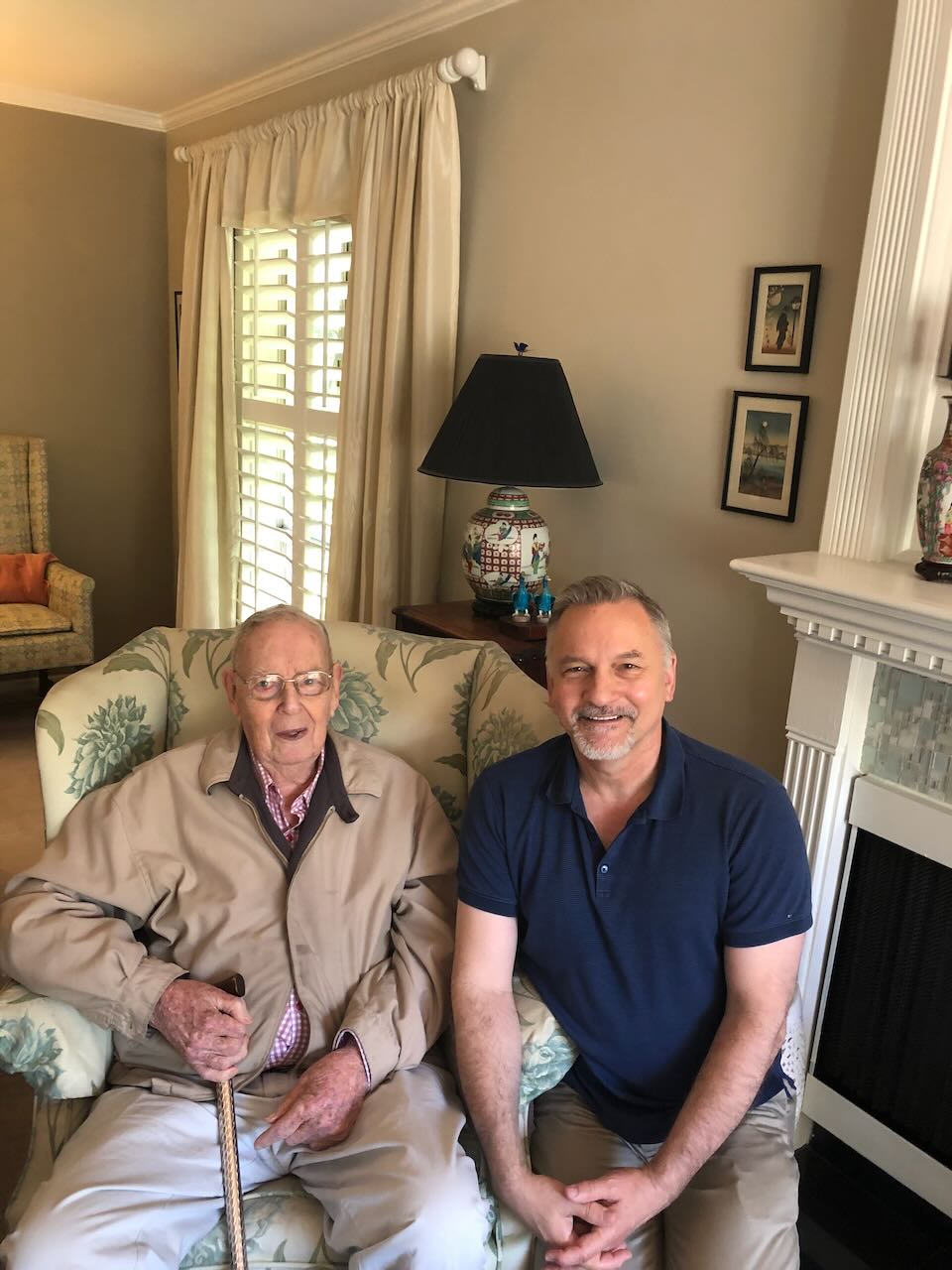
With Ken in his home, May, 2022.

I met Ken in 2006 when a handful of us, fed up with the predations of Bush/Cheney, set about founding a local Democratic Club; it wasn’t much, but it was doing something. Ken was in that first meeting, and became our founding Treasurer (not President, as the obit states). I met him in that first roundup of interested parties and, soon thereafter, his beautiful and charming wife Gloria, who had worked for the state department. (As Ken would note, the two of them worked both ends of undeclared combat:  espionage and diplomacy.) Ken was a liberal from a time when probably most of the U.S. government was liberal (and: effective). We got to be very close, and especially after Gloria died unexpectedly, I started picking up Ken and taking him around to movies and restaurants and over to my house to play games with my family and our friends. Ken was always a hit:  a funny older guy who told great stories. Everyone loved him, from the adults to the kids to the dogs. New friends would come to my house and meet Ken and inevitably spend hours talking with him.

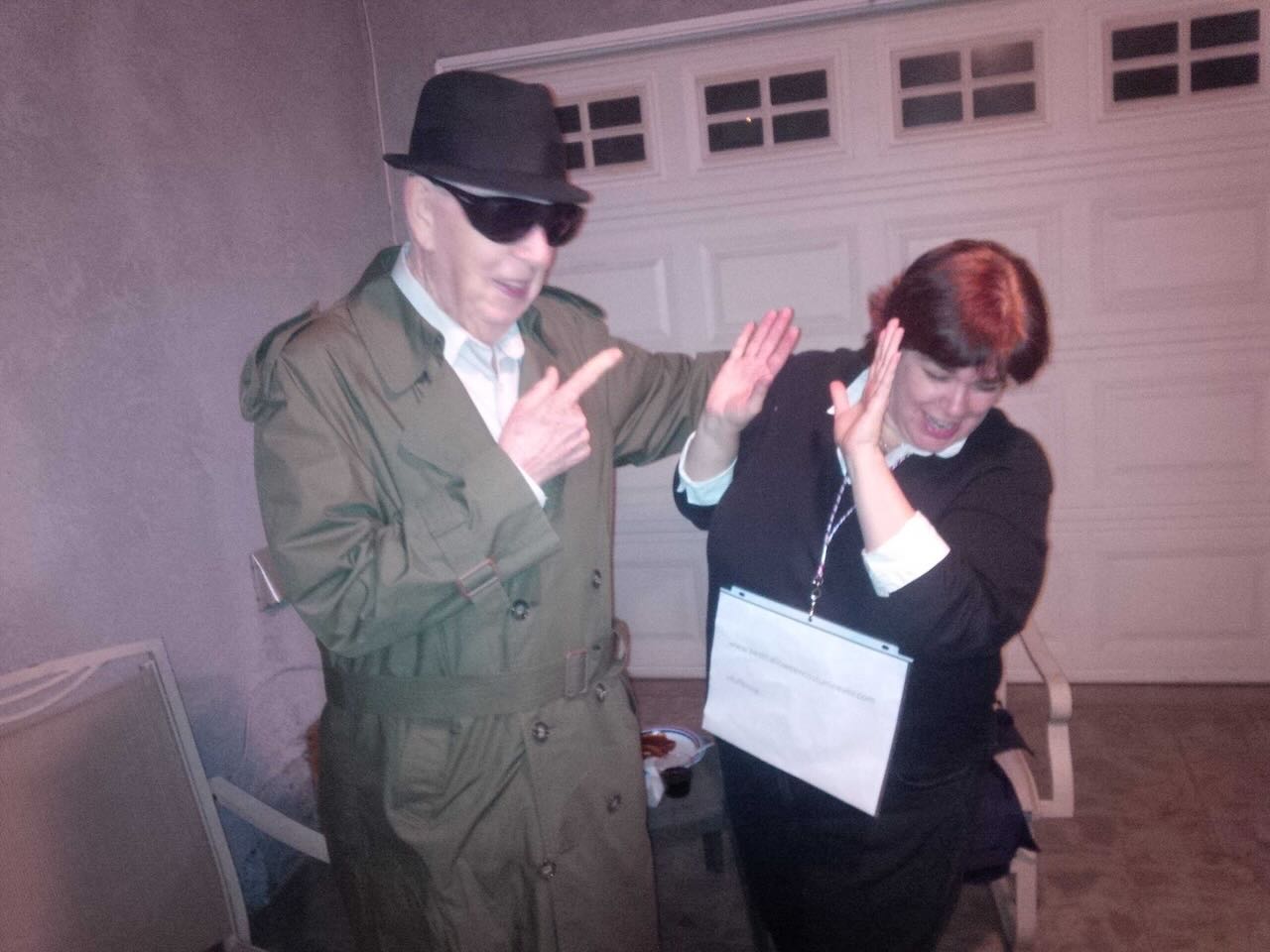
One year, I threw a Halloween costume party and before the guests started to arrive, I took the dogs for a walk. Anyone with dogs knows that it’s good to take them to stretch their legs before company comes. As I approached the house, through the open curtains I saw a shadowy figure wearing dark glasses, a hat, and a trench coat and looking very shady indeed sitting inside at my kitchen table with my kids. All of the protective hairs on my neck jumped to attention and I ran to the door. It was Ken, of course, who had come to the party as a stereotyped secret agent.

October 31, 2014, Halloween party with Ken Ahearn and our friend Shanna Ingalsbee

I would say I’ll miss Ken, and I do, but I’ve already been missing him. About two years ago, his children had a farewell party of sorts for him on his birthday because they were concerned that he may have been slipping a bit into forgetfulness. My friends and I who attended didn’t see any of that, and I would occasionally call and leave a phone message and would always send a card on his birthday. Every time I’d have people over, I’d think about Ken and miss him being there.

Five years ago, when Ken was a mere 92 and still driving and seeming very spry indeed, I took him to lunch for his birthday and asked him about death. He told me, “The body dies, but ‘you’ just move over.” (Which is what I believe as well.) And then I asked him what kept him seeming so young. He said, “What keeps me young is that I’m always curious, and I always wonder.”

Ageless wisdom indeed.

Pop-up sale

December 1st, 2025

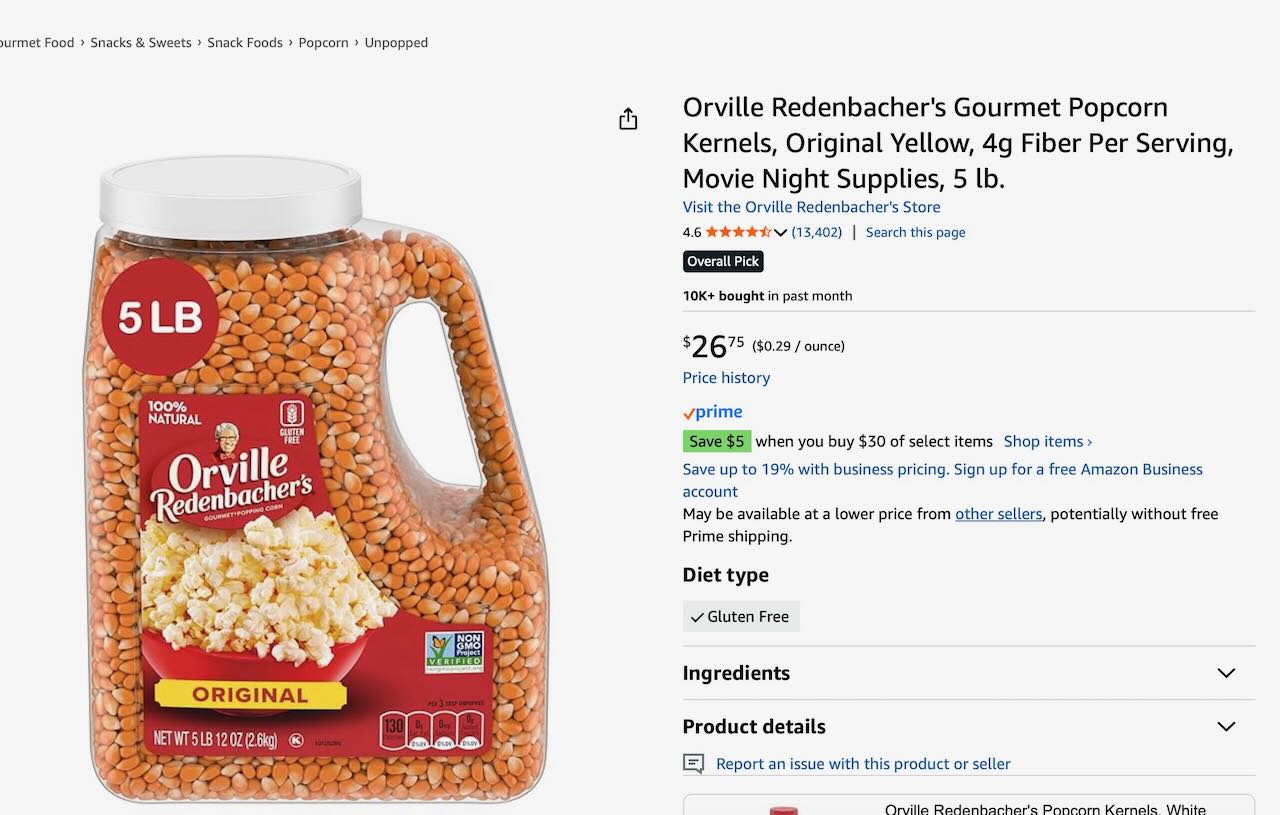
I pop a lot of popcorn, and I do it the way God intended: at home, in a big pot, with oil, and then dressed with warm butter and plenty of salt. Once people taste my popcorn, they forget all about the store-bought prepackaged kind, or movie theatre popcorn, or potato chips, or other readily gotten salty snacks.

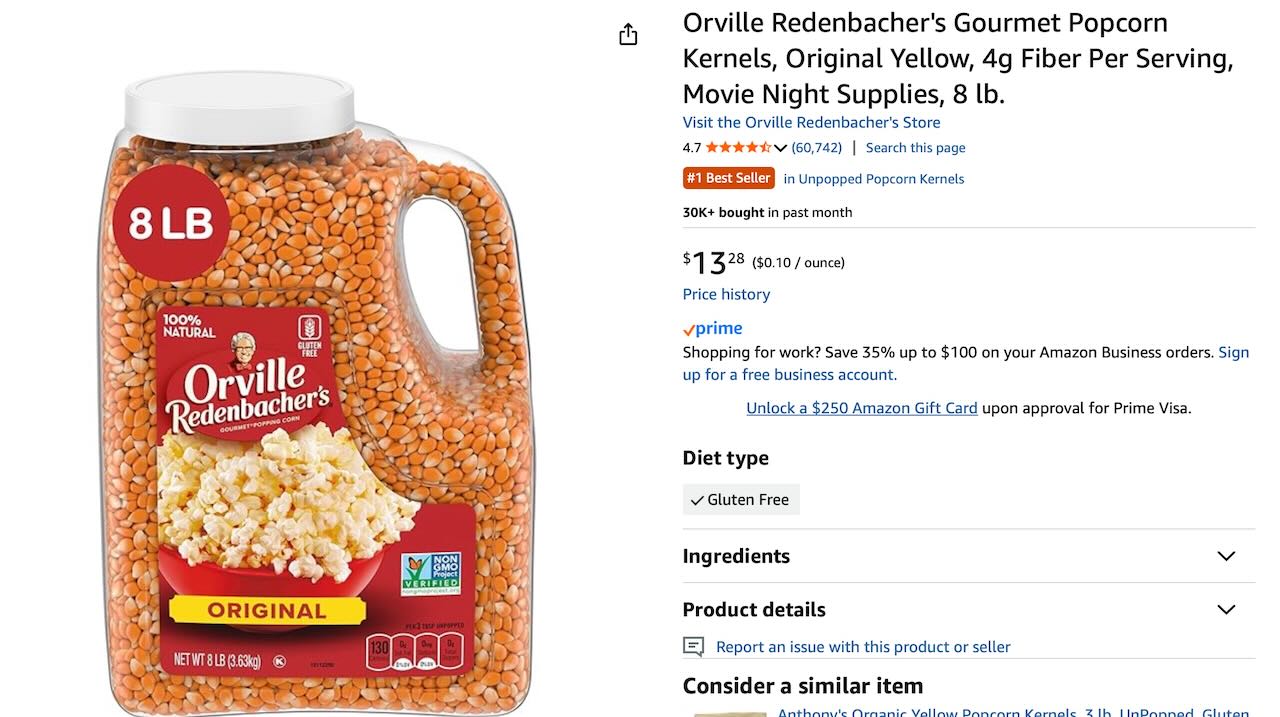
Part of my secret is buying this Orville Redenbacher gourmet popcorn. I don’t know how “gourmet” it is, and I don’t care, because it excels at its job.

Last night, having almost emptied my latest 8-lb. container of it, I quickly fired up the Amazon app to order more, and found a sale of sorts that might interest you.

Here’s the 8-lb. container.

It’s currently* priced at the amazing bargain price of $13.28 as of this posting, and, I can attest, worth every penny of it. *”Currently” is asterisked because Amazon uses dynamic pricing, meaning that the price can change at any moment, and probably will. So get it while it’s available at this price, kids!

Or, if you’re concerned about Jeff Bezos, you have another way to buy this while still supporting this lifestyle. And you might consider doing that. Just six years ago, he forked over an estimated $38 billion in a divorce settlement, and he just got remarried in a wedding that alone cost an estimated $50 million or more for just the event itself. Various websites now peg his net worth as down to about $250 billion. This is no way to live, especially when compared with his archrival, the soon-to-be trillionaire Elon Musk.

So, if you’re concerned about Mr. Bezos’ financial health, consider ordering the 5-lb. container of the glorious Redenbacher gourmet popcorn. Because, while it offers a third less popcorn… it costs twice as much.

Lost down the Amazon

November 17th, 2025

My friend Dan Stumpf is otherwise known as the author Daniel Boyd — which raises the question of “Why have a nom de plume if you’re going to tell everyone about it? I’m sad to see that he’s discovered what some of us already knew about online tech companies: No, there is no way to get help from anyone there.

These companies are predicated on YOU doing everything for them; how can you afford a megayacht if you’re actually paying people to answer inquiries and complaints? Just try getting a human on the phone, or any customer service.

Well, Dan did. It didn’t go well.

Life lessons

November 16th, 2025

When you attain a certain age, you think you know things.

For most of us, that age is 10.

Or, certainly, 13-21. At those ages, we all know everything. Until learning as our 20s and absolutely our 30s roll along, that we don’t know the half of what we don’t know. And, worse:  It starts to look like our parents were right about things.

Truly awful.

Some time after that, a new age dawns, one in which we actually do know some things. When we actually have attained some wisdom. Our hair is falling out, our ability to recall people’s names is shot, it’s a struggle to roll out of bed let alone bench press a bikini-clad girl on the beach, and there is never again any desire to party hardy, or, if there is, there is a public fumble of what that play looks like. I say this having witnessed Hugh Hefner more than once late in his life out in public in his formerly grand style. He was mostly propelled by his bodyguards and his three blonde girlfriends, before dozing away in his seat.

While I’m not yet in my dotage — not by a long shot, you hear me! — I do think I’ve reached a period of wisdom. Or at least, I like to think so. And I choose to believe people who tell me I have. If I seem eager to claim it, and you’re not yet at this stage of life, at some point, you’ll understand.

What prompted this was a video call I had with a friend the other day. We serve together on a nonprofit board, and I passed along a general observation, and he said, “Wait, I’m writing that down.” This was the second time he’d done this recently. He’s about 15 years younger than me, so this exchange fits the pattern:  Not only can he recognize wisdom, he can appreciate it.

So then I thought, I should write down some of these pearls of wisdom rather than just let them clatter onto the floor unstrung, rolling around and slipping away. I’m going to start doing that here on this blog. This, here, that you’re reading? This is just the setup. The intro. Think of it as the introduction to a book I’ll almost assuredly never write, having so far, for over five decades, written none of them.

I may even swipe one or two pearls of wisdom from other people I know — but always with attribution. Well, mostly with attribution. We’ll see how it goes.

While we can’t all have a Boswell, if you think I’ve said something witty and incisive, I wish you’d please let me know. Because I’ve just embarked on this voyage, and as I’m writing this, I have to say that I can think of only two observations I’ve made, and one of them actually came from my mother, who was shrewdly observant. I guess, then, that I have just one, one bit of wisdom to share in the coming days. Which will make this a very short series indeed.

You see why I’m really counting on you.

Tempus Fugit

November 9th, 2025

It’s been two months since I last posted on this blog.

Two Months.

I launched this blog in 2006, and never before have gone two months without posting. A few days, or a couple weeks, once in a great while a month, but two months? Never before.

So now I’m here reexamining where that time went. Was the time spent not writing here well-spent elsewise?

The end of September, I was in a play. That was quite an undertaking. What had started as a lark a full year before (“Hey, we’re workshopping this play, just doing a scene once a month in a kind of salon thing, would you like to be involved?”) turned into an actual full-blown production that I thought long and hard before committing to, first of all because, and I had thought this might be a crucial factor:  I’m not an actor.

Oh, I performed in plays in high school and in college, and I’ve done readings since then, script in hand, and I read roles some weeks in my weekly playwriting workshop. But being in the production of a play? I hadn’t been in one of those in… I counted the years… I think 42 years.

Anyway, I committed to doing the play because 1) I thought it’d be fun (turned out it wasn’t) and 2) because as a practicing Stoic (emphasis on practicing, because I’ll never get there) I know I’ll die some day relatively soon and I want to do new things and make the most of every dollop of time I have while I’m here. Now, a month later, I can say I did that. And now I know that I don’t want to do it again. Kind of like the marathon I ran about 15 years ago:  I can say I did it, and now I don’t want to do it again. But there’s one difference:  With the marathon, I knew I wasn’t a professional runner — those were those people who’d be many miles and hours ahead of me in the race, and whom I had absolutely no hope of catching, let alone competing against. But, see, with the play production I was confronted with amateurs, and I was the professional. I’ve written, directed, and/or produced literally hundreds of plays, events, readings, happenings, whatever, and I’ve learned all sorts of things the hard way — including how to avoid trouble, how to help make it a pleasant experience for the audience and the actors and the production people, how to be courteous and supportive and uplifting when needed and how to be the sadly necessary unpleasant producer person when needed. In this particular production, the actors were treated like packing peanuts, just something poured into the box as needed. In the course of a rehearsal process that started, in a way, a full year beforehand, how many times before opening did I get to rehearse my major scene with the other cast members? The answer is: Never. Not once. On opening night, just before the audience was let in, we were asked to run it quickly in the space of about 20 minutes. Beautiful. 

But I don’t want to complain about this more (I could go on), because I did get to work with a bunch of good actors and make some new friends, and a group of us enjoyed bitching about it one night at the local bar, so I feel I’ve already closed the book on it.

When I wasn’t rehearsing the play (with some of the cast scheduled and available), I was also wrapping up the fourth, or was it fifth, draft of my own new play. I spent a good amount of time in October on that. I wanted to hit some submission deadlines with it, and could have, but I had an aching feeling it was missing something, so I sent my previous play, which had a run in the Hollywood Fringe a few years back but hasn’t had a full production. And then, recently, while driving around and not-thinking about my play, it hit me what it’s missing, so that’s going to be part of my focus in November-December:  supplying the missing part, aka draft five or six.

And I spent a lot of time with my beautiful fiancée. This was time well-spent indeed. She is a joy in my life — sometimes the joy — and is part of the reason I wake up every morning with gratitude. Seriously.

And of course I spent a lot lot lot of my time working on my business, Counterintuity. Clients count on us, and therefore on me, and most organizations of all sorts are under duress right now unless they’re headed by one of those 12 lucky rapacious sorts who own mega-yachts and do “business” with a certain tumescent boil in human form.

And I’ve spent about 30 minutes every day (for a year and a half now) learning French on DuoLingo. In the Dungeons & Dragons nomenclature, I’d say I’m a Level 62 French Dilletante.

And I’ve mourned more friends who have died.

What didn’t I spend any time doing in the past two months, let alone the past four months? Playing Skyrim, a game on the PS4 that I enjoy. I know I didn’t because when I logged in yesterday to play for just a bit I discovered that my last saved position was from August, with no memory of how to get out of this particular maze.

So:  I’ve been doing some rehearsing and some acting, some restaurant-going and card-playing and hanging out with my adored woman, and the quotidian chores of living:  doing laundry, washing dishes, walking dogs, buying groceries.

And right now I’m having a little bourbon and a wonderful Zino Platinum Grand Master cigar and writing this and enjoying all of it.

I’ll see you here again soon.