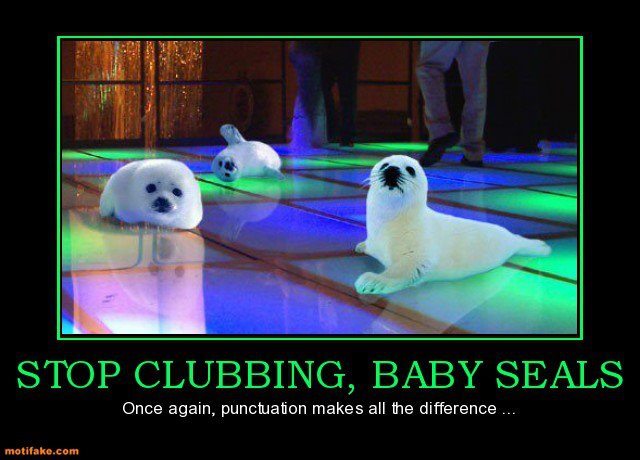
As crrected
February 26th, 2012Nice to see that this review on LATimes.com “as been corrected.” Phew!
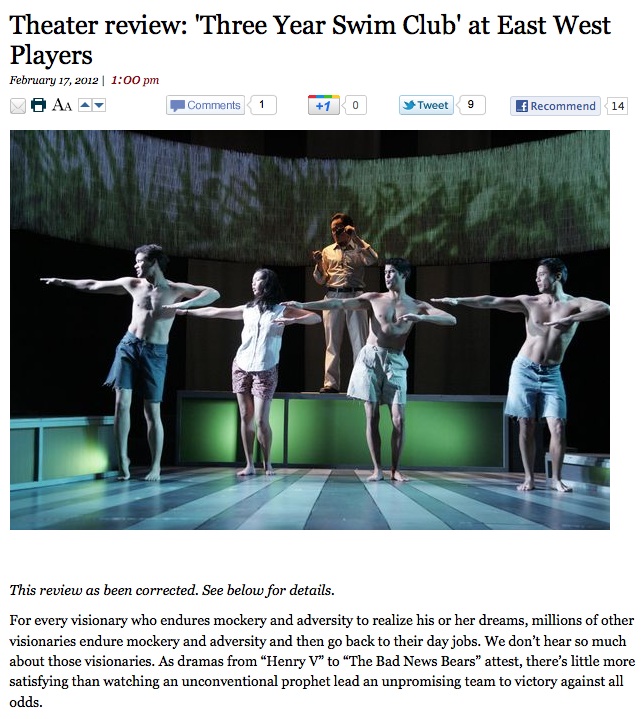
Nice to see that this review on LATimes.com “as been corrected.” Phew!
That’s how long my friend Doug drove today just so we could have dinner together.
He was in southern California from Texas, just overnight. He had a meeting in Carlsbad (that’s just above San Diego), while I had a series of meetings up here in Burbank. The only time slot we had in common was dinner — so Doug drove two hours up and two hours back just so we could meet for dinner. After we ate, as he was walking back to his rental car and I was getting ready to head off to City Hall, he said, “Well worth it!”
This is not the sort of commitment made by passing acquaintances. To drive for four hours to spend 90 minutes together, you’ve really got to be a friend.
Early this evening, after finishing a construction job (see below), I went to a run-through of my new play, Dead Battery. It’s part of The Car Plays, a festival of plays staged within cars and produced by Moving Arts, appearing at La Jolla Playhouse in San Diego starting this Thursday night. Here’s information on the production and how to get tickets.
I was very pleased by what I saw. One of the best directors I know, Paul Stein, is directing the piece, and my friend the extremely talented Sara Wagner is starring. The play is loosely based on some thoughts I had about my college-aged son’s car, parked in our back yard, as well as a writing prompt from Paul: write a car play that is at least 50% silent.
This is the fifth time I’ve had a play in The Car Plays, but it’s the first time I was given a writing assignment. Paul had asked me and the other writers in one of our infrequent writers’ meetings how we felt about writing prompts; I heard myself saying I would be thrilled to get one. I don’t think that that’s what I would have said 15 or 20 years ago, but maybe I’ve come to better grips with the fact that, one way or another, I’ve been writing to prompts most of my life. Most of the things I’ve been paid to write — ad copy, book reviews, radio commercials, videos, op-eds, speeches, web sites, and more — have been to spec, and you know what? The guidelines make it easier. If it’s got to be a certain length, and needs to contain certain things, and needs to be done in a certain way. it’s more like completing a puzzle and less like a big blank screen that you’re supposed to fill with words of some quality.
Car plays in particular are like writing haikus. Each play needs to be nine minutes. It needs to take place inside a car. Ideally, the main action also needs to take place inside that car. And each play needs what sitcom writers call a “button”; an even that buttons up the play and signals the end. In most cases, that means the cast leaving the car.
My first car play, All Undressed with Nowhere to Go, written in July 2006, was a comedy about an adulterous couple who had no place to go to have sex. I wrote a sequel to that, All Dressed Up but Going Nowhere, which featured the same man but now with his wife, and to me it was heart-wrenching because you saw that these two people belonged together but just couldn’t connect. (My wife didn’t like it because in one of the woman’s speeches about the chore list I struck a little too close to home. A recounting of lists seems to be a recurring feature in my plays.) I also wrote a play called Chasm about a couple stuck up in the mountains during an earthquake — in a twist, it’s the young woman who is armed and ready to take charge — and I’m not sure how many more car plays that haven’t been produced, and probably won’t be. (Most notably Snake in a Car — still wish I could make that work.)
I wrote two very different drafts of the current one, the first was a comedy about a woman suffering from empty nest syndrome who keeps calling her son at college, trying to vicariously join in the fun. Then my wife happened to call while I was tinkering with it and I did two things I’d never done in all the years we’ve been together: 1) stopped writing to talk to her; and 2) told her what I was writing, and how it worked. She said, “What if the son is dead?” And I instantly knew that that was better and said, “I gotta go” and hung up. That meant a total rewrite because, well, now that it’s a high-school kid who is dead, it’s not such a comedy any more. Rewrites are like that: One small change begets many more.
And then actors and directors change it more: not the script, but the playing of it. Not because they’re arrogant — that’s an uninformed perspective — but because they bring their own talents to it and, especially in the case of a car play, the production must bend to accommodate the needs of the production. In this case, my script was running a full 50% over the time limit. When I wrote this draft, I wondered if it was actually short — we discovered only in the first reading that it would probably be long, and Paul and Sara didn’t learn just how long until they started rehearsing with props. I’d never before written a play that was at least half silent, and it was difficult to time in my head how long it would take to, for example, look at a CD case with judgment, scowl over an empty whiskey bottle found in the back, pull a face over a pair of discarded panties, and more. In the draft, I have Esme leaving the car to retrieve a trash bag; that was taking too long, so Paul suggested that she use empty shopping bags and junk-food bags left behind in the car. He also found a way to jumpstart the action in Dead Battery by presetting the actor in the car. But finally, he called to ask if he and Sara could suggest line cuts and I said of course. When you’ve got really good people who have earned your trust, it’s only right that you trust them back. I saw the line cuts today in print and heard them tonight and they were minimal and well-chosen.
A couple of months ago I had lunch with another actor, someone I’ve been doing theatre with 15 years. Somehow or other I’d gotten into a joking framework with him on Facebook and then realized I’d stumbled into a concept and posted “I should write this as my next play.” He immediately IM’d me to say yes, do that, and then we met. This opportunity too has a set of specs, so once again I’ll be writing to order. I’ve got notes for that play, and I’m looking forward to writing it this week while I’m down in San Diego with my latest production.
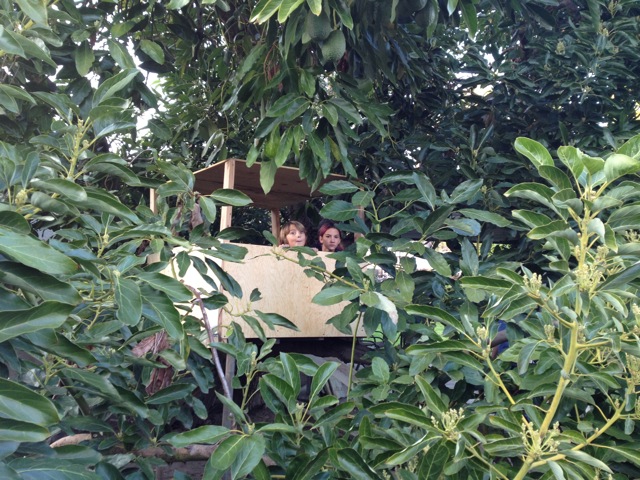
For rent:
Beautiful open-plan loft space situated in bucolic surroundings. This freshly built one-room hideaway, nestled in the bosom of fruit trees providing natural shade, works with its natural environment and is open to both wind and solar. Its compact design ensures efficiency, while allowing affordability and comfort exceeding tenement spaces in lower Manhattan. A simple rope system dumbwaiter ushers goods from ground level. Photos below only hint at the possibilities.
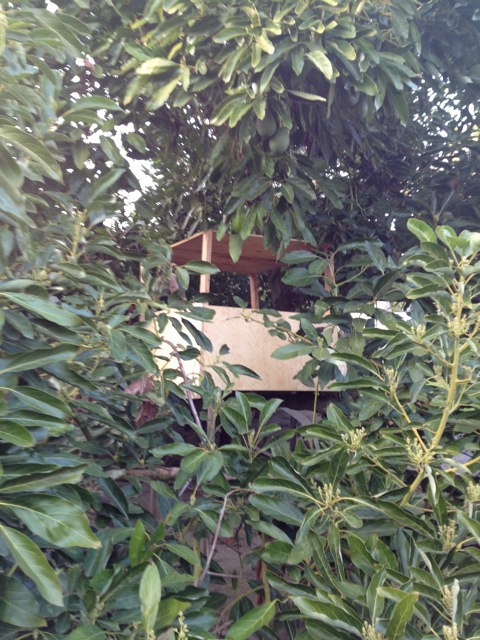
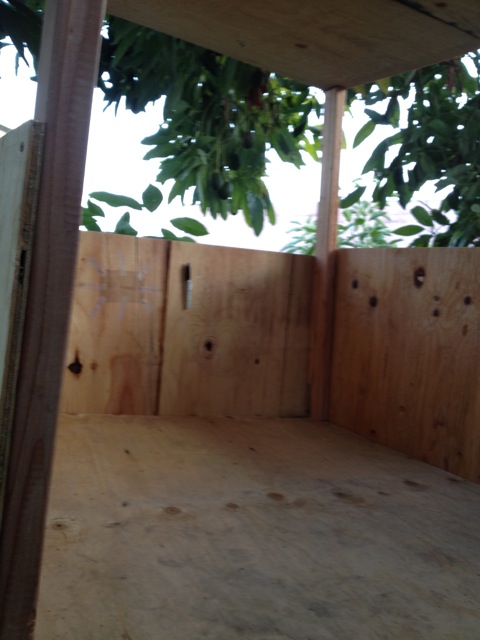
Note: Please do not disturb current occupants. These members of the construction crew are now squatting, but will be removed.
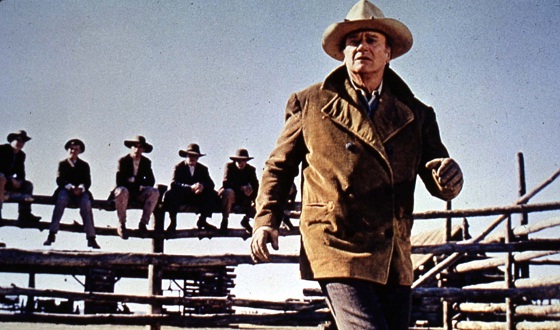
I’m pleased to report that “The Cowboys” still works as it did 40 years ago, for boys at least.
I was thrilled beyond measure when, after John Wayne’s character Wil Andersen is shot five times by Bruce Dern’s evil cattle rustler, my son Dietrich said, “He’s not dead.”
I hit pause on the DVR and asked him, “Why do you say that?”
“He can’t be. He’s just faking it so the boys don’t get hurt.”
This was exactly my reading of the movie 40 years ago when I was his age. Somehow, this restored my hope that somehow today’s kids are not utterly jaded. When it was over and I asked Dietrich what he thought of the movie, he told me how much he’d enjoyed it, and that his favorite part was when the boys all had their revenge on the bad guys who killed Mr. Andersen. Of course — as intended.
The movie is compelling filmmaking for 9-year-olds; for the rest of us, from the beginning scene showing what’s clearly a stunt double for a fat old John Wayne taming a breaking a wild horse, to the triumphant scene where 10 kids, mostly preteen, outwit and outshoot a gang of 11 grown men, it’s science fiction. I’m sure I never noticed any of that when I was a kid. Here’s something else that’s changed in my perception: Now it’s a movie populated by people I’ve known, which makes it harder to focus on purely as a work of fiction. I hadn’t realized that Mark Rydell was the director and producer; some years ago, I co-taught a class with Mark Rydell (although we met in person only once). Now I wish I’d told him what an impact this movie made on me as a child. Lonny Chapman, whom I knew a bit through the Group Repertory Theatre (which is now named the Lonny Chapman Group Repertory Theatre), has a small role as the father of one of the boys. And now whenever I see Bruce Dern in something, where I used to think fondly of the early environmentalist science fiction movie “Silent Running,” now I think of speaking with him a couple of times in recent years, including at his wife’s art opening. (Along similar lines: I was telling a friend last week that whenever I think of Scott Bakula, all I remember is being surprised seeing him in the audience at my tiny little theatre once when he was in the prime of his career. Whenever something like that happens, it’s like: “Audience, audience, audience, major TV star, audience, audience….”)
The other thing that I now notice about “The Cowboys,” something that is so transparent to an adult, is that it’s a movie about fathers and sons. Both of Wil Andersen’s boys died before reaching their prime; now he has a chance to serve as a father figure in what will be a life-transforming experience for these boys. There’s a scene where two of them are tempted by prostitutes — my son had no idea what this was about, and I’m sure I didn’t either at his age — and in another scene, Roscoe Lee Browne’s character tells Wes that with these boys he has another chance at fatherhood. I can see why the film resonated then, and now, with boys of a certain age.
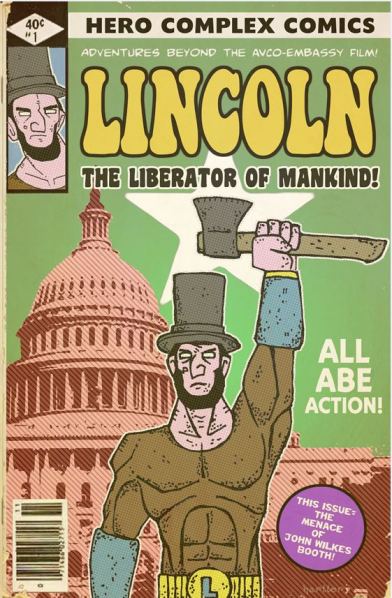
Who was the first superhero? Maybe it was Abraham Lincoln.
And here’s another moment of pop-culture history that shook my childhood: The episode of “Star Trek” where Kirk teams up with Lincoln, and Lincoln gets killed. Again. (And Kirk has to carry on the mandate of fighting for “the good.”) As a kid, it made me sad to see that. As an adult, I have to observe that some people just seem fated to die for a cause.
Last night, my friend Jonathan Josephson’s theatre troupe descended unannounced on Barney’s Beanery in West Hollywood to perform several poems by Charles Bukowski. You can watch the performance below — and be sure to note the reactions of diners seated in and around the playing area. I understand their constrained response: I’m not sure I’d want to be eating Barney’s signature chili dog while being accosted by an actor reciting “My Underwear Has Shit Stains Too.”
Last year, I bought my wife a gift and a card on Valentine’s Day. When I brought them home, she said, “Oh. I thought we weren’t celebrating it.”
I spent days pondering what that meant. Especially since I thought everything was fine.
Today was Valentine’s Day again. As we know, I was busy out of town for four days, then utterly jammed the past two. And I had to pick up not just my son, but also two of his friends after school for a sleepover so their mother could have her first date in three years (on Valentine’s Day, no less). So even though on the way home, I thought about it being Valentine’s Day, if I stopped to get something for my wife, it would be not only last-minute and inconvenient — but also unnecessary, because it seemed to have been established last year that we weren’t celebrating it. I didn’t know why we weren’t celebrating it, or when we had evidently agreed not to, but somehow, the story went, we had. So I drove home with said kids in tow and ordered a pizza and a salad and that was it.
Then my wife came home with a gift and a card for me. “Happy Valentine’s Day!” she said. Then she grew slightly impatient when I didn’t open either item right away.
So I have several theories about this. (As I told someone today, 35 years of writing plays have left me focused on motivation.)
By the way, the year before, we celebrated perhaps the best Valentine’s Day ever for us, with a wonderful time before, during and after a fine meal at a fantastic restaurant with romantic live guitar accompaniment. So one thing you can say for us: After 28 Valentine’s Days together, we’re still not stuck in a rut.