Lee Wochner: Writer. Director. Writing instructor. Thinker about things.


Blog

I scream

February 8th, 2009

You’ve probably already seen this, but I love the taste of this so much I had to post it.

Ben & Jerry created “Yes Pecan!” ice cream flavor for Obama. They then asked people for suggestions of an ice cream named for: George W. Bush.

Here are some of  the responses:

– Grape Depression

– Abu Grape

– Nut’n Accomplished

– Iraqi Road

– Chock ‘n Awe

– WireTapioca

– Impeach Cobbler

– Guantanmallow

– imPeachmint

– Neocon Politan

– RockyRoad to Fascism

– The Reese’s-cession

– Cookie D’oh!

– The Housing Crunch

– Nougalar Proliferation

– Credit Crunch

– Country Pumpkin

– Chunky Monkey in Chief

– WM Delicious

– Chocolate Chimp

– Caramel Preemptive Stripe

Today’s music video

February 8th, 2009

This Saturday, I’m seeing the outre band Sparks with two good friends. They’ll be playing the entirety of the “classic” album “Kimono My House” as well as their new release, “Exotic Creatures of the Deep.” (And here’s what my wife thinks of that one.)

This video comes from their last album and tour, and gives you a strong sense of their live show and of the videos that accompany that show.

Jonesin’

February 7th, 2009

jonesy.jpg

I’ve gotten a lot of emails, Facebook messages, and even one very upset text message from friends apoplectic over the loss of Indie 103.1, which I wrote about here. I’ve been suffering the loss of great radio stations my whole life; what makes this different is that Indie 103.1 may indeed prove to have been the last great independent terrestrial radio station, one where deejays could be tastemakers because they played what they chose. I think this model is now officially dead. Micromarkets serve narrow slices of listenership — on satellite radio, on internet radio — and that’s when there’s a listenership at all. In the age of the iPod, who cares what somebody else wants you to hear?

Much of the music played on Indie 103.1 already exists in my CD rack or stored on a computer, and what I don’t have I can get. The one thing that Indie 103.1 had that is irreplaceable is Jonesy’s Jukebox, a daily dose of iconoclasm from Sex Pistols guitarist Steve Jones. Jones would play music — or not — or play his own version of songs on acoustic guitar — or talk shop with unforgettable guests — or, well, whistle for a really long time. While I miss the notion of Indie 103.1, I miss Jonesy personally.

Here’s what he’s been up to in the three weeks since the station went off the air:  playing lots of Call of Duty, and looking for a new radio gig. I truly wish him luck on the latter. In the meantime, I guess I’ll catch up on past episodes of Jonesy’s Jukebox.

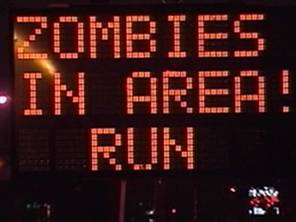
Signs of the apocalypse

February 4th, 2009

zombiesign.jpg

And to think that some people scoffed.

A message from George Carlin’s daughter

February 4th, 2009

In honor of The Mark Twain Prize honoring my father tonight, Wednesday Feb. 4 at 9PM on PBS, AND more importantly to point out the fact that the 7 Words You Can’t Say on Television are still deemed indecent almost 40 years later and will be bleeped in said special tonight – I am sending you the 7 WORDS that you will be missing tonight, and ask that you pass them on to 7 PEOPLE today.

This chain letter will not bring untold riches or dreams coming true.
It might make some people laugh, and it might make others cry.
It could possibly get you in trouble (depending on who you send it to).
But most probably, it will just remind people of my dad, who was funny and a great teacher, and a way cool father.
Oh, yeah, and the hypocrisy of language that still exists.

So here they are:
Shit
Piss
Fuck
Cunt
Cocksucker
Motherfucker
Tits.

Enjoy. Keep the Chain alive. Have a great day.
And watch the show. It is wonderful.

love,
Kelly Carlin-McCall

Golf, the way it should be played

February 3rd, 2009

What would my daughter rather be doing right now? Playing miniature golf. At least, that’s her request every weekend:  “Can we go miniature golfing?” We’ve done this often. Many, many, many times. She hasn’t tired of it yet, but her brothers don’t want to go any more and I’ve been looking for a new course.

Luckily, I found one.  And it’s much closer to home.

Closing Windows

February 1st, 2009

If I owned Microsoft stock, I’d strongly consider selling. Like, right now.

This isn’t because of any great fears about the stock market in general. Lately, I’ve been buying a little stock. And it isn’t because of my long-standing ambivalence toward Microsoft, which stems from my background as an Apple user since 1982.

No, I would sell Microsoft because I think the Third Wave 2.0 is about ready to wash over it.

(In his 1980 book “The Third Wave,” Alvin Toffler posited that the First Wave was the settled agricultural society that replaced hunter-gatherer cultures; the Second Wave was the industrial age society; and the Third Wave was the post-industrial, or information-based, society. I think we’ve already seen a lot of that — and now we’re in the first shakeout, or Third Wave 2.0.)

Problems come in threes, goes the saying. Here are Microsoft’s:

  1. For the first time, sales of Windows are down. This is at the same time that world demand for “netbooks” is going to skyrocket. What are netbooks? They’re small, cheap, portable computers that retail for about $300. These are the machines that will get outer Mongolia online, and the projected adoption rate is staggering. How easily will Microsoft be able to sell an installation of Windows onto these machines for $100, when the machine itself costs only $300? Not easily. Especially when Linux is free.
  2. Microsoft was famously late in recognizing the possibilities of the Internet. Google owns the search-engine business that could have been Microsoft’s, and the Yahoo deal didn’t happen. Now Gmail is going to eat Outlook’s lunch. If Google controls the search business, and Firefox rules the browser world, and Google (again) takes over email, what’s left online for Microsoft?
  3. Problem #3:  pessimism. Yes, I have heard the rumor that the economy is bad. But do I think it’s going to permanently “reset” at a lower level? That’s what Microsoft CEO Steve Ballmer thinks. Really? Even with continued population growth, and new economies coming online all over the world, it’s going to be smaller? Or is it just that Microsoft won’t be able to adapt to new realities? “Perpetual optimism is a force multiplier,” Colin Powell famously said. (And no, I don’t think he was prescribing a Candide-like naivete.) The opposite is certainly true:  pessimism is draining. I suppose such sourness is understandable, coming on the heels of Vista’s grand kerplunk, and those bad commercials with Jerry Seinfeld and Bill Gates buying shoes. But still.

I don’t know what Microsoft is going to do from here on out, except lose market share. (Especially to Google.)

By the way, I would sell Apple stock, too, if I still had any. Not because I think they’re falling behind or screwing up. I’d sell because the performance of the stock market relies  upon perception, and whether or not it’s true, the perception is that Steve Jobs is Apple. That’s the downside of running a personality cult:  There’s trouble when the personality proves to be all too mortal.

News of the weak, Part 2

January 30th, 2009

Bloomberg gives a good overview of the cuts at the LA Times — and the ever-shifting management lineup of recent years.

Which only served to remind me that I had forgotten to indict Tribune Company in all this. My mistake. Consider them blamed as well.

The LA Weekly’s Jill Stewart adds this:

We’ve heard back from several top journalists at the Los Angeles Times, who are still in shock over the stunningly bad news that, amidst more layoffs, the California Section, previously known as Metro, will be wiped out and tucked somewhere in the A Section of the recession-whacked newspaper.

This is a big deal, the news quickly appearing in Variety and dozens of other sites. One of the journos I respect the most in Los Angeles, Times reporter and education expert Howard Blume, who is also a former editor and writer at LA Weekly, had this to say in an email to me a short time ago:

“I don’t really know how this is going to work. The discussions have taken place well above my pay grade. There will still be a newspaper, and some of us will still be working here. And those folks will still do their darndest to put out a quality, relevant newspaper. And the rest of us will be looking for alternative employment. This is Journalism 2009.”

As we continue to follow the decline of the Los Angeles Times, remember: It didn’t have to be like this. They can blame new tech for rendering their quaint ways obsolete — but greed and mismanagement left them unprepared for the tides of change.

News of the weak

January 30th, 2009

A friend who is a longtime employee of the Los Angeles Times leaked the paper’s most recent internal cost-cutting announcement:

From: Hartenstein, Eddy
Sent: Friday, January 30, 2009 12:02 PM
To: zzTrbAllHandsLAT; zzMediaGroups
Subject: Important Message

Colleagues:

As you know from reading our front page and our homepage, not a day goes by that we don’t give our readers the latest news and analysis on the deepening troubles of the US economy. The same challenges that face the companies we report about also are affecting us.  We need to implement changes to our flagship print product, and throughout our organization, that will ensure our future as the #1 source of news and information in Southern California.

In the coming weeks, we will introduce a number of changes to the way we do business, including a new sectional line-up for the paper.  These are necessary to facilitate greater efficiencies in how we approach our operations, production and distribution and, as a result, we expect to eliminate approximately 300 positions.

Beginning March 2nd the paper will be presented in four main news sections:

A/Main News will be repositioned to present local, national and international coverage and opinion together – as each informs, impacts and shapes the others in our everyday lives. The California section report will lead A, followed by The Nation, The World and then Opinion.  The result will combine the stories and reporting of our two most widely-read print sections into one cohesive section.

Business will be the second section in the paper, and the report will be enhanced by bringing back the “Company Town” feature, which will serve as the anchor for our “business of entertainment” coverage.  The obituaries and weather pages will remain at the back of this new B section.

Sports will be the third section, and we’ll be moving the classified advertising pages to the back of this new C section.

Calendar will be the fourth section, and this move allows its deadlines to be pushed deep into the evening (aka “second-daily”), allowing us to make our primary space for entertainment coverage more news-driven. This will enrich this current “must read” section even further, enabling us to add features such as overnight reviews.

The feature-section lineup will remain unchanged, with Health on Monday, Food on Wednesday, Home on Saturday and Image, Travel and Arts & Books on Sunday.  The Sunday lineup also will be unchanged, except for the California report appearing in the A section.

These moves are designed to help us deal with the economic realities of the day, while continuing to allow us to deliver a high-quality product to our readers and advertisers.  We remain unwavering in our commitment to serve our community and to our mission.

We’ll be providing more details in the days ahead.

eddy

No matter how it is presented, this further shrinking of the paper is indeed sad news to me. I have been a loyal subscriber to and reader the Los Angeles Times for 20 years.

At the same time, I can’t help noting that while it’s not unusual in history for new technologies to displace pre-existing technologies — where are the telegraph lines now? — the Times’ particular predicament is largely a result of mismanagement.

In the 1970’s, 1980’s, 1990’s, and indeed until probably 2003, The Los Angeles Times was very profitable. The paper had double-digit profits — an enormous result compared against other companies its size, which make do on 3-6%.

Was any of this invested in the future? Was any of this set aside for a rainy day? While the editorial writers bemoaned Sacramento’s profligate spending, did they ask hard questions of the Chandler family or any of a number of Times Mirror management teams? In a different world, wiser heads would have realized that the Times was in the news business (rather than the newspaper business) and would have monetized the internet more quickly. What’s the difference between Craigslist and LATimes.com? The former makes a substantial global profit. And it was started by one guy named Craig in his house.

Instead of making appropriate investments, the paper has made one cut after another so that a string of owners — Sam Zell being only the latest — can fund their empires and maintain their stock prices. Which only makes me feel all the more foolish for maintaining a paid subscription to a newspaper that has no Book Review, no Opinion section, no Metro section, no Outdoors section, no Lifestyle section — and which maintains all its content utterly free online, where others can see what I’m seeing without paying for it. There are only two reasons I keep my subscription:  1) I’d rather read the comics in a newspaper than online, 2) pure sentimentality from someone who has loved newspapers all his life and who got his first job, with a newspaper, at age 14. And the sentimentality is wearing thin.

So yes, I bemoan what has befallen the Los Angeles Times. What especially saddens me is that its community of readers, as well as everyone else who relies upon the paper, is paying for the gross negligence of management.

One elephant who didn’t forget

January 29th, 2009

Regardless of the GOP members of the House who uniformly shunned the economic stimulus package, at least one Republican Senator has noticed the political trendlines and hasn’t forgotten 2006 (let alone November 2008). Minority leader Mitch McConnell says the GOP has to change. (Well, only if they want to stay in business, so to speak.)

But he also says: “It’s clear our message isn’t getting out to nearly as many people as it should … Too often we’ve let others define us. And the image they’ve painted isn’t very pretty.”

I have a different theory about this:  Your message got out loud and clear, and people don’t want it.