Update on business for sale
September 25th, 2009The link to our previous listing seems to have been rendered inoperable. We will keep you apprised of this exciting opportunity.
The link to our previous listing seems to have been rendered inoperable. We will keep you apprised of this exciting opportunity.
Business for sale.
Famous public school located in scenic Los Angeles seeks new operator. Situation presents great business opportunity for right operator. Estimated annual revenue of $27.6 million with simplified accounts receivable. (Single large client supplies all revenue.) New management strategies, customer-service processes, and the right rebranding could yield significant results. Success will require a nuanced communications strategy with local customer base and key stakeholders. Current management unlikely to provide transition assistance.
The LA Times’ Geoff Boucher on Jack Kirby’s legacy and the inevitable forthcoming lawsuit.
The recent demise of all those record stores like Tower Records and Virgin Records and The Wherehouse has been very good for some other people: the stores that remain. Like Rockaway Records here in the Silver Lake District of Los Angeles, happily near my theatre, which I’ve visited many times over the years. They’re doing just fine because they stock things you can’t find at Best Buy or Target, and because they know what they’re doing. Here’s a great profile in the LA Times that explains their success. Any store offering Frank Zappa collectibles and doing this well must be run by very smart music fans.
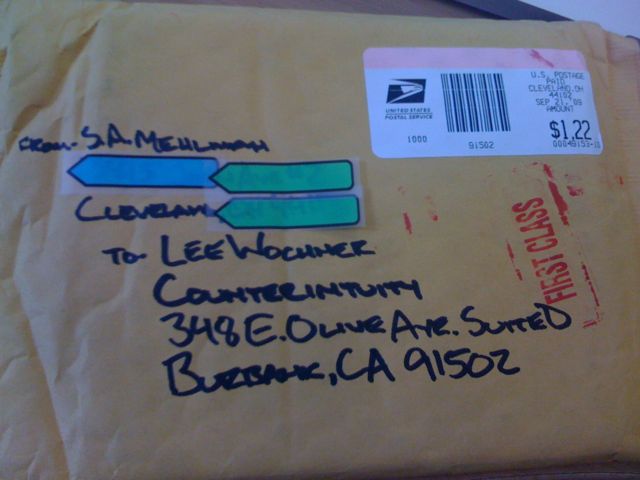
Last week, Pere Ubu guru David Thomas kindly emailed me to say he’d make sure that I got the new Ubu disk, as well as the recent CD he produced for 15-60-75 (the Numbers band), in the mail.
The Numbers’ disk arrived two days ago and I’ve just started to explore its deep soulful blues.
Today in my mail, there was the new Pere Ubu disk. In a hand-addressed bubble mailer. With the hand-written return address of… Steve Mehlman, the drummer.
This has just gotten better and better.
By way of reminder, here are some of the things I’ve written in the past about John Edwards:
Edwards’ checkered history leads me to ask, as a reporter for Newsweek did today, why he is still raising — and spending — money on a presidential campaign. Last I checked, that race was held almost a year ago (and Edwards wasn’t in it). But somehow he has banked $3.7 million in donations and continues to spend it.
I have known many public servants in my life. The vast majority of them work long hours in enormously frustrating situations in service to ideals they hold close to their hearts, striving to make a better life for people. Every time you confront cynicism about politics and government, it’s not because of those people — it’s because of people like John Edwards, a self-aggrandizing phony who preys off people’s misery.

A “noted naturalist” has suggested letting the panda die out:
Conservationists should “pull the plug” on giant pandas and let them die out, according to BBC presenter and naturalist Chris Packham.
“Here’s a species that, of its own accord, has gone down an evolutionary cul-de-sac,” Packham told Radio Times magazine.
With some scientists, the panda has suffered backlash since at least Stephen Jay Gould’s book “The Panda’s Thumb,” in which Gould complained that the animal, which is capable of a far more diverse diet, is dying out because it insists on eating only bamboo leaves. There’s a price to be paid for being picky, and recently conservationists have been picking up that tab.
I greatly doubt that’s going to stop any time soon. In the war for survival, the panda has the best survival tool: marketability. Despite what some over-educated eggheads might make of its irresponsible overindulgence, the panda’s cuteness is irrefutable. For that reason and for all that that entails — in World Wildlife Fund brochures and children’s plush toys and effusions like this one — the panda will be here long after the chacoan peccary has slunk from existence.

Yesterday a friend and I went to Long Beach to see the Brian Eno installation, “77 Million Paintings,” at the University Art Museum of California State University Long Beach. The genesis of the 77 million paintings enumerated in the title — which, Eno later said during his lecture, would actually be 77 million cubed — is described well in this piece by the LA Times’ Reed Johnson. In short, a video mosaic of 12 individual screens pulls images randomly from grouped sets contained in databases held by three different computers, generating an ongoing series of freshly executed video “paintings,” which are sonically supported by a soundtrack of sound loops on six separate tape decks, resulting in randomized musical accompaniment. The intention is to remove deliberation and intention from the artistic process; the result is mesmerizing. As my friend and I found, it was quite easy to get lost in the neverending self-generating inventions of the computers and the tape decks. For one brief period, I felt detached from space and time. I’ve had this feeling before with some art, in various disciplines, but only rarely.
Later, we attended Eno’s lecture at the Carpenter Performing Arts Center (also part of Cal State Long Beach). After 30 years of following the man’s career in all its phases — rock star, record producer, artist, writer, thinker — this was our first chance to see him in the flesh. Eno proved to be thoughtful, puckish, droll, and concerned, in equal measures. I would characterize the first third of his lecture as an admonishment to let go. (This should be expected from an artist whose visual work is created largely from computer generation.) He started by reminding us of something we’ve known for 566 years, since Copernicus: that not only we are not at the center of the universe, we are off in a small corner, in one of a billion billion solar systems, and we exist as only one of innumerable species just on this one planet, where only an estimated 10% of species have been cataloged. In other words, Get over yourself. Again, this viewpoint should be expected from someone extolling the virtues of random, unemotionally generated, art.
On the way home I wondered aloud how well these theories that can work so well in visual art and music would work in long-form narrative. Having read (or tried to read) Samuel Beckett’s novels and some of William S. Burroughs’ longer pieces, I unfortunately believe I know too well. In such cases, even a little plot can go a long way. Organic writing — which I practice and preach — benefits from pruning and shaping. Effects can engage an audience, but only for so long; the best effect is an emotional verisimilitude, however achieved, that transports people into a deep level of caring about what happens. That occurs in better productions of “Waiting for Godot” because Didi and Gogo are present and we can relate; it never happens with “The Unnameable,” which is a true chore to read. When he’s collaborating with, say, Robert Fripp, Eno is free to produce an album of electronic feedback loops, but when he’s producing records for U2 or Coldplay, he must serve the song. To his immense credit, he never claimed in this talk that he was abandoning all oversight; rather, he talked about intentional balance, moderating oneself along the continuum between surrendering all control, or controling all elements, depending upon the desired outcome. I think that’s about right.
If you’re interested in “77 Million Paintings” and cannot make it to Long Beach, where it runs through December, here’s some good news: a beautiful software-and-DVD version exists. Here it is on Amazon.com. I bought a copy at the museum, and at about 35 bucks, it’s a steal. The package includes the software to run these self-generating images on your computer, with accompanying soundtrack. In addition, there’s a beautiful booklet with notes from the artist, plus an interview DVD. Get it and surrender all control to it.