
A sound investment
September 16th, 2009The L.A. Times predicts boffo box office for, wait for it, Michael Moore’s sarcastically named “Capitalism: A Love Story.” (That is, unless the Illuminati derail it.)
The L.A. Times predicts boffo box office for, wait for it, Michael Moore’s sarcastically named “Capitalism: A Love Story.” (That is, unless the Illuminati derail it.)

So last night my good friend Larry and I went to the red-carpet premiere of “Capitalism: A Love Story,” Michael Moore’s new film. We didn’t dress well enough to get on that red carpet, but neither did Michael Moore and he got on it.
I am and I’m not a fan of Mr. Moore’s work. Actually, given that ambivalence, I guess I’m not. He’s a good entertainer, and I agree with some of his points, and I always enjoy it when truth is spoken to power. But I’m insistent on one point: that it’s truth. As we know right from the beginning of Mr. Moore’s body of work, “Roger & Me,” he plays with the truth to comic effect or just to score points. This is fine with comedy; this is not so good with documentary. So I don’t know into what category these films belong; I like my documentaries to be grounded in truth.
To Michael Moore’s way of thinking, the near collapse of the American economy last fall was the result of a nefarious plot originally cooked up during the Reagan presidency and served to variation by everyone in Washington, DC since then. Evidently, every Treasury secretary, plus the major investment houses, plus the Congress, plus the banks, have all been in on it. They have colluded to: strip important regulatory commissions, imbalance the tax code, privatize government functions, cripple labor unions, disseminate fear, and do whatever else it takes so that it can all result in their backing their armored cars up to the U.S. Treasury and leaving with billions of dollars in taxpayer money. Now, it’s almost irrefutable that all these things have happened to some degree; it’s the collusion that I question. Throughout the film, Moore insists upon cause-and-effect relationships that are impossible. The Democrats can’t agree with themselves on anything — how did they agree to this scheme? If you’ve ever sat on a committee of any sort, you know what I’m talking about. To quote Jean Paul Sartre, “Hell is other people.”
Leaving the difficulty of interpersonal relationships aside, he draws bizarre conclusions. According to Moore, somehow or other, the tax code is to blame for Hurricane Katrina. I thought the hurricane was a natural disaster, but hey, I only know what common sense tells me. If he’s implying that the death and suffering that followed result from poor response, then I’m unclear what that’s got to do with his overall theme, especially while there’s plenty of other addresses one can situation that blame: local, state, and federal officials. Even if all those authorities had had the best response in history, almost no conceivable amount of engineering was going to save New Orleans, a city that resides below the water level on a flood plain. The lack of government response was appalling. But is it irresponsible to live in a flood plain? Is it irresponsible to rebuild on cliff faces where mudslides are common? Or to build in forestry areas where wildfires routinely rage? Ultimately, we can’t afford a government response to all of this. In Michael Moore’s mind, if you walk into a building and it’s on fire, then clearly you caused this fire. Where there’s smoke, there’s blame.
Much of his film centers around the collapse of the housing industry. His reading: The fiends ensnared people into finance schemes they couldn’t afford, then made off with all the loot while the economy crumbled. Well, yes and no. I know a number of bankers, and I have to tell you, they’d rather be collecting mortgage payments right now than trying to hawk underwater houses no one wants. During the real-estate bubble I saw two different things that Moore never touches upon: people who bought houses they couldn’t afford to use as investments, and people who refinanced their homes so they could pull out money and buy more stuff. I think those two scenarios covers almost everyone I know who owns a home. What sold most of those big plasma TV’s? The real-estate bubble.
I could go on in this vein, but it was exhausting enough trying to parse it all in real time during the screening as the movie flitted from one far-flung outrage to another in a desperate attempt to string them all together. It was gut-wrenching to watch farmers get evicted from their home, and it was appalling to learn that employers were collecting life-insurance claims on dead employees, and it’s sickening to see the state some people have been left in by the trampled economy, and it’s an outrage that CEOs of bellied-up corporations get rewarded with enormous payouts, and it’s maddening to be reminded yet again that every Western industrialized nation but one — ours! — has a national health-care plan. But every fault should start with the first question: “What did I do, and what can I do about it?” And the first part involves acknowledging your own role in the ruination.

Imagine my thrill when David Thomas of Pere Ubu emailed me just now to thank me for this blog post. In return, I tried very hard not to sound like a sycophant.
I wish I could boil incredibly complex issues down to simplistic and illogical outcomes while drawing absolutely ridiculous conclusions from completely unrelated events.
Because clearly, there’s fame and fortune in it.
And now I have to go to bed. I’m exhausted from performing hours of rhetorical reconstructive surgery.
I don’t have a lot of interest in pleasant music. Yes, I can hear that it’s soothing, but I can’t figure out why you’d want music to soothe you. I want music to snap me out of it, to communicate something new in an interesting, dynamic way that’s impossible to refute.
So, it’s easy to see why I like a lot of what I like: Roxy Music, Talking Heads, David Bowie, the ubiquitously written-about (here, anyway) Pere Ubu, TV on the Radio, Frank Zappa, Sonic Youth, Van Dyke Parks-era Beach Boys, King Crimson, and the like. What are the common elements? Intellectualism, contrapuntalism, dissonance, and surprise. What else do many of them have in common? Brian Eno.
It’s impossible to track the music I like without repeatedly stumbling across the name Brian Eno. The best Bowie albums? (Lodger, Low, “Heroes,” Outside.) They all featured Eno writing, producing, providing “atmospherics,” or a combination of all three. Same with the three Talking Heads albums truly worth owning, including the astonishing Remain in Light. Eno has had the immense good taste or good fortune to work repeatedly with the likes of Robert Fripp, Harold Budd, John Cale, Philip Glass, David Byrne, and many others, and I’ve gotten this far without mentioning another act he’s produced by the name of U2 because their music does nothing for me. Along the way, he invented ambient music and made a lot of money doing so.
Eno can’t “really” play music, although his ability to twiddle knobs on early synthesizer systems and tapeloop machines he stapled together in the early 1970s enabled him to play live with Roxy Music. As someone with lots of ideas and very little skill, Eno is the prototypical modern artist. The abstract expressionists couldn’t paint, Martha Graham’s dances don’t look like dance, there is some doubt that most of the current academically hailed playwrights can write a play, and Brian Eno can’t play an instrument or read music. When asked by one interviewer if he would have been a music had he been born at an earlier time, the 61-year-old Eno said no, because his instrument would’t have been invented yet. What instrument is that? “The recording studio.” There is obvious enormous benefit to the presence of a naif. Why does Eno’s 1974 album Taking Tiger Mountain by Strategy still sound so fresh, and so wrong? Because it wasn’t hampered by someone who knew how to do it “right.”

The past few years, Eno, who is also a painter, and is a painter in a similar way that he is a musician albeit with more training, has been doing installations of changeable art created by a random shifting interplay of abstract images, shown against a backdrop of ambient music. He’s now brought that show, “77 Million Paintings,” to Long Beach, where I’ll be seeing it on Sunday with a friend similarly well-versed in all things Eno before, miracle of miracles, we’ll also catch a lecture by Eno at the Carpenter Center that evening. Yes, I got those tickets almost as soon as the event was announced; good thing, too, because the lecture sold out almost immediately. I’ve been following Eno and his work with great interest for 30 years, and this is the first time he’s made an appearance anywhere near me, so I wasn’t going to miss out. Expect more here after the event.
Yes, today is 9/9/09, the day that a bunch of 40-year-old albums by a certain band got re-released in various CD re-packagings, to the delight of millions around the world.
For others among us, it was another day in the countdown toward the new Pere Ubu album, “Long Live Pere Ubu!” Even if it turns out I hate it, I guarantee it’ll be far more artistically provocative than any other new music coming out this month. Yes, the Beatles were provocative. Forty years ago.
The new Ubu album brings together two things I’ve been interested in for a long time: the band Pere Ubu, and the inspiration for their name, Alfred Jarry’s “Ubu Roi.” “Ubu Roi” was an adolescent prank — a play written by a high-school kid to mock his teacher. I wrote a novel in a similar tone when I was the same age, but my novel’s still in a box somewhere while Jarry’s play radically changed its artform. (Do we get to have Ionesco, or Theatre of the Absurd as a whole, without Jarry? Probably not.)
Fittingly, Pere Ubu the band has been every bit as influential as “Ubu Roi,” and even more doggedly uncommercial. One of the bonus features on an Ubu CD is a series of documents, including one that references an album’s sales as numbering about 6,000. This for a band with a three-decade history and a sound that influenced Nine Inch Nails, the Pixies (and, therefore, Nirvana), Joy Division, REM, Thomas Dolby, Hüsker Dü, Henry Rollins, Bauhaus, and innumerable others including the entire industrial-rock movement, a band rightfully recognized in the Rock and Roll Hall of Fame (albeit in an undeservedly small corner), where one of singer David Thomas’ instruments is proudly displayed: a railroad spike with accompanying ball peen hammer. And if you listen closely enough, you can hear that very instrument on some early tracks where it is played to perfection.
This FAQ about the rationale behind the concept and recording of “Long Live Pere Ubu!” speaks to some of the many reasons I love this band. Imagine this sentiment, by David Thomas about the resurgent appearance of the monstrous Pere Ubu wherever you look, being uttered by any other recording artist this long in the game: “Regardless of whoever or whatever it is that you personally choose to lionize, it’s more than likely that such a person or organization is Père Ubu. Every talking head that you see and admire on the tv is Père Ubu.” Thirty-four years on, 20 years past the last gasping relevance of the Rolling Stones, Pere Ubu retains the industrial crackle of original thought. That makes every new CD by them a release worthy of anticipation.
I have to do some rewrites on my new play tonight so that I can hear them at tomorrow night’s rehearsal, but I thought I’d procrastinate first. (I am a writer, after all.) So I turned on the television.
First, I saw an episode of Penn & Teller’s Bullshit!, which dealt partly with all the millions of people in Africa suffering from HIV and AIDS because they can’t get access to condoms.
When that was over, I caught the tail end of a documentary on another channel concerning the closing of a GM factory in Ohio. The crew followed about a dozen different long-term assembly plant workers around the shop floor on their last weeks, right up to closing day. You have never seen so many grown men cry.
Then on a third channel I caught the last 20 minutes of a documentary about a son who just couldn’t take his mother any more and killed her. The documentary is from the point of view of his older sister. I caught the scene where she asks their father why he never intervened in what I take to be his now-slain wife’s endless criticism and abuse. He says that if he’d suggested therapy, the mother would have divorced him, and so he didn’t know what to do, the daughter says that doesn’t absolve him, so the father bolts up from the interview and storms out of the house. The next scene is the sister visiting her brother in prison.
After this, I was afraid to see what I’d find elsewhere on TV. So now I’m writing the play. Who says theatre isn’t escapism?

Seventeen years ago this weekend, a small group of us built a theatre. It’s called Moving Arts and it’s still running.
And then seven years after that, we built another, inside the Los Angeles Theatre Center, which we had to tear down seven years after that when we vacated the building. So I’ve built two theatres and torn one down. I hope some day in retirement to build one more, but I plan never to tear another one down.
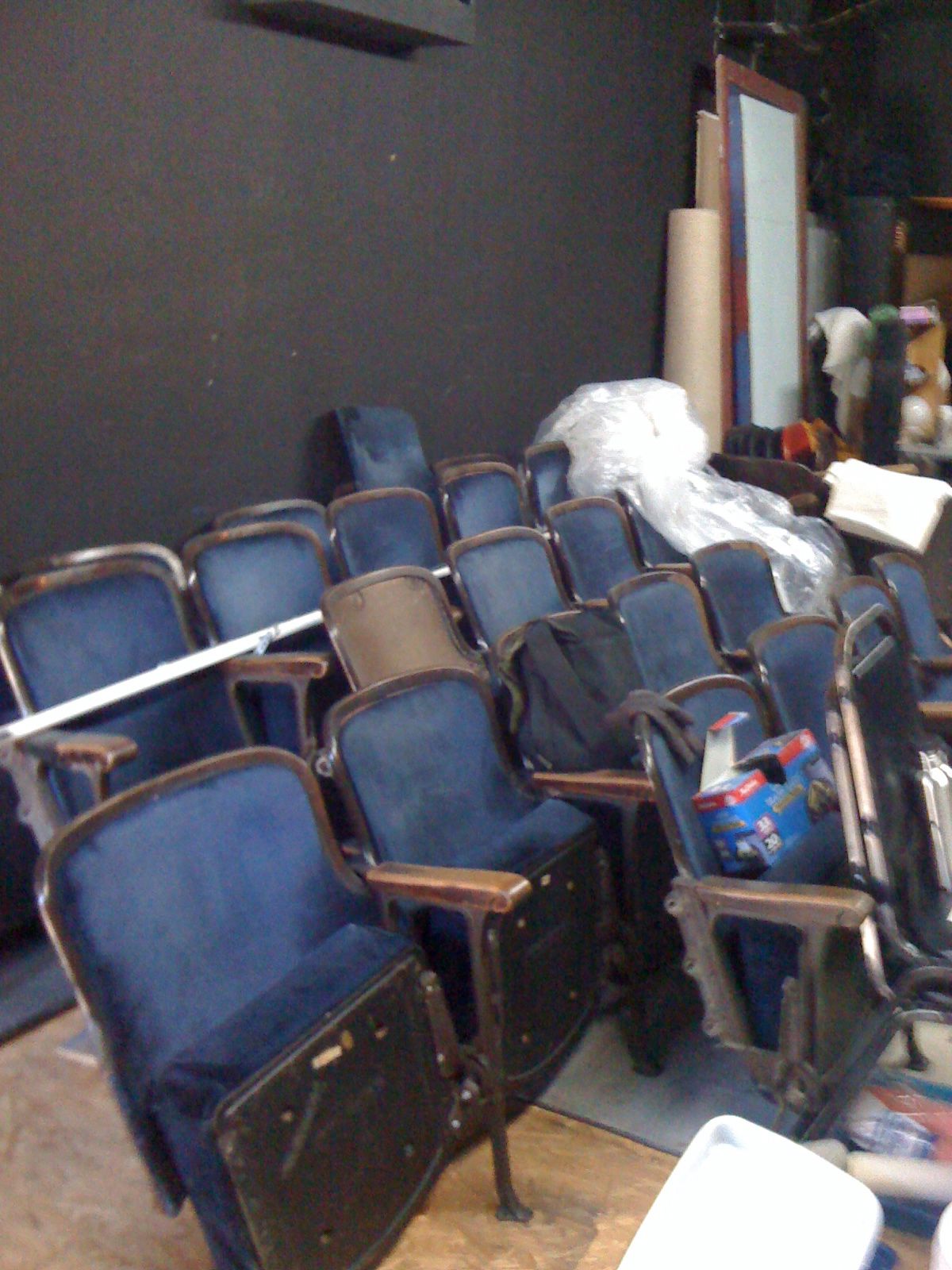
Today the memories of building that first one came flooding back because a crew assembled again in that original space to take almost everything down and apart and rebuild the space. A long long time past overdue, the space is finally getting a rehab. My two younger kids and I arrived to find the risers disassembled, the ceiling fan apparatuses apart, all the drapes and carpet tossed, the bathroom stripped out, the seats unbolted and repositioned, and a nimbus of long undisturbed dust floating like the haze of Los Angeles over everything. It came as a shock.
I love building (and, now, rebuilding) theatres, so I’m glad I came to help out even if only for a few hours. I spackled holes, removed ancient twisted hardware, and painted. Somewhere in our archives we have a photo of my then 1-year-old standing in the window in November 1992 as we post our first (positive) review. That child is now off at college; his younger siblings are further along, so they also got to paint and spackle and drag trash around.
One of the things I tell students is that theatre takes place in a room. (Even when it’s staged outside, that room is implied.) It’s a form that insists on the isolation of space, defining a stage that is apart from an audience, urging us to believe in split universes, the universe of the spectators seeing into the world of the players. But we’re still in the same room. Actors who know how to play off audiences know that, and so does everybody else on some level.
So this is a room I’ve done a lot of theatre in. Hundreds of plays and rehearsals and auditions and workshops and readings over the past 17 years. I’ve grown fond of the place. I’m glad it’s getting a makeover that it has long deserved.
My new one-act play, “He Said She Said,” goes up next month here in Los Angeles. (Details to follow.) Today was our first table reading. Between that, and a drinks meeting I had with my director just over a week ago, I’m reminded again why it’s better if playwrights don’t direct their own plays. At least, this playwright.
I am a director, and depending upon the rightness of the material for me and whether or not I screw it up, I think I’m a pretty good one. But I don’t think I have the sort of insights into my own plays that good directors have. That’s because, having written the play, I can’t discover it. In this case, I thought I had written a simple short play in the style of story theatre. Listening to my director talk about it, I realized that what I’d written was closer to a short story narrated in first-person. This may seem like a fine distinction, but it’s not: Short stories plant images in your mind for you to conjure, while stage plays put them on stage for you to see. This was going to require more directing that I had realized, and probably some changes in the text to eliminate redundancies. (The narrator telling us something, and the actors then doing it. Which unless done for comic effect would be like hearing a skip in a record. It should be one or the other.) I wonder, had I been directing this, how far into the rehearsal process we would have gotten before I discovered this. With good actors (which I’m lucky to have), pretty quickly, I think, because they would have told me. But I hadn’t discovered it already, and my director had. So he definitely earned my attention early on. When someone is being smarter than you, you should listen.
While this play is in rehearsal, I’m also directing a new one-act in an evening of plays by my good friend and former student EM Lewis. We had our first script meeting last week and I think it was like the meeting above, but now I was in the other chair. The current draft of the play is 18 pages, and the discussion took 2 hours, 17 minutes. She is a fine writer. The play has strong characters and good conflict and wonderful dialogue; all those things I like. But there were things I didn’t understand about the play, and to be able to present a vision of it, I needed to understand it. The fault may have been mine, or the playwright’s, or more likely there may have been no fault but rather a case of things that work and things that don’t work, depending upon your line of attack on the play. With “Hamlet,” is Hamlet deranged, or is he crafty, or both? Making that initial decision determines the playing of everything that follows. It’s always that way with all plays — at least the good ones. Bad plays have no creative ambiguity; they are resolutely what they are.
Next week I start on the other two of the four theatre projects I’m doing this and next month. My friend Trey Nichols has been commissioned to write a one-act play for the same festival; I’ll be helping him shape the material with a small cast (three or four actors) and co-directing with him. And I’m also involved in a project at the Natural History Museum where, if I’m understanding this correctly, six or so of us are writing short environmental scenes that interconnect into a larger play about their new spider exhibit. I know which character I’m writing, and that character’s basic storyline (which I pitched), and the actress playing that role (Liz Harris, a good actor I’ve worked with many times).
In “My Dinner With Andre,” Andre Gregory relates to Wallace Shawn that daily life dulls us to our own existence, and that we need to break our patterns to re-engage. I think that with four theatre projects all at the same time and all with different frameworks, I’ll be very conscious for the next two months.