Lee Wochner: Writer. Director. Writing instructor. Thinker about things.


Blog

Archive for the ‘Writing’ Category

Playing in traffic

Monday, February 20th, 2012

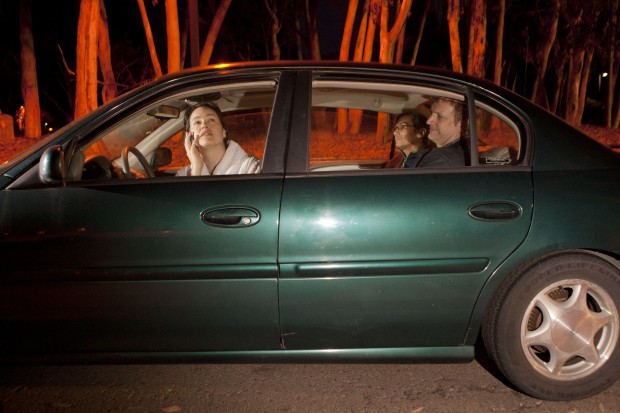
Early this evening, after finishing a construction job (see below), I went to a run-through of my new play, Dead Battery. It’s part of The Car Plays, a festival of plays staged within cars and produced by Moving Arts, appearing at La Jolla Playhouse in San Diego starting this Thursday night. Here’s information on the production and how to get tickets.

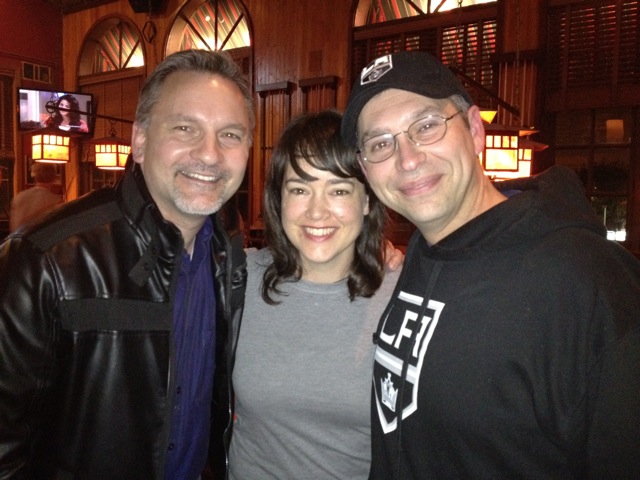
I was very pleased by what I saw. One of the best directors I know, Paul Stein, is directing the piece, and my friend the extremely talented Sara Wagner is starring. The play is loosely based on some thoughts I had about my college-aged son’s car, parked in our back yard, as well as a writing prompt from Paul:  write a car play that is at least 50% silent.

This is the fifth time I’ve had a play in The Car Plays, but it’s the first time I was given a writing assignment. Paul had asked me and the other writers in one of our infrequent writers’ meetings how we felt about writing prompts;  I heard myself saying I would be thrilled to get one. I don’t think that that’s what I would have said 15 or 20 years ago, but maybe I’ve come to better grips with the fact that, one way or another, I’ve been writing to prompts most of my life. Most of the things I’ve been paid to write — ad copy, book reviews, radio commercials, videos, op-eds, speeches, web sites, and more — have been to spec, and you know what? The guidelines make it easier. If it’s got to be a certain length, and needs to contain certain things, and needs to be done in a certain way. it’s more like completing a puzzle and less like a big blank screen that you’re supposed to fill with words of some quality.

Car plays in particular are like writing haikus. Each play needs to be nine minutes. It needs to take place inside a car. Ideally, the main action also needs to take place inside that car. And each play needs what sitcom writers call a “button”; an even that buttons up the play and signals the end. In most cases, that means the cast leaving the car.

My first car play, All Undressed with Nowhere to Go, written in July 2006, was a comedy about an adulterous couple who had no place to go to have sex.  I wrote a sequel to that, All Dressed Up but Going Nowhere, which featured the same man but now with his wife, and to me it was heart-wrenching because you saw that these two people belonged together but just couldn’t connect. (My wife didn’t like it because in one of the woman’s speeches about the chore list I struck a little too close to home. A recounting of lists seems to be a recurring feature in my plays.) I also wrote a play called Chasm about a couple stuck up in the mountains during an earthquake — in a twist, it’s the young woman who is armed and ready to take charge — and I’m not sure how many more car plays that haven’t been produced, and probably won’t be. (Most notably Snake in a Car — still wish I could make that work.)

I wrote two very different drafts of the current one, the first was a comedy about a woman suffering from empty nest syndrome who keeps calling her son at college, trying to vicariously join in the fun. Then my wife happened to call while I was tinkering with it and I did two things I’d never done in all the years we’ve been together:  1) stopped writing to talk to her; and 2) told her what I was writing, and how it worked. She said, “What if the son is dead?” And I instantly knew that that was better and said, “I gotta go” and hung up. That meant a total rewrite because, well, now that it’s a high-school kid who is dead, it’s not such a comedy any more. Rewrites are like that:  One small change begets many more.

And then actors and directors change it more:  not the script, but the playing of it. Not because they’re arrogant — that’s an uninformed perspective — but because they bring their own talents to it and, especially in the case of a car play, the production must bend to accommodate the needs of the production. In this case, my script was running a full 50% over the time limit. When I wrote this draft, I wondered if it was actually short — we discovered only in the first reading that it would probably be long, and Paul and Sara didn’t learn just how long until they started rehearsing with props. I’d never before written a play that was at least half silent, and it was difficult to time in my head how long it would take to, for example, look at a CD case with judgment, scowl over an empty whiskey bottle found in the back, pull a face over a pair of discarded panties, and more. In the draft, I have Esme leaving the car to retrieve  a trash bag; that was taking too long, so Paul suggested that she use empty shopping bags and junk-food bags left behind in the car. He also found a way to jumpstart the action in Dead Battery by presetting the actor in the car. But finally, he called to ask if he and Sara could suggest line cuts and I said of course. When you’ve got really good people who have earned your trust, it’s only right that you trust them back. I saw the line cuts today in print and heard them tonight and they were minimal and well-chosen.

A couple of months ago I had lunch with another actor, someone I’ve been doing theatre with 15 years. Somehow or other I’d gotten into a joking framework with him on Facebook and then realized I’d stumbled into a concept and posted “I should write this as my next play.” He immediately IM’d me to say yes, do that, and then we met. This opportunity too has a set of specs, so once again I’ll be writing to order. I’ve got notes for that play, and I’m looking forward to writing it this week while I’m down in San Diego with my latest production.
4-color emancipator

Saturday, February 18th, 2012

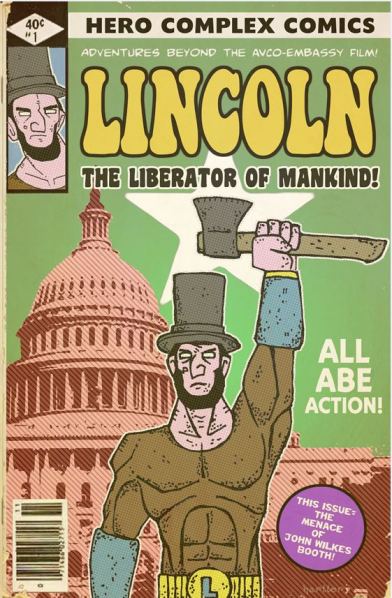
 superlincoln.jpg

Who was the first superhero? Maybe it was Abraham Lincoln.

And here’s another moment of pop-culture history that shook my childhood:  The episode of “Star Trek” where Kirk teams up with Lincoln, and Lincoln gets killed. Again. (And Kirk has to carry on the mandate of fighting for “the good.”) As a kid, it made me sad to see that. As an adult, I have to observe that some people just seem fated to die for a cause.

Plan for tonight

Saturday, February 18th, 2012
  1. Watch “The Cowboys” with my 9-year-old son. I was that age when my father (and mother) took me to see it. In the movie, John Wayne plays a rancher who is forced to hire a bunch of kids who work for him as real cowboys. Near the end of the movie, John Wayne’s character is killed off and the boys have to complete the cattle drive without him. This was astonishing to me, and I kept waiting for the trick ending, showing that he was actually alive and had been secretly watching over the boys the entire time like a guardian angel. But nope, he was actually dead, and I couldn’t get over it. I’m curious to see what this generation will make of that. Prediction:  nothing. They’re inured to everything now.
  2. Stay up really late (or, well, early) writing.
  3. Interrupt extended bout of writing with blog posts.We’ll see.

Bukowski unbound

Friday, February 17th, 2012

Last night, my friend Jonathan Josephson’s theatre troupe descended unannounced on Barney’s Beanery in West Hollywood to perform several poems by Charles Bukowski. You can watch the performance below — and be sure to note the reactions of diners seated in and around the playing area. I understand their constrained response:  I’m not sure I’d want to be eating Barney’s signature chili dog while being accosted by an actor reciting “My Underwear Has Shit Stains Too.”

Valentine’s play

Tuesday, February 14th, 2012

Last year, I bought my wife a gift and a card on Valentine’s Day. When I brought them home, she said, “Oh. I thought we weren’t celebrating it.”

I spent days pondering what that meant. Especially since I thought everything was fine.

Today was Valentine’s Day again. As we know, I was busy out of town for four days, then utterly jammed the past two. And I had to pick up not just my son, but also two of his friends after school for a sleepover so their mother could have her first date in three years (on Valentine’s Day, no less). So even though on the way home, I thought about it being Valentine’s Day, if I stopped to get something for my wife, it would be not only last-minute and inconvenient — but also unnecessary, because it seemed to have been established last year that we weren’t celebrating it.  I didn’t know why we weren’t celebrating it, or when we had evidently agreed not to, but somehow, the story went, we had. So I drove home with said kids in tow and ordered a pizza and a salad and that was it.

Then my wife came home with a gift and a card for me. “Happy Valentine’s Day!” she said. Then she grew slightly impatient when I didn’t open either item right away.

So I have several theories about this. (As I told someone today, 35 years of writing plays have left me focused on motivation.)

  1. She’s toying with me. Then and now.
  2. She isn’t toying with me, and this year she’s in a better mood than last year.
  3. Last year, I did agree not to celebrate it but then forgot, and this year I was too preoccupied and used last year as an excuse. (If those things are true, I’m the unwitting villain in this piece.)
  4. Neither one of us knows what the fuck we’re doing.

By the way, the year before, we celebrated perhaps the best Valentine’s Day ever for us, with a wonderful time before, during and after a fine meal at a fantastic restaurant with romantic live guitar accompaniment. So one thing you can say for us:  After 28 Valentine’s Days together, we’re still not stuck in a rut.

Shocking dictionary discovery of the day

Friday, January 27th, 2012

Microsoft word kept underlining my use of the word “forfend” in red today, suggesting that I’d misspelled it or, heaven forfend, made it up. (And, indeed, WordPress keeps doing the same thing as I write this.) So I took a minute to consult my friend Webster’s New World and discovered that “forfend” is now considered archaic. It may well be, but I’ll continue to use it, and I contemn anyone who would caution me against it.

Random corporate slogan generator

Monday, January 23rd, 2012

Here it is, free and available for your own use. There are many reasons I love the random corporate slogan generator, but here’s just one:  the awful crap it generates typifies what keeps me in business.

Awards: feh

Monday, January 16th, 2012

In my circle of friends (and with readers of this blog), my antipathy for “The Descendants” is well-known. So, of course, I got an email from a sympathizer aghast that “The Descendants” won a Golden Globe tonight for “Best Picture.”

Here’s what I think:

It’s good to bear in mind that “Citizen Kane” lost the Oscar to “How Green Was My Valley” (a film now more obscure than Charles Foster Kane’s sled).

And it’s also good to know that one year, the Nobel committee was tied between giving the prize for Literature to Beckett or Ionesco — until finally one guy just switched his vote to Beckett so they could go home.

I once won an award for a play that I wasn’t sure was the best in the festival; the following year, in the same festival, I lost, when I know I had the best play.

Awards:  meaningless.

Except as marketing.

And “The Descendants” still stinks.

Acceptance

Sunday, November 27th, 2011

Here’s something that’s never going to get old:  that little lancet of joy when I learn that something I’ve written has been accepted. I just had a short play chosen for a festival in San Diego in February. (More about the particulars of it another time.)

Let’s be honest:  most successes, when you dig deeper, are countervailed by many, many failures. If I’ve never been quite as dogged as Thomas Edison (“I have not failed. I’ve just found 10,000 ways that won’t work.”), I nevertheless got used to rejection early on. At age 11, I started sending short stories off to magazines such as Ellery Queen’s Mystery Magazine, Alfred Hitchcock’s Mystery Magazine, Asimov’s, Analog, Magazine of Science Fiction & Fantasy, and the like, and just as quickly, they’d come back, but even then my response was akin to: “Wow! They wrote back!” I was thrilled when some assistant would scribble a note onto the form rejection letter, as the time some kind woman wrote, “But thank you.” I still think about her. (Thank you, unnamed kind woman.) I never got rejected at school dances, because I just liked to dance, and would dance with all the girls — the big ones, the small ones, the pretty ones, the homely ones, the popular ones, the shy ones — in sixth grade, it just seemed wrong to leave any out. When I started actually dating, girls felt freer to reject me if they liked, and that seemed fine because there were others to ask. I wasn’t emotionally invested in it; I just wanted to go out with a girl and see how far I could get. (Results varied.)

When I started to get published, first in fan publications, and then with non-fiction and fiction in magazines and newspapers, it was thrilling. I liked opening a newspaper and seeing my byline. I liked getting some obscure little magazine in the mail and seeing my story (or, gasp, poem!) in there. Then I fell into the theatre and here’s what I discovered:  that live audience response trumped printed byline. How could seeing my name in print in a magazine — perhaps read, perhaps not, by unnamed and unknown people far away — possibly compare with actually being there when a live audience laughed out loud or was visibly moved by my play? One night, during a performance of my play Happy Fun Family, a woman literally Fell Out Of Her Seat laughing. To this day, I love her. Night after night, when women would sob at the end of About the Deep Woods Killer, I felt golden.

Rejection has never really bothered me. If it stings, it subsides almost instantly. I’m fortunate all around:  I’ve got a strong family, terrific friends, and the trappings of a pretty interesting life that I’ve snared and dragged back into my den. But acceptance is obviously preferable, especially acceptance of a play, which means that there’s going to be another audience experience with one of my plays, and if I’m even luckier, I can be there for it.

Fun fact find of the day

Tuesday, November 22nd, 2011

When Andre the Giant was a boy, Samuel Beckett used to drive him to school — in the back of his truck because that’s the only place he’d fit. All they would discuss was cricket. The absurdity of this situation — the future professional wrestler and adored star of “The Princess Bride” growing up carted by a future Nobel playwright of the existential — cries out for a play. Maybe I should write it. (I know Ionesco would have, had it occurred to him.)