Today’s music video
April 4th, 2012We need to get this guy together with David Lynch. YEAH TOAST!
We need to get this guy together with David Lynch. YEAH TOAST!
“Crazy Clown Time,” courtesy of David Lynch. Yes, that David Lynch, collaborator with Angelo Badalamenti, Danger Mouse, Sparklehorse, Karen O, and many other fine talents, and, oh yeah, film director as well, as shown here. Is this video, as a friend of mine posted today hopefully, a return to “Eraserhead” form? No (and it’s not even a return to “Dune,” a film that some of us, for inexplicable reasons, can’t quite get enough of, no matter how ill-conceived and often poorly executed it is). But what the video of “Crazy Clown Time” definitely is is a return to offbeat lo-rent white trash filmmaking, the sort that very few of us knew made up the actually “good” movies at the video stores. Enjoy.
P.s. And, oh yes, David Lynch’s solo album is most definitely available on iTunes.
And who better to help you do that, but the Daleks?
(Well, maybe the Cybermen. After they get involved, you really don’t have a care in the world.)
Yes, I did go see Waiting for Godot at the Taper on Friday night, and it was marvelous. It was surprising how fresh and entertaining the play was, and how moving in its conclusion, especially given how many times I’ve seen productions of it. Big congrats to the cast, director Michael Arabian, all the designers, and everyone else involved, on a flawless production.
But there’s another production that I’d like to talk about at greater length.
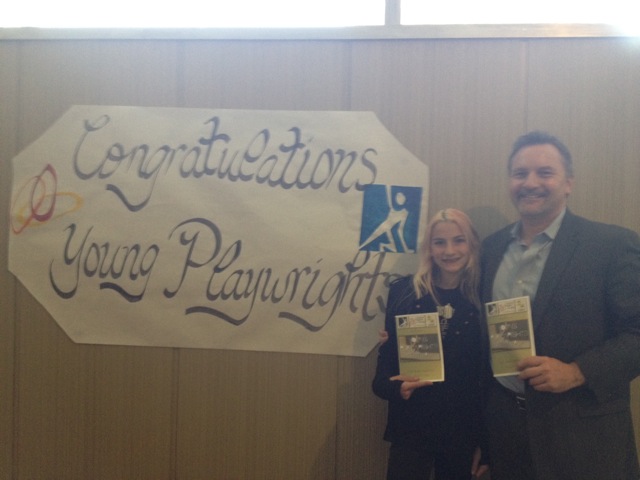
On Tuesday night I was able to see another play, this one the world premiere reading of a new play that marked the literary debut of a promising new playwright: my daughter Emma. Emma is an 8th grader who participated in a program at her school by Center Theatre Group — the folks who put on that Waiting for Godot production you should see — wherein students work for many weeks with a playwright who is a teaching artist to learn how plays work, and how to write one. Over the course of the school year, they do improv games, write scenes and lines of dialogue, and get to work with professional actors, culminating in an evening of readings by those professional actors. (One of whom, it turns out, was Rob Nagle, whom I’ve worked with at Moving Arts.) Eight of these brief plays, each of them co-authored by small groups of the students, were performed on Tuesday night by the actors.
Here’s the plot of the play by my 13-year-old daughter and her co-authors:
A father asks his (13-year-old?) daughter if she’s done her homework. She says she wants to watch TV first. (As I was watching this unfold, I was immediately hooked by the theatricality of this setup. I closely related to it, and its inherently theatrical complications.) He gets angry and loses his cool — so the daughter and her mother leave. They just get on a bus and leave town. For good. And then the father is angry with himself (for enforcing homework, I guess).
Clearly, there’s a lesson here for all of us, and that lesson was not lost on me: Be careful about how you insist on homework getting done, lest your wife and daughter get on a bus and leave town for good.
Over the years, I have made appearances in the writing of other people I’ve known, sometimes in poems, sometimes in plays or stories or essays, sometimes thinly disguised and sometimes not. One time I went to the reading of a play at the Pasadena Playhouse by someone I know and the characters were discussing another character, unseen in the play, who seemed rather much like me, and whose character name was “Mr. Wochner.” That seemed eerily similar to my own name, which is “Mr. Wochner.” So I have had previous experience of seeing a character that might or might not be based upon me shown in another light. But to be the abject villain of a piece — a piece written in part by my daughter, in which our heroine simply wants to watch TV unfettered by the necessities of homework — was new. And to witness the wretched state that the encounter with a demanding father left the mother and daughter in as they rode the bus to a faraway town was to leave me questioning my approach to homework. (Mother: “Do you think we’ll be okay?” Daughter: “I don’t know.”)
I was impressed with all eight of the students’ plays. They were funny, they were dark, they were brave, and they were untrammeled by the proclivities of professional playwriting that insists upon such things as subtext. In these plays, what is said is what is meant, and that made me hunger for such a world, where if we don’t want to go somewhere we say it, where if we want something from each other we just demand it immediately with the expectation that it will be given. The evening was a window into the mind of 13-year-olds, and that made for an experience I’ll long remember. And I offer this as proof: Tonight I took my family out to dinner, and then when we got home, we watched some TV. And when it was over, and only when it was over, did I tell my daughter to go do her homework. I don’t want to find her with a one-way bus ticket to elsewhere.
The Obama Administration’s proposed budget would decimate the Mars Program and planetary science, canceling the planned missions for 2016 and 2018. Late last week, Congressman Adam Schiff, whose district includes the Jet Propulsion Laboratory in Pasadena, grilled the head of NASA about it in an effort to grab some attention and maintain funding.
Schiff posted a bit about this on his Facebook wall, including a link to the hearing, and I was pleased to see he mostly got a lot of support. He also got at least one response of the sort I’ve come to expect:
“I don’t understand you. The USA has NO MONEY. Mars has been there for millions of years and we be there for millions more. What on earth is so important that you totally bankrupt the country right now? You need to wake up sir. Stop spending money you don’t have and quit gutting the constitution. I know its late in the game, but when you begin to be responsible? When will you start representing the voice of your district?”
Given that the response was overwhelmingly positive, and given the makeup of his district (a lot of scientists and tech people), I think he IS representing the voice of his district.
There are many reasons to support the space program, but here are just a few: it creates jobs, it creates new technologies that create new jobs, it furthers interest in science and math education, it dovetails with our history as a nation of explorers, and it’s the right thing to do. And then there are always all those unforeseen benefits. Here’s just one example, of how space research actually led to improvements in firefighting technology. And here’s another — and take it for what you will — without the development of technologies necessary to send people to the moon, we wouldn’t have personal computers or miniaturized computing, and you wouldn’t be reading this blog right now. So think about it this way: When you support space funding, you’re indirectly paying for this blog. Thanks!
For a quarter century now, I’ve been listening to Scott Shaw! say that line at the San Diego Comic Con during his Oddball Comics presentation. A few years ago, he brought his hilarious slideshow of the strangest, most offbeat comics ever made, to a theatre in Hollywood — and next month it comes back. (Same town, different theatre.) Here’s where to get more information, and here’s a sample of what you’ll see.
“Teaching to the test,” i.e., “educating” students to pass government-mandated tests in place of teaching them anything actually illuminating, such as critical thinking, is a perfidious rot on our culture. Rather than teach kids how to think and how to judge, we’re too often teaching them rote memorization of inane facts because someone somewhere in government decided that that was a better way to go. This piece from a teacher who has taught in upstate New York schools for 29 years gives us a window into what’s wrong with these tests and advises them to, well, proudly fail. Given the thoughtful answers she quotes her students as having given — completely counter to the expectations of these tests — I’d say they’re lucky to have her.
I’m seeing Waiting for Godot tonight at the Mark Taper Forum.
Just recently, I was telling the playwrights in my workshop that I would not being seeing this, given how many productions I’ve seen of this play. Just off the top of my head, here are some of them:
I’m sure I’m leaving out four other productions. Minimum.
And yet, I’m going again. Why? Top-notch cast, including Alan Mandell (who is now 84 and unlikely to be doing this sort of thing much longer; sorry, Alan), and featuring two actors who knew and worked with Beckett himself (Alan, and Barry McGovern); a video clip (above) from the production that, just in this excerpt, shows that the approach is right; it’s one of the most important plays of the 20th century and one I find deeply effecting; and, well, my friend Dorinne had an extra ticket and invited me.
Wish me luck.

I suspect this issue is going to dog Mr. Romney.
The Onion is moving its editorial offices from Chicago to New York. As they peel away for another city, much of the editorial staff is staying behind, and they’ve been in skirmishes with ownership about benefits, going so far as to try to find a new buyer. That’s all according to this piece in The Atlantic. I love the sharp-witted satire of The Onion — it’s one of the few sites I consistently repost on my Facebook page. I hope this move and change in staff doesn’t leave a lot of Onion fans crying.