Lee Wochner: Writer. Director. Writing instructor. Thinker about things.


Blog

Eight minutes of comedy genius

October 24th, 2017

I’ve watched this about a dozen times now (either here or in the original films) and I can’t get enough. If you want to understand why Buster Keaton is one of the foundations of filmic comedy, this should help you figure it out.

If there truly is a Heaven, and I get to go there when I die, St. Peter will greet me at the gates by saying, “You’re just in time — we’re screening the new Buster Keaton film!”

Monkee don’t

October 23rd, 2017

On Friday night, instead of going to see “Blade Runner 2049,” I almost went to see The Monkees 2049, the age that the surviving members are fast approaching. I was on Twitter when I saw that Mike Nesmith would be joining Micky Dolenz for his concert at the Canyon Club, not far from here up in Agoura Hills. Last year, and a few years before that, my friend Richard had gone with me twice to see the Monkees. (You can read about those concert experiences here and here.)  So I emailed him:

Late last night, I learned that Mike Nesmith will be joining Micky Dolenz in his little club shows this Friday.

It’s pretty last-minute — but I’m toying with the notion of going.

Want to go?!?!?

Nesmith has tweeted about it and said he and Micky are rehearsing “Me and Magdalena.”

My main interest here was, of course, in Mike Nesmith, who had said that last year’s appearance in Hollywood would be his final concert with The Monkees. Although I’m a huge fan of their 50th anniversary album of last year, I’m not much of a Monkees fan; what I am is a fan of Mike Nesmith’s singing voice and his Monkees songs. That this appearance would feature Mike Nesmith and Micky Dolenz and no Peter Tork just seemed like a bonus:  even more focus on Nesmith.

Richard passed on the opportunity. I’m not much of an agonizer, but I have to admit even after Richard said no I was agonizing a bit about whether to go to this show. The Canyon Club is not my favorite venue; to get a seat, you have to order a (bad) dinner. When I went to see The Tubes there, the steak I ordered could have doubled as home plate, and I think it cost me thirty-six bucks. It’s like dinner theatre, with aging rock bands or people who’ve been kicked out of their bands putting on solo shows. Some time ago, Adrian Belew played there with some other former members of King Crimson. I’m surprised Pete Best isn’t playing there as “Best of the Beatles.” So you can pay handsomely for both the concert ticket and an inedible meal but claim a seat, or you can buy just the ticket and stand in the back for hours, through the opening act(s) and the headliner.

Finally I decided that as much as I would have liked to see Mike Nesmith, especially singing “Me and Magdalena,” one of my recent favorite songs,  I’d pass. Instead, I took my wife and kids out to dinner and to Amoeba Records in Hollywood, where I bought myself another copy of Pere Ubu’s exceptional new album, “20 Years in a Montana Missile Silo,”and bought my wife a copy of Tom Petty & The Heartbreakers’ Greatest Hits because she wanted one and because I guess we were the last household in America to own one. Between dinner and the record store and my wife stopping in to ask excited questions at a sushi place where all the sushi comes along on a  conveyor belt and you just pick what you want, and then her oohs and aahs when we stepped into the Arclight Hollywood and then the Cinema Dome, movie palaces she hadn’t been to before, we were having a terrific time, and then we went to see “Blade Runner 2049” and all of that slowed to a crawl… much like the movie… which left me thinking that maybe I should’ve gone to the Micky Dolenz / Mike Nesmith show.

Except:

As Micky Dolenz continued to tweet (or retweet) promos for Mike Nesmith’s forthcoming appearance at his show, the message got subtly changed:

Tonight! Join @TheMickyDolenz1 & special guest Michael Nesmith (1 song) in Agoura Hills, CA at @canyonconcerts

Note the “(1 song)” part. I had read that at the end of dinner while I was waiting for the check to arrive. Somebody felt the clarification was important (perhaps Mike Nesmith himself) — but didn’t it come too late for all those people who’d already bought tickets?

Here, by the way, is that one song (although it appears that Nesmith joined in for an encore at concert’s end as well). It gives me no satisfaction to note that Nesmith isn’t playing guitar… and that his vocal is off-key. Ouch.

Our health care system

October 7th, 2017

The other day, I finally got in to see my doctor. I say “finally” because I’d waited three weeks for the appointment. Yes, it was mostly because of something routine that I was going (a physical check-up), but I do have this little rash — nothing extreme, but something small and itchy that doesn’t seem to be going away. I actually thought that while waiting for three weeks to see him about it, it’d melt back into wherever it came from, but that didn’t happen. He looked at it, prescribed some sort of heavy-duty two-day antibiotic and also a cream, and said he’d refer me to a dermatologist. Yesterday, when the referral from the dermatologist came in the mail, I called right away to schedule an appointment.

Sometimes, the answering folks at medical practices are friendly, sometimes they’re helpful, and sometimes, rarely, they’re friendly and helpful. The woman on the phone made no pretense of being friendly or helpful. Answering the phone (on the twelfth ring — but I was determined) was the last thing on her mind. I gave her my info and told her what I was looking for.

“Our next appointment is January 9th,” she said.

“January 9th! Today’s October 6th.”

“I know.”

“That’s three months from now!”

“Yes. Should I schedule you?”

I was considering taking the appointment for three months hence — because who knew what would happen if I didn’t take this one? — but then happened to look down at the authorization that had been mailed to me.  “My authorization expires on December 15th!” I told her.

“Yeah, that happens,” she said airily. “You’ll have to go back to see your doctor. Ask for an extension.”

I said, “Goodbye” and hung up.  (Note the absence of “thank you” — because there was nothing to be thankful for.) Then I thought, “Maybe the rash will just go away by then.”

And, really, isn’t that the hope of every HMO and every insurance company? That whatever thing is ailing you, and maybe you yourself, will just… go… away?

Len Wein, R.I.P.

September 10th, 2017

Just before heading into the gym today, around 2, I learned from Kurt Busiek‘s Twitter feed that Len Wein had died. That made for a very thoughtful workout.

In my lifetime, I have read many, many, many comic books that Len wrote, including a landmark run of “Justice League of America” that reintroduced The Seven Soldiers of Victory and the Freedom Fighters (and which I bought again two months ago at Comic-Con), his Batman run in “Detective” and then later in “Batman,” and, at Marvel, his work on “Marvel Team-Up,” “Thor,” and, of course, “Fantastic Four.”

He was also the co-creator of many of the most significant new characters of the 1970s:  Swamp Thing, Wolverine, Nightcrawler, Storm and Colossus. Without Len, there would have been no new X-Men comics, let alone the movies.

I knew him a little bit — enough to say hello and to say, “Hey, here you are again!” That’s because I kept running into him, and not just at comic-book conventions. Although I probably first met him when I was a kid and he was a force to be reckoned with at DC or Marvel, I can’t pinpoint when I got reintroduced as an adult, here in Los Angeles.  It might have been almost 10 years ago, when my company was the sponsor of a live stage revival of “What’s My Line,” hosted by a very clever guy named J. Keith Van Straaten. Len’s first appearance on the show was as a mystery guest. The next time, I saw him sitting in the audience. Finally, he was made a panelist. To my recollection, he was there week after week in some capacity or other, because he just loved the show. If that wasn’t how I (re)met him, then maybe it was at my friend Jackie’s improv show — because Len had studied improv with her and also loved improv. And I would run into him at the theatre all the time. In early ’09, I took my wife and kids to see the revival of “Pippin” at the Ahmanson — and Len Wein happened to be sitting in front of us. That happened to me lots of times in lots of different places. He was a bit of a theatre geek.

He was also a pivotal figure in comics. Of all his achievements, these three in particular cemented his reputation:  He co-created Wolverine, who is by far the most popular comics character introduced in the past 60 years; he launched the X-Men revival, which financially carried Marvel all through the mid-1970s, 1980s, and 1990s at least; and he hired Alan Moore to write “Swamp Thing.” That was Moore’s big break — and ultimately led to Vertigo comics and the more-literate line of comics since then. Without Moore there’d of course be no “Watchmen” — but probably no “Sandman” (Neil Gaiman’s big break), no “Preacher,” no John Constantine or “Hellblazer” (another Moore invention), no “Lucifer” and on and on.

Not just in comics, but in all the areas they now touch, Len Wein was a very, very big deal. I’m glad to see all the obits today acknowledging his impact.

More about Shelley

September 2nd, 2017

Here’s the excellent obit for Shelley Berman, from today’s Los Angeles Times. Yesterday, I said that the infamous “Comedian Backstage” documentary had cost him a lot of money — note that here Shelley is quoted as saying it drove him into bankruptcy.

The piece also pays greater attention to his acting career, which was where his performing career began, than I did.

Reading this today also reminded me of something else, a side note of sorts about Shelley’s time at USC.

Eight or 10 years ago, in the graduate writing program where we were both teaching, USC transitioned Shelley into emeritus status. The university had gotten more than a few complaints from students in his humor writing course, and this would allow him to stay associated with the program and the university, and to participate in special events and seminars, while removing the rigors of an actual regular course. And, of course, it’d allow the university to stay associated with a legendary comedian.

But that left the question of who was going to teach humor writing. The dean running our program asked for a recommendation, and without hesitation, I said:  “Mark Evanier.”

At that point, Mark had been writing funny stuff for about 40 years already, and knew just about every comedy writer or comedian in LA and beyond; also, he was a generalist, which was important for a program that wanted you to write in many different disciplines. Mark had written sitcoms, jokes for standup comedians, variety shows, animation — and comic books. Many, many comic books. This was my opportunity to get a comic-book writer — someone who works with Sergio Aragones, no less! — onto the faculty. I reached out, he was interested — and he got hired. Mark proved popular with students,  just as quick on his feet as I promised he would be, and reliably entertaining for the dean.  He also had good taste:  He took immediate dislike to the new director of the writing program — who was later responsible for its collapse.

This is the same program where I got to study under Robert Pirosh, who wrote for the Marx Brothers on “A Night at the Opera” and “A Day at the Races,” and Jerome Lawrence, who co-worte “Inherit the Wind” and “Mame.”  It’s where I got to work with and socialize with Hubert Selby, Jr., the author of “Last Exit to Brooklyn” and “Requiem for a Dream.” And it’s where I got to know Shelley Berman. And it’s where I met the woman who started booking me as a teacher at writing conferences, and who talked me into starting a playwriting workshop.

For about 25 years of my life, that program was a good thing. Shame somebody had to come along and ruin it.

Shelley Berman, R.I.P.

September 1st, 2017

shelleyandlee


I was sorry to learn just now of the passing of my former colleague Shelley Berman. Sorry, and not sorry.

Sorry because he was a terrific comedian and comic writer — a very clever and entertaining man who made me laugh a lot, in person, and on TV.

Sorry because he was struggling with Alzheimer’s and had stopped performing about three years ago. To the extent that I knew Shelley, he was all about performing, so I can only imagine how it felt to him to stop.

Just hanging around in our department at USC, you could pick up great writing tips from other writers. Shelley’s weren’t exactly revelations, but they sounded especially good to a playwright like me, because we knew Shelley worked in the spoken word, as we do. Here’s something I posted on this blog 10 years ago:

Tonight, as I was standing at the copy machine violating Harold Pinter’s copyright (sorry, Hal — just a few pages, I promise), Shelley came by and started sharing the advice he gives his class. The essence is this: shorter sentences are funnier, and beware of actors who add extra words to your lines. Whether or not you already know these things to be true, they sound truer coming from the mouth of Shelley. For 10 minutes I felt that I was getting a private lesson in comedy writing from an expert. Some of us see Shelley every week and we don’t think twice, and I understand that. But just this once it occurred to me that I was talking to Shelley Berman.

I had that feeling because, of course, I grew up seeing Shelley Berman on The Merv Griffin Show or the Mike Douglas Show, doing his telephone bit or some other bit of standup, and laughing my teenage butt off.

Later that year, I flew to Las Vegas to catch Shelley’s act in a casino lounge, which I wrote about here. Two things that I didn’t put in that brief profile:

One was his extraordinary anxiety. At one point, he called out from the stage for a drink. It looked to me like, at age 82, he’d lost his place (which, of course, all of us do — but we’re not on stage) — so he called out to a waitress to bring him a drink. About one nanosecond later he followed that up with, “Is it coming? Is anybody bringing it??!?!?” And I caught a flash of extreme dislike from the bartender and the wait staff that told me this wasn’t the first time this had happened. He got his drink, recovered and carried on, and finished very very well — but I at least didn’t forget the earlier moment. Which also called to mind this episode, tactfully summed up in today’s Variety obit:

In 1962, Berman participated in NBC’s documentary-style television show “Comedian Backstage,” where cameras followed him as he prepared for and performed his nightclub act. The cameras caught Berman becoming angry when a telephone backstage started ringing during his act, which dimmed his popularity for a time.

Yeah, that’s one way to put it. The way he put it — to me and to many other people, for 30 or more years — was that it was unfair treatment, that the club had been expressly told to turn off all phones (of course), and that this (temporarily) ruined his career and cost him a lot of money.

The other thing that I didn’t put into my piece here 10 years ago — and I’m surprised I didn’t — was this. I said that Shelley very kindly seated me next to his wife, Sarah, for his act. If you are an artist of any sort, the very best thing you can do in life is this:  Get an adoring spouse. An adoring spouse will make all the difference. She (or he) doesn’t always need to adore  you, but if she can adore your work, you’ve got it made. I say this from experience. Throughout the show, Sarah roared with laughter at everything Shelley said — not to shill, but genuinely. She absolutely loved his work, and loved him. Sarah and Shelley were together for 60 years, and I have no doubt that she is a very big reason he had such a long, and large, career.


Is Hurricane Harvey the result of global warming?

August 29th, 2017

“To take but one additional case study close at hand, it is now estimated that New York City will suffer ‘500-year’ floods once every 25 years. And sea-level rise is more dramatic elsewhere, which means that storm surges will be distributed unequally, too; in some places storms on that scale will hit even more frequently. The result is a terrifying, radically accelerated experience of extreme weather — centuries worth of natural disaster compressed into just a decade or two.”

Here, you be the judge.

My life with Jack Kirby

August 28th, 2017

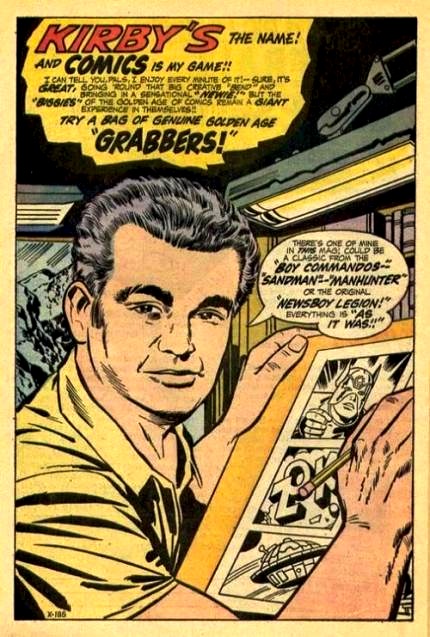
JackKirby_selfp

In my life, I have known about a dozen MacArthur “genius” grantees — generally, very noteworthy writers and performers whose names you would know. But I think that for range of vision, for sheer scope of work and for lasting influence, Jack Kirby, who was largely unrecognized as a genius during his life, tops them all.

I was very lucky to meet him, as well. Which I’ll get to in a minute. But first, on the 100th anniversary of his birth, I have to pay tribute to his genius.

To credit Jack Kirby as the (co-) creator of the entire foundation of the Marvel universe — and the resultant Marvel Cinematic Universe — is to lavish him with faint praise.

Jack Kirby created entire categories, and subcategories, of American popular culture, inculcating multi-billion-dollar enterprises along the way, while bringing new thrust to his special undertaking:  the dynamic depiction of story.

Yes, Jack Kirby created, or co-created:

  • Captain America
  • The Fantastic Four
  • Thor (Marvel Comics’ version)
  • Iron Man
  • The Hulk
  • The Fly
  • Spider-Man
  • Boy Commandos
  • The Newsboy Legion
  • Groot
  • The Inhumans
  • Black Panther
  • Doctor Doom
  • The X-Men
  • Darkseid
  • Kamandi
  • Ego the Living Planet
  • the Silver Surfer
  • Mr. Miracle
  • the Forever People
  • Ronan the Accuser
  • the Watcher
  • The Kree
  • The Skrulls
  • The Supreme Intelligence
  • The Challengers of the Unknown
  • The Eternals
  • The Celestials
  • The Avengers
  • and the list goes on and on

(And just for the record, and although I’m somewhat sad to bring this up, what did the far more glorified Stan Lee create without his primary creative partner, Jack Kirby? Just about nothing. Meanwhile, Kirby created noteworthy characters long before his partnership with Stan Lee, during his partnership with Stan Lee, and long after his partnership with Stan Lee. The only constant factor in this incredible 60-year outpouring of creativity was:  Jack Kirby.)

But Kirby also created:

  • Entire new mythological universes, as with “Thor,” and his “Fourth World” series
  • Kid-gang comics (“Boy Commandos,” “The Newsboy Legion”)
  • the entire genre of Romance comics
  • whole strata of the DC and Marvel Universes (both the upcoming Justice League and Avengers movies directly spin out of Kirby underpinnings)

Kirby also created new methods of illustrative storytelling.

He created Kirby krackle. Here’s an example of a layout without it, and with it.

Kirby Krackle

Once you know what it looks like, you’ll spot Kirby krackle everywhere. It brings energy to the panel.

Kirby also brought forced perspective to the page. Note how Captain America seems to be leaping out at us:

Kirby forced perspective

Kirby’s work hummed with action and virility. Compared to Kirby’s, most other comics artists’ work of the time just stood there.

(For a list of even more of Jack Kirby’s innovations, click here.)

When I was a boy, I was awestruck by Jack Kirby’s work. It is hard to remain awestruck about anything in one’s fifties, but I am still awestruck by Jack Kirby’s work. That’s why it’s all the more memorable to me that, at age 11, I got to meet Jack Kirby.

At age 11, I was someone who very much did not want to be living where he was:  out in the woods, far away from the thrum of Manhattan. In Manhattan, it seemed, one could run into Doctor Strange or the Human Torch or Daredevil out on the street, because in Marvel Comics these heroes were on every street corner — recognizable street corners. Over in the pallid land of DC Comics, things happened in “Smallville” or “Gotham City” or “Metropolis” or “Coast City” — places that didn’t exist on any map. But with Marvel, it looked like you could go to the Upper West Side and walk right past Avengers Mansion. That, plus the interconnectedness of their comics, lent Marvel its verisimilitude, its uncanny shimmer that made everything seem so possible.

What I especially loved about Marvel was Kirby’s primary triumph (with Stan Lee, who provided dialogue), “Fantastic Four.” The Fantastic Four were not superheroes. Superheroes confront arch-villains, evildoers and ne’er-do-wells. The Fantastic Four were primarily science explorers (modeled after Kirby’s previous creation, The Challengers of the Unknown); as such, they explored outer space, inner space, alternate dimensions, the past, the future, and the limits of human cognition, meeting different races and different beliefs all along the way and expressing the very best of the human race in a meeting of the minds. Sometimes they did battle on behalf of their (our) beliefs — but frequently they found common cause with strange and outwardly alien people of all types.

And that’s what I wanted to do:  to get out of the woods, to meet new people and different viewpoints, to exchange ideas, and to advance together.

Maybe it’s naive, but that’s still what I want to do.

So, you see, Jack Kirby shaped my life.

But when I was 11, I was just amazed to see him in person. It was like seeing Leonardo da Vinci or Abraham Lincoln or Jesus Christ or some other enormously great historical figure in the flesh. How was it even possible?

That July, just a week-and-a-half before my 12th birthday, my father took me to the 1974 New York Comic Art Convention; this was an incredible gift, which I’m still grateful for, 25 years after his death. And there, in some little room, back when comic-book conventions were far far smaller, I stood at the back of a line of maybe 10 people waiting to meet Jack Kirby.

Kirby was seated at the left of two folding tables, drawing sketches and signing autographs and chatting with whoever was next in line. To his left (my right) was his longtime inker on “Fantastic Four,” Joe Sinnott. (Mr. Sinnott, aged 90, is still with us.) Although Kirby by this point had left Marvel for DC, and I had read some of those DC comics, I was still completely enamored with “Fantastic Four” — as was seemingly every person in line ahead of me. One by one, each of them remarked upon “Fantastic Four.”

But I didn’t want to be like them. Who would want to approach the godhead and seem like just another supplicant?

So, when it was finally my turn to approach the great man, I said with as much of a squeak as I could register, in something like a high-pitched mumble filled with nervous anxiety, “I really like your work on ‘The Avengers.’ ”

Now, for the record, Kirby’s work on “The Avengers,” while displaying the same dynamism he brought to pretty much everything, was nowhere near on a par with his work on “Fantastic Four.” And I knew this. I said this only to be different. At age 11, and small in stature and frame and tiny in self-confidence in front of Kirby in particular, it was, in retrospect from 40 years later, a little brave for me to say:  “I really like your work on ‘The Avengers.’ ”

To which Jack Kirby replied, “What?”

At age 57, he hadn’t quite heard what my pipsqueak voice had said.

Fully intimidated to be in his presence, I couldn’t even bring myself to look up and see the great man sitting eight inches in front of me. I just trembled and managed to say in a quaking voice, “Oh, never mind” and stood quaking as Kirby signed an autograph for me.

I am not exaggerating this encounter.

And I have never again been so intimidated in my life. Not because of him — he was eminently approachable — but because of what he signified:  everything that was important to me.

Joe Sinnott, God bless him, saw my extreme mortification and called me over and drew for me a full sketch of the Thing, a member of the Fantastic Four, and wrote my name and signed it and I cherish it to this day and am still struck by his monumental kindness.

I got to meet Jack Kirby twice after that, many years afterward, after I moved to Los Angeles in 1988 and started attending the San Diego Comic Con (now Comic-Con International), where he was an adored guest and fixture. He was a very nice man, and, honest to God, a genius. And, it must be said, he was a true entertainer — someone who filled countless hours of my life then and now with enjoyment. I think Kirby viewed himself as a cartoonist, but when you look at the panoply of his work you see that he was much more than that. As much as Homer or J.R.R. Tolkein, or any other noteworthy fantasist, and moreso than most of them, Jack Kirby was a world builder.

And because he was also a progressive and an optimist, he helped build in me an ongoing thirst for a better world.

I’m in his debt.


Out of focus

August 24th, 2017

The irony of Evernote sending me this email may be lost on them. (As is the irony of my taking the time to post it here.)

And no, I didn’t read more.

Avoid focus-stealing traps: Four tips for improving concentration
Between phone alerts, social media, and tasks competing for our attention, we’re in a constant state of distraction. How can we stay focused? Read more about how focus works and get tips for maintaining concentration.

How the Millennials are killing Applebee’s and 18 other familiar things

August 23rd, 2017

I have no great love for Applebee’s (but I’d take it over the local Big Boy) — and neither do the Millennials. According to this article, their “psychological scar” resulting from the Great Recession has them attacking all sorts of formerly favorite American hangouts and activities.

Either that, or — and this is my theory — they’re so stressed for money due to their underemployment and relative low pay that, no, they can’t go hit the golf course.

A third theory:  Maybe they just need some Irish to straighten them out.