“Literary fiction in crisis as sales drop dramatically,” the headline reads. And that’s in England, which is theoretically filled with readers.
The story in The Guardian, which you can read here, posits that part of the decline is due to free, easy, readily available entertainment in the form of Candy Crush. I know this to be true. Someone I’m close to has, throughout her life, been an inveterate reader; now, though, she’s always “feeding her chickens” on some digital farming game on her iPad. I understand the temptation. A couple of weeks ago on a day during a particularly draining spell of flying around the country on brief trips; being over-scheduled here, there, and everywhere; and getting pulled in multiple directions simultaneously by the necessities of career, family, writing and more, and feeling that I couldn’t read another paragraph of anything or write another word of anything else, let alone think straight, I hopped on Amazon.com and bought myself a PlayStation 4 and a copy of “The Last of Us” and spent two blissful worry-free weeks shepherding a digital young girl through the post-apocalyptic zombie wasteland. Since then, I’m navigating another post-apocalyptic scenario courtesy of “Fallout 4.”
At the same time, somewhere in there, I did read two novels, what the The Guardian would call “literary” but which I call “novels,” or “fiction,” both of them debuts by former graduate writing students of mine at USC. I knew they both could write, and given that both books were from major publishers, I assumed they were good. What (pleasantly) surprised me was how good they both were.
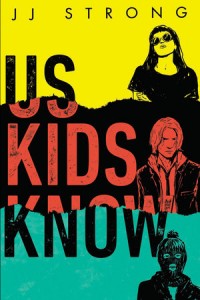 I found JJ Strong’s “Us Kids Know,” about three teenagers in post-9/11 New Jersey getting deeply into bad trouble, unputdownable. While always advancing the plot, JJ alternates each chapter from a differing point of view from one of the three protagonists — a device I first encounter in Philip K. Dick’s “The Confessions of a Crap Artist,” the only one of his mainstream novels worth reading, and a book I recommend wholeheartedly and frequently; the net effect is to constantly keep you reading a bit further because you want to see what’s next, and because you want to get back into a previous character’s voice. It’s a sly form of plotting, and incredibly suspenseful. When I was an undergrad studying writing, a long long time ago, my writing professor said to me, “Suspense is cheap” — but having read many writers who have no clue how to create suspense, I’d say that suspense is valuable; you may not always know you need it, but when you don’t find it in something you’re reading, you sure know it’s not there. (Besides, I can’t help throwing in that that professor was a poet — so what would he know about this?) My recommendation to JJ, and this is a serious recommendation, is this: I encourage him to write a literary horror novel. Stephen King can write suspense, but not literature (the proof I offer of his awful, clunking, lurching writing, can be found here); while any number of major literary writers can write well, but without suspense. (T.C. Boyle being an exception.) Imagine a well-written, beautifully evocative horror novel that keeps you on the edge of your seat and features characters whose entire personality isn’t summed by a King-like quirk like, say, the big killer Indian chief collecting shoes. (That would be King’s “Firestarter,” which was even more ludicrous than most of the rest of them.) JJ Strong is the man to write that novel (and rake in the sales, The Guardian be damned).
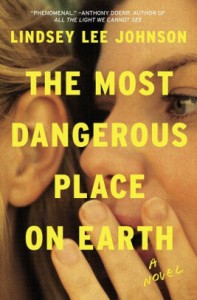 The other novel I just completed, on the flight back from Portland on Sunday, “The Most Dangerous Place on Earth” by Lindsey Lee Johnson, follows a group of students and an idealistic new teacher through high school. Filled with penetrating insights into what in untalented hands would be archetypes — the hippie chick; the striving Asian kid; the handsome jock; the beautiful but aloof girl; and more — the novel builds into an emotionally devastating conclusion, leaving all of us glad to no longer be in high school. While I don’t think I learned anything additional about why I so completely hated high school — the forced regimen; the bad teachers; the sense that I was in the wrong place for me and at the wrong time, when I could be learning a lot more in some other way at some other place — I did learn a great deal about student behavior these days, and about what it might be like to be the beautiful girl who doesn’t want attention and doesn’t seek it but who is misunderstood as being an aloof bitch, or the poor dullard whom teachers view as a menace to teaching and everyone knows to be a troublemaker but who finds out far too late that others will actually have a future, and are planning around it, and that those others will soon be leaving him behind, and that, already, his life will be going nowhere rewarding. Somewhat like JJ’s book, chapters are told from alternating perspectives, but here each plausibly could stand alone as a short story; (tenuously) like “The Canterbury Tales,” these are standalones that add up to a whole, with an arc.
“The Last of Us” and “Fallout 4” are incredibly diverting and entertaining. But I haven’t learned anything from them — except, perhaps, the bad lesson that ultimately global nuclear war isn’t so bad, because our species survives, just in degraded situations and without cable TV. (I prefer to think that global annihilation means global annihilation, and we’re better off just avoiding it.) These novels, on the other hand, are incredibly diverting and entertaining — and illuminating as well. They’ve made me feel in a different way. While I think all day long and generally in the middle of the night, too — it’s impossible to turn off — feeling is different; so much of everyone’s day is spent in so much rote behavior that it can be hard to feel something. That’s a gift that literary novels provide. Some of us will always understand that. Others never will. (And maybe they turn to music for the same sensation, or movies, or art, or food, or drugs. I like all of those too (if the “drug” is cigars or bourbon). )
There will always be some sort of market for literary fiction. I say this with authority, because the art I express is mostly in the theatre, and that’s a form that’s been written off as dead or dying for millennia now. But I saw a new play just recently, I’m writing one myself, and I’m directing one now. It’s scheduled to open in January. And I’m ready to start reading another novel.