The good ol’ red, gray, and blue
March 24th, 2007Over at Newsweak, a rabbi discourses on the demise of Captain America and gets it almost entirely wrong:
Captain America was created by Joe Simon in 1941 as a fictional ally in the war against Hitler and Nazi fascism. In the most recent issue, Cap was gunned down in New York City after 65 years of fighting for freedom and the American way of life. Pop culture mavens said that Cap’s death symbolized the death of the American passion for freedom and of the kind of heroes who give their lives in its defense.
This particular maven said something different: that Cap’s demise ipso facto symbolized the demise of the American symbol of freedom, one it wasn’t clear we deserved any more.
Rabbi Marc Gellman continues:
It’s obvious to me that movies and comic books can make this case better than any subtle novel and more authentically than any spin-tested political speech. Comic books, and the graphic novels that evolved from them, are about the struggle of good against evil. Other art forms can make the claim that everything is gray, nothing is true, and nothing eternal. Of course these latter claims may be right, but if they are, then the age of heroes is over and both Cap and Leonides are really dead.
It may be “obvious” to him that comic books reflect a dualistic morality, but as someone who has actually read a comic book at some point since 1941 (including just last night), I can say he’s wrong. (Which is not an uncommon reaction from me when religious leaders say something is “obvious.”) As we discussed here just recently, comic books post-Watergate have indeed become more and more gray. The conflicting necessities of doing right in a world without good choices — precisely contra the Manichaeian belief system Gellman thinks pervades comic books — was the entire subtext of the Civil War storyline.
Finally, Gellman opines:
Embracing the need to spiritually justify the fight for world freedom carries its own perils. Chief among these dangers is what we now see in the world of Islamic fascism: the use of religion to extol death and tyranny. The biblical name for this is idolatry, and the seductions of idolatry are hard for some to resist. In the end, though, the spiritual truth of freedom’s cause is eventually clear to all.
Although he’s right that we “now” see the danger in Islamic fascism, when it comes to the misuse of religions that seek to create utopia (here or hereafter), I suggest the rabbi dig into some 20th century history. Or Medieval history. Or the history of the Crusades. Or of the Holy Roman Empire. Because this “use of religion to extol death and tyranny” is not precisely a new thing. The Founders of this nation were right that people yearn for freedom (even though they were unable at the founding to grant it to all). They were also right to recognize that when left unchecked man is a morally bankrupt creature and that the freest form of religious practice is for the state to have no attachment to religion.
Where could one find some of the themes I’m talking about? Throughout comic books post-9/11. I just wish that media critics, either religious or not, who choose to write knowingly about comic books would show some evidence that they had actually read any.
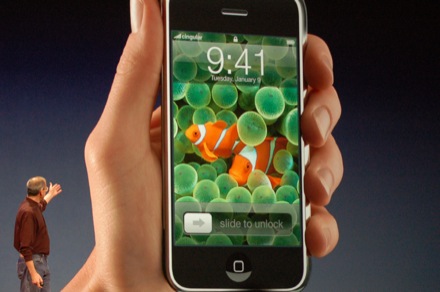
 Every day it becomes more clear that I should not have sold that Apple stock a couple of years ago. If anything, I should have sold it now so I could buy the new Apple products I want.
 As I
As I 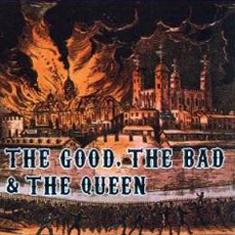
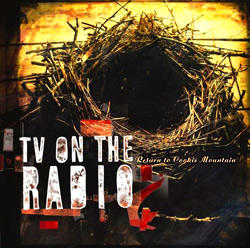 “Return to Cookie Mountain” by TV on the Radio. If “The Good, the Bad, the Queen” is a creepy clown acid trip, this album is the soundtrack to that post-apocalyptic Cormac McCarthy novel I keep talking up. I’m so taken with “Wolf Like Me,” which I had heard all of twice, that I had a dream in which I was listening to it; I guess it made an impression. I saw this band two years ago when they opened for Franz Ferdinand at the Greek, and at the time I thought this was quite possibly the worst band I’d ever seen (a distinction soon achieved by The Polyphonic Spree, who opened for Brian Wilson and who were loudly and justly hooted and laughed at by whole sections of the Hollywood Bowl). I couldn’t imagine the raves they’d earned from people like David Bowie, whose opinion always counts. Even while I thought TV on the Radio was bad, very bad, I also could see that they had probably alienated some very key people at the Greek, i.e., the people working lights and sound, because they were mostly unlit and had a sound mix so bad I felt we were listening to a band playing underwater and on a distant planet. Listening to this record proves once again that Mr. Bowie is wise in all things.
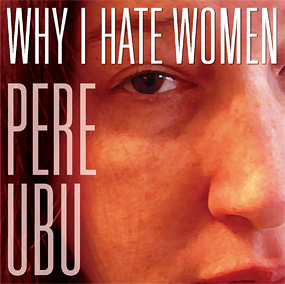 While Pere Ubu is in no way a new band, “Why I Hate Women” is a new album by a band that continues to change. At times I find myself wondering if this may not be the best album in their 30-year history. They actually pull off what amounts to a blues song with “Blue Velvet,” featuring a haunting harmonica turn by Robert Kidney (The Numbers Band, the Golden Palominos). That song is bracketed by the atmospheric small-town ghost story of “Babylonian Warehouses” and the teenage raveup “Caroleen”; together these become a mini-suite probably never equaled in the history of the band. The rest of the album, especially “Love Song,” is just a strong. Vocalist David Thomas assays the neurotic subconscious of lost people on empty roads, but it is Robert Wheeler, playing theremin and synthesizers, whose sonic architectures evoke alien landscapes rarely explored.
 Playwriting should be – needs to be – freeing. The act of writing a play frees playwrights, through their characters, to explore issues and ideas however they see fit: to see where they take us, to look at things in a new light, to find out what we think and to learn what we don’t know. This is a gift we pass on to the audience. Being free in your writing is a prerequisite to writing.
 And playwriting should be fun. This is the other reason that rules are to be understood but rejected: They usually stand in the way of the creative impulse, of the fun. If you’re having no fun writing your play, imagine how little fun actors are going to have acting in it and audiences are going to have seeing it. By “fun,” I don’t mean comic (although if you’re writing a comedy, it’s generally a good thing if at least you think it’s funny). I mean: exciting. You get up in the morning eager to work on it and go to bed feeling the same way. You think about it in odd moments. It colors your perceptions, as when you see someone in a supermarket berating a child and you realize that’s the way your protagonist would act. You feel truly alive when you’re writing the play and somewhat asleep when you aren’t. Fun is motivational. If everyone had more fun – if everyone were able to have more fun – the world would be a funner place.