Richard Jeni remembered
March 26th, 2007A nice piece in today’s LA Times about a remembrance for the comedian at The Laugh Factory.
A nice piece in today’s LA Times about a remembrance for the comedian at The Laugh Factory.
 I few months ago I was troubled by the bizarre Citibank ad campaign built around some master-slave relationship I didn’t quite understand.
Now I find that I can’t figure out why Lincoln and this… beaver?… are hanging out together. The online vid at theymissyou.com shows a drowsy insomniac lurching into his kitchen in the predawn hours to find Lincoln and this beaver awaiting him. “We’ve been expecting you,” Lincoln says as the beaver prepares to make a chess move.
Although this metamessage seems beyond one’s immediate grasp, I suspect that the subconscious grabs hold of it immediately. The beaver I think most of us would equate with nature’s most reliable sleep aid (what the French call “the little death”). Lincoln was kept awake many nights by the horrors of the Civil War and his own depression, although I wonder how many people associate him with that. Mostly, he probably means three things to most Americans:
I don’t think one sees Lincoln and thinks about insomnia, nor do I think one sees a beaver and thinks about insomnia. (Of course, prior to “The Shining,” I never thought of oral sex with a bear as a sign of madness.) When it comes to sleeplessness, most of us think of counting sheep. So (stovepipe) hats off to whoever came up with fresh imagery for this. And on a meta level, I am confident that anyone having neurotic dreams about Lincoln and a beaver playing games in one’s kitchen would gladly take a pill that would make it stop.
When I first stumbled across this little campaign in my local CVS drug store, I peeled off a coupon for further investigation. I’m ordinarily of the take-no-drug school of self-prescription; my mother’s cure for all ailments was a shot of whiskey and bedtime. But I was curious. I’ve been suffering from various forms of sleeplessness even before the Reagan Administration (to which I originally ascribed blame). According to the website, this pill is for those “who have trouble falling asleep.” That leaves me out; I can fall asleep just fine. It’s waking up 46 minutes later that makes me crazy. Not crazy enough to want to drug myself, but all bets would be off if I were seeing dead presidents and large rodents.
As they say in the movie trailers, “This time, it’s personal.” That’s because it’s about me.
Over at The Burbank Leader (owned by, you saw it coming, the LA Times), they’re reporting this story:
Burbank Democrats elect officers
The Burbank Democratic Club has selected its officers for the 2007 year. Club member Janet Reynolds was elected president and David Dobson was elected vice president.
Club secretary Larry Nemecek and treasurer Ken Ahern will retain their posts. Outgoing president Lee Wochner is taking a seat on the executive board.
Wochner and club member Dana Ragle will travel to the 2007 state Democratic Convention in April.
The club’s next meeting on March 28 at the Hill Street Café will feature former Assemblyman Dario Frommer, who will speak about his career and future plans. For more information, call (818) 288-2649.
Before this story ran, I sent an email to my fellow members of the executive board wondering what the Leader would get wrong and offering a few ideas. Well, I was way off-base; the Leader found a unique way to get far more wrong than I suggested. Here’s what they got wrong:
With regard to my election as delegate, I previously covered some of this ground here.
I show up in the media only occasionally and I don’t generally have time to correct the errors. (And by “errors,” I mean factual errors, not opinions. I mean verifiably erroneous reporting, the sort that should not be reported by reporters, or should be caught by editors or fact-checkers.) What must life be like if you’re an actual media presence? The Burbank Leader isn’t out to get me, they’ve just made mistakes; but what if you find yourself on the wrong side of The Drudge Report, or Fox News, or a producer at CNN or 60 Minutes? What must it feel like to wake up every morning and hear your name on the radio, on television, see it in newspapers and magazines, and feel to the core of your being that that is not you? And the only thing you have to back it up with is facts, and facts just aren’t that interesting any more.
11. That five minutes after you get it, the newer one will be out.
For nos. 1-10, click here.
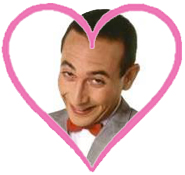 You might have thought that Pee-wee Herman was finished. But his recent splash at a nostalgia convention right here in Burbank is just part of a surprising comeback, as reported here in the LA Times. The print edition had a terrific photo of the 54-year-old Pee-wee, who has aged rather gracefully; unfortunately the photo isn’t online.
(And you’ll note, in typical Times fashion, that it takes six decidedly unclever paragraphs to get to the point.)
If or when the new Pee-wee Herman movie actually happens, the line to see it starts right here.
The LA Times’ Tim Rutten lauds the decision to kill the questionable edition of Opinion to have been guest-edited by Brian Grazer, which we talked about here. The gist of Rutten’s piece:
While I’ve been distressed by the paper’s various lapses, you can’t say they aren’t at least covering their own mistakes — and Rutten, the media critic, does a fine job. I know a number of people who work at the Times and everybody seems aware of the enormous problems within the paper. But what I haven’t heard — aside from wild outside schemes for making newspapers either non-profit or entirely digital partnerships — is a plan to fix them.
Over at Newsweak, a rabbi discourses on the demise of Captain America and gets it almost entirely wrong:
Captain America was created by Joe Simon in 1941 as a fictional ally in the war against Hitler and Nazi fascism. In the most recent issue, Cap was gunned down in New York City after 65 years of fighting for freedom and the American way of life. Pop culture mavens said that Cap’s death symbolized the death of the American passion for freedom and of the kind of heroes who give their lives in its defense.
This particular maven said something different: that Cap’s demise ipso facto symbolized the demise of the American symbol of freedom, one it wasn’t clear we deserved any more.
Rabbi Marc Gellman continues:
It’s obvious to me that movies and comic books can make this case better than any subtle novel and more authentically than any spin-tested political speech. Comic books, and the graphic novels that evolved from them, are about the struggle of good against evil. Other art forms can make the claim that everything is gray, nothing is true, and nothing eternal. Of course these latter claims may be right, but if they are, then the age of heroes is over and both Cap and Leonides are really dead.
It may be “obvious” to him that comic books reflect a dualistic morality, but as someone who has actually read a comic book at some point since 1941 (including just last night), I can say he’s wrong. (Which is not an uncommon reaction from me when religious leaders say something is “obvious.”) As we discussed here just recently, comic books post-Watergate have indeed become more and more gray. The conflicting necessities of doing right in a world without good choices — precisely contra the Manichaeian belief system Gellman thinks pervades comic books — was the entire subtext of the Civil War storyline.
Finally, Gellman opines:
Embracing the need to spiritually justify the fight for world freedom carries its own perils. Chief among these dangers is what we now see in the world of Islamic fascism: the use of religion to extol death and tyranny. The biblical name for this is idolatry, and the seductions of idolatry are hard for some to resist. In the end, though, the spiritual truth of freedom’s cause is eventually clear to all.
Although he’s right that we “now” see the danger in Islamic fascism, when it comes to the misuse of religions that seek to create utopia (here or hereafter), I suggest the rabbi dig into some 20th century history. Or Medieval history. Or the history of the Crusades. Or of the Holy Roman Empire. Because this “use of religion to extol death and tyranny” is not precisely a new thing. The Founders of this nation were right that people yearn for freedom (even though they were unable at the founding to grant it to all). They were also right to recognize that when left unchecked man is a morally bankrupt creature and that the freest form of religious practice is for the state to have no attachment to religion.
Where could one find some of the themes I’m talking about? Throughout comic books post-9/11. I just wish that media critics, either religious or not, who choose to write knowingly about comic books would show some evidence that they had actually read any.
Captain America is dead, but his legacy lives on.
Yesterday, the LA Times ran a front-page obit headlined “Milton Wexler: 1908-2000.” I thought, “Why is the Times profiling people who died seven years ago? What’s the news angle?” The lead channeled the quintesssenial New Yorker-type lead, i.e., you had no idea where you were or what the story was (it was an anecdote about the dead man’s wife, 40 years ago). The kicker on the jump page (A14) read, again, “Milton Wexler: 1908-2000.” Finally, in graf 5, I learned that Mr. Wexler had died on Friday.
Shout out to the LA Times: Guys, it’s 2007.
I understand that, well, this is a typo. But it’s on your front page. And if Mr. Wexler was indeed “a towering figure in disease research,” as you say, a man whose death warrants a front-page story, then I would assume that someone had read this story and at least the on-screen mockups before sending it to print. I also doubt this was a last-minute drop-in, given that the great man had perished almost a full week before.
And before I go on, let me state again: I love newspapers. This is why this is so distressing and why it seems I keep kicking the cripple.
This sad affair reminded me of the time that Allen Ginsberg died and the Times, on its front-page obit, misspelled his name. Rule number one of journalism: Get people’s names right.
In today’s Times the sad saga continues in a different way. The paper’s editor and its publisher killed a much-ballyhooed guest-edited opinion section scheduled to run this Sunday because they now decided that a perceived conflict of interest might exist; the would-have-been guest editor, film producer Brian Grazer, is represented by the publicity firm headed by the girlfriend of the Times’ heretofore opinion editor. Here’s the story, which covers the resignation of that editor, Andres Martinez, in response.
I’m not interested in the romantic lives of newspaper editors (various 1940’s screwball comedies be damned), but I am greatly interested in the health of newspapers, especially with regard to conflict of interest. The (Los Angeles) Daily News has what I call a “roll your own” section in which people online “report” their own “events,” with many of them selected for a special print edition delivered with the paper. (Which we also get.) I don’t want people reporting on themselves in what I can only imagine would be a relentlessly positive light. Even at this stage of the decline of newspapers I hold some hope that a true reporter would at least try to report objectively. (As part of full disclosure, the Daily News section editor called me no fewer than six times last year asking me to write pieces related to my own local political activity for the paper. I demurred. Would our political club have benefited from the coverage? Sure. But I was part of forming the club because I was distressed by the ethical breaches of various government officials; to me that precludes my involving the club itself in ethical breaches. Others may disagree and plan their own route; I stuck to my preferred path.)
With regard to the LA Times opinion-section story, I’m with the editor and the publisher on this one. The Times can’t afford even the perception of conflict of interest with the business community. It took the paper years to recover from the Staples “advertising section scandal,” in which advertorial was presented as editorial in a special section devoted utterly to the arena, in a deal that included profit sharing between a newspaper and a major advertiser (!). And actually, some of us would argue that the paper has never recovered.
Last September in Fast Company, a columnist extolled the virtues of newspapers and forecast a robust future, albeit in a different delivery format. (And I think that’s probably right, at least short-term.) In the current issue (no link available yet), someone lays out an entirely different prescription: public non-profit status.
Whatever is going to happen with newspapers, they aren’t going to much resemble what’s currently landing on my doorstep. Given the recent error-prone Los Angeles Times, that may be a good thing. Or it may just be far, far worse.
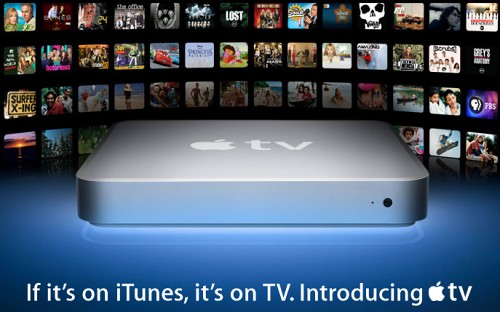 Every day it becomes more clear that I should not have sold that Apple stock a couple of years ago. If anything, I should have sold it now so I could buy the new Apple products I want.
I don’t think of myself as a true gizmo hound (although I did have a home computer in 1980, and was on the Internet very early, and was an early adopter of first the Handspring Visor, then the Visorphone, then the Treo). No, it’s that I like useful gizmos that help me with information exchange (communication), because that underlies every single bit of what I do, professionally and personally. I am scheduled to the max, and my Treo helps me handle that. My wireless card (and/or Treo) allow me to get email most places I need to. Synching to .Mac allows me, potentially, to access backups from anywhere in the world. Could I have survived without these things even 10 years ago, let alone in Chaucer’s time? Sure. But now I don’t have to.
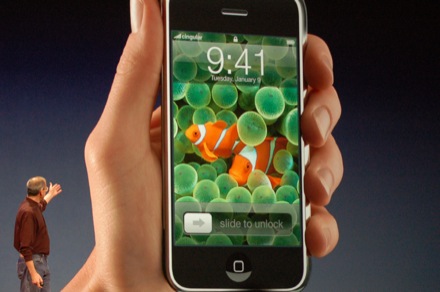 As I shared here previously, I greatly covet the iPhone. The Treo was state of the art; now, by comparison, the iPhone is a Lamborghini and the Treo is a Chevy Aveo. But the Treo does get the job done, at least for the moment. So maybe what I really want first is:
The iTV (or Apple TV). Why? Because I am indeed one of those guys with a bigscreen TV who finds himself all too often huddled over a 15″ laptop screen watching video. Sometimes it’s downloaded from iTunes, sometimes it’s streamed (as from CBS.com, where for some inexplicable reason I continue to watch “Jericho”), sometimes it’s made and edited by me myself with my Canon digital camcorder. Wouldn’t it be better to just beam it via the iTV to the large flatscreen, for the enjoyment of all in the household? (Especially when it’s a movie of my short play, or a movie of a speech or presentation I just gave? What could be more entertaining on the large screen?)
I’m not the only one pondering the calculation of iPhone or Apple TV (assuming one is not going to buy both, which this one is not, at least not right away). Over on Macworld, they’re wondering which will go over bigger. (And just 10 years ago, this was not the question on analysts’ minds; the question was when would Apple be going out of business.)