Hope you’ve already got your Comic-Con 4-day pass…
July 15th, 2007…because as this story makes clear, they’re sold out!
My son’s immediate reaction: “You mean it’s going to be more crowded?!?!?”
…because as this story makes clear, they’re sold out!
My son’s immediate reaction: “You mean it’s going to be more crowded?!?!?”
If you aren’t already alarmed by the monarchical overreach of the Bush/Cheney White House, visit this site and watch the video. It’s from Friday night’s episode of “Bill Moyers’ Journal” and features a conservative Republican and a liberal (and Democrat, I guess) jointly making a very strong case for impeaching Bush and Cheney. Their main thrust is not the malfeasance of the Bush Administration — evidence of which seems, well, unimpeachable. No, their main thrust is that we need to pursue impeachment now before this Pandora’s Box of limitless presidential power is passed on to someone else on January 20, 2009 and the idea of the unfettered executive becomes forever inculcated in our fragile democracy.
Watergate? The Gulf of Tonkin resolution? Errant fellatio and subsequent perjury? These were mere warmup acts. Watch the video and see if you don’t think the nation is threatened as never before.
And who, surprisingly, is newly culpable? Speaker of the House Nancy Pelosi, who has said impeachment is “off the table.” As one of the guests says, Nancy Pelosi is wrong and doesn’t understand her job.
We need to start by agitating her into action. Today.
As related here, I’ve been having a delightful time recently with oral surgery. But just now I had two new frights at the surgeon’s office.
The head of Homeland Security was quoted yesterday as saying that he had “a gut feeling” that we were about to be attacked by terrorists. And for all we know, he may wind up being right. But his comment in no way makes me feel better:
So after all our expenditures on Homeland Security, and all the civil liberties we’ve lost, and the deep damage to habeas corpus and due process and our international reputation, this is what we’ve got? A gut feeling? My gut tells me this is not enough.
 In this week’s New Yorker, Hendrik Hertzberg does a good job of summing up in a few short paragraphs what I was wrangling over at length the other day: the malfeasance of this administration, most especially its main perpetrator, the wrongfully appointed Dick Cheney.
The San Diego Comic-Con is almost here, so you’re going to want to plan accordingly. Here’s a sneak peak of the Con’s events, which you should study closely. (Elsewise you risk getting crushed in the mass of humanoids trying to get into Hall H at the last moment.)
The list of offenses by George W. Bush and his sneering co-conspirator that qualify as “high crimes and misdemeanors” — and therefore merit charges of impeachment — is so long that if I detailed them here we might indeed finally hit a sign that says “Internet ends here.” So let’s just deal with one that, while I know it’s been exhausted elsewhere recently, I have to cover for just a moment to get off my chest.
Being connected to the outing of one of our own spies has to qualify as treason. Our spies are, well, ours. Ideally, spies gather intelligence that helps fend off the threat of war. But of course, that wasn’t what was wanted here — in fact, what was wanted was quite the opposite, at all costs. And so, to silence our spy’s husband, our spy was outed. By her own government.
I don’t put anything past Bush/Cheney, which is one reason I view askance the pony race of the presidential campaign in progress: I’m not sure these people are stepping down. I’m predicting “a national emergency” that requires them to stay in power. In college when we played a lot of the board game Risk, one of our friends would always maneuver with others to attack this country or that, saying that it was “for the good of the game.” But we knew that it really wasn’t for the good of everyone in the game; it was for the good of his vested interest in winning the game. No one was fooled. I’m predicting that this “national emergency” will be “for the good of the game. “What I don’t know is whether or not we’ll be fooled. (If the past is prelude to the present, then probably so.)
Since I don’t blame Bush/Cheney, given that it’s the scorpion’s nature to sting, I blame a media that did things like focus on Al Gore’s sighs in the 2000 debates (and don’t those sighs look appealing now), and a Supreme Court that overturned all jurisprudence to install an illicit regime. Re the media, this piece right here from Newsweak is what has prompted this posting. It details Bush’s “process,” such as it was, to commute the sentence of Scooter Libby, one of those guys involved with jeopardizing our spy’s life while she was doing things like serving the country.
Here’s a telling paragraph:
Behind the scenes, Bush was intensely focused on the matter, say two White House advisers who were briefed on the deliberations, but who asked not to be identified talking about sensitive matters. Bush asked Fred Fielding, his discreet White House counsel, to collect information on the case. Fielding, anticipating the Libby issue would be on his plate, had been gathering material for some time, including key trial transcripts. Uncharacteristically, Bush himself delved into the details. He was especially keen to know if there was compelling evidence that might contradict the jury’s verdict that Libby had lied to a federal grand jury about when—and from whom—he learned the identity of Valerie Plame Wilson, wife of Iraq War critic Joe Wilson. But Fielding, one of the advisers tells NEWSWEEK, reluctantly concluded that the jury had reached a reasonable verdict: the evidence was strong that Libby testified falsely about his role in the leak.
So the Administration’s own person concluded that the jury was right. And Bush himself was “uncharacteristically” consumed with details (his more characteristic responses having been well on display during 9/11 and Hurricane Katrina). (I guess when it comes directly through his own door, it’s important. If we’re ever attacked by Martians or zombies, we can only hope they hit the Oval Office first so that there’s a response.) Then, in the piece in Newsweak, we get this:
The president was conflicted. He hated the idea that a loyal aide would serve time. Hanging over his deliberations was Cheney, who had said he was “very disappointed” with the jury’s verdict. Cheney did not directly weigh in with Fielding, but nobody involved had any doubt where he stood. “I’m not sure Bush had a choice,” says one of the advisers. “If he didn’t act, it would have caused a fracture with the vice president.”
Newsweak just about gives the most disturbing aspect of this a pass: Although the aide found that the jury had reached the proper — and reasonable — verdict, because Bush “hated the idea that a loyal aide would serve time,” and because he didn’t want to risk pissing off Dick Cheney, he commuted the sentence.
So here’s my question:
Is this a nation or laws, or not?
Because if laws can be ignored because we “hate the idea” of some of them, then we’re in for an even worse time when more people start to notice this. But hey, why not, when you can act this way:
Internet ends here.
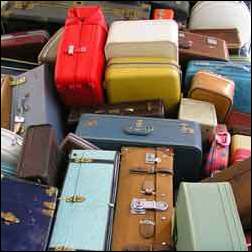 My luggage arrived last night just before midnight, or almost a day and a half late. I had arranged with the manager of the Men’s Wearhouse here in Cleveland that if it didn’t arrive by midnight, I would be on his doorstep bright and early the next a.m. and he personally would fit me and get my new purchases tailored in time for the wedding and in preparation of my pursuing Southworst Airlines for the full amount. Now that won’t be necessary.
When the bag was first missing, I said to my son and to the first of the four baggage mishandling agents I dealt with, “I think someone else took it by accident.” My son agreed — it is, after all, a rectangular black roller bag, one of about 900 that rolled off our plane — but the baggage mishandlers didn’t think that was plausible. I think the reason for their skepticism is this: this would be akin to admitting a different form of fault, because while claim tickets are issued for each piece of luggage you check, no one checks them against the baggage before handing them out. Why not? To expedite the process — and save money. We all like low-cost airfare, so to some degree we’re all culpable for this situation, but given that I’ve had a baggage problem twice in a row now I’m starting to think I wouldn’t mind a small surcharge. (Either that, or eliminate the ridiculous fear-mongering Bush/Cheney-originated dictum that one can’t travel with more than 3 oz. of liquid or lotion, which is what forced me into checking a bag in the first place.) Last night, after setting forth a plan of action for myself (if no luggage by midnight, then new wardrobe in the morning) and therefore feeling empowered and therefore feeling better, a helpful Southworst baggage agent named Jennifer left me a voicemail saying that my bag had been found and would be delivered. What had been the problem? While they were theoretically scouring the system from Fairbanks to Freeport looking for one of a jillion black roller bags, a “confused elderly lady” took mine by accident and had just returned it. In other words, precisely what I had said in the first place. The bag arrived and I opened it for inspection, wondering if the confused elderly lady had picked through my frillies. My son wondered if there would be “old lady smell.” (He’s 16.) Everything seemed fine, and we enjoyed the remainder of our evening in downtown Cleveland and made arrangements to join my brother and his family and my 82-year-old mother and the rest of our family this morning.
Then my brother called, about 40 minutes ago. My mother’s plane had arrived. But the airline lost her luggage.
The wedding’s tomorrow.
And of course they lost my luggage.
So it’s the worst of both worlds: Not only am I in Cleveland for 5 days, I’m there with no luggage.