The Edward Albee resurgence first begun with “Three Tall Women” continues, as recounted in this fine piece recently in the New York Times. If I do go back east to go duck hunting in January, I can try to catch “Me, Myself, and I” at the McCarter; while in Philadelphia around May for the aforementioned Bill Irwin show, I can try to add in “Occupant” at the Signature in New York. (I’m afraid to see “Peter and Jerry,” the prequel/sequel to “The Zoo Story,” afraid because I don’t want “The Zoo Story” ruined for me — it’s played too large a role in my life.)
Albee is an ongoing inspiration and I’m glad the theatre and its patrons have embraced him back. In the 1980’s he was decidedly out of fashion. I will never forget the infamous cover of New York magazine with a photo of Albee emblazoned with the legend “Edward Albee: Should he quit?” I don’t think the Nazis treated Brecht this badly.
Three years after losing an election that should have been his, John Kerry has decided to refute the “Swift Boat” allegations and to make T. Boone Pickens, one of the funders of the smear campaign, pay for it personally. Here’s the full story.
My question is the obvious one: With a response time like this, how did Kerry ever win a Senate seat?
And yes, I spent a weekend in Arizona in 2004 with Democratic activists as well as my son Lex campaigning door-to-door for Kerry. He lost there, too. I wouldn’t be surprised if he’s now considering doing some door-knocking there this Sunday.
I hope he proves his case to Pickens, but I’m not holding out much hope. It’s hard to convince anyone of anything they don’t want to believe; it’s got to be even harder with rich Republican activists from Texas.
Bill Irwin’s upcoming new show, The Happiness Lecture, premieres this spring at Philadelphia Theatre Company in, well, Philadelphia. Click here for information and tickets. Not only must I see this, I must round up appropriate friends (Rich? Joe? Paul?) who will appreciate the show with me. Yes, this will entail going from Los Angeles to Philadelphia expressly to see the show, as well as returning thereafter, but some things should not be missed. If I can’t see Buster Keaton live (although I hope to see him some day while dead), at least I can see Bill Irwin.
I have seen Mr. Irwin perform live twice before, in the delightful “Fool Moon” last decade at the Doolittle in Hollywood, and early this year in the decidedly undelightful and unforgettable “Who’s Afraid of Virgina Woolf” at the Ahmanson, which I complained about here. (I continue to believe that production may have forever ruined the play for me, so no, I’m not going to forget it.) It will be a pleasure to see Mr. Irwin back in his element: comically deconstructing existence. At least, I hope that’s what it’s going to be, especially given that it’s going to cost me a cross-country trip to find out.
Buster Keaton didn’t like them (although he wound up working for them), but I love The Three Stooges. No, they do not deliver the comic existentialism of the master or of his disciple (Samuel Beckett). But for comic menace and anarchy, no one tops the Stooges. (And surely, anyone who has had to deal with an unruly child can sympathize with Moe’s handling of Curly.)
If you’re in LA, next weekend’s your opportunity to see the Stooges at their biggest: on a big screen. Their act was built on the stage, which means their malevolence was delivered the old-fashioned way: in person, and minus special effects. Technology has given the film industry innumerable new toys, but it has also taken away the pleasure of knowing that Keaton could break his neck (as he once did), that Harold Lloyd was indeed hanging from a clock (and lost part of his hand in a filmed explosion), and that when Moe misjudged, Larry did get his eyes poked. Comedy is attached to pain; visceral thrills are associated with danger. I don’t want performers getting hurt, but it’s hard to muster much concern or astonishment when CGI replaces human beings.
…because I seem to have missed the Los Angeles stop of the “Zappa Plays Zappa” tour, dammit! Not sure how I didn’t hear about this in time, but… argh! And as if having one of my students say in passing, “That was a good show,” wasn’t bad enough, now I get this report from Rich Roesberg of an event I very much would have liked to see:
My son Justin treated me to a concert tonight, Dweezil Zappa playing his late father’s music, appropriately called ZAPPA PLAYS ZAPPA. It was at the House of Blues inside the Showboat Casino. We got there and Justin asked me if someone he saw was ‘that friend of yours’. Sure enough it was my pal Micky, who is one of the heads of security at the HOB. He asked us if we had general admission tickets and, when we admitted that was all we had, he took us upstairs in the private elevator and put us in the preferable balcony area. Comfortable seats plus great view and acoustics.
The band came on promptly at eight. There were eight players, including vocalist/guitarist Ray White, who had played with Frank Zappa. The group jumped into an early FZ tune. Justin and I had the same thought. Were they only going to play the more accessible songs? Nope. They were soon displaying amazing musicianship on complex FZ pieces like Zoot Allures and G-Spot Tornado. Before performing Dupree’s Paradise, Dweezil explained that it involved a lot of improvisation. He also got a pair of audience members to contribute one word each, to be used later in the number. The words were ‘fabulous’ and ‘time’. Each member of the band got to take a solo, all of which were excellent. Then Dweezil announced that he had decided the contributed words were to be used in an improvised story about a school bully. Ray White made up a song concerning the bully, who had a ‘fabulous time’ beating him up. It became perversely suggestive.
There were video screens above the stage. For three songs they showed footage of FZ. In two of them there were audio tracks of FZ’s guitar playing, and on the other his vocal. The band backed up these recorded performances and, in one case, Dweezil played responses to his father’s guitar work. The entire show was very well paced, with vocal selections balanced against longer instrumentals. The elder Zappa’s humor was intact. Dweezil performed his own version of FZ’s technique of ‘conducting’ the band with hand signals. Best of all, the younger Zappa has developed his guitar skills until they compare favorably to his father’s. Except for plenty of noisy drunks in the audience, fueled by the drinks available inside the club, it was a fine two-and-a-half hour performance. Anybody who appreciates FZ’s music should definitely try to catch this concert if it plays anywhere near you.
Zoot allures! Given that Dweezil is famously a valley guy, this has got to be coming back to my neck of the woods. Let’s hope so.
I guess I’m glad that my good friend Doug Hackney had corrective surgery to his eyes. Doug’s always been a visionary, and we wouldn’t want to lose that.
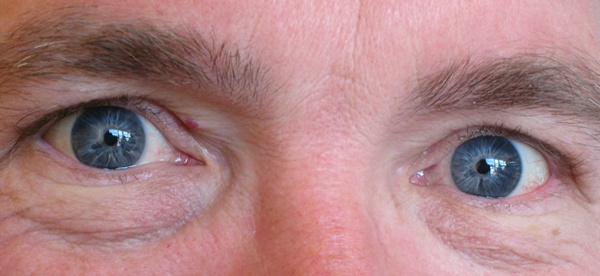
But describing the procedure at length — and including photos of every gruesome up-close eye-scraping and incision, as you can read here if you’re of strong stomach — brought to mind what we in comics fandom call “injury to eye motif.” Here are some sterling examples:
These comics are highly collectible, and I think we can see why: They prey on one of our deepest fears. And although Doug sadly knows little or nothing about comic books, I think he understands the collective subconscious as well as anyone. Why else tease us with a close-up of his visage looking like something straight out of “X, the Man with X-Ray Eyes?” And who could possibly read his story and look at the photos without flinching? No one. Because seeing is believing.
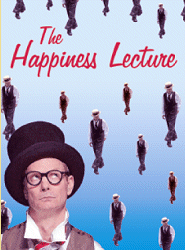 Bill Irwin’s upcoming new show, The Happiness Lecture, premieres this spring at Philadelphia Theatre Company in, well, Philadelphia.