Lee Wochner: Writer. Director. Writing instructor. Thinker about things.


Blog

Best promotional item ever?

June 1st, 2008

I have an Obama bobblehead on my desk. Now I’ve found a wonderful companion piece, if only I could get my hands on it:  this promo piece for the Saint Paul Saints, which depicts some of the prominent parts of Larry Craig in his most famous public works project.

Anyone know how I can get one of these? My birthday is in July.

The (ideal) human condition

May 31st, 2008

Remember this post the other day, in which the lovely and incredibly helpful Shanda Clark, project coordinator for the Great Plains Theatre Conference, drives me to a television taping I’m unaware will star myself? In that post, I also mentioned that she picked me just after I’d gotten a promising report on my little boy, who had been briefly hospitalized with a truly upsetting autoimmune deficiency. I shared a little about that with her in the brief car ride.

The next morning when I opened the door, there was a package sitting there in the hallway on the floor. A white gift box tied with an attractive red ribbon bore a card from Shanda and the message, “Hi Lee, Just thinking of your family… and thought your boy would enjoy this when you arrive home. Shanda.” And inside were a rubber dinosaur, some playdoh, and a children’s art kit. I shared something about my son in passing, and she responded in this way for a little boy she’s never met, and for his father who, mere days before, had been a complete stranger. I was moved by this heartfelt gesture.

When I’ve been brought into retreats and conferences like this in the past and been well-treated, I’ve half-joked that “they treated me the way everyone should have to treat me.” This conference has gone one better: They’ve treated everyone the way we should all treat each other. The graciousness shown here has been nothing short of astounding. (Which, tomorrow when I’m not rushing off for final-evening cigars and drinks, will take me to the subject of playwright Doug Wright, perhaps the most gracious highly accomplished person anyone will ever meet.)

Today’s political prediction

May 31st, 2008

Now that the fate of the Florida and Michigan delegations have been decided, with Hillary Clinton picking up 24 delegates but nowhere near enough to ever close the gap with Barack Obama, she will continue through the final primaries this Tuesday. Then, within a week, she will fold her tent and begin repairing her image with certain segments of the Democratic party.

I make this prediction for three reasons:

  1. She must go on, because she has proclaimed her desire for the party of “count every vote.” (Even though her long-ago plan was to effectively seal up the nomination within the first six weeks, therefore rendering meaningless all the ensuing votes. Have I menioned “hubris” here in connection with the Clintons? I think I have.)
  2. There is simply no scenario whereby she can gain enough delegates to take the nomination, even if a chunk of Mars were to crash through the atmosphere and cave in Obama’s skull. He’d still have more delegates.
  3. To go further than a week after the final primary would truly anger the party and all its activists and foreshorten her political future.

So:  By June 10th, she’ll be out. Unless, that is, she’s crazy. Given that she’s running for president, that shouldn’t be ruled out.

Sound communication

May 30th, 2008

Marshall W. Mason is one of the esteemed guests here at the Great Plains Theatre Conference. He’s a legendary director and, indeed, directed the first show I ever bought a ticket to, in 1980:  Lanford Wilson’s “Fifth of July,” starring Christopher Reeve, Jeff Daniels, and Swoozie Kurtz.

While he’s here, Marshall has been directing a snippet from a Doug Wright play as part of a tribute that was performed last night. Tonight, we’re all going to see “I Am My Own Wife,” a remounting of a production that ran here recently, brought back especially for the conference. The director of that production, a local whose name is Kevin and who seems like a very nice man, is noticeably caught up in the anxiety of remounting a small-town small-theatre production for the benefit of the visiting Pulitzer- and Tony-Award-winning author. Marshall, who shows every sign of being the kindest director I’ve ever met, has been nothing short of warm and supportive.

One of Kevin’s concerns has been about the theatre, a beautifully appointed mid-sized house with a colonnade supporting a balcony trimmed in warm wood. The theatre is undeniably attractive, but those stone columns add an echo to the acoustics. So Kevin had requested that thick black stage drapes be used to dampen the echo and support the actors. He had requested this in a friendly but firm fashion for several days, but nothing had come of it. Then, yesterday, Marshall had his tech runthrough for his segment of the tribute to Doug Wright, and now the black curtain was up. At dinner, he was eager to share this with Kevin and allay his fears about the acoustics.

So the execrable Robert Caisley and I are having dinner at our end of the table with Marshall when he politely excuses himself. “They’ve put up the black drapes and I must go tell Kevin,” he says. “He’ll be relieved.” He runs over to a table near us and leans in to someone he mistakes in the dimness for Kevin, someone who turns out to be Doug Wright’s partner David, in other words, someone who has no idea of the desire for dark sound-muffling curtains. Marshall leans over the table excitedly.

“Good news!” he proclaims. “They’ve hung the blacks!”

Much explaining of that gleeful statement ensued.

Word of the day

May 30th, 2008

Courtesy of VisualThesaurus.com, and no, I couldn’t believe it either when it arrived in my in box: “Playwright.”

Good Wrighting Word of the Day

Playwright

Of the half dozen English words ending in -wright in use today, playwright is the only one in which the creative act is writing, and the latest coinage (17th century) of them all. The -wright part is from very old English and denotes a maker of something, as in shipwright.

I’m betting the contemptible Robert Caisley already knew all this.

A sudden appearance

May 29th, 2008

So this morning I’m sleeping in my room here at the Great Plains Theatre Conference and I’m awakened by a phone call from my wife. I’m glad she’s calling — I wanted to check up on our little boy, who’s been ill — but it’s awfully early, i.e., around 10 a.m. She thought I would be engaged already with adjudicating duties, but someone here at the conference knows me better than my wife of 20 years, because the schedule has never mandated an appearance by me before 3 p.m.

She updates me on the condition of our youngest (improving: good), and hurries off the phone because she can hear that she woke me. But now I’m up. So I read a little more of the Edward Albee biography I’m reading, and I do some further rumination on my new play, make some notes, and go downstairs and have coffee and shredded wheat with Silk. (Again: some wonderful person at this conference has channeled the inner me, because I don’t do milk if I can help it.) Then I throw some laundry into the washing machine in the basement. Now I’m back up in my room. I decide to check the schedule and find out what sort of thing happens before 3 p.m. On my personal itinerary that the helpful person or people have provided, it says, “12:15 — Metro & More taping.” I figure, Hey, they’re going to interview the conference guest of honor, Doug Wright, and I would indeed like to go see that: I’ve met Doug the night before and like him and his work (“I Am My Own Wife,” “Grey Gardens,” “Quills”). So I shower and shave and because I’m also now halfway into doing laundry, I put on last night’s clothes — the semi-casual clothes from last night — well, early into the morning — the clothes that a quick sniff tells me don’t smell too much of cigars and bourbon. Having miscounted the underwear I packed, I have no choice but to put yesterday’s back on, but it seems fine for now.

Just then, my cellphone rings again. It’s a weird phone exchange — 402 or something — nothing I recognize.

“Lee? This is Shanda.”

Shanda is one of the incredibly helpful conference people. Whatever you write on a list on the refrigerator, she provides. Someone else here wrote down “grapefruit,” and they arrived. Someone wrote “eggs,” and they arrived. I wrote down “Impeach Bush/Cheney.” I’m hopeful.

“Hi, Shanda,” I say.

“Are you coming to the Metro & Me taping?” she asks.

“Y’know, I am,” I say. “I’m just now heading out.” I can see by my Treo that it has started 10 minutes ago, but I figure I’ll slip in the back.

She says, “Would you like me to pick you up?”

Her ongoing thoughtfulness astounds me. “That would be really great,” I say. “Thank you.”

So I make some last-minute dabs and pats at my wet hair, glance again at the shaving cut on my neck, and walk downstairs, and she’s there already. I climb into her car and make some small talk.

“Who are they interviewing?” I ask. I know it’s stupid – they’re interviewing Doug Wright – but I have nothing else to say.

“You,” she says.

Ha ha. That’s a good one. “That’s funny,” I say.

She looks at me as she maneuvers the car onto the road. “No, they’re interviewing you.”

“What?” I say. Except it looks and sounds like this: “WHAAAATTTT?!?!?!?!”

“They’re interviewing you,” she repeats.

Suddenly I’m going to a very different sort of taping than I had imagined. Until one moment ago, in my mind I’ll be in the back of a studio audience enjoying the wit and wisdom of Doug Wright. Now with no notice I’m being asked to perform. It’s the actor’s nightmare: finding yourself on stage with no clothes and no lines.

“Am I dressed right for this?” I screech. “I just got out of the shower! I cut myself shaving! Are you serious? You’re kidding!”

She assures me that she’s not kidding, that I look fine, and that it’ll be fine, and I start to wonder if she’s polite or if because she hasn’t commented on it I can assume she can’t smell last night’s porch party on my clothes. About one nanosecond later I’m in the studio skirting cameras as I’m prodded toward the moderator’s desk and fitted with a lavalier mic. At no time is there a makeup person to check in with, which has me wondering just how greasy my forehead is at the moment, and how, by the way, is that cut on my neck doing?

Now I’m seated between the interviewer and my colleague, playwright Robert Caisley. Caisley has had more time to prepare than I: He found out about this five minutes before I did. He bears a similar surprised expression, although he’s had the savoir faire to grab the stage-left seat, so that he can hold forth, pontificating with ease and waving his arm about freely, as he’ll do throughout the interview in the periphery of my vision, resulting in a constant twitching blink from me every time his index finger draws close to my eye. I, in the middle seat, will be caught up in the ping-pong match between the host and the erudite Caisley. I decide on the spot that I hate Robert Caisley and for that chair would gladly run him through. I lean over to the interviewer, a cleanly composed gentleman with the bearing of a professional talk-show host.

“How long is this interview?” I ask. I’m trying to devise a strategy: perhaps a few pithy comments and I’ll be out. I’ve done interviews before; on radio they sometimes go 20 minutes, on television you’re looking at a couple of minutes and plenty of editing later.

“An hour,” he says.

I laugh. “That’s funny,” I say. “How long is this—“

“An hour,” he says again. He’s not laughing. He tells me it’s syndicated to about a bajillion different markets through some network or other, but I can’t hear anything except the surf pounding in my ears. He looks at his notes and tape begins to roll as I ponder my coffee mug.

For the next hour, I do my best to sound like I know something – anything – about writing and the theatre, all the while wondering about my forehead, my absurd clothes, my stale underwear, and the overarching all-informedness of Robert Caisley, who seems to know absolutely everything about everything, including the complete origin of Aristotle’s Poetics. Being better versed myself in the origin of Ant-Man, I realize I can’t compete on Caisley’s turf, so I blithely volunteer that I haven’t read Aristotle because I don’t want it to infect my own writing. (Caisley later congratulates me on this tactic.) I throw in a couple of bon mots about Arthur Miller and… someone else, I can’t remember… and the interviewer applauds me on my being able to capture in one short phrase what he himself has been wandering on about at length. This has me wondering if I’m stepping on his toes and now he’s punishing me for it. At some point, I launch into an anecdote about a play that my wife Valorie and our good friend Joe Stafford were in together in college. In this play, Joe’s character goes offstage to the bathroom, but because someone blew his cue and all the actors got lost in the action of playing Monopoly onstage, Joe’s character never made it back on stage – to this day, 20 years later, that character is still in the bathroom. The interviewer loves this story, and to illustrate his love of it, uses my coffee mug to represent a Monopoly piece in that play – and moves it over to his end of the desk, away from me, where it stays for the remainder of the taping. Now I’m sure that he’s in an unspoken power struggle with me. Meanwhile, Caisley is referencing great Russian directors that I’ve never heard of, and sharing stories of his father’s illustrious acting career in England and his own early introduction to the professional theatre back when I was building tree forts, and I start to fall back on my humble origins and my lack of formal training in the ardent hope that, as Americans, we will once again root for the underdog (in this case, me). Caisley impresses all and sundry with an impromptu discourse on the aesthetic unities, while I try to sound clever about what one’s chosen Monopoly piece says about one’s character. Who are these people who choose the thimble, and what does it say about them? (I am the horse and rider. Make of it what you will.)

The taping ends and while I now understand the feelings of the deer narrowly missed by a truck, everyone seems quite happy with it. The producer and the crew and the host are all upbeat. I’m still not sure what just happened. I congratulate the host on his sterling work — he was an enrapt and engaging conversationalist and I tell him this because it’s true and because perhaps it will prod someone in post-production to be kind to me on tape and use ProTools to erase the shine from my forehead. I’m led to another room to pick up a takeaway lunch and Caisley and I stumble out into the drizzle. I can’t help noticing that now that the taping is over, there is no ride back.

“What just happened?” I ask him. I tell him I had expected to be watching Doug Wright getting interviewed. Or, perhaps, someone else. I was not prepared for it to be me. He doesn’t understand it either, and relates that he had been lolling around outside in shorts and a hoodie when Shanda found him. He had run back to his lodging at breakneck speed to get dressed.

What now? Now, we wait. At some point or other, an hour of myself and Robert Caisley will be popping up on a channel near you. They’ve promised to send us each a DVD. If they host it online I’ll link to it — after I’ve reviewed it. In the meantime, I think I’ll study the rest of my conference itinerary very, very closely.

Writing vs. editing

May 27th, 2008

One of the things I tell students, and which I heard myself saying again the past two days in my workshops here at the Great Plains Theatre Conference, is that you shouldn’t try to edit while you write. It’s better to write, then edit. Otherwise, definitionally, you’re editing yourself — and writing should be a freeing process, not a judging process. It’s best to write, then edit.

My friend and colleague Shelly Lowenkopf is a writer and an editor, someone with major credits in both regards. If you’re interested in writing, I direct you to this posting on his blog, where he discusses the purpose of editing. Like most things I hear Shelly say, it’s filled with useful wisdom.

Theatre and youthful activism

May 27th, 2008

Back in Burbank, CA, my son Lex is rehearsing “The Laramie Project.” (And, being a strapping young white guy, he’s playing the unrepentant town asshole — which he isn’t.) Here in Omaha, I was just now reading the LA Times online to find out what’s going on back home, or, at least, the Times’ version of what’s going on, when I came across this news profile, which covers the production my son is in.

A little back story: Originally, the Gay Straight Alliance at John Burroughs High School (where my elder son is a junior) proposed doing “The Laramie Project.” When the principal learned of this, he banned the production — so those enterprising kids got some money elsewhere and are doing it on their own. Now, in his own words, the principal is “eating crow” and has allowed them to rehearse on campus.

I know most of the players involved — the high-school principal who initially banned the production, the drama teacher he doesn’t get along with, one or two of the kids in the picture, Greg from Actors’ Gang, Trent Steelman and the Colony Theatre (where I saw that remarkable production of “The Laramie Project”), and so forth. Burbank is a town where most people somehow or other know most other people, and theatre is the same sort of town, stretched around the world. Don’t believe me? I saw a play last night here in Omaha, and was startled to see that one of the leads was played by a terrific actress I had directed in the world premiere of “Remember I’ll Always Be True,” by Kevin Barry, in, I think, 1997. (Or whenever OJ was acquitted, which made for one very memorable rehearsal night.) My friend Catherine Porter in New York posted a comment to this blog suggesting that I say hi to a guy named Deke if I see him here — yes, I see him here; we’re sharing a house.

The Burroughs kids’ youthful activism cheers me. It also takes me back to my own fights with the high-school establishment involving, oh, the dress code, the content and length of my first play, various things I said or wrote, just where exactly I was at some times when I was supposed to be in other places and, finally, whether or not I was going to graduate. Now I see these kids doing this play and I’m glad for them — and at the same time, having sat in assemblies where I learned the worldview of some scattered segments of the parent population, I’m well aware of this principal’s no-win situation. Actually, his being “forced” to at least allow them to rehearse on campus may be the best thing that could have happened for all involved. Had he merely allowed the production to go forth, I have no doubt he would have gotten angry phone calls and emails, as well as letters published in the Burbank Leader (the Times’ “community newspaper,” which I guess means that the overall LA Times is not a community newspaper — a position I’ve begun to share), all from an outraged sliver of parents. It’s not noted in this news article — and how could it be? — that my son’s best friend is not in the play because he was afraid of his parents’ reaction. They are very religious, and very strict, and the principal is in the position of having to take that into consideration. As one high-school teacher recently told me, when certain reading material is assigned, the teacher can always count on upset parents calling.

That leads to an insidious self-censorship. “I’m not going to try out for this play because it’ll get me in trouble with my parents.” “I’m not going to assign this text, because I don’t want to do battle with parents right now.” “I can’t let them rehearse on campus, because I’m going to get angry parents showing up with pitchforks and torches.”

Every writer I know faces this sort of challenge as well. “I can’t write this — what will they think?” “I can’t put Bill’s story in there — what if Bill sees this?” Or, in my case, “Will my kids ever confuse these characters with me?” I like to think not — and plow on. Robert and Aline Kominsky-Crumb have explored their sexuality and their open marriage in their comic strips, at the same time with a running narrative wondering what their child would think of this when she got old enough to read it.

It’s easy — and right — to condemn the principal. Nobody likes small-mindedness or censorship.  And I’m glad the way this worked out:  The show goes on, and the high school is permitted, in a small way, to support it. But each of us every day makes choices, conscious or unconscious, about our public face versus our private face, and sometimes principles are tested by the exigencies of living with other people.

The nature of nature

May 25th, 2008

Here in Omaha, Nebraska at the Great Plains Theatre Conference most of the talk is about two things: plays, and the weather. The refrain has been, “We’re going to get some weather.” That was accompanied by instructions on how to find the shelter in our individual residences or in the main building here on the hosting college’s campus. When I saw the news coverage of tornadoes in pretty much all the states encircling this one, I understood just how euphemistic “some weather” was — and the imp in me perversely wished some of that would come here. (Very bad idea, I know.)

graymourningdove.jpgThe day before I left L.A., I saw a mourning dove on the fence opposite our house. This in itself wasn’t especially interested, our own back yard and entire neighborhood being a favorite place for mourning doves. But ours have always been gray — indeed, that’s why I thought they were called “mourning” doves, because it looks as though they’re in mourning. I found a photo of his fellow on the left on the internet, and yes, he looks a bit pinkish/brown in some places, so imagine him as more purely gray. Now look at this one:
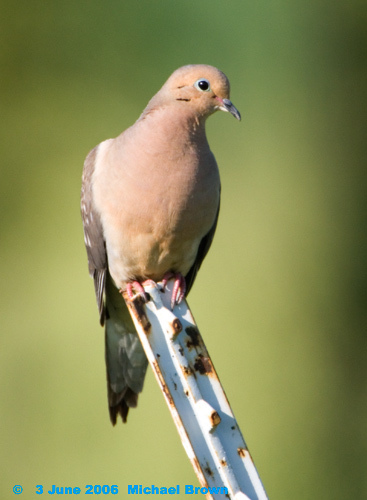

He’s tan and brown — no gray. He stood out among the six or seven relentless gray mourning doves surrounding him. Maybe they’re common elsewhere, but I’d never seen a brown mourning dove before. My first thought was: Are there brown mourning doves and I’ve never seen them before, or is this a mutant freak right here in my own neighborhood? A little internet search later (well, just now) revealed that they aren’t uncommon , even though I’d never seen one before. So either I’m not terribly observant , or they’re not in my neighborhood.mourningdove.jpg

The shocking intrusion of the brown mourning dove in no way prepared me, though, for what I saw just an hour ago. It was sleek and black and fuzzy and looked at me and ran straight up a tree and I thought, “Is that a squirrel?” Because, similarly with the brown mourning dove, I’ve never seen a black squirrel. Thank God again for the internet, because here’s what it revealed:

black_squirrel.JPGSo yes, there are black squirrels, and yes, that was a black squirrel I saw. It was also hands-down the handsomest squirrel I’ve ever seen (albeit photo-shy, because it kept running around the tree and away from my camera, hence the internet photo at left).

As someone who grew up out in nature I know one thing about nature that I like to share: Nature alternates between being boring and dangerous. If you don’t know what I mean about it being boring, then head out into a meadow and have a sit and see how long you handle that. It’s pretty dull. If you’ve ever been charged by a stag, or lived through a hurricane, or almost drowned during an incoming tide (I’ve done all three), then you understand the danger. Having in the space of just three days encountered a brown mourning dove and a black squirrel, I guess I should add that nature’s surprising; you’re never sure what you’re going to find in the place you’re in, if you look about.

My most unexpected sighting was about 20 minutes ago. Leaving one of the readings, I met Frederick J. Simons and his wife (that’s Mr. Simons on the lower left). Their family business? Omaha Steaks. It was a pleasure telling the Simons that I’m a loyal customer, having stocked my freezer at home many times with Omaha Steaks, and sending them to my mother on special occasions. The Simonses are supporters of this conference and were attending the reading of a play (a very fun new play) that I served as a panelist for. It’s gratifying to know that one of the companies I support is supporting an artform that supports me.

Buttonholing

May 21st, 2008

Remember the other day I was mentioning my discussion with my assemblyman, Paul Krekorian? Here’s a photo of that moment in time from today’s Burbank Leader (the local newspaper supplement to the Los Angeles Times), and here’s the story, if you’re inclined to bone up on Burbank politics.

Although the paper’s caption says he “talks to John Gallogly and Lee Wochner,” the photo clearly shows me buttonholing him about, that’s right, the state budget (I want it balanced). And redistricting (I want it). And term limits (I’m opposed). For the record, I have great respect for Assemblyman Krekorian and think he’s representing us well on these and other issues. It’s the State Legislature as a whole, and our governor in particular, that I’m up to here with.

By the way, the story erroneously reports that we had only 25 people for this picnic. I understand their mistake, given that it seems to be a policy of the Times (and, by extension, the Leader) to get at least one major fact wrong in every story. In actuality, we had about 75 people. Much closer to the number at this guy’s event.