Head-bobbing poll results
September 18th, 2008This just in. Maybe Obama is winning.
This just in. Maybe Obama is winning.
As Nancy Pelosi famously remarked, “Elections have consequences.” This is important to remember: The contest this fall between McCain and Obama is not just about who will sit in the White House; it’s largely about who will sit beside that person throughout all levels of government — tens of thousands of appointees.
Take the case of Christopher Cox, an unmissed former Congressman from Southern California whom “President” Bush appointed to the chairmanship of the Securities and Exchange Commission. Want to know why Lehman Brothers, Bear Stearns, and Merrill Lynch have collapsed? Look no further than Cox and his predecessor, who removed provisions designed to ensure the stability of these institutions. Is there a direct line of political contributions and favors between the principal players at these failed firms and the powers-that-be responsible for these rules changes? I suspect so.
(In the interest of fair indictment, it’s worth noting that Cox’s nomination was approved unanimously by the Senate. So don’t expect any of those Democrats to come out blazing against him.)
A couple of weeks ago I did finally buy a new iPhone. The video below shows why.
(And by the way, I thought I was buying the product shown in the video. But as every guy learns quickly enough, it turns out I was only renting it.)
Time to check again to see if the Large Hardron Collider has destroyed the world yet. Hm. Looks okay.
Now, let’s see if years of banking and insurance deregulation have destroyed the world economy yet. Uh oh.
Stan Lee is the speaker at this month’s Hollywood Networking Breakfast. ‘Nuff said.
By the way, one link on the site above promises “History of Breakfast.” Which I expected to begin with “mastodon.” But no.
For almost three months now, my state of California has been operating without a budget, which has made me irate (as I noted here and here). Like the House of Usher, the entire economy seems to be slipping into the tarn, but the legislature in California has been unable to get its act together and pass a budget. In a classic case of chicken, the GOP has insisted on draconian cuts, while the Democrats have insisted on more taxes instead, with both parties refusing to budge. (And Schwarzenegger, as a governor with no party loyalty to call upon, appearing utterly powerless in this ideological death match.) In the meantime, state workers have been laid off, vendors aren’t getting paid, and schools and communities and who knows what else have been going unfunded.
Today I went to the opening of the Democratic Party of San Fernando Valley’s campaign headquarters. It was a mob scene. It was like the turnout of an Obama rally, without the rally space. If this is any indication of excitement about Obama and fear of Palin (and it largely isn’t), the reports of McCain’s impending electoral victory have been greatly exaggerated. (Especially when one figures in Obama’s just-announced $66 million fundraising month.)
I ducked back outside for air and saw Karo Torossian, one of Assemblyman Paul Krekorian’s aides. I’ve written here several times of my admiration for my assemblyman. (I’m one of his delegates.) Before I could ask Karo where Paul was, he told me that Paul was running late and might not make it — the state Speaker, Karen Bass, had just set a conference call for 3:30. On a Sunday. I could figure what that was about. Anyone could have.
“They better pass a budget,” I said.
Karo said something like, “They have to pass a budget that protects against cuts….”
“They better pass a budget,” I repeated, being well aware of the statewide bipartisan anger over this issue. People who had lost their jobs or gone without pay were literally in tears on the news or the radio every day.
Well, it looks like they’ve got a budget, and one that will pass. As this story in the Sacramento Bee avers, it’s a budget that nobody likes. It looks like there will be further cuts and no new taxes.
But at least they’ve got a budget. Eleven weeks after its passage was mandated by law.

National Endowment for the Arts Chairman Dana Gioia has announced he’s leaving his post in January so that he can return to writing poetry. (The Chair is prohibited from getting published while in office.) While I wish him well, I have to say I’m sorry to see Gioia go; he’s done a terrific job, bringing Shakespeare to communities across the country that in previous years have gotten nothing for their arts dollars, getting private funding for projects that enrolled Iraq War veterans in documenting their experiences, and making friends and allies everywhere for a department that was used as a kickball for most of the 90’s.
Gioia is so highly respected that the venerated Onion put him on their front page today. Here’s the news of his last, and largest, project at the NEA.
(And check back frequently for updates.)
Theatre of the absurd is one of the most misunderstood forms — probably because of the unfortunate name Martin Esslin stuck it with. Thirty years ago Saturday Night Live ran wonderful parodies of bad theatre of the absurd and its accompanying high-minded criticism; Dan Ackroyd, as the sour confection Leonard Pinth-Garnell, would watch a pretentious bit of downtown performance art with us and then sniff, “Mmm. That was truly bad.” That’s very funny, because it takes the perceptions of that period about theatre of the absurd, which had sprung up on these shores in New York in the 1960’s, and magnifies them.
Funny, but not accurate. Because, as Edward Albee pointed out in 1962, if there was an “absurd” theatre, one devoid of life and humor, it wasn’t the one downtown. The theatre of the absurd I’ve always loved is packed with meaning, and tends toward the very funny. This includes the work of Pinter, the supposed playwright of menace, and the bleak existentialist Beckett, as well as Ionesco, and Shepard, and the other major writers Esslin put together. They were all saying important things, and they were all funny.
The most important class I took in college was Theatre of the Absurd, an elective taught by professor Jeanne-Andree Nelson. I took the class on a lark: I liked Jeanne-Andree and I figured I could sail through it and get on to the serious business of graduate school and becoming a novelist. But I emerged from the class someone I hadn’t intended to be: a playwright. Theatre of the Absurd was so much fun, so filled with wild energy, so easy to do at any place and on any budget, that fiction looked like work.
In Jeanne-Andree’s class I learned about the writers above, as well as Boris Vian (whose “Empire Builders” I still revere), and Amiri Baraka, and Jean Genet — and I learned about the wonderful comedian Emo Phillips. In 1984, Emo was doing a sort of standup comedy that no one had done before, an insanely inventive and funny comedy that functioned on two levels: piercingly intellectual on the top, and clownishly foolish on the bottom, as though a cocktail-party philosopher had been cross-bred with the town moron. In other words, like theatre of the absurd. Professor Nelson, to whom I remain indebted, was smart enough to recognize the affiliation and to somehow secure a tape of the newly emergent Emo and screen it in class.
Here’s a copy of that first recorded Emo Phillips video, which I just found on the web. (It’s on Emo’s MySpace page, but it hasn’t always been there.) I recognized it immediately because it left an indelible impression on me (especially the joke about the basement). (You can find part two of the video on Emo’s site.) My friend Mark Chaet and I went to see Emo last year at the Steve Allen Theatre and I’m happy to report that Emo is as clever and funny as ever. I’m sure he’ll be back there at some point; you might want to sign up for the email alert.
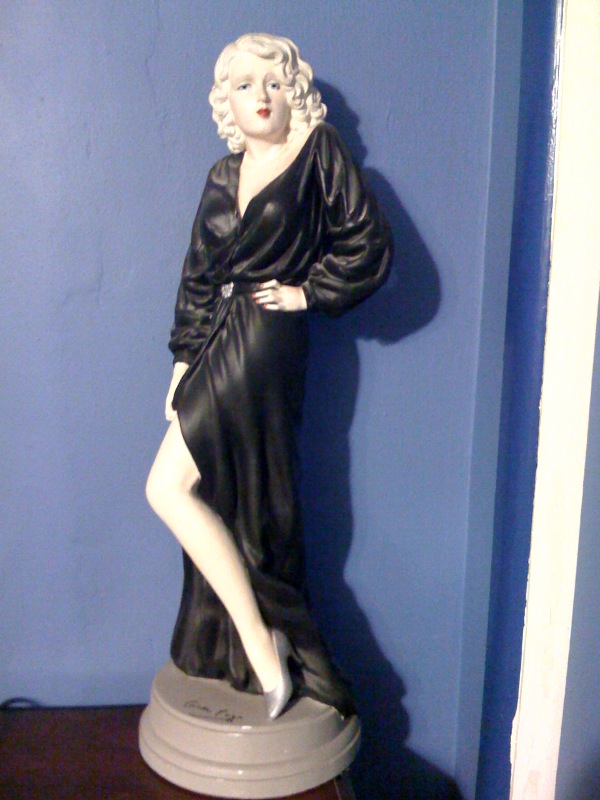
Almost every day I think about Anita Page, and several times a week I check online to see if she’s still alive. No more. She died today at the age of 98.
Ms. Page was a movie star of the 20’s and 30’s, appearing in the silent era in one of MGM’s biggest hits, which ultimately led to her being partnered with — and this is why she matters to me — Buster Keaton, in his first talkie, “Free and Easy,” in 1930. Keaton liked her so much he requested her again for “Sidewalks of New York” the next year, making her the only female costar he worked with twice in movies with sound. Neither movie is very good — Keaton was drinking heavily and furious with MGM for taking control over his movies and changing his character; the ending of “Free and Easy” is especially hard to watch, as Keaton, made up as a sad clown with a teary expression looks on hopelessly as the shallow male romantic lead makes off with the girl. But both movies have their bright spots, and in both of them Anita Page is very good as a moll with wonderful comic moxie.
The reason I’m reminded of Anita Page on an almost daily basis is that above my desk I have a statuette of her that she signed for me almost 15 years ago. (When I retrieve my camera I’ll post a photo.) Back then, I went to the Silent Movie Theatre on Fairfax every month to see all the Buster Keaton movies, and in the process got to meet Mel Brooks, Anne Bancroft, Dom deLuise and other Keaton fans who would come by. On the night of what would have been Keaton’s 100th birthday, I took with me another Keaton fan, the Ohio playwright Kevin Barry, who was in town because I was producing his play, and I wound up sitting next to another one of the great comic’s co-stars, Eleanor Keaton. I can’t remember what we talked about (except our mutual affection for her late husband), but I wish I did.
Some time after that, Silent Movie held a tribute to Anita Page and my friend Joe Stafford and I went. Ms. Page was selling and signing these statuettes, and Joe bought one for me as a gift. I’m still grateful. It’s one of the nicest gifts I’ve ever received. (Another is the framed photo that Paul Crist took for me of the lake deep in the woods where I spent so much of my youth.) It’s a reminder of friendship, and it’s a reminder that I got to meet two people who worked with Buster Keaton, who has brought me immense joy.