Lee Wochner: Writer. Director. Writing instructor. Thinker about things.


Blog

A word about weight

May 8th, 2009

deluise.jpgPicking up on something I saw on Mark Evanier’s blog about Dom DeLuise:

In 2002, I was executive producer of the Ovation Awards here in Los Angeles. The director of the show suggested we invite Dom DeLuise to be one of the presenters. I loved Dom DeLuise’s work, but I had concerns. As delicately as I could ask (and I’m sure I could have been more tactful), I wanted to know how he was going to be able to get on and off the stage. The man was massive. He could barely walk. How was his health? And how was the audience going to feel about this? These were real concerns, no matter how harshly the director looked at me. He promised he’d figure it out, and he did — in the best manner of stage misdirection, he drew our attention elsewhere while Mr. DeLuise was helped into his position in the dark. The light came onto him and he was absolutely wonderful. He got huge laughs, and I was glad we all had him for the event.

This was the second time I met Dom DeLuise.

The first time had been seven years prior, when  I went to Buster Keaton’s 100th birthday at The Silent Movie theatre in Hollywood. Buster wasn’t there, having died almost 30 years prior, but Eleanor Keaton was (I sat next to her and spent much of the time talking to her), and so were Mel Brooks and Anne Bancroft and their good friend… Dom DeLuise.  The three of them were big Keaton fans, and at that time, I was well-versed in every aspect of Buster Keaton minutia, so they kept calling on me for answers to various questions about Buster. (Now much of that information has been replaced in my head by, well, certainly nothing as important.) When everyone went to sit, Mr. DeLuise was so large that he couldn’t fit into any of the theatre seats. The proprietor of the movie  house found an extra wide stacking chair, the sort one sees in conference centers in Wisconsin or at garden parties populated by immense people wearing muu-muus, and plopped it against the wall in the left aisle. He then took the stage with microphone in hand and acknowledged the celebrities in the house, landing finally on Dom DeLuise poured into this chair on the aisle, and paid what was intended as a warm tribute, ending it by saying with a glow, “The last person we had sitting in that special chair in the aisle was John Candy.” John Candy had died the previous year from a heart attack at age 43. A connection that every one of us made when we looked over at Dom DeLuise sitting in that chair.
The deluge and the drought

May 8th, 2009

Forget the burning of the library of Alexandria. Right now, we’re losing more information than ever in history, and just as Caesar’s  setting fire to antiquity’s greatest repository of knowledge was accidental, today’s loss is equally unintentional. As a couple of readers have noted here recently, we’re losing art and information to the forward march of technology.

Some examples from my own warehouses of art and information:

  • I can’t play my LPs or singles. My wife and I  haven’t had a turntable since at least 1996, when we bought this house. The only reason we had one at the previous house was that my theatre company had an extra one that we used at home to record cues. How many of us have turntables any more? And no, not all of the records that I still have are available on CD, and some never will be. I have the limited edition Deutsche Grammophone boxed set of Roxy Music’s albums (from back when such things had to be ordered through the mail, by sending a letter with a check). The original LP version of the album Manifesto has a wonderful (original) version of “Angel Eyes” that was subsequently remixed into what I’ll call “the hideous disco version” by Bryan Ferry. All subsequent versions of this album include the Hideous Disco Version. I haven’t heard the original version (or, as I like to call it, “the real version”) in almost 15 years. Except I can still hear it in my head.
  • I have dozens of cassette tapes that play almost nowhere:  not in my car, not on a computer, not on my iPhone, etc. etc. So in essence, they’ve lost their primary advance:  portability. For most of these, that’s not a problem (the ones I cared about I’ve now got in digital files or on CD). But there are dozens that I recorded myself — of my band, or of discussions with various writers and interview subjects.
  • Recently I took a hard look at the 120 or so square 3.25″ hard computer disks in my home office closet. They were formatted for my Apple IIGS, which I used until 1992 when I got my first Mac. I wrote on that computer for five very industrious years — probably 10 or 15 plays, most of them full-length, innumerable essays, short stories, poems, failed novels, detritus, and utter drivel. I hope it’s all printed out and in my files, because I pitched the disks. No way to read them.
  • Should I even go into the hundreds of thousands of emails I’ve sent and received, all of them deleted? God knows I’m not saying I should have printed them out and filed them, but surely somewhere in all that there were virtual letters I would have liked to keep for reference in my dotage. As I’ve switched from one email client to another — from the Claris version of Mail to Microsoft Entourage to the Apple version of Mail — I’ve lost one archive after another of this correspondence.
  • Same thing with my calendars. I can tell you what I did day to day in the 90’s because I used leather daybooks. My son pointed out to me that the iPhone deletes appointments older than 3 months. (To save memory, no doubt.) They get backed up onto the computer you sync with — but maybe that’ll change too.

I could go on in this vein — and discuss Betamax tapes and VHS tapes and so forth. But let’s talk about those things we never thought we’d lose:  books. One of this blog’s correspondents, my friend the theatre producer Isabel Storey, points out that the shelf life of our archives is geting shorter and shorter:

Each progression of the way we record words seems to make them less permanent. We still have stone tablets dating back thousands of years…paper lasts at least a few hundred…but words stored in electronic devices – do they even really exist anywhere – and will anyone ever remember, find them, even tomorrow?

It’s not just words. (Hence my laundry list above.) But what happens when in our zeal to replace the printed word with the electronic version we toss out too much collective wisdom? I’m referring to this piece in The New Yorker from 1996 concerning Nicholson Baker’s battle with a library that was destroying its card catalog — and its books! — to set up electronic versions. Here’s the abstract of that piece, which has stuck with me all these years:

Baker received an e-mail from a librarian following the move inviting him to “save” the card catalogue. Having ignored an inquiry from the Rochester library, Baker agreed, and made a formal request to inspect the card catalogue. It was denied by Kenneth E. Dowlin, the City Librarian. Baker sued for legal access (Baker v. San Francisco Public Library). He found that there were more books in the cards than in the new on-line catalogue, and realized that San Francisco is a case study of what can happen when telecommunications enthusiasts take over big old research libraries and attempt to remake them, with corporate help, as showplaces for information technology. The S.F.P.L. is now essentially broke, and relies on corporate benefactors. It has sent more than two hundred thousand books to landfills — many of them old, hard to find, out of print, and valuable. The New Main (library)’s shelf space is inadequate. “Weeding” takes place in all libraries in moderation, but the San Francisco librarians had to do it in a sweeping, indiscriminate fashion. The Old Main library has a Discard Room where workers from the Department of Public Works would pick up books to load their trucks. Baker found last copies of old books there. Since January, the book-dumping has ceased, following an expose in the San Francisco Chronicle. Now there are giveaways to the public and to charity. Dowlin will run for president of the American Library Association next year. After the Loma Prieta earthquake in 1989, Dowlin combined departments. Many books were moved to an abandoned building, and damaged. D.P.W. trucks took loads from the library several times a week. Dowlin obtained a large grant from the Federal Emergency Management Agency for repairs and a new computer system. In 1992, the library signed a multimillion-dollar agreement with Digital Equipment and put its catalogue on-line. In the sixties, City Librarian William Holman amassed books with the ambition of making the S.F.P.L. a high-level research library. Subsequent librarians built on this until Dowlin: “S.F.P.L. is a public library, not a research facility.” He introduced a program of “levelled access,” offering current material supplemented by “focus collections.” In December 1989, William Ramirez, then Chief of the Main Library, wrote a memo objecting to the foreseen change “from a strong reference, research resource and service center to an undistinguished ‘popular library.'” Many of Dowlin’s employees have resisted the change, protecting books by hiding or falsely stamping them. The new book return system damages books, and reshelving is slow. Last May, Baker presented his charges at the invitation of the Intellectual Freedom Committee of the Librarians’ Guild. In July, a letter from representatives of fund-raising affinity groups went out to every member of the library and staff, attacking Baker for using Holocaust references in his speech. In August, Baker, a historian and two librarians measured the shelves of the Old Main. High preliminary figures were leaked to the press, printed and then retracted. Kathy Page admitted that storage capacity in the New Main was inadequate. Dowlin attacked Baker in the press and called his writing “crap.” The library once kept a “Withdrawal Register,” but there is no record of books discarded or destroyed since 1987. There is a computer file entitled “Purge of Items Declared Withdrawn,” which shows troubling losses. Baker was told that there is “really no need to keep a history” of books that are gone.

Almost 15 years later, this is still painful to read. If something with all the commercial appeal of The Traveling Wilburys’ first CD could go out of print — which it was for almost 10 years, despite four top-ten singles and nine million albums sold in the U.S. and Canada– what chance does a book have of ever reappearing? Yes, books have gone out of print since books were invente, but they weren’t blown aside by the gale force of technology.

For all the wonders of the age of digitization– of which I am an acolyte, from which I make my living, via which I am now sharing this with you — it has carried with it twin unforeseen curses:  the deluge and the drought. The deluge has swamped us with so much information that we now cannot contain, process, or access all of it. (This would be my hundreds of thousands of emails that, had I saved them, I would never have the time to read.) It has been accompanied by a drought that leaves vast trunks of information and content without access to any tributary of support. All we can do is gaze upon the dusty boxes of floppy disks and wonder what might be encoded in them in a language every bit as dead and unknown as the Maya glyphs.

Don’t try this at home

May 7th, 2009

Watching this reminds me of how the whole nation felt about the economy last September-October. (Without the faked excitement.)

Overbooked

May 6th, 2009

My friend Doug — he of Doug’s Reading List and the only modern explorer any of us will ever know — was in town last week from the lower provinces of Patagonia or wherever his latest trek has taken him. You may recall that Doug, who is a reader for the ages, ejected all his thousands of books several years ago because they couldn’t fit onto a boat or a motorcycle. Now he and his wife, fellow adventurer Stephanie, have invested in a Kindle 2. I have seen the Kindle 2 and admire its functionality. But, as with print newspapers, it has proved difficult to break my addiction. I love books — not just reading them, but holding them and turning their pages and admiring their papery feeling and their floral aroma of decaying pulp. I also like having them on shelves in bookcases throughout my house and my office where I can see them and, let’s admit it, where others can see them. I check out the books in others’ homes and I like to see them checking mine out too.

But now I’m overbooked. Either that, or under-bookcased. All of our eight bookcases at home (one in office, three in kids’ rooms, one in bedroom, three in living room) are overstuffed with books and I pledged to my wife that we were done adding bookcases. And I’ve been unable to purge myself of any of these books because of the painful memory of my senior year in college when I sold my books back to the college bookstore because I needed the money. My favorite professor caught me in the act and said sadly, “Monsieur Wochner, you are selling your books?” It was heartbreaking. And stupid — because over the years I wound up buying most of them again at full price. I now know:  When you’re a playwright, you might have further need some day of “Seven Plays” by Sam Shepard, and books like it. Since then, I’ve lived in fear that the book I part with will be the book I’ll need. Having a Kindle 2 might help with that; my purchases would be digital files on Amazon.com.

But… what if Amazon.com goes out of business in my lifetime?

And what about after my lifetime? I like to think my books will find future readers. Who will read my future digitized Amazon library? Probably no one.

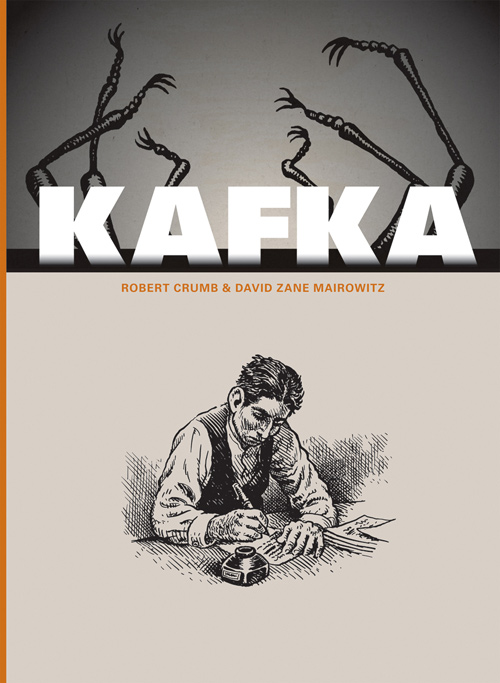
kafka_crumbcover.jpgHere’s something that I wonder if having clear bookcases — so I could actually see the spines of the books — might help. Last night I was reading Kafka by Robert Crumb and David Zane Mairowitz. Crumb provides wonderful illustrations to summaries of Kafka’s great works, with introductory-level biographical text by Mairowitz. Recently on this blog, a friend suggested that I get this and read it, and I almost did buy it two weeks ago at my local comics store. Then I stumbled upon it in the last stack of unread books from last summer’s San Diego Comic Con. So I had already bought it and completely forgot. I dived right into it two nights ago and was thoroughly enjoying it and was surprised, given that I’m a fan of both Kafka and Crumb, that I hadn’t already bought it when it first came out, in 2004. As it was, some of it seemed familiar, but I just figured I’d seen chapters in Weirdo or other magazines with Crumb work.

kafkaintroducingcover.jpgI Tweeted a tiny rave about the book today and resolved to write an appreciation here tonight. In so doing, I Googled for images and found this. First thought:  “Crumb did two books about Kafka? He must be a huge fan!” Second thought: “This is an earlier edition of the same book.”  The cover looked hauntingly familiar. As in, familiar from my bookcases. I went to the “K” section of the first living room bookcase, moved aside two stacks of books, and found “Introducing Kafka” by David Zane Mairowitz and Robert Crumb right where I now thought it would be.  The same contents, but in a 1994 First Edition from Kitchen Sink Press. So I’ve now bought and read this book twice (and almost bought it thrice). That’s the downside. The upside:  It’s been a great first read — twice. Because in the 15-year interim I’d forgotten I’d read it.

(By the way, the Introducing Kafka cover  shown here has a slightly different title layout at the top than my first edition, meaning it must be a later edition. Proving that there’s still money to be made in Crumb and Kafka, if not Mairowitz.

kafkacrumborange.jpgEnd note:  My Google investigations turn up yet another Kafka book illustrated by Robert Crumb and with text by David Zane Mairowitz.  This one is called R. Crumb’s Kafka, “with text by David Zane Mairowitz.” I’m thinking this is the same book. (And given the title, I’m guessing it’s Mr. Mairowitz’s least favorite edition.) The cover is different, but they’re right when they say you can’t judge a book by its cover.

I’m not falling for it again.

Latest sleepwalking incident (but not by me)

May 6th, 2009

A few minutes ago while I was working on a longer post for this blog, my 10-year-old daughter  suddenly appeared behind me, giving me a start.

“What are you doing up?” I said.

“I had to turn off the fan in my room because it was getting too hot for me.”

I noted two things: 1) this doesn’t make sense; and 2) she had a slightly confused look about the eyes. Then she added, “Plus, I had to put the… um… foam thing… on the counter.”

“I think you’re sleepwalking,” I said.

She looked at me, spun around and went back upstairs. I followed her to make sure she wound up in bed and found her there almost instantly. She must have run. On the way back to my office, I took note that there was no, um, foam thing on the kitchen counter.

My family has been having fun encounters like this for decades, from my grandparents to my parents to myself and my siblings and perhaps back to the start of our bloodline for all I know. All three of my kids are carrying on the tradition. As far as genetic curses go, I guess it beats sickle-cell anemia.

Bad dog names overheard during my bike ride

May 5th, 2009

“Brutus” and “Judas.”

Jeez.

Two things I’m scratching my head about

May 2nd, 2009

Number one: It seems to me that the U.S. taxpayer just paid Fiat $8 billion to take over Chrysler so that Fiat can get access to the U.S. market in exchange for pretty much nothing (except the strongly opinionated management of the Fiat CEO). Am I wrong about this? Is it just me?

Number two:  Last night at the opening-night performance of the play Loveswell, an event benefiting Heal the Bay, a woman said to me, “Were you an actor?” “No,” I said. “Oh,” she replied, “You look like you were an actor.” What does this mean? Do I somehow look wrung out from years of waiting tables or bartending (two occupations I’ve never held)? Also, if I were an actor (which I am not and never have been), how does one look at me somehow reveal that I’m now through with it?

There’s still time to partake in Free Comic Book Day!

May 2nd, 2009

How fortunate we are in this great land to have Free Comic Book Day. And woe to the nations that do not observe it! They do not know the despair they endure.

This year’s Free Comic Book Day might place in your hands free retro reprint editions of classic Marvel comics (Avengers #8, the first new Ant Man, the first Spider-Woman, an early Iron Fist, and so on), a great Simpsons comic starring Comic Book Guy (!), a new New Avengers / Dark Avengers mini, Sonic the hedgehog for younger boys and Betty & Veronica for stinky older sisters, and on and on. All for the cost of nothing!

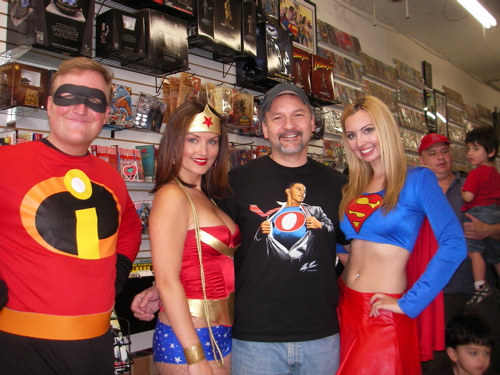
Submitted for your perusal, photographic evidence of just some of the wonders available to you at your local comics store. These esteemed visitors were seen at House of Secrets in Burbank.

lee-with-mr-incredible.jpg

Mr. Incredible, defending my ability to secure free comic books.

artist.jpg

My favorite artist, right, gets a sketch from comics artist Tony Fleecs.

heroes.jpg

My daughter Emma considers a future line of work. (After asking me why Supergirl had a navel piercing, which was “wrong.”)

lee-with-heroes.jpg

Mr. Incredible trying to horn in on my action. Right after this pic, I dialed up Mrs. Incredible and that put an end to that. Still, I’m glad to be seen with four defenders of truth, justice, and the American way (the three heroes in the flesh and the hero depicted on my shirt).

Afraid you’ve missed out? There’s still time to discover similar wonders at your local comics shop. This link will direct you hither.

Bowling, now and then

April 29th, 2009

Just got in from a night spent bowling in Hollywood. Bowling is not what it was when I was a kid:  filthy lanes with middle-aged guys in NRA hats chain-smoking and chugging Schlitz, getting served greasy snacks by a washed-up bottle blonde at a grimy window into a dank kitchen area. Now it’s video screens, club music and a deejay, Asian wraps, a serious dress code, and the hipster Hollywood contingent. At least that’s what we found at The Lucky Strike in Hollywood,  on the corner of Hollywood and Highland (our town’s new epicenter).

The lane next to us was taken up by six playboy bunnies and their photographer and videographer. How did we know they’re bunnies? One of our crowd asked the girls, “Why are all of you blonde?” and one answered, “Because we’re Playboy bunnies.” That, plus when they were checking in, they announced at the shoe counter, “We’re the Playboy party.”

The eight of us in our lane bowled two games and I lost both of them. (Well, the second time I tied for last place, so see, I was getting better.) Somehow or other I bowled a gutter almost every time. Not that the Playboy bunnies were a distraction. I don’t know what it used to cost, but tonight bowling for eight for two hours with drinks and snacks ran three hundred bucks. And it seemed like a bargain.

Golden girl

April 27th, 2009

Charles McNulty reminds us where Bea Arthur developed the killer comic delivery we loved so much on television:  in the theatre.