Lee Wochner: Writer. Director. Writing instructor. Thinker about things.


Blog

Dramatic inspiration

September 7th, 2009

I have to do some rewrites on my new play tonight so that I can hear them at tomorrow night’s rehearsal, but I thought I’d procrastinate first. (I am a writer, after all.) So I turned on the television.

First, I saw an episode of Penn & Teller’s Bullshit!, which dealt partly with all the millions of people in Africa suffering from HIV and AIDS because they can’t get access to condoms.

When that was over, I caught the tail end of a documentary on another channel concerning the closing of a GM factory in Ohio. The crew followed about a dozen different long-term assembly plant workers around the shop floor on their last weeks, right up to closing day. You have never seen so many grown men cry.

Then on a third channel I caught the last 20 minutes of a documentary about a son who just couldn’t take his mother any more and killed her. The documentary is from the point of view of his older sister. I caught the scene where she asks their father why he never intervened in what I take to be his now-slain wife’s endless criticism and abuse. He says that if he’d suggested therapy, the mother would have divorced him, and so he didn’t know what to do, the daughter says that doesn’t absolve him, so the father bolts up from the interview and storms out of the house. The next scene is the sister visiting her brother in prison.

After this, I was afraid to see what I’d find elsewhere on TV. So now I’m writing the play. Who says theatre isn’t escapism?

Labor Day theatre labor

September 7th, 2009

labordaytheatre1.jpg

Seventeen years ago this weekend, a small group of us built a theatre. It’s called Moving Arts and it’s still running.

And then seven years after that, we built another, inside the Los Angeles Theatre Center, which we had to tear down seven years after that when we vacated the building. So I’ve built two theatres and torn one down. I hope some day in retirement to build one more, but I plan never to tear another one down.

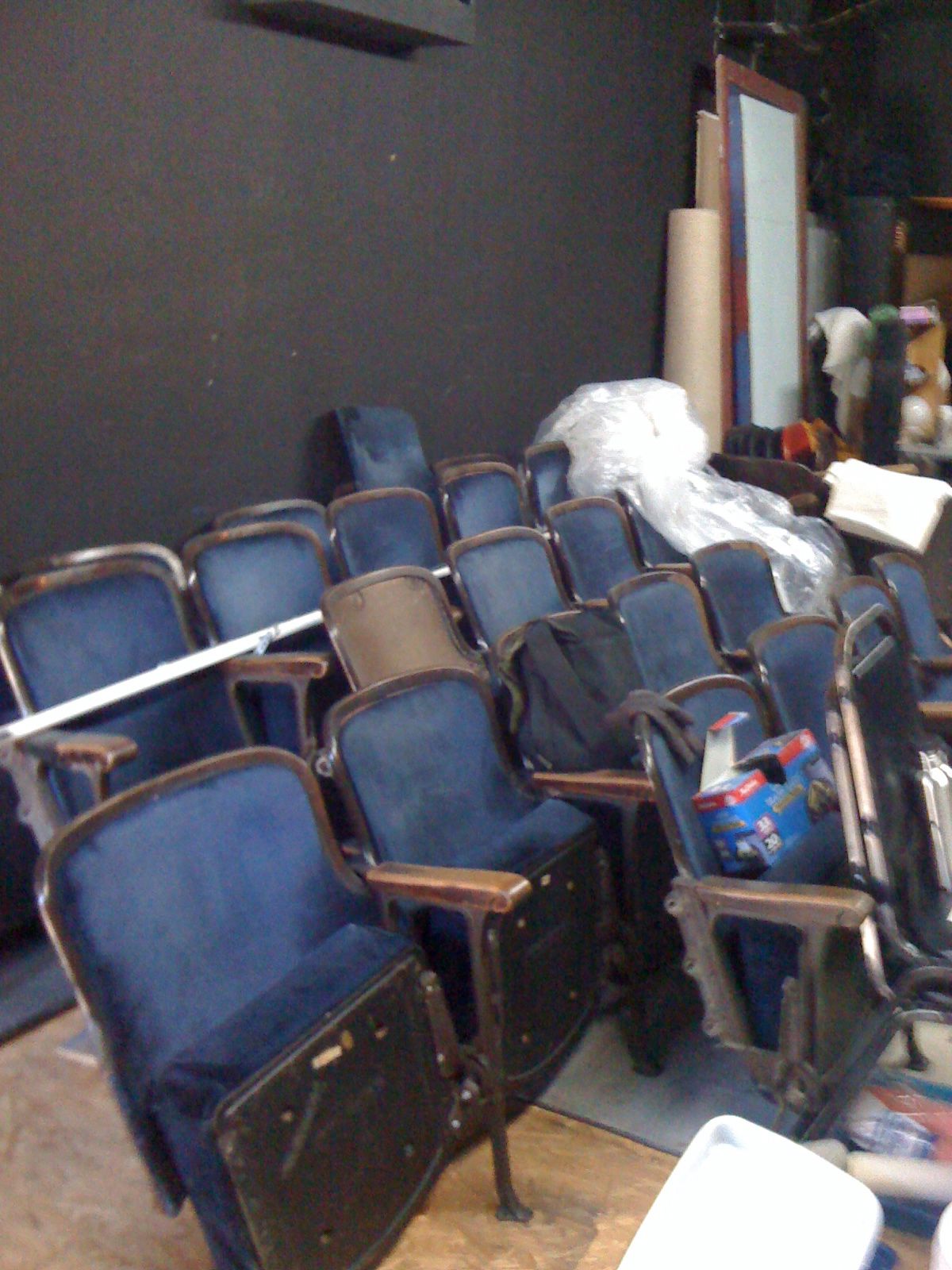
Today the memories of building that first one came flooding back because a crew assembled again in that original space to take almost everything down and apart and rebuild the space. A long long time past overdue, the space is finally getting a rehab. My two younger kids and I arrived to find the risers disassembled, the ceiling fan apparatuses apart, all the drapes and carpet tossed, the bathroom stripped out, the seats unbolted and repositioned, and a nimbus of long undisturbed dust floating like the haze of Los Angeles over everything. It came as a shock.

I love building (and, now, rebuilding) theatres, so I’m glad I came to help out even if only for a few hours. I spackled holes, removed ancient twisted hardware, and painted. Somewhere in our archives we have a photo of my then 1-year-old standing in the window in November 1992 as we post our first (positive) review. That child is now off at college; his younger siblings are further along, so they also got to paint and spackle and drag trash around.

One of the things I tell students is that theatre takes place in a room. (Even when it’s staged outside, that room is implied.) It’s a form that insists on the isolation of space, defining a stage that is apart from an audience, urging us to believe in split universes, the universe of the spectators seeing into the world of the players. But we’re still in the same room. Actors who know how to play off audiences know that, and so does everybody else on some level.

So this is a room I’ve done a lot of theatre in. Hundreds of plays and rehearsals and auditions and workshops and readings over the past 17 years. I’ve grown fond of the place. I’m glad it’s getting a makeover that it has long deserved.

Four frameworks for theatre in two months

September 5th, 2009

My new one-act play, “He Said She Said,” goes up next month here in Los Angeles. (Details to follow.) Today was our first table reading. Between that, and a drinks meeting I had with my director just over a week ago, I’m reminded again why it’s better if playwrights don’t direct their own plays. At least, this playwright.

I am a director, and depending upon the rightness of the material for me and whether or not I screw it up, I think I’m a pretty good one. But I don’t think I have the sort of insights into my own plays that good directors have. That’s because, having written the play, I can’t discover it.  In this case, I thought I had written a simple short play in the style of story theatre. Listening to my director talk about it, I realized that what I’d written was closer to a short story narrated in first-person. This may seem like a fine distinction, but it’s not:  Short stories plant images in your mind for you to conjure, while stage plays put them on stage for you to see. This was going to require more directing that I had realized, and probably some changes in the text to eliminate redundancies. (The narrator telling us something, and the actors then doing it. Which unless done for comic effect would be like hearing a skip in a record. It should be one or the other.) I wonder, had I been directing this, how far into the rehearsal process we would have gotten before I discovered this. With good actors (which I’m lucky to have), pretty quickly, I think, because they would have told me. But I hadn’t discovered it already, and my director had. So he definitely earned my attention early on. When someone is being smarter than you, you should listen.

While this play is in rehearsal, I’m also directing a new one-act in an evening of plays by my good friend and former student EM Lewis. We had our first script meeting last week and I think it was like the meeting above, but now I was in the other chair. The current draft of the play is 18 pages, and the discussion took 2 hours, 17 minutes. She is a fine writer. The play has strong characters and good conflict and wonderful dialogue; all those things I like. But there were things I didn’t understand about the play, and to be able to present a vision of it, I needed to understand it. The fault may have been mine, or the playwright’s, or more likely there may have been no fault but rather a case of things that work and things that don’t work, depending upon your line of attack on the play. With “Hamlet,” is Hamlet deranged, or is he crafty, or both? Making that initial decision determines the playing of everything that follows. It’s always that way with all plays — at least the good ones. Bad plays have no creative ambiguity; they are resolutely what they are.

Next week I start on the other two of the four theatre projects I’m doing this and next month. My friend Trey Nichols has been commissioned to write a one-act play for the same festival; I’ll be helping him shape the material with a small cast (three or four actors) and co-directing with him. And I’m also involved in a project at the Natural History Museum where, if I’m understanding this correctly, six or so of us are writing short environmental scenes that interconnect into a larger play about their new spider exhibit. I know which character I’m writing, and that character’s basic storyline (which I pitched), and the actress playing that role (Liz Harris, a good actor I’ve worked with many times).

In “My Dinner With Andre,” Andre Gregory relates to Wallace Shawn that daily life dulls us to our own existence, and that we need to break our patterns to re-engage. I think that with four theatre projects all at the same time and all with different frameworks, I’ll be very conscious for the next two months.

Reading resumes

September 5th, 2009

My son sent me an email asking for my advice on writing a good resume. He’s off at college and wants to go get a part-time job. I’ve been hiring people since I was a teenager and was promoted to classified supervisor at the newspaper where I worked. In the 30 years since, I’ve made some mistakes, but I like to think I’ve learned not to repeat them. Here’s what I told him:

I do read cover letters. Yes, I filter out people who make spelling errors and grammatical errors and punctuation errors. (Anyone who confuses it’s and its, your and you’re, and to and too, is definitely out.) If it’s not relevant, fine, but in almost anything I’m hiring for, it’s relevant. (The exception being visual artists.) Even if it isn’t precisely relevant, I don’t like seeing these mistakes on the page. It hurts my eye. If I had to see it every day from someone I was paying, I would start to feel culpable.
So:  Once someone has passed my close reading of his or her spelling and grammar, I’m looking for relevant skills and character. Character is important; you can teach skills, but you can’t teach character. Both the cover letter and the resume should make character statements. And the resume should list relevant skills.

Beyond that, I don’t think there’s any mysticism at work here. Look at sample resumes and adapt accordingly. A good opening line on a cover letter will almost assuredly help you jump to the top of the pile.

Good luck.

Today’s music video

September 4th, 2009

In two short weeks, the new Pere Ubu album, “Love Live Pere Ubu!” comes out. (Its sales will in no way threaten those of 40-year-old “new” Beatles albums released at the same time.)

From that new CD, here’s “Song Of The Grocery Police,” as animated by The Quay Brothers.

Not taken

September 3rd, 2009

In which the film version of The Road gets an early review every bit as devastating as the apocalypse that catalyzes the novel.

In livingsk color

September 3rd, 2009

Between 1907 and 1915, the photographer of Czar Nicholas II traveled his nation taking photographs of pre-Revolutionary Russia. In color. Here are 28 of them — including one of Leo Tolstoy — and they are stunning.

Rock god

September 3rd, 2009

Occasionally you come across something so wonderful on the internet that you must immediately worship it.

In most cases, it involves William Shatner.

This is only the latest example.

(By the way, I’ve worked with many many wonderful actors, and not one of them has had insights anything like those in this video. Now I think they need to get with the program.)

Fevered writing

September 2nd, 2009

The LA Times’ theatre critic, Charles McNulty, reviews the new book of essays from my favorite working playwright, Wallace Shawn.

My favorite line:

Shawn’s signature tone, familiar to those who know his one-of-a-kind dramatic works, such as “Aunt Dan and Lemon,” “The Fever” and “The Designated Mourner,” or his movie colloquy with Andre Gregory, “My Dinner With Andre,” is a kind of canny naïveté, in which complicated questions are approached with a simplicity that strips the conventional barnacles from the search for truth.

Yes! That is true. Mix that with free-floating entitled guilt, and you’ve got much of the tone and approach.

What McNulty’s review doesn’t get at, and where Shawn excels in both his plays and his essays, is the net result of this approach:  a fresh way of seeing. “Clearing the barnacles” allows one to see the hull, and to sail more speedily. Clearing the detritus, or “camouflage of details” (another sharp observation from McNulty), allows one to see the truth and to act. The Bush Administration was all about obfuscation, with heavy layers of incompetence.  Whether or not, from the comfort and safety of his couch, Shawn is taking action, in all his work he nevertheless calls into question basic assumptions about safety and privilege and morality and humanity in ways that are thrilling and not a little jarring.

Make Mine… Mickey?

August 31st, 2009

spider-manlionking.jpg

A couple of weeks ago I was in a meeting when someone said that a design looked “really powerful, really Marvel Comics.” I turned to the woman next to me, an executive with Warner Brothers, and whispered, “Should I say it looks really ‘DC Comics?’ ” Because after all, Warner Brothers owns DC, and is located right here in beautiful downtown Burbank.

Now, it turns out, Marvel too is owned by a studio headquartered in my hometown. That studio is named Disney.

Although I hadn’t heard anything about this deal in advance — and evidently, just about no one else did either — I’m not surprised. In a world of entertainment agglomeration, where radio stations and television stations and movie studios and newspapers and digital providers and satellites and publishing houses and so forth are all owned ultimately by one company, and that one company is owned by Rupert Murdoch or Steve Jobs or Barry Diller or some combination thereof, it had come to seem increasingly strange that there Marvel was, all by its lonesome, an attractive bauble sitting neglected at the billionaires’ ball. I don’t know how well Ariel, the Little Mermaid, has been feeling lately, but Iron Man and Spider-Man and friends have never been more powerful at the cash register.

While I don’t pine for the moment I spy the Hulk waving glumly alongside Goofy in the Main Street parade, I’m glad the characters have a well-furnished new home backed by unimpeachable credit. Too many characters, and comic-book companies, have found themselves in foreclosure. As Mark Evanier noted on his own blog, I do wish that Jack Kirby were alive to see this day — and, somehow, to financially benefit from it. Although Kirby’s plight pales against that of the creators of Superman (in his declining years, Joe Shuster worked as a deliveryman to make ends meet), he never saw the sort of payday given recently to, say, the creators of RockBand, which has been a persistent money loser but which recently netted a $150 million performance bonus for its creators. For Marvel (or its predecessor, Timely), Kirby co-created Captain America, the X-Men, the Fantastic Four, the Hulk, Thor, Iron Man, Doctor Doom, the Black Panther, the Silver Surfer, and indeed almost all the major characters in the Marvel pantheon. (Spider-Man and Wolverine being the most notable exceptions.) Without Jack Kirby, Marvel wouldn’t have been worth half its $2 billion purchase price today. Just how much would a fair performance bonus have equaled?