Lee Wochner: Writer. Director. Writing instructor. Thinker about things.


Blog

Coming soon to a theatre with me in it

November 15th, 2009

The new “Bad Lieutenant” movie by Werner Herzog — starring Nicolas Cage (of all people). I was already eager to see it, but this piece in the LA Times further tantalizes me. Some choice excerpts:

  • “…Roger Ebert  [observed]: ‘Cage is as good as anyone since Klaus Kinski at portraying a man whose head is exploding.’ “
  • “Almost impossible to classify, the film is a glorious mess: part ‘CSI’-style police procedural, part over-the-top B-movie and part surrealist character study in flamboyant dissolution.”
  •  “Still, for all its sleazy, loony brilliance, doubts about the film’s ability to connect with a mainstream audience linger.”

Let’s see… Herzog, Kinski, messy, surreal, sleazy, loony, brilliant, and possibly uncommercial. I can’t imagine missing this.

What I’m not seeing

November 14th, 2009

Thursday night I was in Burbank.

Friday night I was in Palm Springs.

Tonight I’m in San Diego.

Here’s what I haven’t seen in any of those cities:  signs of a recession, at least with restaurants. In fact, the restaurants are packed. In Palm Springs I dined at a Fleming’s Prime Steakhouse and stayed at a Waldorf Astoria. Both were busy. Tonight I met friends for drinks at the Gossip Grill in Hillcrest, then two of us ate at The Fish Market on Harbor Drive. Both of them buzzing. (The Fish Market must have been busy, because my waiter forgot first the extra horse radish I wanted for my oysters, and then the second drink I wanted. My dinner companion nicknamed him “Goober.”) Then we went to a dessert place and it was so mobbed we couldn’t get in. Instead, we went to a gelato shop; they just opened a second cafe and are looking to launch a third.

So I do think the economy is improving. Unfortunately, it’s a jobless recovery. We need more people employed. But in the meantime, I’m glad to see so many restaurants thriving.

Open enrollment Sesame

November 13th, 2009


And someone tried to tell me he wasn’t “real”

November 12th, 2009

Reed Richards is on Facebook.

Today’s Music Video

November 12th, 2009

Yes, it’s Pere Ubu again — but it’s my blog, and I’m trying to evangelize. Or, at least, be understood.

So why do I so love this video of “Folly of Youth”?

It reminds me how sexy Michele Temple is. I took a friend with me to see the band on the tour that accompanied this album release in 1995 (hard to believe now that it was that long ago). He was a novice, and he was smitten too. Her bass line fills my dreams.

I love the way Jim Jones warps the guitar tones with feedback.

I think the song, and David Thomas’ singing, are hypnotic. To me anyway.

And I could watch Robert Wheeler play that homemade theremin all day. Very much calls to mind this.

Welcome waggings

November 12th, 2009

In honor of Veteran’s Day, we should all take a minute or two to watch videos of dogs welcoming soldiers home. My dog is so glad to see me every day, I can only imagine her reaction if I were off in some godforsaken desert for a year or two.

Stan Lee’s marketing marches on

November 11th, 2009

stanlee.jpg

I owe an enormous debt to Stan Lee, and I know it. The Marvel comics line was hugely important to me growing up and is perhaps only slightly less important now because I’ve got things like dependents and employees. Even with that, there are moments that I get completely caught up in Reed Richards’ quest to solve everything. But Stan’s latest profile, in Inc. magazine, is puzzling to me.

Firstly, Inc. is a magazine aimed at entrepreneurs, i.e., people who start their own companies. That isn’t really Stan Lee. He was an employee at Marvel, and even at his own companies (Stan Lee Media and Pow!) I believe he was a  figurehead for other people. He’s a gifted storyteller of a certain sort, and God knows he’s a marketing genius, but an entrepreneur he isn’t.

Secondly,  I’m disturbed by this quote in the profile:

All of the characters at Marvel were my ideas, but the ideas meant nothing unless I had somebody who could illustrate it. For Spider-Man, I called Jack Kirby, and he did a few pages that weren’t right. Jack drew everything so heroically, and I wanted Peter Parker to look more like an average, schlumpy kid. So I got Steve Ditko to do it. Whenever I would discuss the strip, I would say that Steve Ditko and I created Spider-Man. I certainly don’t own the Marvel characters. I’ve never owned them. If I did, I’d be too wealthy to be talking to you.

“All of the characters at Marvel were my ideas”…? I guess it depends upon the definitions of the words “all” and “ideas.” The pre-eminent Marvel way of scripting was thus:  a plotting session between writer and artist; the penciller  would render the pages; the writer would then script in balloons and captions. The first time Stan Lee thought of the Silver Surfer, for example, was after seeing him drawn into a Fantastic Four storyline about Galactus. Stan asked Jack Kirby who that was, and Kirby said he figured that someone as important as Galactus would have a herald — and that was the herald. Stan has agreed in interviews that this was the origin of the character. Here’s the relevant snippet from Wikipedia:

The Silver Surfer debuted as an unplanned addition to the superhero-team comic Fantastic Four #48 (March 1966). The comic’s writer-editor, Stan Lee, and its penciller and co-plotter, Jack Kirby, had by the mid-1960s developed using a three-collaborative technique known as the “Marvel Method“: the two would discuss story ideas, Kirby would work from a brief synopsis to draw the individual scenes and plot details, and Lee would finally add the dialog and captions. When Kirby turned in his pencil art for the story, he included a new character he and Lee had not discussed.[5] As Lee recalled in 1995, “There, in the middle of the story we had so carefully worked out, was a nut on some sort of flying surfboard”.[6] He later expanded on this, recalling, “I thought, ‘Jack, this time you’ve gone too far'”.[7] Kirby explained that the story’s agreed-upon antagonist, a god-like cosmic predator of planets named Galactus should have some sort of herald, and that he created the surfboard “because I’m tired of drawing spaceships!”[8] Taken by the noble features of the new character, who turned on his master to help defend Earth, Lee overcame his initial skepticism and began adding characterization. The Silver Surfer soon became a key part of the unfolding story.[5]

The Silver Surfer, therefore, was not solely the idea of Stan Lee. Taking Stan’s definition of “idea” as I believe he’s using it, the Surfer wasn’t his idea at all. So clearly, by this one example alone, “all” isn’t accurate.

I’m not an intellectual property attorney, but doesn’t the “idea” of Spider-Man expand to include the character as conceived? Stan Lee partially got the “idea” for Spider-Man by watching a spider crawl up the wall, but our understanding of Spider-Man redounds largely from the costume as well, which was designed and drawn by Steve Ditko. In Stan’s version, Ditko is an “illustrator” whom he also recognizes as a “creator.” Fair enough. But can you “create” if you’re not part of generating the “idea”? I do a lot of collaboration in all sorts of arenas, especially in the theatre, and part of that is the exchange of ideas. You want people to bring their ideas. (Unless you’re Bertolt Brecht. But that’s another story.)

Throughout the years, Stan Lee has been attacked for taking too much credit. I’m not interested in joining in on that and I’m not trying to. Reading this interview in Inc., though, I see again the sort of interview he gives that lends the impression that he’s edging others out of the spotlight, or minimizing their contribution.  I also like to think that since he’s 86 years old we should pray for his continued good health and look the other way when something he says comes out the wrong way.

And once again, all of this would feel better if Marvel and its various corporate entities over the years had done more to acknowledge the genius of Jack Kirby with tribute, and with money. He was co-creator of a multi-billion-dollar universe of characters and he couldn’t even get his art returned to him.
Painful promotion

November 9th, 2009

Sir Ian McKellen went on The View last week to promote the new and updated “Prisoner” series on AMC. What ensued was painful — for the audience, at times for Sir Ian, and hopefully for the not terribly bright women who host this show. Check out Geoff Boucher’s take on it, then watch the excruciating video below. Rule of thumb: It’s good when the interviewers prep, or have some basic notion what they’re talking about. But maybe I’m old fashioned.

Final act

November 8th, 2009

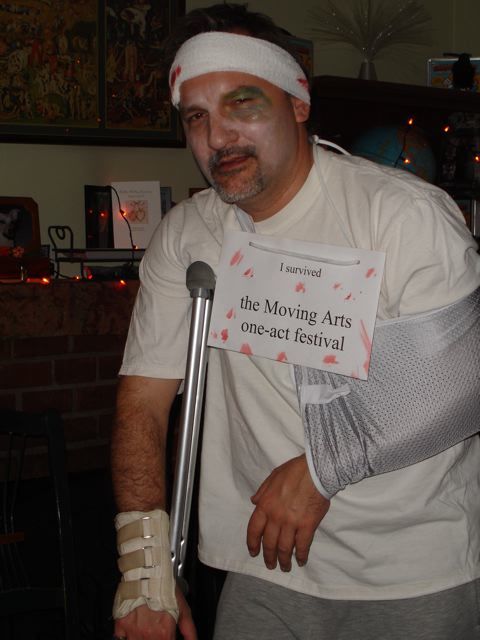
Last night, this year’s Moving Arts one-act festival closed. Afterward I hung around ’til 1:30 in the morning with a few other people and dismantled the set flats for pickup and storage the next morning. I was sad to see the festival close, especially because I was proud of so much of the work, including the three plays I was most closely involved with: one that I wrote, and two that I directed. (I wrote a scene for the event at the Natural History Museum, too, but never got to see it. I hear it was good.) But while I was sad to see it close, another side of me wasn’t sorry at all. To give you an idea why, I share my Halloween costume this year:

maoneactcostume.jpg

This was our 15th annual one-act festival, so I think at this point we know how to do such events. But we had so many problems it’s like we were cursed:

  • an actor in one of my plays was hospitalized with a heart infection
  • another actor was hospitalized after passing out in a bus
  • the understudy I cast to take over for actor #1, above, suddenly came down so ill he was laid up with an IV drip
  • another actor almost broke her wrist because a flat was moved into a position it didn’t belong, blocking her entrance in the dark
  • another actor slipped and fell outside on the cement — twice
  • the lead in my play was in a car accident just prior to opening
  • a supporting actor in one I directed was in a car crash and hospitalized with a concussion

You might (somehow!) chalk that up to actor problems, but we had major ongoing tech problems, too.

  • At the end of an 8-hour cue-to-cue rehearsal in which all the light and sound cues were programmed, they mysteriously disappeared. All of them had to be reprogrammed, which added nine hours onto the day. (I said, “I won’t be here at 2 a.m.” And wound up leaving at 1:56 a.m.)
  • Some nights the stage lights would seize, stranding the actors in the dim lights set for scene change. After this happened a second time, the tech crew spent an entire day checking every cord and cable and instrument and all the impressive buttons and levers on all the tech equipment, but couldn’t duplicate the problem.
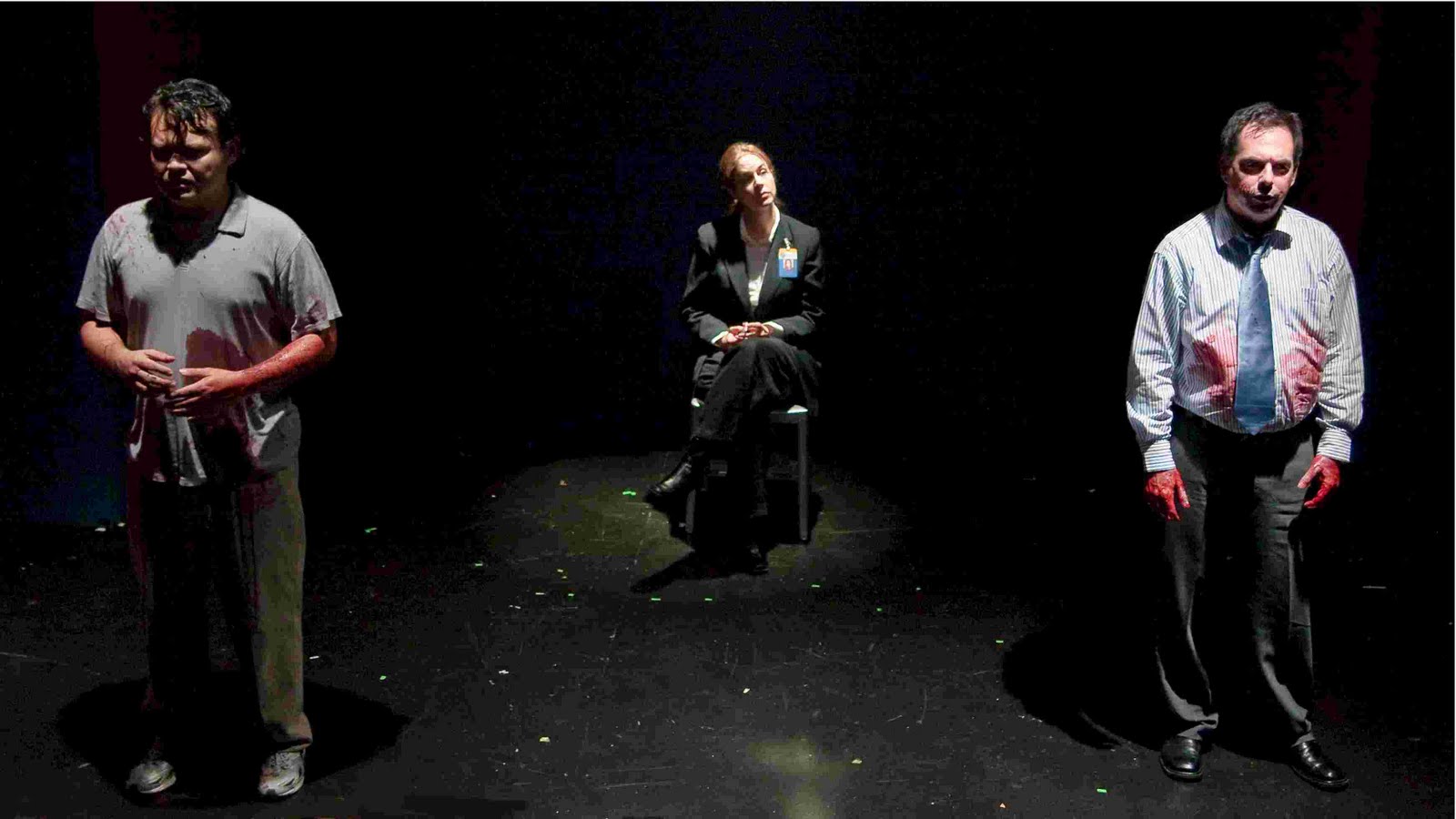
  • One night prior to opening when we’re getting our press photos taken, it starts to rain. Water starts to drip onto the stage floor. Our producer wisely puts down a bucket and a towel. Naturally, in all the press photos for my play, the bucket and towel are front and center. Later someone Photoshops them out (but not before we nickname them Mr. Bucket and his sidekick, Towelly). But more editing is necessary later, because the actor on the left is one of those who wind up hospitalized.
  • Props and set pieces and costumes would mysteriously vanish. One night the bottle of Rolling Rock so emblematic of my lead character’s small-town truck-mechanic milieu was gone, substituted quickly with a PBS-subscriber Heineken someone helpfully located. Another night the prop baby openly referenced in one play couldn’t be located, so the woman playing its mother had to mime carrying a baby. When the mother shared her distress about the baby, her fellow actor helpfully chimed in, “But Mom — the baby isn’t even there!”
  • Previously, I shared the story of  the incredible professionalism of an actor who went on for one of those hospitalized actors, off-book, with no rehearsal, and who was absolutely terrific in his performance.  What I didn’t share at that time was the rest of the story. The play starts and I’m sitting in the house and I’m just blown away by how great this actor is — in fact, by how great all three cast members are. I’m very proud of this play and them and my work directing it, and I’m enjoying the stark lighting that I wanted, and then… I start to hear something. It sounds like… music. In Spanish. Like a Mexican radio station, slightly not tuned in. I pull out my iPhone and text the board op in the booth:  “Why is there music on stage?” I get a text back:  “I don’t know. It’s not coming from the booth.” In other words, she doesn’t show it and she can’t hear it. My actors, including the understudy who has taken over, bravely soldier on, but everyone in the theatre is well aware of this music now, and of course, it’s the night that we’ve got a critic from one of the more important papers. I sit there and seethe.I don’t know who, but someone must die. And so I go down the mental list of suspects and as I pick through that list scratching off one name after another because really none of them is to blame, I start to realize that it’s even worse than I’d imagined:  There is no one to blame. No one.

No one is responsible for the out-of-tune Mexican radio station providing lively background for what should be the searing drama about a passenger getting beaten to death on a commercial airliner. No one is to blame for the vanishing props and the tumbling actors and the car crashes and the deadly airborne toxins and the wandering electrical shorts and on and on. We’ve done a festival for 15 years, and many of the people involved in this festival have been involved in many of those years. No, we’re just somehow… cursed.

My friend Trey blamed his play “Move”:  “This is the last time I write a play with a ghost in it.” My wife picks up this theme and says that a la “Macbeth,” which theatre people superstitiously call “The Scottish Play,” Trey’s play should now be referred to as “The Motion Play.” That was funny — but whatever ghost might have been the root cause plagued all the plays in all three evenings.

The night of the Mexican radio broadcast, I figured that somehow the equipment in the booth had become a receiver. This can happen. (It never happened again, and no, we never figured out how it happened that once.)  But once I realized there was no one to blame, I did the smart thing after that night’s show ended:  I gave up. Uncharacteristic, I know, but it’s one thing to struggle against oneself or others, it’s another to shake your fist at the sky. We had surmounted every possible torment and soldiered on, and no amount of testing and retesting and trial and error had been able to replicate any of the tech problems — they simply happened or didn’t. So I gave in and guzzled wine in the courtyard with about 20 other Moving Artists and we all laughed and laughed great rolling waves of laughter, the cascading eruptions of people who’ve been electrocuted but lived. The only thing left to befall us would be a meteorite crashing from the sky, and if that was going to happen, well, there was no stopping that either. So we all just gave in and gave up.

And after that we never had another tech problem.

incident-report.jpg

C-boosted!

November 8th, 2009

cboost_back.jpg

After a day well-spent playing backyard baseball with my seven-year-old, who hit a home run that literally tore my baseball cap off and kept going, I decided I needed a late-night boost. Luckily, one bottle of Bolthouse C-Boost remained in our refrigerator. And they’re right:  all this fruity vitamin-enriched goodness definitely lifts your spirits. Especially when you pour it over ice with a healthy dose of vodka.