Lee Wochner: Writer. Director. Writing instructor. Thinker about things.


Blog

Voting for complexity

May 24th, 2010

When I got home this evening I was glad to see my vote-by-mail ballot waiting for me. I had mailed in the application only a few days ago and was worried I wasn’t going to get the ballot before leaving town on Thursday for three weeks, thus missing the election. And I always vote. Always. We had a special election a couple of months ago and I purposely booked my flight for a couple of hours after polls opened so that I wouldn’t miss the chance to vote. That wouldn’t work this time, though, and given the frequency of my travels the past year I figured it was better to file for a permanent absentee ballot, despite my preference for tradition:  going to the polling place, lining up with people, discussing politics and local issues, greeting the polling-place workers, and proudly leaving with a sticker on my lapel that reads “I voted.” Yes, I am corny about my vote. So I was pleased to see that the ballot had arrived.

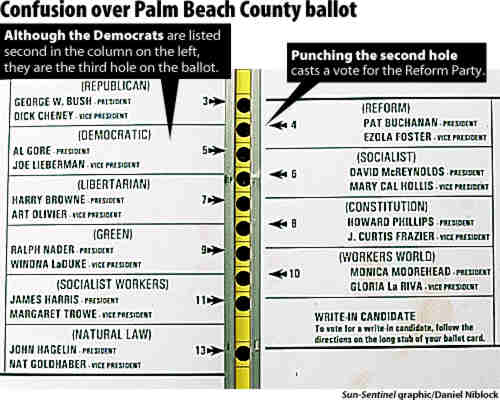
What surprised me was how relatively complicated it was to fill out. Remember the infamous “butterfly ballot” that was the excuse some people gave for seating George W. Bush after the election that Al Gore won? Thousands of surprised seniors, many of them liberal Jews, learned that they had accidentally voted for Pat Buchanan for president. Here’s why:
recount_pic2-ballot.jpg

Gee, wonder why they got confused. The GOP apologists said that people who couldn’t understand their ballot shouldn’t be allowed to vote anyway, but look at that image, and then imagine you’re in your 80’s and you know perfectly well whom you want to vote for. But because of the layout you vote for someone diametrically opposed to most of what you’re trying to support. (Which wouldn’t have mattered if the state had counted all the black votes in other districts… but that’s a separate story.)

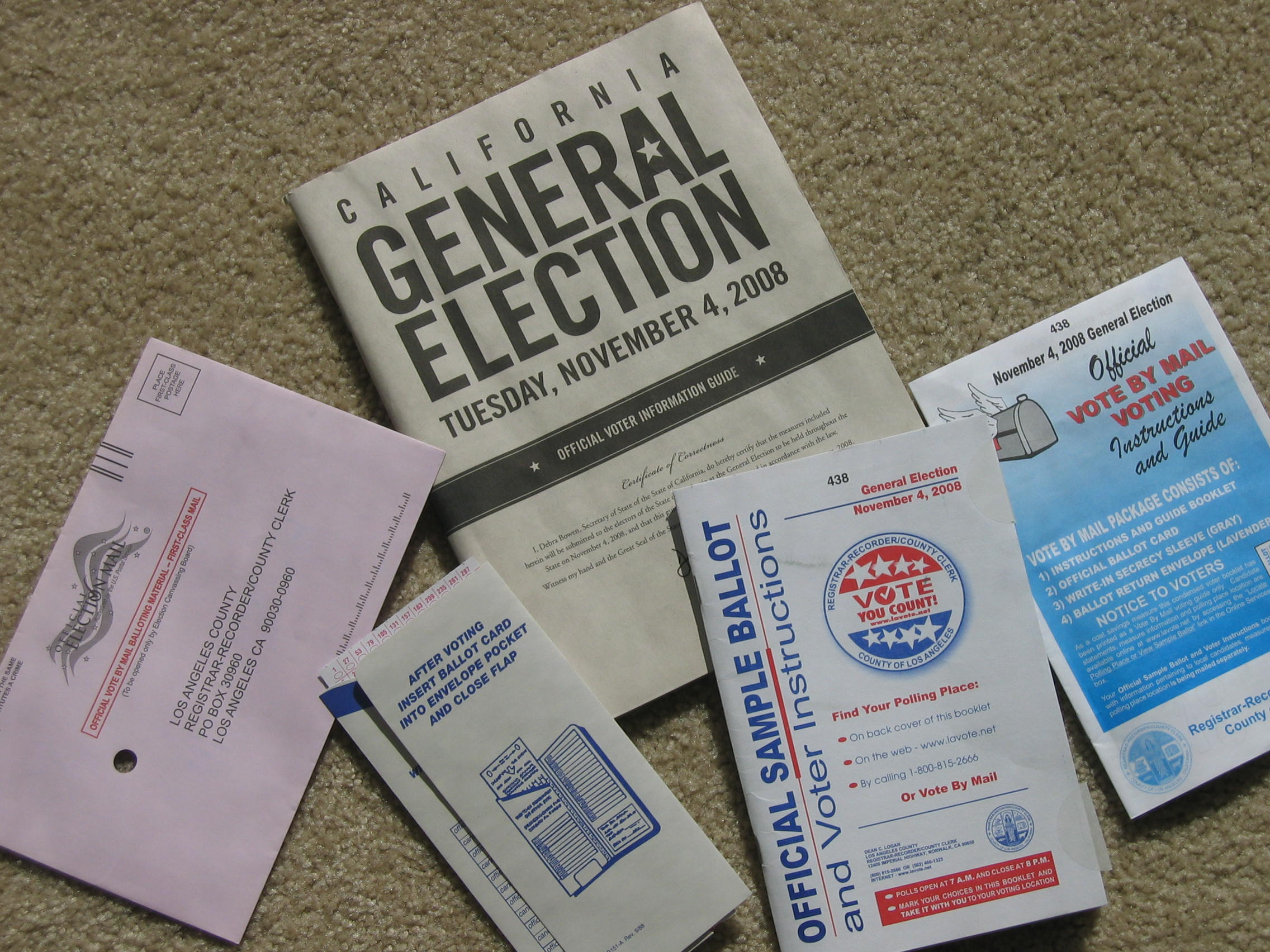
Now let’s take a look at California’s absentee ballot kit. Here’s an example (yes, taken from 2008, but the components are the same):
img_1151.jpg

You get a general election guidebook, mailed separately. Then you get the kit, which includes, from left to right, the envelope in which to mail it back, the “privacy sleeve” for you to insert your completed ballot, your actual ballot (tucked in this case inside that privacy sleeve), your voting instructions and sample ballot containing the candidate names and issues on which you’re voting (plus a numbered bubble next to each option, and the Vote By Mail instructions and guide. I opened this up, looked over all of this and — was confused. A few facts before we go on:

  1. I’m 47, not 87.
  2. I read, and write, for a living.
  3. I am a delegate for one of the two major parties, and in this state.
  4. I have three college degrees.
  5. I’m a reasonably intelligent person.

To me, the first indication that this might be confusing to a great number of people was that I actually had to read the instructions.  I know that they are there to be read, but how often does anyone have to read instructions any more? I didn’t read them for my iPhone (which should be far more confusing than a ballot). I didn’t read them for setting up my home computer. Have you read them for your microwave oven or your coffeemaker or your refrigerator? But to vote, you need to read the instructions — not to grow informed about candidates and issues, but to fill out the form. That seems wrong. And it is mandated mostly because the candidate names and issues are on one booklet of paper, and the ballot is a separate piece of paper with just numbered bubbles in it. And those numbered bubbles aren’t printed in the same array as the representative numbered bubbles in the official sample ballot. Also, the back of the pink return envelope has three places to sign it — I signed it on the left side only, which seems to be correct, but the two options on the right side seemed like viable choices as well before I studied it more carefully. All of this left me wondering how many of these would be left uncounted because of a technical foul — signing the wrong side, let’s say — or how many of these would result in votes that are counter to the wishes of the voter. But then, I was also left wondering this:  How many of these just won’t get delivered? Because, you’ll note, it requires a stamp. If someone is mailing in a ballot, should we really require the postage? If members of Congress have the franking privilege, could we at least extend it to voters when they mail in their ballots?

I’m now a permanent absentee voter. Unless I go through the process of changing that status, I’ll be dealing with these ballots every time. That prospect makes me miss the voting booth. It also reminds me again how far behind our public institutions are; surely there must be a viable secure way to vote online, and if there isn’t, we should develop one. Until then, we’ll be seeing more and more of these mailed ballots — some elections are mail-only (including some here in Burbank), and in some areas of California, all elections are done by mail. That may be good for the post office, and good for voters, like me, who can’t make it to the polling place. But the only way we’ll know it’s good for democracy is if the format is simple.

Sometimes it just happens

May 22nd, 2010

The other night I told a playwright friend over dinner that I felt “pregnant with play.” It’s a repulsive metaphor, but better than the alternatives that seem somehow equally right:  that a play is going to burst out of me like an alien through my chest; that a play is going to pop like a pus-filled blister; and so forth. Whatever the appropriateness of the image, she knew what I meant:  Sometimes you feel like you have a play coming on, and this was one of those times. I had thought I was going to puzzle out the missing section of act two of the play I’ve been writing, and which I told my wife I wanted to drive to Omaha and back (rather than fly) in order to be able to write.

Instead, it turns out it’s a new play. One that just came to me earlier today while driving with my college-student son back to Los Angeles from San Francisco. We were listening to an album by a band he likes. He said, “Do you like this?” “No,” I said. When it came to the end, though, I told him to leave it on so we could listen to it again. Because by then I was writing a play in my head, and this was the soundtrack. Eventually I pulled onto an embankment off the interstate, dug out my journal, and wrote down everything I knew about this play while my son looked around in the passenger’s seat, unsure what to do with himself. Later I had him fish me out a napkin from the glove box so I could scribble down two new notes:  the name of a made-up song in the play, and the last line of the play. This sort of thing kept happening. There was the realization that “Oh my God, I know the last line of this play….” And actually I could envision the last scene, completely staged. Then I could see the transitions between time periods — and this is not the sort of thing that I’m very good at. I quickly scrapped the first scene, set at the protagonist’s home, because I never wanted the action to go there, because I didn’t know how to go back there once the play moved on. Then I realized that I could have one actor play two roles in two time periods. Then I had the back story — of how the protagonist and the third main character came to meet again in the present.

This went on in my head for hours.

So now I have to write it, and I think that starts tonight. This is a good time to start it — a few days before I go off to a theatre conference, and then off to visit my mother on the East coast. In the next three weeks I’ll have more available time than I usually have, and as I told my friend the other night, “I’m a clumper.” I write plays in clumps.

After I put the pen back in the unashed ashtray of my car, I heard myself say this to my son:  “I don’t particularly want to be a playwright. I just am one.” Because plays have just come to me this way.

“Batman’s weekend car”

May 19th, 2010

g1.jpg

Yes, it can be  yours.

Boy Wonder comes separate. (Despite what you may have heard.)

Today’s bizarre wildlife video

May 19th, 2010

Perhaps now people will take seriously my childhood story of being charged by a horny deer late at night on the hilltop field behind our cabin.

Another reason to like Obama

May 18th, 2010

His former pastor, the Reverend Jeremiah Wright, says that Obama “threw me under the bus.” Which leaves me thinking that in his choice of friends and foes, Obama continues to impress. Wright is quoted as saying, “I am radioactive, Sir. When Obama threw me under the bus, he threw me under the bus literally!” I think that from now on, we need to enforce the use of the word “literally” literally. In this case, that will mean literally throwing Jeremiah Wright under the bus. I will grab a shoulder if others will help me.

He is also quoted as saying, “Any advice that I offer is going to be taken as something to be avoided. Please understand that!”  This opens a wealth of possibility. I would like Reverend Wright to strongly advocate that we continue to skew the tax code in favor of the top 1%, that we defund schools and roads and bridges, that the U.S. Postal Service discontinue Saturday deliveries, that we include High Fructose Corn Syrup in every food product possible, that every comic book be priced at $3.99 or higher, and that Rush Limbaugh be kept in the U.S. at all costs. I’m now off to work on the rest of my wish list.

Anarchy in the U.K.

May 15th, 2010

In which Mr. Lydon, once and future bomb-hurler for the Sex Pistols and who once upon a time preached anarchy in the U.K., endorses buying British butter. Not sure if this leaves me feeling happy or devastated. God save the queen.

Today’s live video stream

May 14th, 2010

Live squirrel action. Because I love squirrels. (My dog feels so betrayed right now.)

Hometown cock-up

May 13th, 2010

When I tell people here in Los Angeles that I’m from New Jersey, many of them immediately launch into a fond reminiscence of “The Sopranos,” a bad goombah accent, or some other upward nose-turning about the industrial wasteland they think I sprang forth from.

None of any of that has anything to do with where I grew up.  Mullica Township is a backwoods borough where some of the roads still aren’t paved, and where most of the commerce takes place at roadside produce stands. It has a culture all its own, and one in no way redolent of most assumptions about New Jersey.

Oh, and we have cockfighting. Ever see cockfighting on “The Sopranos”? I didn’t think so.

What the headline should have said when Doris Eaton Travis died

May 12th, 2010

“Last Ziegfeld Girl Kicks.” Instead, they went with this.

False memories

May 11th, 2010

The other day while awaiting the latest unpleasant procedure at the dentist’s office, I came across Reminisce magazine, “The Magazine That Brings Back the Good Times.” Those “Good Times” are defined as the 20’s, 30’s, and 40’s. (Here’s the link, if you’d like to stroll down mothball lane yourself.)

People are entitled to their memories and to be nostalgic for what they’ve lost. Although I know that comic books are printed better now than when I was a kid, I miss that smell of decaying pulp. It was part of the experience. So I do understand. But, while I admit to being biased against the 20’s, 30’s, and 40’s — partly, I’m sure, because I wasn’t there — I have to wonder how “Good Times” has been defined. Given that the 20’s, 30’s, and 40’s encompassed global aftereffects from World War I; the Great Depression; the dustbowl migration; lynching; famine; polio; World War II; the extermination of millions of non-combatants; and the development and use of the atomic bomb (to name just the hits), I’m thinking that these are “Good Times” if you survived.