Lee Wochner: Writer. Director. Writing instructor. Thinker about things.


Blog

Mama, they took my Kodachrome away

August 2nd, 2010

Someone just shot the very last roll of Kodachrome film. What’s on it?  The Brooklyn Bridge, Grand Central Terminal, a nomadic tribe in India, a taxicab, Robert De Niro, and other subjects. What is not on the last roll of Kodachrome? Paul Simon.

Like you, I haven’t shot any Kodachrome film in ages. I haven’t shot any film in ages.  What was the last time I took a non-digital photo? Um… seven years ago? Something else that happened seven years ago:  Polaroid declared bankruptcy, rendering my 700 shares of stock worthless. Those of us who grew up watching the “Planet of the Apes” movies always expected things to end, just not this way, and not to us.

Thought for the day

August 2nd, 2010

Now that I just had to walk halfway around the block, I know why there’s no one outside in Miami. Whoever invented the indoors is a genius.

(On a side note, my brother told me last night that he was “keeping the house cool” for me. Which means he turned on the air and set it for 84. Which, granted, is about 10,000 degrees cooler than outside, so he was true to his word.)

More Moore

July 31st, 2010

The New York Times lets us in on what Alan Moore’s up to at the moment. Perhaps the most promising development: “I can conclusively prove that death is a perspective illusion of the third dimension and that none of us have anything to worry about.” Phew! Major sigh of relief there.

Thanks to Joe Stafford for letting me know about this.

How Disney saved Broadway

July 31st, 2010

Twenty years ago, few would have predicted that Disney would become a major force in American theatre, especially in employing the avant garde. In retrospect, it’s not as strange a development as it may seem; after all, Walt & Co. did found California Institute of the Arts expressly to turn out avant garde animation (and, later, performance) as a research-and-development lab for the Mouse. (And where have so many of those Nickelodeon and Cartoon Network shows come from? You guessed correctly.)

This piece examines the secret behind Disney’s success on stage:  hiring the most creative people. (Something the company has always done.)

Backblog

July 31st, 2010

I’ve got a backlog of things I want to write about on this blog (or, perhaps, a “backblog”), but first an explanation of my recent absence, which is not the norm. (An astonishing two weeks of being MIA is shocking in extremis.) My absence can be tied to, well, absence:  Yes, I travel frequently, but lately it seems I’ve been out of town constantly.

First, I went to San Jose for three days.

Then I was back in Burbank for two days, and left for San Diego.

When I got back from San Diego, I had to get ready to head off for Miami. (I’m en route now, writing this from the airport in Las Vegas. Where I just won seventy bucks on an airport slot machine, thank you very much.)

Yes, we live in an age of Wifi, and yes, it’s available just about everywhere. But here’s what’s really changed:  The incredible draining inconvenience of air travel. Thank you, terrorists, for all these changes to airport security. It gladdens my hear to have my car stopped at airport drive-ons and cursorily checked, and you know how much I enjoy the near strip-search at every airport. And the commute to the airport, whichever airport it may be, and the commute back from the airport, and, often, the connecting flights to other airports. I’d also like to thank the number-cruncher who figured out that it was in airlines’ best interests to overbook every single flight because it’s economically advantageous to piss off your customers rather than leave some seats unsold. The long and the short of all this is this:  In this country at least, it’s far more draining and time-consuming to be a frequent air traveler than ever before in my lifetime, a situation that is exacerbated by the termination of so many routes and the overloading of so many flights that I can’t recall the last time I took a trip wherein some leg of it the flight wasn’t late or canceled, and sometimes with even worse results because I’ve now missed a connection, a situation that sadly we’ve now all grown accustomed to and accepting of.

Anyway, now that I got that out of my system (can you tell that my first flight was delayed?).

NEWS FLASH — while I was writing that message, an alert came over the loudspeaker. Guess what? It seems that my flight to Ft. Lauderdale is “overbooked,” and they’re offering a hotel stay here and a roundtrip ticket anywhere in the U.S. to anyone willing to take a later flight, i.e., a flight tomorrow.  If  I didn’t have plans for tomorrow in Florida, I might consider it. But it just proves my point, doesn’t it?

It’s not just the frequent travel that’s kept me off the blog, because, well, all those hotels obviously have Wifi too. It’s that I’ve been busy. Really busy. Jammed. Like, “How can I get all this done?” jammed. I’m writing a book, I’ve got lots of client work (always reassuring), and, well, I did go to this thing called Comic-Con. (!) But now I’m back and although posts may be relatively light the next few days as I finish playing catch-up, please know that I never intend to be AWOL for two weeks again. And, to the readers who sent kind little inquiries, yes, I’m alive and well.
Somebody else who’s hung up on the iPhone problem

July 16th, 2010

Meanwhile, over on Slate, somebody who didn’t get invited to the press conference is P.O.’d because Jobs didn’t snivel. Jeez.

Splendid American Splendor tonight

July 16th, 2010

 pekarpekar.jpg

Harvey Pekar died a few days ago. I started reading his comic book, “American Splendor,” when he started publishing it in the late 1970’s. Why did I buy those early issues? Two words:  R. Crumb. It was an interesting time for comics — undergrounds had already died, but now we had graphic realism, in the form of Pekar’s work, and what Crumb’s comics were evolving into, and what is generally recognized as the graphic novel, Will Eisner’s “A Contract with God.” I bought and appreciated all these things.

I also met Mr. Pekar a few times. While I admired his work, I  never enjoyed meeting him. His curmudgeonly appearances on David Letterman’s show weren’t an act; if anything, speaking with him in person was worse. Whenever I told him that I bought his comics and books and enjoyed his work, his response was a glare and a snarl. I’ve hung out with movie stars and sideshow freaks who treated their fans better. The last time I saw Pekar, a couple of years ago at the legendarily jam-packed Comic-Con in San Diego, he was the only person anywhere near his table. In the middle of 135,000 bodies in motion, his table was the doughnut hole of activity. Everyone gave him a wide berth, and I understood why.

Although I faithfully bought all his comics and books, I found much of the writing slack. It isn’t compelling to observe the dailiness of life if you have no observations to make, and in general, Pekar didn’t. His novelty was that he was among the first to put this sort of unwashed realism into comics form. Absent the work of some of his artists — Crumb, but also Frank Stack, and especially Budgett and Dumm — many of the stories wouldn’t hold any interest.  I’m not alone in this opinion.

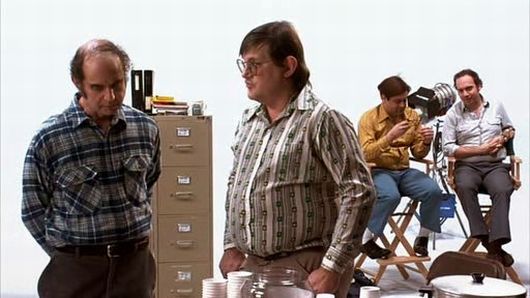
What was the best of Harvey Pekar’s work? Moreso than the comics, or his books, or his newspaper and magazine writing, or the movie adaptation, the best Harvey Pekar work I ever came across was the stage adaptation I saw around 1990 at Theatre/Theater in Los Angeles. The show was deceptively simple — Dan Castellaneta (of “The Simpsons”) and an ensemble of supporting actors, and some theatre cubes. The cubes got restacked at times to form filing cabinets (Pekar was a file clerk) or to serve as a table and chairs, or to stand in for the front seats in a car. The writing was fast and funny and loose. The actors did a great job of fleshing out the characters from the comics; even the man who played Mr. Boats, who was clearly not an actor per se, but someone they found because of his physical similarity to the actual person, did fine. I went to see the play three times, then saw it again when the producers took it to the Comic-Con and did it again. Twenty years later, I’m still lifting ideas from that show. I was  glad to be in LA and able to see such things (and it felt lousy when the movie mocked what had been a terrific, sold-out, award-winning show).

I’ve always wished I could see that show again. I can’t — but tonight, in tribute to Harvey Pekar, we can listen to a shortened radio version of it once last time, at 7:30, Pacific Time, on Santa Monica’s KCRW. It won’t be available on demand or podcast. So if you’d like to hear it, here’s your one (and only?) chance. 

Today’s music interview

July 16th, 2010

I’ve written here before of my admiration for the work of music producer Danger Mouse, who is one half of both Gnarls Barkley and Broken Bells, and whom I consider to be this generation’s Brian Eno — a visionary musical force to be reckoned with.

Here’s an interview he did recently with KCRW about his recent collaboration with Sparklehorse and with David Lynch (who is also interviewed), “Dark Night of the Soul.” I highly recommend the album, which is the product of three highly interested disparate artists — Lynch, Danger Mouse, and Mark Linkous — as well as guest artists such as the Flaming Lips, Black Francis of the Pixies, Iggy Pop, and others.

I may also have mentioned it here: Two months ago, I caught Broken Bells in San Francisco. They were wonderful. Until that concert, I had thought that Danger Mouse was expressly a producer. But over the course of the concert, he moved to every position on stage and played each instrument — keyboards, drums, guitar. He did everything but sing, and did all of it well and, in a way, humbly. There’s as much or more great music today than there was in the 60’s — you just have to go find it. If it says “Danger Mouse” on it, you’ve found it.

Got an iPhone hangup?

July 16th, 2010

If you’re all hung up over the iPhone 4’s dropped-call problem, you should watch this music video, which presents a great solution: if you don’t want one, don’t buy one; if you bought one and you don’t like it, take it back. Exactly right. And in the meantime, get over it.

How the man your man could be became the man he is

July 14th, 2010

I’ve got about a million posts I want to put up here — including one in response to a semi-luminary (to me) who recently commented on this blog — but my schedule being what it is at the moment, they’re going to have to dribble out over the next several days.

In the meantime, you may have been following the Old Spice marketing phenomenon of the past couple of days in which the ad agency Wieden + Kennedy has been doing video responses within two hours to tweets they’ve been getting, all of them starring the now-famous new Old Spice ideal man. It’s fun, impressive stuff. Google it now if you haven’t seen it.

In the meantime, I provide this video, in case you were wondering how the Old Spice commercial that kicked all this off back in February was made. Watch this show — it’s 20 minutes long, but well worth it — and as you watch the commercial get deconstructed, make a bet with yourself as to how much of the commercial is physically staged and how much is CGI. I think you’ll be surprised.