Overall, the proportion of daily print newspaper readers decreased from 38% in 2006 to 30% in 2008, before slipping to 26% this year. That represents a 32% drop in the size of the newspaper-reading population in just four years.
In a stark illustration of the shifting generational dynamics of news consumption, just 8% of the 26% cohort who read a print newspaper every day was between the ages of 18 and 30, compared to about 20% of the U.S. population.
In other words, they’ve lost two generations. (I started reading the newspaper at age 11. None of my kids reads the newspaper.) The report also finds that the proportion of people who get their news from newspapers, even the digital editions, is declining as well.
On a side note, the grammarian in me can’t help correcting the headline, “Pew: Americans Consume More News, Less Newspapers.” Rather than “less,” they mean to say “fewer.” Going forward, I think that fewer and fewer of us will know that.
I’ve written here before about my friend Gerald Locklin. Gerry is a poet who somehow made a career in academia while being shunned by it. That fine distinction — being in academia while not being of it — has resulted in a fine poet. Gerry’s work is insightful and accessible, which practically makes it unique today. This poem, which I’ve printed here before, states the case:
The Iceberg Theory
all the food critics hate iceberg lettuce.
you’d think romaine was descended from
orpheus’s laurel wreath,
you’d think raw spinach had all the nutritional
benefits attributed to it by popeye,
not to mention aesthetic subtleties worthy of
verlaine and debussy.
they’ll even salivate over chopped red cabbage
just to disparage poor old mr. iceberg lettuce.
I guess the problem is
it’s just too common for them.
it doesn’t matter that it tastes good,
has a satisfying crunchy texture,
holds its freshness,
and has crevices for the dressing,
whereas the darker, leafier varieties
are often bitter, gritty, and flat.
it just isn’t different enough, and
it’s too goddamn american.
of course a critic has to criticize:
a critic has to have something to say.
perhaps that’s why literary critics
purport to find interesting
so much contemporary poetry
that just bores the shit out of me.
at any rate, I really enjoy a salad
with plenty of chunky iceberg lettuce,
the more the merrier,
drenched in an italian or roquefort dressing.
and the poems I enjoy are those I don’t have
to pretend that I’m enjoying.
If you like that poem (and I hope you do), here’s some good news: the online poetry zine Rusty Truck is dedicated this week to the work of Gerald Locklin. Here’s the announcement, and here’s the first day’s poem. And here, on the same site, you’ll find an interview where Gerry discusses his friendship with Charles Bukowski, the conflict between “underground” and academic writing, and just how one goes about writing more than 125 published books. Gerry’s work embraces Wallace Stevens’ maxim that a poet looks at the world the way a man looks at a woman. It’s a pleasure reading him, and knowing him.
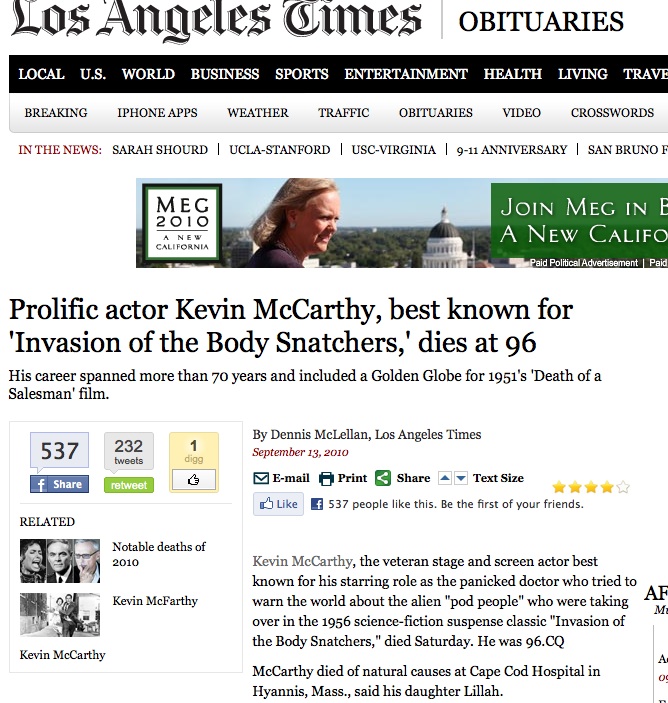
I was just checking out this obit for actor Kevin McCarthy, who starred in the science fiction thriller “Invasion of the Body Snatchers.” Want to know what’s truly science fictional? Evidently, the LA Times sent this obit back to us from the future.
Whenever people in LA tell me they’re going home, I say, “You go home every night.” Because, in Los Angeles, by “home” they usually mean that place they grew up, and it’s usually either on the East Coast (New York or New Jersey, most probably), or smack-dab in the middle of the country (Kansas, and so forth). I think that “home” is where you are now, and it’s best to get used to that notion as soon as you start living there.
Today someone texted me, relevant to a discussion we’d had earlier, to ask “What city did you grow up in?” I texted back: “There wasn’t any city.” Which is true. While my wife grew up in “the city” — as I used to think of it as a boy, as in “please drive me into the city!”, that city being Egg Harbor City, population at the time 3200 — I grew up in a township. We had no city. I just checked, and Mullica Township has a population of 5,912 people scattered throughout its 56 acres. Which means it’s grown enormously since I left. For comparison, Burbank, California, my home since 1988, has 108,000 residents in 17.4 acres. Burbank has 6207 people per acre; when I was a boy, Mullica Township has about 53 people per acre. This is one reason why almost all my childhood friends were comic-book characters.
I didn’t text much more of that back. It seems beside the point. I grew up there; now I’m here. Recently I’ve been in San Francisco, Miami, and Las Vegas, and I’m soon to visit Washington DC and Baltimore. Two things that have been a constant in my life: I’m still magnetically attracted to cities and to comic books. Anything to escape the woods.
The song “Two Reelers” by Frank Black (aka Black Francis of The Pixies) features these lyrics, about The Three Stooges:
Most important was brother Moe
He was the one who made it so
He got a Joe and another Joe
He would not quit, he would not quit
When you listen to the song, Black shouts this part with enthusiasm and wonderment: “He would not quit — he WOULD NOT QUIT!” He sounds incredulous and admiring, which may be why it’s stuck in my head for almost 20 years.
I thought of that today when I read that Roger Ebert has found yet another way to keep his movie-review show on TV. Against all the odds — the failings of syndication, lackluster ratings, the death of his original co-host and a revolving door of hosts ever since, Disney pulling the plug, and his own inability to ever speak again — Mr. Ebert has resurrected this show yet again. Given everything he has battled and overcome, we should all sound incredulous and admiring.
The residents of Whisper Glen Court, Florida can sleep soundly again, now that local police have blown up a stuffed 5″ My Little Pony toy horse that somebody was just pretty darned sure had been rigged by terrorists to explode. Evidently someone saw things “hanging” from the horse, and that sparked the panic. The less alert among us might have wondered if they were toy stirrups, but in the age of all-fear, all-the-time, it’s best to assume that such things are wires leading to explosives.
How bad (and badly managed) is the California economy? So bad that the UCLA Anderson School of Management is preparing to give back about $18 million in state funding because they’d rather take their chances getting more donations and raising tuition than counting on the state to actually supply the money budgeted to them. Any time any institution says it would rather give back $18 million, you have to figure they’ve done the calculation and figured it just wasn’t worth taking.
As somebody who has sat on the local school district’s budget committee for two years, I get it. What the state promises to pay the schools is a guess at best and a crime at worst. It’s the equivalent of the classic parental response to a child’s request: “maybe later.” I used to think that the schools in my state were over-funded. (And actually, that’s a suspicion I still harbor.) But one thing I’ve learned for sure: they are erratically funded. Money promised in September arrives in, say, February, and it’s never the full amount. Once I got an up-close look at our district’s financials I discovered two things, the first being that the financial model made absolutely no sense. The second thing I learned was this: that every year, for at least the past 13 years, our budget had been cut. Why do we suffer teacher layoffs, class-size increases, broken playground pavement, reduced programs (a music teacher who comes in only once every two weeks; a gravely reduced Gifted and Talented Education program; fewer field trips; fewer counselors; and so forth) and more, when theoretically the schools are allocated 40% of the state’s revenues and the state had several very healthy years in that time frame? Partly it’s because the state “borrows” this money, with promises to pay it back later. Partly it’s because… I just don’t know.
A few of us around here have come up with our own solution, and it somewhat mirrors what the Anderson School is proposing. Although we have no intention of suggesting giving back $18 million in funding (if we could even get it), we proposed some ideas to bring in our own funding for our schools, funding that each school could control and allocate on its own. Is that an ideal solution? No — imagine the impact on schools in poor neighborhoods if every school across the U.S. counted on local funding. But for Burbank it’s a good start, and it’s better than hoping that the state will get its act together. Because, as they say, hope is not a plan.