Lee Wochner: Writer. Director. Writing instructor. Thinker about things.


Blog

Writing: good, bad, variable, and influential

July 3rd, 2011

“Learning not to dislike Hemingway.”

That was the title an editor gave to a piece in today’s LA Times by book critic David Ulin. (Here it is; points go to the print edition’s copy editor — online it’s tagged “Under the influence of Hemingway,” a headline so weak that it seems a subtle jab at Hemingway’s manly writing style.) I read this piece with great interest because I’ve always read all of Hemingway with great interest since first coming across his short stories in high school, when one of those stories taught me the word “milt,” as Nick Adams strips clean a fish he’s caught. Almost 35 years later, this word has stayed with me. Indeed, I used it in my play “He Said She Said,” written two years ago and produced in LA and, recently, Omaha at the Great Plains Theatre Conference. The play concerns a vacationing PTA mom reading bad erotic poetry she’s written, and that setup flashed me back to the oddly sensual description of Nick Adams cleaning that fish. Here’s the comically bad poem from my play:


                        AMANDA

This is called Deep Sea Diving. Except the “Sea” is spelled “s-e-e.”


Deep see diving.

I can see you down here with me.

The shellfish scuttle out of the way

Forming a cloud of ocean dust around you.

There you are.


Don’t hide.

I can see you.

Peering at me from beneath your coral

Thinking that you’re safe and protected

I reach for you and pull you out

And take you above and slit you open

And run my tongue down the length

Of your milty flesh

Careful not to get your bones

Stuck in my throat.


Hemingway finds the right sensual word — “milt,” the sperm-containing secretion of the testes of fishes — and then in my play Amanda adulterates it into “milty.” Even as a teenage writer, I could see that Hemingway had the knack of finding the right word, something I struggled then and now with.

I picked up other tricks from Hemingway, purposely or accidentally. Here Ulin quotes Hemingway in “Death in the Afternoon”: “If a writer of prose knows enough about what he is writing about, he may omit things that he knows and the reader, if the writer is writing truly enough, will have a feeling of those things strongly as though the writer had stated them.” Note the circular reductionism, as Hemingway returns again and again to the baseline words:  writer/writing; about; enough. There’s a rhythm to this that just pulls you into it; it’s practically Biblical. This element of style infected my writing early on, and that’s fine; I got it from Hemingway, and Hemingway got it from Gertrude Stein, just as Shakespeare got Troilus and Cressida from Chaucer, and Chaucer got it from Boccaccio. All of which means that whether or not I admire Hemingway’s work (and I do), I certainly have been influenced by it.

(Who else was I influenced by? My friend Joe Stafford likes to point out that many of my plays contain what Joe calls “a laundry list” monologue in which someone complains about a host of items or events. In retrospect, the inspiration for this is obvious:  Harold Pinter,  and The Caretaker specifically.)

So here I am, filled with admiration for Hemingway, and somewhat put out by the Times’ book critic writing a piece bearing the headline “Learning not to dislike Hemingway.” To add insult to injury, Ulin goes on to say:

“The one who most spoke to me was Faulkner, with his flowing sea of language, his sense of of the past, of history, as a living thing. Next to him, Hemingway seemed flat, two-dimensional.”

Oh, William Faulkner. You  mean the famous writer I cannot read. The irony here is that, much as Ulin doesn’t care for Hemingway, I can’t abide Faulkner at all. Ever since I posted Doug’s Reading List six years ago, I’ve received many emails and personal comments that the entire list should be held suspect because Faulkner isn’t on it. But I can’t imagine a reason to put him on; I remain unclear what his impact is (on writers in general, or certainly on me). And oh, I have tried reading him, most notably Absalom, Absalom! (three attempts) and, just recently, Light in August again, this time getting to page 152 before bailing out. Here’s an excerpt prototypical paragraph:

He was standing still now, breathing quite hard, glaring this way and that. About him the cabins were shaped blackly out of blackness by the faint, sultry glow of kerosene lamps. On all sides, even within him, the bodiless fecundmellow voices of Negro women murmured. It was as though he and all other manshaped life about him had been returned to the lightless hot wet primogenitive Female….

What are “fecundmellow” voices? Like “milt,” the word aims to be erotic, but Faulkner’s neologism subtracts more than it adds, as do “manshaped” and “primogenitive.” To Ulin, Hemingway may seem “flat” by comparison, but I would respond that he doesn’t yank you out of the milieu with awkward showiness.

While I disagree with the Times’ book critic, I respect him for coming out with his opinion about Hemingway. I’ve been out about my dislike for Faulkner for six years, and I’ve suffered the slings and arrows of lit-snob derision — and I’m not the book critic of a major newspaper. I’m sure Ulin is in for a pasting from readers (and I’m betting he’ll be delighted to get a reminder that people are reading him). Ulin notes Hemingway’s influence — on Raymond Carver, Denis Johnson, Russell Banks, Tobias Wolff, Albert Camus, Norman Mailer, and Hunter S. Thompson (I would add Charles Bukowski) — but he doesn’t care for what Faulkner would call the primogenitive Writer.

All of this reminds me of something that happened last night, after the latest round of readings from my “Words That Speak” playwriting workshop. A couple of weeks ago, some of us in the workshop had plays performed in Moving Arts’ “The Car Plays,” and another playwright and I spent a few minutes last night discussing some of the plays we’d seen (of 26 different car plays, I’d seen 10). We came to the subject of one that neither of us particularly liked;  “It just doesn’t go anywhere,” I said, and my friend agreed. Then he said, “But I saw some people come out of that car wiping tears away.” We think it’s a bad play; others were emotionally swept away; and neither one of us could figure it out.  Just as I still can’t figure out the appeal of William Faulkner.

A pressing matter

June 30th, 2011

I just got back in town from another trip east (this time for a memorial service, unfortunately; more about that this weekend, I hope, because I have things I want to say about it), and now we’ve just moved the Counterintuity offices. So I’m looking forward to catching up on some things this weekend.

In the meantime, I thought I’d alert you to this,  yet another threat posed by global warming. According to scientists at Stanford (one of California’s private universities, and therefore able to afford scientists), global warming could hurt California’s wine industry. If in 30 years, we find that our favorite bottle is now called Four-Buck Chuck, we’ll know why.

Peter Falk, R.I.P.

June 24th, 2011

I grew up watching Peter Falk, shaking my head at the murderers underestimating him on “Columbo” and feeling him light up the screen whenever he turned up in a terrific ensemble comedy, of which there were many (for example: It’s a Mad, Mad, Mad, Mad World; The Princess Bride; Murder by Death; The Great Race). He was a cagey performer, good at playing comically outraged, or seeming more dimwitted than, of course, he was. His everyman edge came from the comic exasperation all of us feel at some point during the week; it’s what made him so relevant.

Truly good comic actors transition well into drama. As Buster Keaton said, comedy is serious business. That’s because it’s harder. This is by way of saying that Falk gave powerful dramatic performances as well, most notably in Mikey and Nicky, in which he plays a man who has snitched to the mob about his lifelong friend who is in hiding from them. Late in the film when the moment has come when the mob is about to catch and kill his friend (played by John Cassavetes), Falk’s desperate conflicted anguish is palpable. It’s a great moment in a very good film filled with them. Even when I didn’t like the films Cassavetes himself wrote and directed — and, by and large, I didn’t — I always liked Falk in them.

It was exactly four years ago today that I had the great good luck to meet Peter Falk. He was the mystery guest on my friend J. Keith van Straaten’s show “What’s My Line? Live on Stage” in Hollywood. Falk was loose and funny and charming and hung around a very long time afterward to meet anyone who wanted to meet him and to take pictures and sign autographs. I’m glad I got to meet him, and I’m glad that somewhere on this hard drive I have a photo with him, a photo taken by the wife of Len Wein, Mr. Wein being someone else I “grew up with” who was also in attendance. These are the benefits of being in Hollywood:  getting to touch the hem of artists you admire.

Gene Colan, R.I.P.

June 23rd, 2011

dd90.jpgI was sad to learn tonight of the death of comics artist Gene Colan at the age of 84. Many of us who followed his work and career have been expecting it for some time now, but that doesn’t lessen the blow.
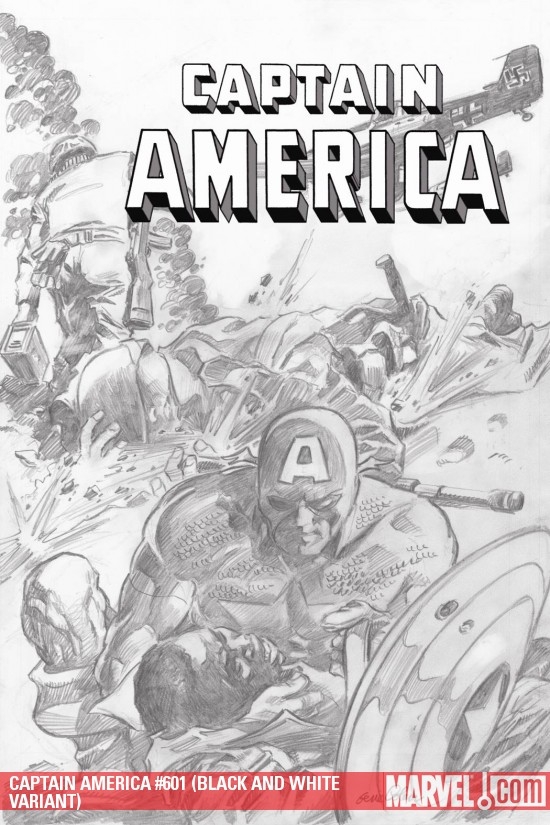
With Jack Kirby and John Buscema, Gene Colan was one of  the foremost comics artists of my youth. While Buscema worked in a somewhat more photorealistic version of the “Kirby style” — which was, for all intents and purposes, the Marvel house style — Colan’s work was utterly distinct. His figures had a balletic flow and propulsion unique to comics. Colan was the first comics artist I noticed; I distinctly remember reading an issue of Daredevil and staring at the art and flipping back to the splash page to find out Who drew this?

Somehow or other, Colan became counterculturally cool in the early to mid 1970s,  through the strength of his work and partly because of the odd raft of assignments he picked up from Marvel:  Daredevil (which eventually saw the character transferred to San Francisco and running into the hippie subculture), Tomb of Dracula (with a lead who was no one’s idea of a hero), Dr. Strange  (who applied Eastern mysticism to fight psychedelic threats), and Howard the Duck (an acidic anthropomorphic commentator on the ills of our society).  The supple action Gene Colan brought to all these titles pulled the reader through some very strange times.

cap601.jpgTwo years ago, Marvel invited Colan to draw Captain America #601. This represented a return to the home of his fame, and his final achievement.  Although the script (by Ed Brubaker) was weak, the trademark Colan flourishes were there:  forced perspective that grabbed your attention, fluidity of movement, and pencils so detailed that inks seemed superfluous. It wasn’t his best work, but it was strong, especially given his terrible eye trouble, and I was glad to see anything by him. My college-age son read it, though, and having no familiarity with this artist, said to me, “What’s with the lame artwork?” Because what has happened in the past 20 years in Marvel comics is this:  the photorealists have won. Comics are scripted and “drawn” to resemble film. Which is fine, but it means that with the passing of Gene Colan, we have truly seen the end of an era.
Booked out

June 20th, 2011

I just found out that while I was out of town, the bookstore where my daughter and our friend Steve and I have done Christmas wrapping for the past four years to raise money for Moving Arts… went out of business. I’ve grown to expect bookstores to close; I didn’t realize the trend was going to take our holiday traditions with it. Feels lousy.

The most hilariously offensive political ad ever

June 15th, 2011

Here’s an ad some nutjob named Ladd Ehlinger, Jr cooked up against Janice Hahn, who is running for Congress here in Southern California in a special election.

A lot of people were offended. (I know I was: Stupidity is offensive to the commonweal.) Here was his response:

“The DCCC and Janice Hahn demand that the video come down and that I apologize! My answer: No! I didn’t kill anyone. I didn’t even enable anyone to kill anyone. And… oh yeah: suck it! The ad’s funny. It makes me laugh. So if, for some reason, it’s pulled by YouTube, a thousand will be launched in its place all over Algorez’ Internetz. Because you’re only drawing more attention to your past of supporting criminals, Janice, and forcing policemen out of their jobs for doing their duty. So there you go. Claim victimhood all you like, but how many people were victimized by your coddling? There’s a reason Mayor Villaraigosa took the program away from you. He’s a Democrat. So are you. Think about it.”

Paraphrasing Lloyd Bentsen, let me say that I know Janice Hahn, that Janice Hahn is an acquaintance of mine, and that Janice Hahn is not a ho’ gunnin’ and runnin’ wif gangstaz. What she is is a successful city councilwoman, member of one of LA’s most storied political families, and almost assuredly her district’s future Congresswoman.

That said, why am I sharing this video? Because I still like to think that if you expose stupidity for what it is, most people will laugh it away. Not to overstate the case, Mel Brooks said that the best weapon against Hitler would have been ridicule, if only someone had used it. I don’t think this ad is going to get any traction (except on behalf of Hahn), but in the meantime it does make me laugh and it reminds me to be grateful for actual public servants.

A public service discussion

June 13th, 2011

Here’s the latest in a line of spoofs of the musical Spider-Man: Turn off the Dark. Setting aside for a moment my thoughts about the well-documented travails of that show (documented here and here and here and here and here and here and even here and now I’m thinking maybe this subject should have a tag all its own), let’s discuss something else I’m on about:  PBS.

Because I’m still trying to figure out why public tax monies are supporting, for example, Dr. Wayne Dyer.  And I remain unclear how Antiques Roadshow and its ilk serve any public need, especially given that shows very much like it are on commercial stations. But now I find that I’m turning against Sesame Street, too, because while I enjoy the clip below, I can’t find any educational justification for it. In what way is this different from things on the commercial networks Sprout or Hub? Why does it somehow make more sense to fund television programming than, for example, public education? Anyone?

Speaking of complainers….

June 9th, 2011

Speaking of people who “in the cosmic scheme of things have no problems,” I submit the current “debate” generated by Tony Kushner, the everything-award-winning playwright of “Angels in America” and many other globally produced plays, including “Caroline, or Change,” “A Bright Room Called Day,” “Homebody/Kabul,” “Slavs” and “The Intelligent Homosexual’s Guide to Capitalism and Socialism with the Key to the Scriptures,” which is currently playing off-Broadway. Evidently in a recent interview, Kushner said in passing that “I don’t think I can support myself as a playwright at this point. I don’t think anyone can.” Which ignited this controversy.

While I know that they are rarer than a royal flush, I have met some wealthy playwrights, including Stephen Sondheim and Edward Albee, and got to know one of them somewhat well, Jerome Lawrence. Jerry and his writing partner Robert E. Lee were responsible for “The Night Thoreau Spent in Jail,” “Auntie Mame” (which led to their further hit adaptation, “Mame”), and “Inherit the Wind.” Each of these was wildly commercially successful. From its premiere in 1955 until at least the early 1990s, there wasn’t a day that “Inherit the Wind” wasn’t in production somewhere in the world. Judging from his house alone, which Jerry had built on a bluff with a three-quarter view of the Pacific Ocean, the UPS man was arriving every day with boxes of more cash.

Granted, times have changed. But on the face of it, the idea that Tony Kushner can’t support himself as a playwright is ludicrous. His plays are in constant production around the world, his lecture fees are noteworthy, and I imagine he’s received any number of awards, fellowships, scholarships, and distinctions, that come with monetary rewards. (Note that I’m leaving out his screenwriting career.)

Kushner’s complaint strikes me the way movie stars do when they say about a pet project, “I did it for nothing.” What they mean is: They did it for scale (which every actor I know would be delighted to get), and for back end (which almost no actor I know gets). Jerry Lawrence was a playwright, not truly a screenwriter (although he had credits there as well), and made millions upon millions from his plays. Given all the productions “Angels in America” alone had, including the current one, plus all the productions from his other plays, plus print royalties, plus lecture fees (which are part of being a playwright), I find it hard to believe he can’t make a living. Perhaps what he means is that he can’t make the living he’d like to; that’s a different matter, and to that I’d note that I’ve yet to meet anyone, from my low-wage theatre friends to the two billionaires I’ve met, who felt they should have less.

After I posted this sentiment online, someone else weighed in with something even more to the point: “He can’t make a living as a playwright and he’s surprised? This is a joke, right? I once helped Tony Kushner move a daybed that he bought in Austria for $10k. I wouldn’t lose any sleep over his checking account or how he manages to pay his bills.”

Exactly right.

Hearing the things you say

June 9th, 2011

I haven’t posted on here in so long that for a moment I was afraid I’d forgotten the login.

Not sure why I’ve been absent. I last posted just before leaving for the Great Plains Theatre Conference, and I guess 10 days of constant talking and writing left me talked-out or something. At the same time, I’ve been stockpiling some things I did want to post here, so expect more frequency going forward.

While in Omaha, I led two playwriting workshops; served as a panelist on I think six plays; attended evening play performances; attended rehearsals and tech for my play, as well as the performance; and participated in the requisite bouts of drinking and cigar smoking.  I also petted a friend’s pet piglet (and here’s that photo):

leewithpig.jpg

I know — it’s difficult to see. That’s because my friend Max Sparber decided to get arty with the photo.  I guess that with photography, arty means you can’t see what’s in the photo.

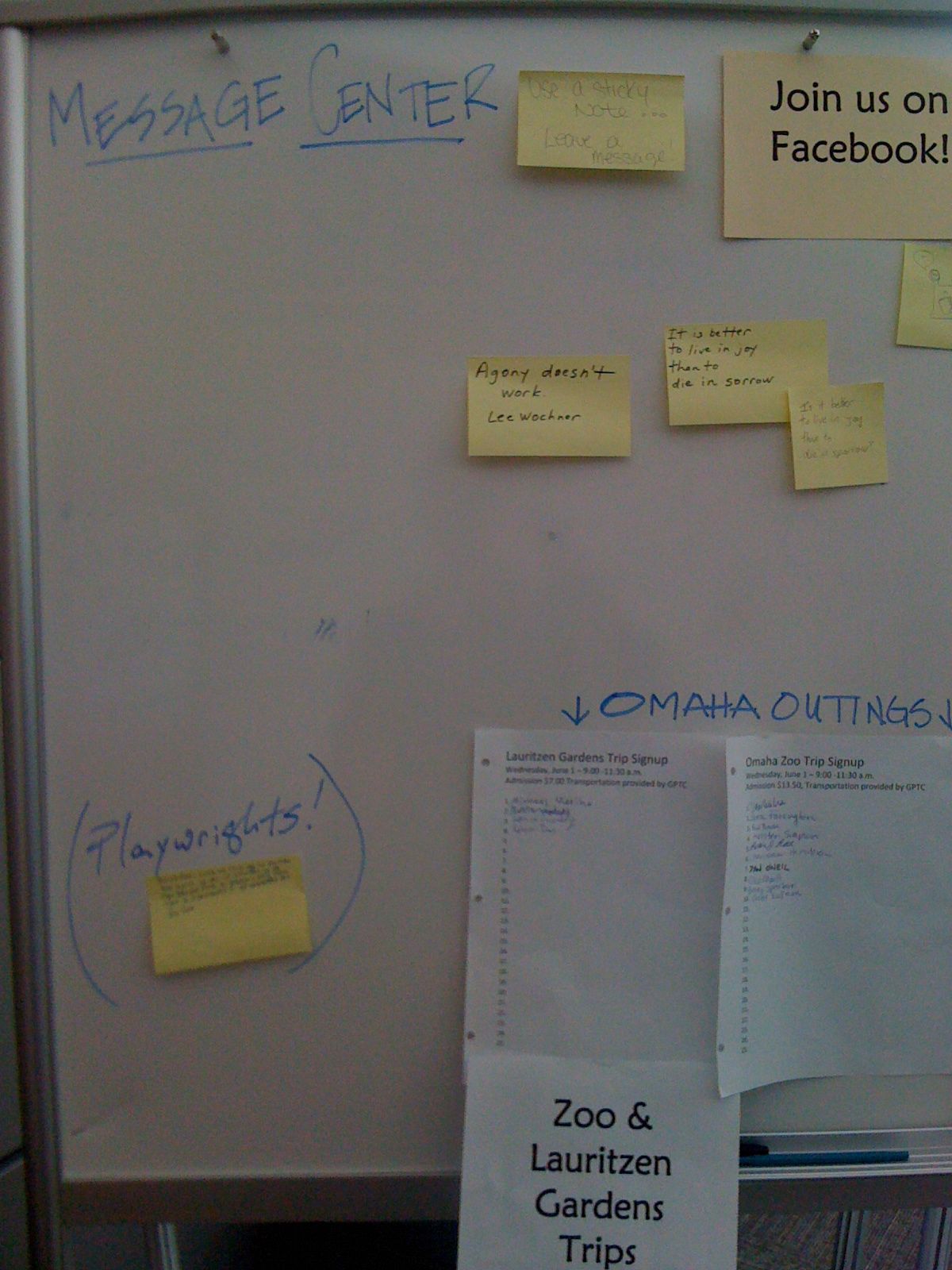
With all that walking around teaching and talking, you’re bound to say a few things over the course of 10 days. I’m pretty sure that in one of my workshops, “Starting at the Start,” I advised people to stop worrying about it and just write. I’m pretty sure I said that because I always say that, and for two reasons:  1) whining and complaining drive me crazy and I’m especially tired of hearing it from people who in the cosmic scheme of things have no problems; and 2) it’s unproductive. Whereas freeing yourself to just write, and edit later, often leads you somewhere good. Perhaps I stressed this philosophy of mine even more than usual, because here’s the quote I later saw posted on the conference whiteboard:

omahaagony.jpg

In case you can’t quite see that, it say, “Agony doesn’t work. Lee Wochner.” So I got quoted. At first I wasn’t sure what to make of this, but then I figured that since I evidently said it, I must agree with it. I thank the anonymous person who posted it, and wonder if it was intended as further inspiration to others, a reminder to himself, or a combination of both.  Or, since the message stayed posted for the remaining eight days of the conference, maybe no one bothered to notice.

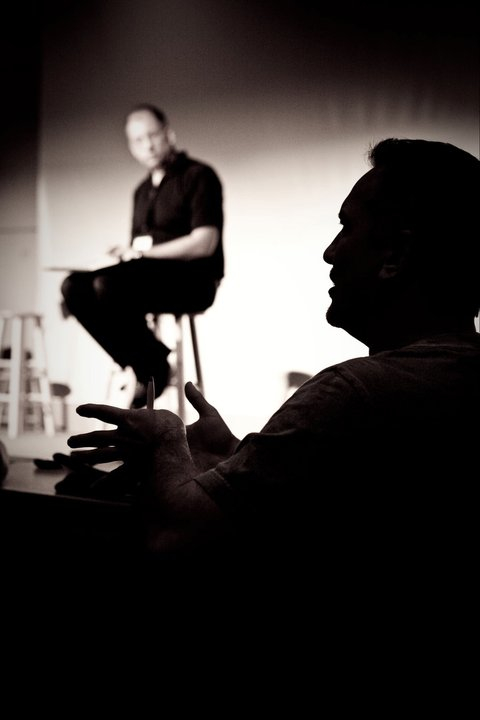
Courtesy of the conference photographer, here’s a photo of me in my official duties as a panelist, giving post-show feedback to a playwright. Note again the arty photography that inhibits seeing what’s in the photo.

leepanelist.jpg

A playwright in my workshop in LA saw this on Facebook and said I looked “very Citizen Kane-y.”

And evidently I said this, which I saw on Facebook because the playwright tagged me:  “Do what you want to do. You can have all your careers. Just make sure they’re all creative. – Lee Wochner.”

Yes, I remember saying this, and I think it was on the first bottle of wine. This was probably part of my discourse that we should “plan to live to age 120,” built around a speech I attended last year given by an osteopath, the gist of which was that because we can successfully replace more and more body parts, we should all make plans to be here a lot longer. (This did indeed go into my planning: I’m trying to get rid of things at an even greater pace, now that I understand just how long they’re going to be weighing me down.) Mostly, though, I was inveighing against pigeonholing; this young woman was concerned that people were trying to fit her into a specific box. Barring that mythic bus that may strike each of us out of the blue at any moment, we’ve all got plenty of time and options.

I left the conference on Sunday, and have been in southern New Jersey staying with my mother and family since then, at a low bubble in the local heat, humidity, and troublesome flying insects. More to come about the conference and other things soon. Right now I’m hearing myself say that it’s time to go back outside.

Gullibility test

May 24th, 2011

OK, so the Rapture wasn’t Saturday.

That hasn’t deterred Harold Camping, who now explains Saturday’s non-event in two ways:

  1. It’s actually been postponed ’til October (which is good for those of us who had summer plans); and
  2. It actually happened, but it was “a spiritual coming,” which means, again, that we’re still on for October.

I’m proffering three further explanations.

  1. He’s deranged;
  2. He’s a con man;
  3.  Both

In any event, what would be truly inexplicable would be for people to continue to listen to him. I like to think that if God had something to say right now, he’d choose a better vessel.