Unemployment, visually represented
August 24th, 2011Click here for a graphic (and frightening) visual representation of the spread of unemployment in the past four years. It’s deep, and it’s widespread.
Click here for a graphic (and frightening) visual representation of the spread of unemployment in the past four years. It’s deep, and it’s widespread.
There are two phrases that mean nothing to almost anyone else, but which have stuck with me most of my life: “Glx sptzl glaah!” and “Tlon, Uqbar, Orbis Tertius.”
The former is the baby-speak cry of Sugar and Spike in the comics of the same name by Sheldon Mayer. When the babies talk, all the parents hear is gibberish. But we lucky readers are privy to the rather sophisticated notions and outlandish schemes of these toddlers. If you’re wondering if this was unacknowledged source material for “Rugrats,” I suspect so. The first season of “Rugrats,” before rampant commercial needs overwhelmed creative impulses, was often wonderful. “Sugar and Spike” was consistently wonderful; even as an adolescent reader of mainstream superhero comics who groaned when some relative would mistakenly give him a “Richie Rich” or, God forbid, “Archie” comic, I was devoted to “Sugar and Spike.” And soon, very soon, you too will be able to share the joy: an archive edition will finally be released by DC Comics next month.

(By the way, I bought the issue above right off the stands in 1970. I was 8.)
“Tlon, Uqbar, Orbis Tertius” is a short story by Jorge Luis Borges that I first read almost 30 years ago. It concerns a massive conspiracy by intellectuals to plant the false idea that there is a secret world called Tlon, with a nation called Uqbar. Inserting this false information into encyclopedias and referencing it elsewhere helps to, in essence, create the actuality — just as the creation of fiction implants ideas in readers that sometimes become reality. (Who invented the satellite? Well, the notion came from Arthur C. Clarke.) The fact that this phrase has stuck with me for 30 years proves the point.
In other words, both phrases are about imaginary languages and secret meanings.

Which takes me to today’s Google Logo (shown above). I was thrilled beyond measure to see that it was an homage to Borges, born 112 years ago today. More about that Google doodle, and how Borges’ thinking led to the creation of hypertext links, can be found via this hypertext link.
To some degree, we are all of us privy to secret languages all around us every day, even when spoken in languages we purport to speak: the thrum of jargon and subtext and obscure reference. It’s amazing we can understand anything. To some degree, this is what all of Harold Pinter’s plays are about: that we understand nothing, while understanding everything all too well.
ProPublica’s Michael Grabell examines the top seven “truisms” you hear about the economy and the now-ended stimulus program — and finds that most of them are false.
Now that I’m 49, and getting a closer look at 50, I’ve decided that I’m making some changes. I don’t want to become set in my ways. I want to stay young and open to new experiences. I thought I’d start by just listing a number of changes I’m going to make.
I will be adding more to this list as time goes by. (Or I won’t. It’s up to me.)
I just found out that when PETA (People for the Ethical Treatment of Animals) gave Bill Clinton their Person of the Year Award nine months ago, they estimated that his new vegan diet spared the lives of 200 animals a year. So, put another way: Are they saying that Bill Clinton ate 200 animals a year? I mean, I know the guy had an appetite, but this seems preposterous. I’m wondering if someone over there did inhale. And did any press, then or now, question this? This is roughly one animal every other day. That’s a lot of animals, so they must have been small. Was he picking robins out of their nests? Tossing baby chicks into his mouth like popcorn? What’s the deal with this?
This video from Jon Stewart reveals again the herd mentality that is the press and the professional talking-points circuit. They’ve all anointed a troika atop the GOP nomination sweepstakes — Mitt Romney, Michele Bachmann, and Rick Perry — but it takes a TV comedian to remind us that Romney and Perry have won nothing, and that someone else — someone they ignore or mock — came within about 150 votes of winning. That guys name is Ron Paul (the name they shall not mention). While I generally disagree with Congressman Paul, he has more integrity than the other three put together and squared.
Last year when I flew back east with my family, a TSA agent detained my 12-year-old daughter to search her floral pink roll-on bag. While Emma stood there and cried, the agent pulled out markers, drawing paper, socks, and girls panties, but no weapons or explosives. None of the passengers seemed reassured that a terrorist threat had been averted. I know I wasn’t, and my wife was so angry that, if anything, the level of potential threat rose.
Yesterday while flying home, a friend and her family were similarly held up by TSA, this time so that her son could be frisked. Clearly, he is another imminent threat. (He starts kindergarten tomorrow.)
Good news, though: The TSA is further bolstering its training and its security measures. Now, in addition to frisking kids and pawing their gummy bears, they will chat up everyone in line. After an extensive two-week training course, they will employ new skills in casual interrogation and reading of “micro-expressions.” I don’t mind their reading my expressions — I’m going to make them no matter what — but here is my planned answer when they ask me what is the purpose of my trip: “None of your damn business. I still live in what’s left of America.” And then they can read the accompanying expression on my face.
If the Taliban or al Qaeda ever succeed in convincing middle-class Americans to strap their kids with explosives to blow up planes, I suggest that we just turn the country over to them, because truly they will have won, and deservedly so, because we will have abandoned all decency, all morality, and every shred of common sense. In the meantime, I think they should leave the kids alone and not grill us about where we’re going or why.
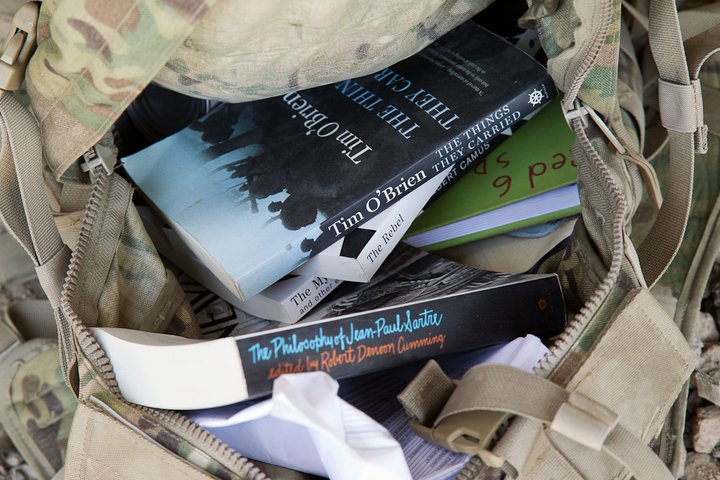
This little photo on Facebook is generating some traffic. It’s a shot of books in the backpack of a U.S. soldier deployed in Afghanistan. We can’t make out all of them, but I applaud the thinking behind two of them: Tim O’Brien’s “The Things They Carried” (which must be required reading in every college literature or creative-writing class, because everyone I know in one of those has read it) and “The Philosophy of Jean-Paul Sartre.”
I would add “Cat’s Cradle” by Kurt Vonnegut (and not, notably, “Slaughterhouse Five,” probably best left for reading when one isn’t actively deployed).
What would you add, if you were fighting a miserable war in a terrible faraway clime?
“Power concedes nothing without a demand. It never did, and it never will. Find out just what people will submit to, and you have found the exact amount of injustice and wrong which will be imposed upon them.”
So here’s the question: How come I know this quote from Frederick Douglass and, apparently, Barack Obama doesn’t? Because I have to think if he knew it, he’d heed it, instead of hoping to get along with people powerfully opposed to him.
I saw the new “Planet of the Apes” movie last night (“Rise of the…”) and absolutely loved it. (But then, I love all the “Apes” movies… with the exception of the execrable Tim Burton version.) One of the many delights of the movie were all the references to the classic film series, which many members of this Los Angeles cinema audience got. (When one of the characters cried out “Take your stinkin’ paw off me you damn dirty ape!” the audience broke out in applause.) The LA Times has helpfully compiled a list of all the new movie’s tips-of-the-hat to its forebears. Here it is.