Lee Wochner: Writer. Director. Writing instructor. Thinker about things.


Blog

Archive for the ‘Bukowski, Charles’ Category

The writing habits

Monday, March 23rd, 2026
I don’t believe in rules for writing. There are no rules to writing. No good ones, anyway.

Yes, you can bend the language — Chaucer did it, and so did Shakespeare, and Mark Twain, and thank God for them. You have my permission, and you should give yourself permission.

No, you don’t need to write every day. That’s some sort of constraint — a self-imposed dictate, someone listening to the advice of people who don’t themselves follow it. If it works for you to write every day, splendid. If not, don’t. My generous and inspiring teacher Jerome Lawrence told me that his friend Tennessee Williams, no matter how ill or hung over, wrote every day; fine, that worked for him, and I’m glad of that. But you don’t need to act accordingly.

You also don’t need to stick to one medium. (The people listed above didn’t.) Why was it that the University of Southern California was right for me? Because the graduate writing program actively encouraged writing in more than one discipline — which, as someone writing plays and fiction and essays and (very bad) poetry and also business writing I was already doing.

But I do believe in habits.

Habits can be good, and habits can be bad, but if you develop habits to your writing, they help you reacclimate yourself to doing the work.

At base, and setting aside the spiritual realm (whatever you may believe), we are made up of chemicals. So I believe in establishing the chemistry of what you’re writing, and how it will affect you, and re-establishing that chemistry every time you’re writing that thing.

That means:

Whatever you’re drinking when the writing is working, that’s what you’ll be drinking every time you’re working on that piece.

If you started out by drinking, say, orange juice, it’s orange juice you’ll be drinking every time you’re writing that play.

Sometimes, for me, that’s bourbon. I’m careful about that. Obviously, I won’t be writing a play in the morning if it requires bourbon; the ramifications of that sort of approach are well-known to followers of writers. My late friend Gerald Locklin, who was close to Charles Bukowski, said you had to catch Buk at the right time of day:  After he’d had one or two beers, but not too many. Much as I love Bukowski’s work, having known many alcoholics and seen how unhelpful that approach can be and also knowing myself and my own life, that’s not the path for me.

Although my current play does require bourbon so, yes, I work on it on Sunday late afternoons or evenings. It requires bourbon because I started with bourbon, and one way to stay unstuck is to reacclimate yourself into the environment of its creation.

The drink I strenuously don’t advise, at least for me:  coffee. I once wrote a play on coffee, and found I was going through half a pot or more in each session. I had the jitters for weeks. Never again.

(I’ve been writing all morning today, and you may be cheered to learn that I’m doing it via seltzer water.)

If you started with a nice cigar, as I’m wont to do sometimes, then a nice cigar is required.

If you started writing with music in the background, you queue up that music again. I’ve written 66 plays, some of them good and probably many of them pretty bad, and dozens and dozens of them have been written to music. Sometimes punk, sometimes postpunk, sometimes classical (thanks here to Glenn Gould in particular), once a particularly cherished album by David Sylvian and Robert Fripp that somehow transported me into a different state. People in the writing workshop I’ve led for 32 years now will ask, “How can you write while listening to music?” I tell them, “You don’t listen to it. It’s just on.”

If you’re writing outside, which I like to do (hence the laptop), then you’re better off always writing that piece outside. The outside-ness is part of the environment you’ve created.

Again, the goal is to recreate the environment in which you were succeeding.

By the way, real professionals do this in every profession. Some years ago, I read a lengthy profile of the swimmer Michael Phelps even though I have no interest in him or swimming or sports in toto. What fascinated me was Michael Phelps’ system:  his carefully orchestrated timeline for practice and for performance, the time he arrives, the time he puts on his trunks, the time he does warmups, and so on. His system is brilliant and inspiring, and he’s a true champion.

The other habit I endorse most:

Always stop in the middle.

In the middle of a sentence, preferably.

Because when you feel ready to pick it back up, you can start immediately by finishing that sentence.

I learned that a long time ago by reading a biography of Lester Dent, pseudonymously the Kenneth Robeson who cranked out a novel a week in the form of Doc Savage pulps while traversing the globe on a boat. Yes, the books were formulaic, but he was never stuck.

And finally: Don’t edit while you’re writing.

Editing is a judgmental process — a thinking process — and writing is a feeling process. If you’re editing while you’re writing, you’re sitting in judgment of what you’re writing, and that’s a wonderful way to sit back and assess yourself negatively. You’ll never finish anything that way. Every writer I know already has enough self-judgment; the only ones who don’t are the truly bad writers. Write your piece, then edit it. They are separate functions, and should be kept separate. Need some inspiration on this topic? I always recommend Natalie Goldberg’s book “Writing Down the Bones.” She’s smart and fearless.

Anything much beyond that in the way of writing advice, I’m suspicious of. The world is full of bad advice ready to disempower you. What you need to do is what works for you — what’s above is what works for me. But whatever habits you need, figure them out and stick by them. It’s easy to get stuck; habits, being habit-forming, make it easier to stay unstuck.

But, again, that’s my advice. So make of it what you will.

Not drinking with Bukowski

Sunday, March 10th, 2024

I’m at a small-bore writing retreat somewhere in a small town in middle America at a string of scrubby individual motel rooms like one used to see, or still sees in resorts near, say, Big Bear, California, where each room is its own little building. Nearby there are classic decaying school buses, shallow puddles, patchy grass, and what looks like a rundown convenience store with some gas pumps.

I’m standing out there with my fellow five writers when our special famous writing guest walks up: Charles Bukowski. He looks the same as from all the photos we’ve seen. Except he’s wearing crocs. And he’s not drinking or smoking. Also, he isn’t ornery, just contrary. And useless as a writing instructor. When it comes time to read the first attending writer’s work, we settle into a circle of chairs and Bukowski decides that he will read the work aloud with her, and when he does so, he reads his parts as he imagines various characters would sound, filled with bellicosity for men or an off-putting flutiness for women. He’s putting his all into his terrible theatricality, at the expense of understanding any of the material. He’s so delighted by his own performance that he goes on far too long, leaving the rest of us to worry that he’s never going to get to our own material — although I’ve begun to think that I don’t want him to read any of mine anyway.

Recalling all the well-known people I’ve met in my life and never got a photo with, when we break and start for some reason to move into the surrounding woods, I ask Bukowski if I can take a photo with him. (I don’t use the word “selfie” because I hate the sound of it and because I’m sure Bukowski will mock me for using it.) He says, “Sure. Let me show you how it will look,” and takes my phone and starts taking photos purely of himself, framed by the trees and murky pools of water. I say no, that I want to be in it too, and he reluctantly allows this. The other writers stand around in judgment because I wanted a photo.

Somehow or other, we’re now inside in a cafeteria and Bukowski is getting passive-aggressively interviewed by a reporter. It’s clear she doesn’t like him and now I don’t either. Where did his fire go? Is this really the person whose novels I gobbled down, maybe 15 or 20 of them? Where’s the fun? Now she’s remarking to him that he hasn’t written a book in 20 years, and why not? And I think, Well, for one thing, he’s been dead for 40 years. Then it hits me: Waitaminnit, he’s dead!

And then I woke up.

A man goes to the doctor

Monday, August 4th, 2014

That’s the start of many a joke. But you’ll have to tell me how funny you find this after reading it. This is a true story from a close friend of mine who is fighting cancer. My friend is doing well — he’s certainly in good spirits, and the scans he shared with me show great progress in treating the cancer.

My friend compares this situation to something out of Ionesco, and it certainly conjures up theatre of the absurd. But I think it would be funny if it weren’t depressing, or, maybe, depressing if it weren’t funny, so that makes it a bit more like Beckett. (Which I prefer on the stage, and not in medicine.)

Here goes:

OK, so even though I feel fine my Red Blood Cells and White Blood Cells and other things are completely out of whack.


One more transfusion (three units this time).  Hopefully I’ll be good for this coming Thursday.


Eugene Ionesco (the absurdist) comes to oncology


Arriving at Dr. M–’s office on Thursday I went to the receptionist’s desk and signed in as per usual.


Receptionist – Last name, please.


Me – [name]


Receptionist – Oh, you’re here for an infusion.  Just go right in to the center.


Me – No, I have to have blood drawn and see Dr. M– first.


Receptionist – I don’t see you on his schedule.  You’re just here for an infusion.  Go right into the infusion center.  Through that door there.


Me – No, I have a card that says I have an appointment with Dr. M–.  I have to have blood work done before the infusion and I have to see the doctor.


Receptionist – Well you’re not on the schedule.  Go on into the infusion center and they’ll draw your blood and take your vitals, and I’ll check with Dr. M– about seeing you.


Me – OK, but no one is supposed to stick a needle in me except George.


Receptionist – What?


Me – George told me that no one should put  a needle in me except him.  I am telling you what he told me.  Maybe you should check with him.


Receptionist – OK, just go into the infusion center and I’ll check with George.


Me – OK, thank you.


R– and I go into the infusion center and see the head nurse.


Me – I’m here for an infusion but I’m supposed to have blood drawn and then see Dr. M– before that.


Nurse – Uh, OK.  Have a seat and we’ll take your vitals and draw some blood and then we’ll see if Dr. M– is available to see you in here.


Me – OK.  George told me that no one is supposed to stick a needle in me except him.


Nurse – What?


Me – George told me that he is the only person who’s allowed to stick me with a needle.  I’m telling you what he told me.  Maybe you can check with him.


Nurse – OK, well take a seat and we’ll get your vitals.


We sit.  Nurse comes over with a tray to draw blood.


Nurse – It’s OK, I can do it.


Me – Uh, OK.


The nurse looks at my arms, chooses a vein in the left one, swabs me down and inserts the needle.


Nurse – There, that looks good.  Oh, the vein collapsed.


Me – George said he’s the only one who’s supposed to do this to me.


Nurse – OK, I’ll be right back.


She removes the needle, puts on some cotton and tapes it in place.  She leaves.


Ten minutes later . . .


Nurse – [name], go down the hall and see George.


Me – OK.


We get up and troupe down the hall, nurse in tow (I don’t know why) where George is waiting.  He sees the bandage on my arm.


George – What are you doing?  No one is supposed to stick you except me.


Me – I told them three times.


George – Never let them poke you.  Just come and see me.


Me – I told them.


George – If they tell you something else just get up and come down here and yell my name.


Me – They also said I had no appointment.


George – well you do now.


Nurse – he was only scheduled for an infusion.


George – He can’t be infused without seeing Dr. M– and doing his blood work.  That’s crazy.


No response.


We go into an examination room and I sit on the table.  The nurse sits down right beside me, looking at George as if to say, “OK, show me what you got.”


George pulls out a new needle and swabs, looks at the nurse and says,


George – You can go now.  I don’t need an audience.


Nurse – But, . . .


George – You can go.  You don’t need to be poking him anymore.


She leaves.


George – Don’t ever let them do this to you again.


Me – OK . . .


George picks his vein, inserts the needle, gets a good location and draws the blood.  No muss, no fuss.


The rest of the appointment went as usual.  Dr. M– came in.  We talked about Scotland, and movies and then he told me my blood work was in sad shape, and I wasn’t infused (as previously stated).  If I had let them do what they wanted to do I might be in very bad place right now.


George also told me to come and see him to put a needle in the next time I have a CT or PET scan done in the radiology center down stairs.  “Just come up here and I’ll put it in.  Don’t let them do it.”


Apparently George owns me now.

Ironic reading

Saturday, June 14th, 2014

A hilariously
pretentious
reading

(of a poem exalting
the commonplace)

and therefore
missing
the point.

Bukowski unbound

Friday, February 17th, 2012

Last night, my friend Jonathan Josephson’s theatre troupe descended unannounced on Barney’s Beanery in West Hollywood to perform several poems by Charles Bukowski. You can watch the performance below — and be sure to note the reactions of diners seated in and around the playing area. I understand their constrained response:  I’m not sure I’d want to be eating Barney’s signature chili dog while being accosted by an actor reciting “My Underwear Has Shit Stains Too.”

Something for your little pisser

Monday, July 11th, 2011

bukonesie.jpg

What would better suit your little cutie than this adorable Charles Bukowski onesie? Available in 6 colors, including “Asphalt,” and just right for that upcoming baby shower, this snap-shut one-piece for your little bundle includes a lovingly rendered image of the great man, as well this memorable quote:  “Sometimes you just have to pee in the sink.” All yours, for just 21 Buks.

Odd links in the literary chain of being

Monday, October 11th, 2010

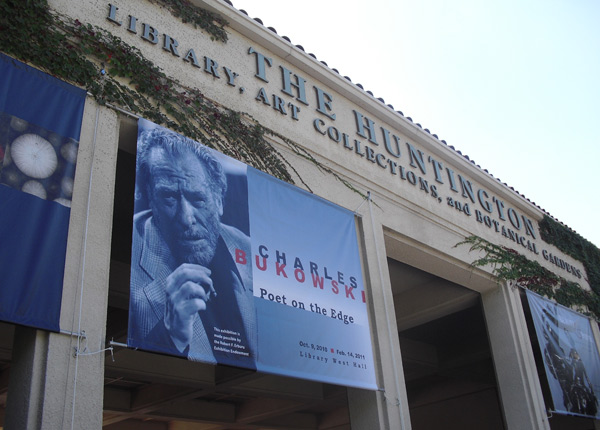
bukowskihuntington.jpg

Here’s something some of us never thought we’d see:  a major exhibition of Charles Bukowski’s work at a major, respected institution here in the U.S. I wonder if  the Times’ Carolyn Kellogg is trying to make something of the Bukowski exhibit’s proximity to a rare edition of Chaucer, as if to say, “Here is the work of a bum beside the work of an acclaimed artist.” I don’t think that’s her point — she seems too smart for that — and I certainly hope it isn’t. If anything, Bukowski owes a clear debt to Chaucer, as do Mark Twain and Hemingway and Carver and indeed every other writer in English who wrote in the vernacular. Chaucer invented that style. No Chaucer, probably no Bukowski.

I’m always glad to see it when academia and the forces of order working from their fortresses of solitude pry open their doors and let in someone new or underground, so it’s a delight to see Bukowski honored in this way. I’m not sure how he would have felt about it (half-embarrassed and half-exalted, probably), but I intend to ask our mutual friend Gerald Locklin. And I intend to go see the exhibit.

Upchuck with Buk

Friday, March 13th, 2009

bukowski.jpgY’know those celebrity tours where you can see Fred Astaire’s house, or visit W.C. Fields’ gravesite, or whatever?

Now you can go throw up where Charles Bukowski did. And visit the post office where he was infamously employed. And so forth.

And all for the “didn’t know there’s a recession going on” price of 58 bucks — which is about 53 bucks more than Buk ever had until the end.

Irony abounds.

Celebrating Bukowski

Monday, March 9th, 2009

The 1st Annual Bukowski Festival is this month in (where else?) Hollywood. Here’s the info:

bukowskifestival.jpg

bukowskifestivalback.jpg