Lee Wochner: Writer. Director. Writing instructor. Thinker about things.


Blog

Archive for the ‘Writing’ Category

Fourplay

Saturday, December 13th, 2008

Today I did something I haven’t done in at more than 15 years: I signed up for someone else’s playwriting workshop. This one-day affair was run by a very good friend and former student who confessed to me the other night that she was a little unsettled when she found out I’d signed up for it. (And I had thought she’d be hurt if I didn’t. Which shows why we shouldn’t make assumptions.) I assured her that I just wanted to be “anonymous playwright #7.” “I signed up for your workshop,” I told her, “because I already know what I think and I already know how I write plays, and I’m actually pretty tired of me, so I’d like to be putty in someone else’s hands.”

Which I was, and which I was glad to be. This workshop turned out to be just what I needed to do today:  unwind artistically, using someone else’s methods. It reminded me of fly fishing the first time under the tutelage of my friend the skilled master. And, as you’ll see, I got something else out of this workshop, something I hadn’t expected.

The workshop started in typical fashion for most things: waiting for the people who are late. Which always annoys me. Perhaps in 2009, I’m going to be consistently late so that people can wait for me. I was determined to be as unannoyed as possible by anything all day, so I checked email while pretending to be blase about waiting. (And the last person didn’t arrive until 10:52 — almost a full hour late. Glad we didn’t wait for her.) We got going by introducing ourselves and why we were here. Everyone had their own reasons, none of them far from mine: to change the workout routine. When it came to me, I volunteered that I was writing three plays at the same time and that I think they’re coming along well enough, but that I wanted to do something different for the day to get out of my head.

After a brief intro, we got the first writing prompt, which was: “Write an action. A single action: changing a lightbulb, changing a tire. Step one, step two, step three, step four.” “Plays are about action,” the workshop leader said (and I agree — good ones are, at least). Here was mine:

Starting my car:

Pick up my keys with my right hand. Put them into my pocket for some reason even though I’m going to fish them back out within a minute. (That reason being that I’m still afraid I’m going to drop them down a storm drain as I did once in 1984.) Find the car. If it is parked inside a parking garage, this is easier than ever because for five years and two cars in a row now I’ve made a point of buying a red car, having once lost a common grey-blue colored car in a parking structure in Pittsburgh for no fewer than two hours. Press the button on the key remote to unlock the car. Open the door, clutching those keys tightly so that, again, I don’t drop them onto the street or otherwise lose them. Throw my jacket onto the passenger seat. Get in. Close the door. Insert the key into the ignition. Hear music or the news as it comes on and if George W. Bush is on the news, immediately switch to a CD. Turn the key. Look in the rearview mirror. Look in the side mirror. Put the car into drive. Drive. Think about how much I love this car while driving.

(Just after I finished reading this aloud, that last late-arriving person arrived. Fifty-two minutes late, as I said, and now she had missed hearing what we’d read as well. “I’m so sorry,” she said, seeming not very sorry at all and, in fact, sounding rather casual, as though this were her routine. The way she said “So sorry” sounded like “Sue Sorry.” Later in the day we had a disagreement about what an unreliable narrator is (because, I think, she doesn’t understand the term), and I couldn’t help thinking that she exemplified one: saying she’s sorry when she isn’t.)

In any event, this little piece of unconscious writing clarified for me why I do that odd key thing: picking up the keys, putting them in my pocket, then removing them from the pocket less than a minute later when I’m near the car rather than simply carrying in my hand all along. I knew why I had the red car — to find it and because I like the color red and I like it on that car — but I hadn’t realized I’d internalized the 25-year-old lesson of how not to drop your keys down a storm drain. It’s unfortunate to be reminded just how self-programmed you are.

The next three prompts were drawn randomly over the course of the day from an envelope that the workshop leader had brought. We were to write a scene for each. The first prompt I drew said: “One of the characters is naked.” That stopped me for a few seconds, in which I conjured then rejected these three ideas:

  1. My former roommate Gary’s story about a boy they used to call “Puddin’ Pop” who lived across the street and who would run naked into the woods; I couldn’t see what to do with that
  2. someone who has been vomited all over and gotten locked into a bathroom while changing; again, it didn’t seem alive with possibility to me, and additionally drew forth in my head an image of Jim Carrey, a surefire creativity killer for me
  3. a couple having had sex and the one partner refusing to hand back the clothing of the other; this seemed too close to play I already wrote some time last decade.

And then I had it — something I liked that I could run with. It was a story I’d read long ago about two famous men, one that has lived with me ever since. And so I had great fun writing that scene for about 10 minutes.

We were then told to write a scene while thinking about “compression of time,” i.e., a ticking clock — an imminent deadline that drives the action. I drew the prompt “one of them has a gun.” As soon as I saw it, I realized it could work with the scene I’d already written. So I just kept writing that scene, but now introduced a gun, which took me to a very fun place.

Now we were told to write a monologue. I immediately had a monologue in mind for one of my characters, in which he could pass judgment on the other man to us, without fully realizing his own declining situation. (Which would again provide an opportunity to display unreliable narration.) I drew my last writing prompt, which was “father and daughter” and I remembered that the other character had had a daughter, and so now each of them would have a monologue.

By now, having completely tossed out the instruction to write separate scenes, I realized I was writing a play that I would indeed be writing to completion, I said to the workshop leader, “Damn you. I came here with three plays I’m writing. Now I’m writing four.”

Every one-day writing workshop should work like this.
The GREATEST poet that ever lived

Sunday, November 30th, 2008

saroyan-a.jpg This semester, I’m having immense fun team-teaching a survey class with fellow writers Christopher Meeks, S.L. (Sid) Stebel, and Aram Saroyan.
I realize you may already know this, but Aram is most famous for, secondly, being the son of William Saroyan, and, firstly, being the (in)famous poet behind the poem that first got the NEA into hot water politically, almost 45 years ago. Here’s the entire poem (no need to get comfy, it’s quick):

lighght

That was it. If you need further time, go on back and read it again and we’ll wait here.

Okay. Good. For more about this poem and the controversy it stirred, here’s the full story. Let’s just say that some people were outraged that taxpayers’ dollars were funding such work, and even some well-known and highly respected poets had responses to Aram’s early work that could be best summed up as, “What the fuck is this?”

However one feels about that, here’s how I feel every Monday night:  pretty fucking lucky because I get to hang out with Aram Saroyan. (And, make no mistake, Sid Stebel and Chris Meeks. But we’re talking about Aram at the moment.) Whenever Aram’s lecturing, I learn more in that hour than some people learn in their entire lives. A couple of weeks ago I stirred the pot by getting some students riled up about seemingly bad meaningless poetry just so we could see what would happen. The result was electrifying. Aram never lost his cool, proved that he knows his stuff, and didn’t bother to fall into the trap of defending poetry other people don’t like. “Maybe this isn’t for you,” was the gist of his response, but the general lesson was that he’s deeply schooled in literature and language. It was impressive.

So. Onto last Monday night.

After class, we faculty members usually go drink. (We are, after all, writers.) Somehow or other we got to talking about Aram’s name — that he’s known  for these accomplishments, including the rather strong-selling “Complete Minimal Poems” (which would take less time to read than this blog post, but which will live on far far longer). Aram would have none of it. Despite his produced plays, his widely collected and awarded poetry, his biographies of the Beats, his essays, his novels, his lineage, his personal association with other important writers, Chris and I couldn’t get him to see himself the way we do. Which, no doubt, is good.

So yesterday I’m on Facebook and still thinking about this discussion and I decide to add Aram as a Friend. So I search “Aram Saroyan.” Turns out he’s not on Facebook. But there’s a group devoted to him. Here’s what it’s called:

“The GREATEST poet that ever lived”

Here’s the link.

Here’s the description:

Aram Saroyan the author of the famous award winning poem, Lighght. We come together to support this amazing man.

You can see all of his amazing work here:

http://www.ubu.com/historical/saroyan/saroyan01.html

No, it wasn’t started by Aram. Or a relative.  It was started by a young woman in Washington, DC.

So I emailed this to Aram:

Subject: OK, Aram, TELL me you’re not so famous

On 11/29/08 12:25 AM, “lee@leewochner.com” <lee@leewochner.com> wrote:

There’s a frickin’ Facebook group DEVOTED TO YOU!

And it WASN’T started by you! (Some girl on the East Coast.)

And it’s called — drumroll please —

“The GREATEST poet that ever lived”

(Boy, you’d better NOT have started that!)

Here’s the URL:  http://www.facebook.com/group.php?gid=18400632419

No, I haven’t joined the group. I mean, don’t misunderstand, I like you, but there’s this Shakespeare guy, and I kinda like Rilke, and Eliot is pretty good… I’m sure  you understand.

I’m standing by my debt to Shakespeare, Rilke, Eliot, and some others (Whitman, Dickinson). But hey, as Aram jestingly suggested when he emailed back, maybe these other poets ultimately led to him.

Extinction in the theatre

Sunday, November 30th, 2008

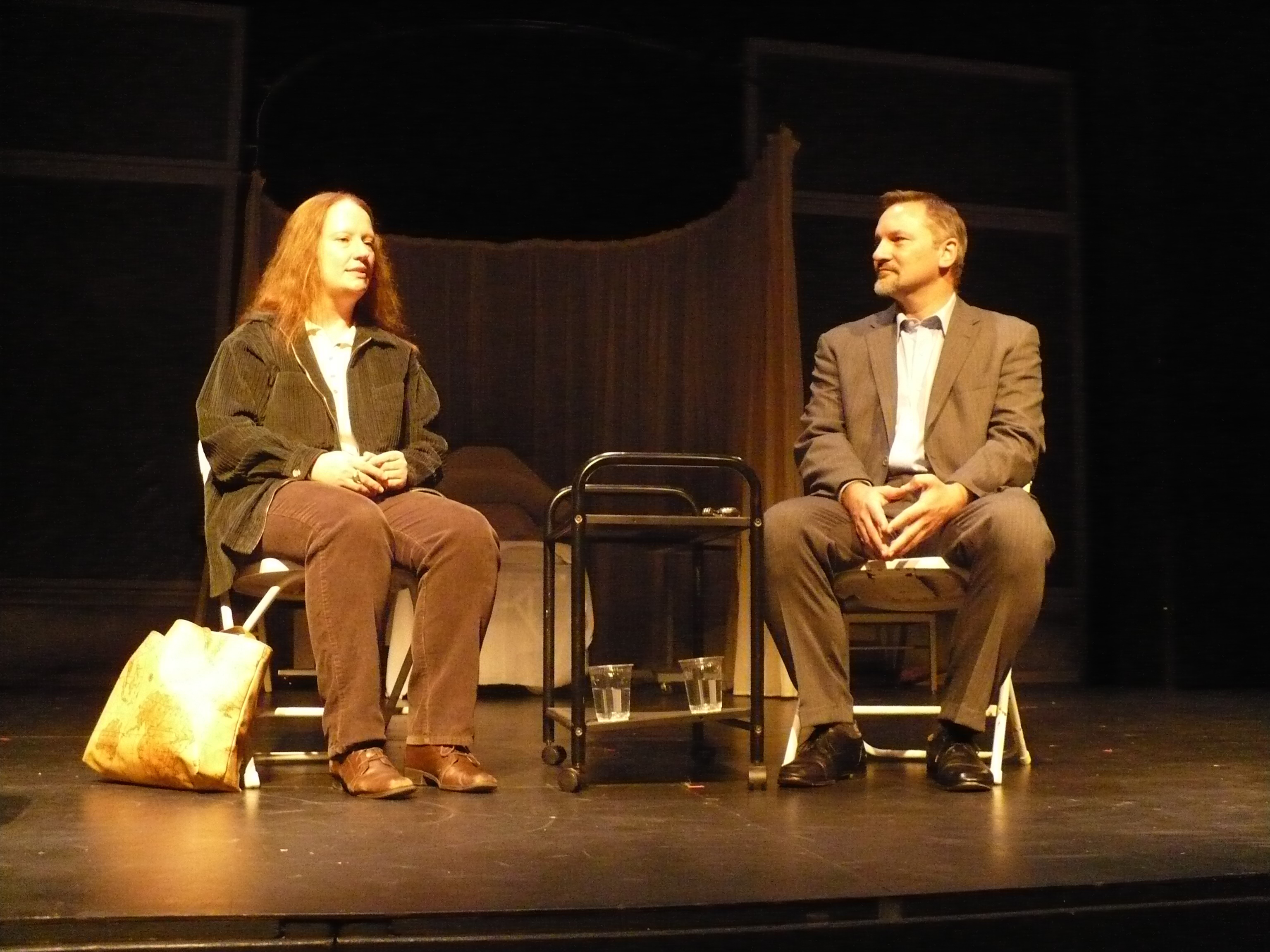
p1000603.jpg

Last weekend, I did a talkback with playwright and good friend EM Lewis after a performance of her play “Song of Extinction,” which she developed in my “Words That Speak” workshop. That’s us, above, while she ponders the answer to one of my questions. It may have been this one: “Your play is about extinction, and yet even plays like ‘Waiting for Godot’ and ‘Wit’ are life-affirming precisely because they take place in this live medium. It is called ‘live theatre,’ after all. In your play, we’ve got genocide, parental death, and species extinction. Is it still life-affirming?”

(And yes, that was pretty much the question. And Ellen’s unspoken answer may have been this one: “Why did I agree to do this with him?”)

Like Ellen’s writing, her answer was thoughtful, poetic, and unexpected. Her characters are entering a new phase after the play, she said, and so are we as a species. And she is hopeful.

The producers promise me that our 45-minute discussion, including questions and answers from the audience, was recorded for podcasting and will be uploaded soon. When it’s available, I’ll let you know. In the meantime, I’m going to once again highly recommend this play (this time after having actually seen it). Ellen’s play is smart, funny, and packed with meaning, and the production is filled with terrific performances, especially by Michael Shutt, whose work always blows me away. (I have directed Mr. Shutt, and he’s directed for me — now I need to get him cast in some of my plays.) The show runs through December 14th. Info and tickets available here. I’m very proud that this production at the lovely John Anson Ford Amphitheatre is by Moving Arts, the theatre I proudly serve.

Join me this weekend

Thursday, November 20th, 2008

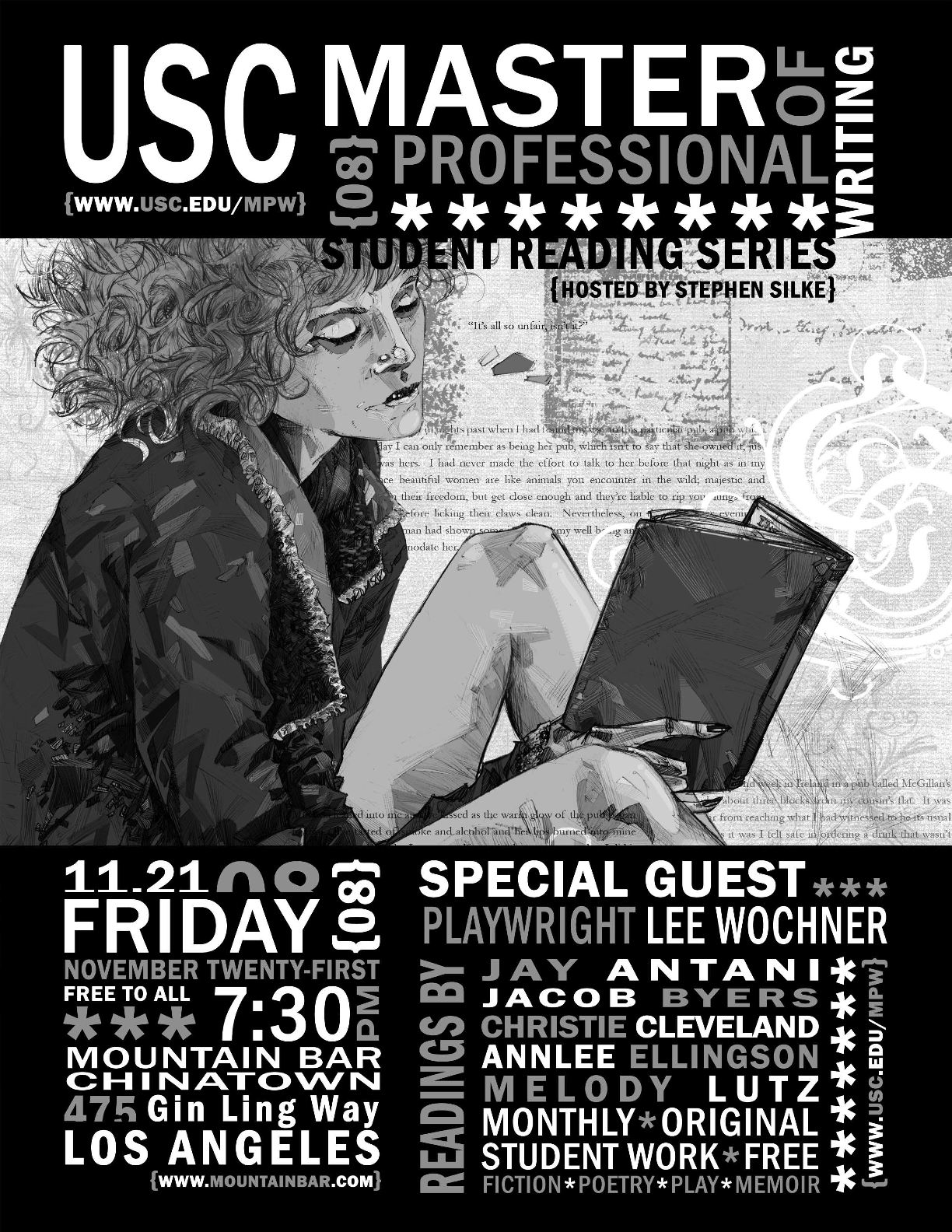
 mpw-reading-poster-nov.jpg

Tomorrow night at 7:30 I’m doing a reading downtown as part of the USC Master of Professional Writing program reading series. The reading is in a bar, so in the fine tradition of Charles Bukowski and any number of Irish poets, I have high hopes for this. The bar’s website (the URL of which is unfortunately wrong on the flyer, by the way — it’s actually www.themountainbar.com) promises “bleeding walls,” which is something I last saw in a Takashi Miike movie. I think if they were to bleed while I was reading, I would find that distracting. Anyway, please join us for this. Previous student readings have been fantastic, and hey, drinks are available. The address is 475 Gin Ling Way, and no, I have no idea where that is either, but that’s why we have mapping technology.

My friend EM Lewis’ terrific new play, “Song of Extinction” is currently running at the John Anson Ford Amphitheatre’s Inside the Ford venue in a production by Moving Arts. Ellen (that’s what some of us call her) is a gifted playwright and I’m proud to say this play was written in my workshop. The production is populated with theatre friends I’ve worked with for many years, every one of them fiercely talented — so I’m going to take the risk of vouching for this sight unseen. But hey, why don’t you be the judge? This Sunday at 5, I’ll be moderating a post-show discussion with the playwright, and the producer (another longtime theatre ally, Kim Glann), is offering a 20% discount to readers of this blog; just enter the promotion code SONG when you click here to RSVP. And students with ID are $12, so yes, USC student, this means YOU should come join us. Ellen is a graduate of that program of ours.
Stumbling into the deep woods

Saturday, October 4th, 2008

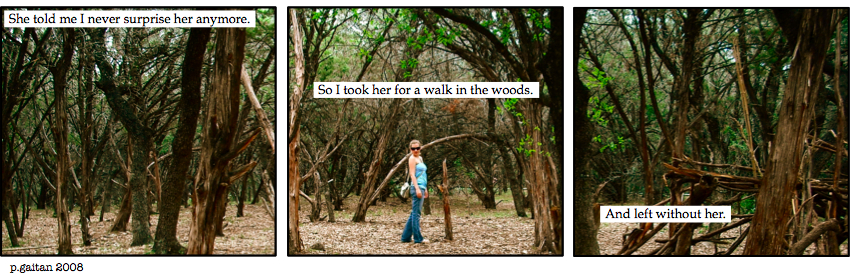
Earlier this year I wrote a short play called “About the Deep Woods Killer.” If you think it was about the Deep Woods Killer, you would be wrong — it was more about his now-grown son and the emotional wreckage he’s inherited, and it was perhaps even more about a young woman he meets who is strangely drawn to troubled men. (And, indeed, the full-length version I’m now working on is called “Troubled Men.”) The story is very loosely based upon the Green River Killer, whose story I came across on MSNBC in my hotel room in April. The Green River Killer lured women down by the river and killed them. This went on for 20 years. Estimates of his rampage vary.

I changed the setting from river to woods because while I know something about rivers, I grew up in the woods. To me, the river is metaphoric for journey (think “Huckleberry Finn”), while the woods are metaphoric for the subconscious, and how deep you can go. (Here’s an old logic puzzle:  “How far can a dog run into the woods?” “Halfway. After that, he’s running out.”) In my play, nobody’s getting out — but they do go deeper. Hence the woods.

A minute ago I was Stumbling around the internet and found the image below. Stumble promises to find things on the Web that you’re interested in but which you didn’t know about. In this case, I experienced a frisson when I saw the image. I know someone did it for a lark — it’s posted on some “humor” page — but given my play, I read it differently.

deepwoods.jpg

A writing anniversary

Friday, September 19th, 2008

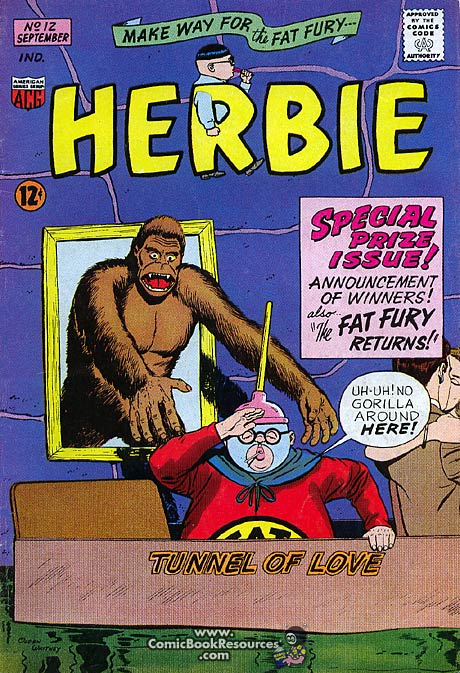
herbie12.jpgForty-three years ago this month, a friend of mine got his first writing credit. It was in a comic-book, and it was the weirdest (and possibly best) comic book ever: a sophisticated absurdist comic called “Herbie.” Herbie was a fat little boy who was viewed as worthless by his father, but who was capable of seemingly anything, including flight, magic, communicating with animals, traveling in time, serving as lady’s man to Cleopatra, and dryly solving the world’s problems while slowly sucking a lollipop. Given the theme and the audience it spoke to, I’m surprised this comic was ever canceled.
For the September, 1965 issue, the winners were announced of a contest to plot the latest adventure of Herbie. One of the prizes went to a guy named Marv Wolfman, who later created Blade the Vampire Hunter, most of the New Teen Titans, and many of Superman’s more memorable supporting characters of the past 30 years, who created the newly definitive Lex Luthor (not so much an inventor of easily smashed giant robots, but rather a supremely immoral corporate raider who later becomes president), and who at one time was editor-in-chief of Marvel Comics. Marv Wolfman is the guy who came in second. The guy who came in first was my friend Rich Roesberg.

Here is Scott! Shaw’s remembrance of Herbie, and that winning story.

A better name for Larry

Thursday, July 31st, 2008

I think my friend Larry Nemecek’s name is fine. It’s his blog that needs a new name.

Larry is acknowledged as the world’s foremost expert on “Star Trek.” (Note to my modest friend Larry: “Who acknowledges you as that? Me. So there.” Me, plus all the people who put his book “The Star Trek Companion” on the New York Times bestseller list, plus all the readers over the years of his other books and magazines, including “Star Trek Communicator.”)

Larry is smarter than I’ll ever be about “Star Trek.” Perhaps too smart: He’s named his new blog about all things TrekCheck the Circuit.”

Huh?

Oh, yeah. Larry informs me that that is the very first line of dialogue ever spoken on “Star Trek.” (It’s in the background in the first scene of “The Cage” and is spoken by Mr. Spock.) Of course.

Like me, you might think this reference too arcane for a) anyone under 45, and b) anyone who also has other interests in life. Both of which would disqualify 99.9999% of the people I expect to be seeing the new “Star Trek” movie when it comes out. Or, as I like to think of them, new people who might become interested in my good friend Larry’s blog.

So I entreat you: Help me come up with a new name for Larry’s blog.

Ideally, it should reference “Star Trek.” (Which, sorry Larr, “Check the Circuit” doesn’t quite do.) Larry is widely known in his field, and he deserves a great blog name. Anything less and he should just pick one of the two blog names I suggested:

  • “LarryNemecek.com”
  • “Fred.”

The politics of reading

Friday, June 13th, 2008

Here’s my friend and colleague Shelly Lowenkopf on the top 10 political novels.

In the future, this book might show up on a revised list, one that includes fantasy.

About my deep woods killer

Friday, June 13th, 2008

ma-2008-oaf.jpg

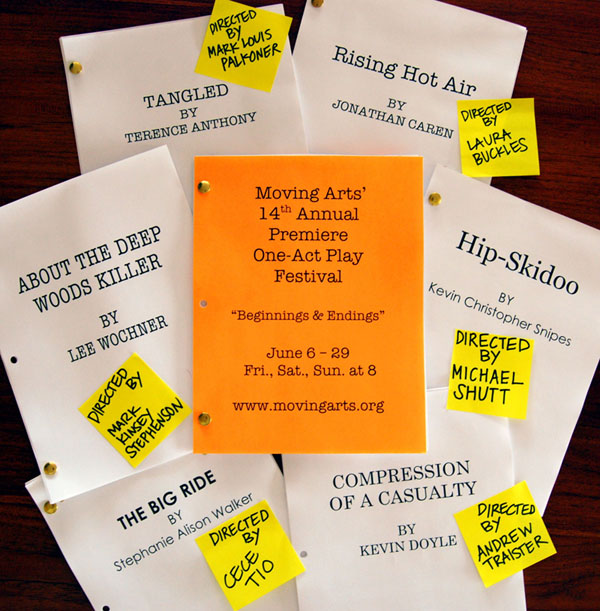
I’m very happy with how my one-act play, “About the Deep Woods Killer,” has turned out in the 2008 Moving Arts Premiere One-Act Festival. It’s a tribute to the cast, to everyone involved in the production, and especially to the director, Mark Kinsey Stephenson. Mark really understands the undercurrents in the play and has worked with the actors to express them. If you’ve never had a bad or mediocre production (and I have), you can’t fully understand how invaluable it is to have a director who understands your play and, in Mark’s case, your overall body of work — and who also has the talents to bring that vision to the stage. I’m grateful. Mark and I have been doing theatre together for 15 years; he’s directed my plays before, has acted in my plays, and I’ve directed him several times, as well as producing plays he’s been in. We’re a good match. If I’m lucky we’ll be doing theatre together for another 15 years, and beyond.

In the same festival, I think Terence Anthony’s play “Tangled” is a standout (and is a play I’m going to blog about later today or this weekend, when I have a chance), and I’m quite taken with “Compression of a Casualty,” which marries an Ionesco-esque device with  contemporary CNN coverage of the death of a U.S. soldier in Iraq, to great effect and, to my immense thrill, into an indictment of the timid and celebrity-obsessed mainstream media. I’m glad we’re doing that play, and I’m delighted to see the inestimably talented Michael Shutt prove, yet again, that he’s among the most versatile theatre artists I know.

The festival runs three more weeks. Here’s more info, including ticket information.

All of yous

Thursday, June 5th, 2008

Y’all.
Youse.
You-uns.
You guys.
All of you.

These are just some of the regionalisms that Americans use to substitute for the lack of a different plural form of “you” in English. My favorite is the one employed in my mother’s hometown of Johnstown, Pennsylvania:  “Yins.” Yes, Virginia, there are many thousands of people in the Pittsburgh area who say “yins” when they’re addressing a group of people. My theory is that “yins” is a further contraction of “you-uns.”

Even though in my own speaking voice I use just “you guys” and “all of you,” I love every one of these locutions. For playwrights, they’re useful baubles to adorn characters with. But until yesterday I had forgotten one, and shame on me. Spending the day in Philadelphia, and seeing the Bill Irwin show “The Happiness Lecture” – developed with an ensemble of Philadelphia theatre artists – reacquainted me with one of the best plural-you forms in the country. Here it is, and no, I’m not making this up, and please keep your mind out of the gutter:

Yizz.