Lee Wochner: Writer. Director. Writing instructor. Thinker about things.


Blog

Archive for the ‘Thoughts’ Category

Happy Creation Day!

Tuesday, October 24th, 2006

GodLet me just add to the day’s festivities by saying “Happy Creation Day!”

Yes, it was a mere 6009 years ago today that God created the Universe, as revealed in the 1600’s by Bishop James Ussher.

It might have been a Tuesday.

For the Mayans, and converting the esteemed Bishop’s research, this great work occurred on 2.5.3.14.0 13 ‘Ahaw 8 Yaxk’in. (Today being 12.19.13.13.7 13 Manik’ 0 Sac, but you knew that.)

But while calendars can read the date differently — and while some would call the whole thing into question claiming that the “fossil evidence” refutes the entire claim — none of us should take such a day lightly.

So what have we learned in the past 6009 years?

We’ve learned this about God:

  1. God is ever-present — except when He isn’t.
  2. He is a benevolent God — except when He isn’t.
  3. He is on your side — except when He isn’t, and that’s because of you. It’s your fault somehow.
  4. Sometimes when you think He isn’t on your side, He really is — He’s just trying to teach you a lesson, which you later absorb if you are faithful enough to understand.

These seeming contradictions are self-clarifying when you give them enough consideration. Skeptics may have a hard time reconciling people who, say, narrowly escape the wrath of Hurricane Katrina and “Thank God” for their rescue, while never “blaming God” for the hurricane in the first place. The hurricane was a test — which they passed — and those didn’t pass may have been part of the lesson for those who did.

We’ve learned this about Creation:

  1. No matter how bad you think it is, there’s someone who has it far worse. And that is worth remembering.
  2. It’s pretty big. No matter how much you travel, you can’t visit all of it.
  3. Most things that seem incredibly important at the time — like LonelyGirl 15 — really don’t matter at all.
  4. There is just about no place to park.
  5. For the most part, it is what you make of it. Is it a miserable place? That probably started with you.

So today is a day for celebrating. If you’re reading this: You’ve made it!

At least so far.

Boldly going where space opera rarely has gone before

Monday, October 23rd, 2006

A nifty little piece in today’s LA Times about Battlestar Galactica and its fictive relationship to the Iraq war (and others). There’s nothing revelatory in it — and you’d have to be flatlined not to get the obvious parallels in the storylines — but it’s worth reading if, like me, you’re drawn to the basic survivalist theme of the show:  How much will you sacrifice to survive, and what must you never sacrifice in order to save your humanity?

Friday night’s episode was especially gratifying for two little bits of character work:  Tigh’s poisoning of his own collaborationist wife, and Thrace’s reaction when she learns that her “half-Cylon daughter” isn’t actually hers at all.

The former was expected; the resistance had provided exactly what the colonel needed (an obstructionist mission that kept him off the sauce and on-goal). But Michael Hogan’s portrayal was beautiful and moving in depicting just how much the colonel was giving up by putting down his leggy blonde wife: given that his post-torture character is now a lame one-eyed old wretch, it’s doubtful there are many romantic relationships in his future.

Perhaps even better was Katee Sackhoff’s response when someone else on Galactica thanked her for having rescued her child, which Sackhoff’s character had thought was her own.  Her expression in handing over the little girl was a rolling tableau of shock, hurt, and humiliation. I used to see that face on people in bars just before they threw up in the parking lot.

Lessons from today’s LA Times, Part 2

Sunday, October 22nd, 2006

I’m beginning to think we’ve lost all sense of proper accountability and justice.

On the one hand, no one can seem to convict Robert Blake or O.J. Simpson or what seems like a host of other celebrities charged with murdering their spouses or companions by express design. (And we’ll see how Phil Spector makes out, when that finally goes to trial in January 2007, almost four years after the incident.)

On a larger scale, we have a civilian administration that appears to have deeply lied to the military, from top to bottom, and which is responsible for the death and damage of thousands of U.S. troops — not to say hundreds of thousands of civilians overseas. This same administration routinely overturns or subverts or rewrites either the Constitution directly or any number of underlying principles, habeas corpus being only the most recent example. And yet at least so far there seems to be little direct prosecution of these actions and not enough outrage.

On the other hand, a jury in Los Angeles yesterday convicted an 89-year-old man of felony manslaughter for “running down and killing 10 people at the Santa Monica Farmers’ Market.”

From the Times:

UCLA law professor Peter Arenella said the jurors’ difficulties suggested that they simply could not accept that ‘human life can be lost in a tragic accident where no one is at fault. The jury finds it hard to believe there might be a noncriminal explanation for this.’

I wasn’t on the jury, but I have a noncriminal explanation for this: mistake. Confusion. Accident.

If I had been the mother whose three-year-old child flew from her arms and to her death, I’m sure I would feel differently. But I can’t bring myself to believe that George Weller intentionally sped through the marketplace with the intention of taking out as many bystanders as possible. In fact, as someone whose van was grazed last week in the parking lot at Albertson’s by a thoroughly distracted and seemingly stone-deaf mummified husk of a woman who didn’t see us and didn’t respond when I blared the horn and tried to get out of the way, I think the true culprit is the system that licenses the elderly and performs no further checkup.

Of course, applying that logic, the true culprit of the malicious malfeasance in Washington would be the people who allowed them into power.

Lessons from today’s LA Times, Part 1

Sunday, October 22nd, 2006

On the cover of TV Times, beneath a photo of Sam Neill, scowling and unrecognizable in some PBS period piece, the caption reads “Veteran actor Sam Neill stars in…”

When did Sam Neill become “veteran actor” Sam Neill? He just turned 59. What does “veteran actor” mean? And is this particular “veteran actor” happy about this designation?

I seem to recall “veteran actor” being euphemistic for “grizzled old character actor we’ve all come to respect.”

Lurch

Saturday, October 21st, 2006

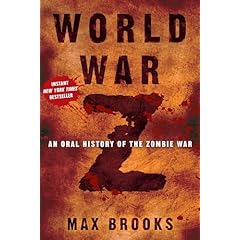
Ninety-nine pages in, and the zombie war is not going well — at least for me. As an “oral history,” the book constantly shifts interviewees — we’re listening to a former Pakistani now in Iceland, or a mercenary who high-tailed it out of Long Island, or a doctor in mainland China. This makes for a travelogue of adventures you weren’t invited to. With every new interview, I wish the book had been written as a straightforward novel, so that we could follow a handful of people and not only witness the events from their perspective — but also grow to know them through their experiences. Instead, this book is like speed dating: Just when you get to know someone, the bell rings.

If you’d like to see if you disagree, click here.

Fowl play

Saturday, October 21st, 2006

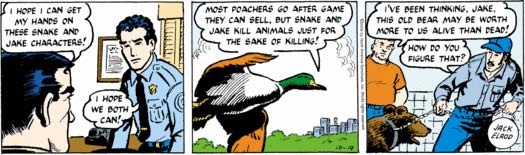
If only there were disaster movies about giant talking ducks! (As seem to exist in “Mark Trail.”) What city is that being attacked? Will Jake and Snake be able to evacuate that bear in time? Who is “Jack Elrod” and why is his name on a bowling ball?
i061019marktrail.jpg

On cinematic apocalypse

Saturday, October 21st, 2006

The past several months I’ve been watching apocalyptic disaster films with my four-year-old son and eight-year-old daughter. We started with “Last Man on Earth,” in which Vincent Price stars as the eponymous enemy of vampiric zombies (or zombie-like vampires) who slowly and ineptly stalk him at night. For the kids, the most memorable part is when Price finally finds some companionship in the form of a bedraggled poodle — until he discovers that said poodle is also infected and he has to put it down. (My daughter especially seems to think the movie is about the poodle.) On a scare level, even given that the film features nominally flesh-eating undead, the film rates a zero even for young children, who endlessly roam the house muttering, “Morgan… come out…” in a caricature of one of the scenes.

After we had exhausted the charms of this odd little film — in the end, Price winds up battling what seem to be mutant humans who are introduced far too late — I figured we’d move on to “The Birds.” Still somewhat scary, still in a sense apocalyptic. Not having seen “The Birds” in 30 years or more, I had forgotten two things:

  1. That for the first half it’s a tedious romantic comedy built around the misadventures of a man who wants to buy lovebirds and the woman determined to deliver them to him;
  2. That the ending is lame — and as you find out from the bonus DVD feature about that ending, evidently Hitchcock or the studio or both decided that the true ending would have been too expensive to film… so they just didn’t.

Still, for that brief period of the movie (half an hour?) when the birds are truly on the attack, the kids (this time including my 15-year-old son) were held in its grip. Apparently, birds can kill schoolteachers, pluck out farmers’ eyes, peck through roofs, blow up gas stations and, I guess, if truly pissed, unleash a torrent of birdshit all over you. All of this made an impression.

What is more powerful than flocks of antagonistic birds? Try a swarm of killer bees, as seen in “The Swarm.” This time, there was action throughout, starting with the murder-by-bee of a picnicking mother and father while the son helplessly watched from within the car. Now the kids were riveted. Bees are evidently far more destructive than zombies, birds, or whatever election horseplay Karl Rove can cook up: Bees can derail trains, blow up nuclear power plants, and decimate Houston.

So, what’s next? We watched “The Omega Man,” but this didn’t go over so well, I think because of the testosterone-amped Charlton Heston’s character. After the relatability of Vincent Price’s zombie chores — find them, stake them, haul them to the dump, burn them, much like cleaning the kitchen and taking out the trash — Chuck Heston’s zombie war was clearly high fantasy. It just didn’t carry the threat of dad getting really mad.

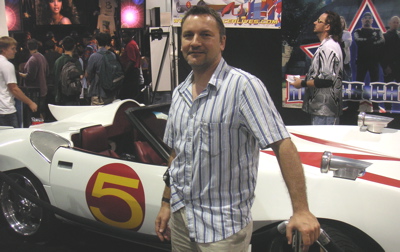
Mach 5So lately we’re watching “Speed Racer.” For one thing, since the lease on my Mustang is up, I think it’s going to be my next car. For another, Spritle and Chim Chim are clearly the heroes of the show — something my kids relate to. (While they don’t hide in the trunk and jump out at key moments to save their older brother, they do like to get into my wife’s minivan through the hatch.)

Once “Speed Racer” is exhausted, I think we’ll move on to other forms of disaster movies, starting with “The Poseidon Adventure.” Or, if we want to see a disaster of truly magnificent proportion, we’ll just rent the recent remake.

Not so Funky

Thursday, October 19th, 2006

Well, I’ve checked Funky Winkerbean every day since, and there’s been no further mention of “the day I’d never forget” (and no further appearance of that character), so I’m chalking it up to an acid trip by the artist.

In the meantime, I’ve talked myself out on the Funky junk — brought it up in my class at USC on Monday night, brought it up last night in my workshop (and I think I’ll spare my Saturday workshop), and generated alarmed stares from my family, who somehow don’t see the incredible importance of correctly depicting the timeline of comic books as cultural markers.

But it is important. Verisimilitude is part of what lends power to literature. Art doesn’t have to be literal — witness Guernica — but it benefits from being specific. Funky may not be art (clearly), but it even fails as pop art because its interior universe is so wrong that everything is called into question.

It’s better to get it right. Asking the right questions — who, what, when, where, why, how — of the universe you’re creating leads you to new and interesting answers. Not asking the questions leads to cliche, sentimentality, and weakness.

Get yer story straight

Monday, October 16th, 2006

funky061015.jpgDidn’t realize I had so much in common with Funky Winkerbean. I can relate to this origin story, from the 10/15 Sunday strip: “After (reading that first comic book)… the world was never the same!”

Except certain things about the execution of this strip fill me with doubt. For one thing, the comic he’s rhapsodizing about doesn’t belong with the other comics it’s shown with.

The comic he’ll never forget — Action #242 — debuted in July of 1958 and introduced both Brainiac and the bottle city of Kandor. But shown alongside it is an issue of Archie’s Mad House — and that title didn’t debut until 1959. I know that sometimes comics distribution was spotty and slow, and perhaps the Action #242 hung around unbought, but how to explain the Captain Marvel #1, which debuted in 1968 — a full 10 years later?

You’ll also note that the cover price of Captain Marvel #1 was 12¢. In 1968, comics went to 15¢ (making this one of the last 12¢ issues). When had they last been available for 10¢? Try 1962. The cash register in panel five shows a sale of 10¢, which is correct for Action #242, but again, it’s displayed alongside a comic from 10 years later that would have cost more.

In the background of the same panel, one sees a poster for the community Halloween Party, meaning that this is set in October. The issue of Captain Marvel shown would have been distributed in August — so this particular issue would have been pulled and replaced twice in this timeframe.

So… what year is it supposed to be here? Or are we supposed to think that the drugstore (and its distributor) kept comics lingering on the same spinner rack for Ten Years?

Also, whether it’s the 50’s, or the 60’s, what era is this kid’s weird clothing ensemble from? One could charitably say late 60’s / early 70’s, in vogue with the then-counterculture, except in panel 3 it looks as though his jeans are either cuffed or rolled. (Rather than no cuffs, and flared.)

Along a similar line, note the druggist’s eyeglasses. They don’t look 50’s. Or 60’s. They appear to be from the 1970’s.

Why is any of this important?

Because all of the details are wrong, they make the entire story unbelievable. This mishmash of bad facts leads me to only two possible conclusions: The narrator is either a liar manipulating an unseen audience member, or he’s seriously brain-damaged. Ordinarily, I don’t follow Funky Winkerbean. But now I’m going to, just to see which theory is true.

The third potential scenario would take us outside the strip: that the cartoonist didn’t care enough to get it right.

Miscommunication

Saturday, October 14th, 2006

Think it’s obvious what you’re saying (or writing)? Read these instructions for surviving a terrorist attack.