Lee Wochner: Writer. Director. Writing instructor. Thinker about things.


Blog

Archive for the ‘Thoughts’ Category

Not Steve Allen

Tuesday, November 14th, 2006

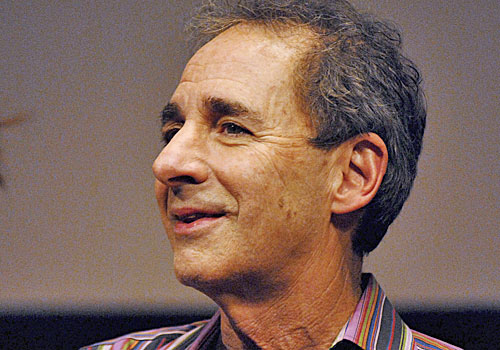
shearer.jpgClick here for a nice profile on Harry Shearer in today’s LA Times. (And do it fast, while the paper is still in business.) I’ve been a Shearer fan for a long time. I can’t think of anyone who qualifies as the Steve Allen of this generation, but Shearer probably comes closest in having the ready wit and penetrating intellect. (But not, I understand, the avuncular charm.)

Best opening line

Friday, November 10th, 2006

The best opening in contemporary drama is this one, from “True West”:

“So, Mom took off for Alaska, huh?”

Look how much it tells us:

  1. Because we see two men on stage, and the one refers to “Mom,” they must be brothers.
  2. This character who says it, Lee, didn’t know Mom was gone, and now he’s asking about her. So clearly, he’s been away.
  3. Not only was he away, he’s been out of touch with Mom. In general, middle-aged women don’t take off for Alaska on a moment’s notice. Lee knew nothing about it, so, unlike many of us, he doesn’t give Mom a courtesy call once a week.
  4. He’s also been out of touch with his brother, Austin. Austin knows Mom’s gone, so he probably knew Mom was going, too. Yet Lee didn’t.
  5. Because she took off for Alaska, Mom’s probably not coming back soon. It’s far away. (Although she does show up unexpectedly late in the play, we are led to believe that she won’t. This provides backdrop for her sons’ actions throughout the play. If she were coming home any minute, they might behave very differently.)
  6. Mom’s gone, and Austin is there in the house. Everything seems in order. This tells us that he probably has a good relationship with Mom. She trusted him.
  7. It also tells us that she was probably right to do so. Everything looks to be in order. It seems that Austin is a responsible person, so Mom’s trust is warranted.
  8. Lee, on the other hand, seems belligerent, right from this opening line. There’s something snotty about the way the question is framed: Mom didn’t “go” to Alaska, she “took off” – as though someone or something is being left behind. And the “huh?” hardly seems casual.
  9. Lee’s resentment is palpable, both at Mom because she’s not there…
  10. …And at at Austin because he is. Lee went looking for Mom, and instead found Austin in her place. Or, more appropriately given what we know of sibling rivalry, in Lee’s place.
  11. Given his upset at finding Mom missing, Lee probably came seeking Mom or help of some sort. Why is he there? Because he needed something.

Did Sam Shepard know all this before he wrote the line? Probably not. Was this the first line as he wrote it, or did he find it later in the rewriting process? I have no idea. But this one line achieves a near miracle in launching the play. It sets up a stark conflict between two very different men, united by blood but divided by need, still waging their sibling war decades into adulthood against the placid backdrop of Mom’s kitchen and, later, the unseen terra incognita of Dad’s desert wasteland.

I think “True West” is a masterpiece. Not a word I toss around lightly.

That first line tells us a great, great deal, without any resort to exposition. It seems effortless. Moreover, because it’s clearly the response to a previous line – one we don’t get to hear because it happened before we got to enter their universe – we feel that we’re dropped directly into the action of the play. This play doesn’t just start when it starts, it starts a moment before it starts. That would be a problem if our initial reaction were one of confusion – who are these guys? Where are these guys? What’s going on? – but Shepard addresses all that with this very first line.

Unlike “True West,” too many plays start long after they start.

Further down “The Road”

Friday, November 10th, 2006

My wife, who originally hooted at my admiration at The Road (and my preference for it over “World War Z”), now says that she keeps thinking about it and “may have to read it again.”

And one of my grad students, Lindsey, took my recommendation to read it and said she thought it was stunning but that it “gave me nightmares.”

I think this book is going to be with us for a long time.

Great opening lines

Thursday, November 9th, 2006

And I don’t mean for you to use in a bar.

No, I mean great opening lines in drama.

Tonight in one of my classes at USC I invested half an hour in discussing what I think is the best opening line in all of contemporary drama, this one from “True West” by Sam Shepard:

“So, Mom took off for Alaska, huh?”

(More about that — and the 13 things it tells you — tomorrow.)

Shepard grabs us and pulls us right into the play. Too many plays – including too many of his own plays – start long after they start. When I’m rereading my plays with an eye toward production, one of the questions I ask is, “Is this really the opening line?” Or, is that opening line buried somewhere on page 3? If it truly is on page 3, your play probably should be two pages shorter.

How do you know if you’ve got the right opening line? Some questions that help:

  1. Does it say something about the speaker?
  2. Does it say something about the setting?
  3. Does it say something about the play, helping us understand why we’re here?
  4. Most importantly, does it help start the play by grabbing the audience in some way?

You’ve really got only a few minutes to enlist the aid of your audience. If it’s a comedy, you’ve got less than that – audiences need permission to laugh. (Nobody wants to be the only person laughing – they’re afraid to be wrong and look foolish.)

It’s best to get your play started right away.

Getting poled

Wednesday, November 8th, 2006

polling-place.jpegThis morning I went to vote, as I have done without fail in every election since I came of voting age.

There was a polling place directly across the street from our house at the Burbank Adult School, so naturally I walked over there. They couldn’t find my name on the list, though, and so told me that my polling place was “the school.”

So I got into my car and drove to Luther Burbank Middle School, where I have voted a few times. I parked and walked all around and could see that it wasn’t a polling place.

Then I decided that by “the school,” perhaps they meant Bret Harte Elementary School. So I got back into the car and drove over there. By now, I was about a mile away from my house — notably farther away than, say, the polling place across the street from my house.

I walked in and a, well, let’s put it charitably, hippie, said, “Are you here to vote at the Green table?” This sort of electioneering is illegal — and whether or not I’m going to vote Green (which I’m not), it’s none of his business. So I said, “I’m here to vote.”

He asks my name and address, I tell him, and he scans the rolls and says, “You’re not registered to vote.”

I said, “WHAT?!?!?!?!” What I should have said is: Tell that to the 1000 prerecorded callers who have bombarded our home phone and my cellphone, let alone the seemingly hundreds of organizations that have emailed me, all of them seeking money and my vote. They all sure think I’m registered to vote.

He said, “Are you sure of your address?”

I said, “Given that I live there, yes.”

At this point, an older man came over and said, “You have the wrong polling place.” I said, “This is my third one.” (Counting “the school” that was no longer a polling place.) He takes me outside to look at a map taped on the exterior wall. It is a zigzag of district lines, with rarely a street name or number. He says, “Where do you live?”

I give him my address and he says, “Where is that on this map?”

Looking again at the map, which looks like a spectrographic survey of the Earth’s core and nothing like a map of Burbank, I say, “If you can’t find it, I sure can’t.” Then I spot the Burbank Adult School on the map. (Big letters: “BURBANK ADULT SCHOOL.” The one thing on the map that seems to deserve being named.) “Wait,” I say, “I live across from that.”

Now he’s staring at the map quizzically again and trying to determine just which polling place would cover that. Then someone from inside the building yells, “Wait! We found him!”

A woman comes outside and tells me that I should be voting at the ORANGE table. Evidently, there’s a “green” table and an “orange” table, hence the hippie’s question. I forestall the obvious question: What the Hell is this, and why are there “green” and “orange” tables at the same polling place, what could that possibly mean, and how is someone expected to know that?

A little background here: I have lots of education, I am a local political activist, vote in every election, and read lots of newspapers and magazines. So it’s not like I’m uninformed.

Now I enter the school’s auditorium just in time to hear the woman admonish the hippie: “You have to check the master list.” (Oh, of course: The master list. Don’t check the junior list, or slave list — whatever he’s got.) How many people have already been sent away?

Sure enough down front at the apron of the stage there is another table area set up, this one manned by someone I know: Lisa, the mother of one of my daughter’s friends. Since I know her, I take the opportunity to vent, making it plain that I’m not holding her personally responsible.

“In the past three years, I have voted at Bret Harte, Luther Burbank, the White Chapel church, the Burbank Adult School, someone’s home, another church, and, most recently before today, an auto body shop,” I say. “Why is my polling place constantly moved? Why is there a polling place ACROSS THE STREET FROM ME that is NOT MY POLLING PLACE? A suspicious person would reason that a game is being played here! This isn’t Florida and I’m not black, but I’m starting to think there’s active disenfranchisement at work here!”

She seeks to reassure me by saying, “You work here just once as a poll worker and you see how things can go wrong.” This in no way reassures me.

I get my ballot and go vote. Then I see — wait for it — that the little inking stamper is not correctly blotting out every circle I choose. In most cases, I have to stamp it two or three times for it to work.

I go back to Lisa. “The inking stamper isn’t working properly. I had to do it two or three times. It doesn’t work.”

“Oh, I know,” she says. “The same thing happened to me.”

Now, she’s been there all day. I can only assume she voted four or five hours before me. So… how many ballots didn’t get marked? How many people noticed?

By the end of all this, I felt like I’d been polled all right — right where it hurts.

Is it really this complicated to vote?

And while we’re busy “exporting Democracy,” are we exporting this voting system?

Thought for today

Sunday, November 5th, 2006

mills-mccartney.jpgRe the Paul McCartney divorce saga:

If you had assets worth $1.5 billion and you wanted to marry a model, couldn’t you find one with two legs? And couldn’t you get her to sign a prenup limiting her to, say, $50 million in benefits for her three years of hard work?

I guess John was “the smart Beatle.”

Filled with “Doubt”

Saturday, November 4th, 2006

doubt.jpgA couple of weeks ago I went to see “Doubt” at the Ahmanson Theatre with two friends. The play was well-written, funny, surprising — and a bit of a cheat.

I say that because it purports to be a play about… well, doubt… but it never gives you enough information to truly feed doubts or build convictions. The play should be called “Intuition,” because it is largely built around a nun’s intuition that a priest is molesting a young boy. She confronts the priest, who denies it, and that is somewhat the extent of the plot. She confronts, he denies, she makes up a lie, he (and this is just to ruin the play for you if you haven’t seen it) finally sees there’s going to be no end to her accusations and gains a transfer to another church, and now that he’s gained what turns out to be a promotion to another parish and this time in a role that includes heading the school she turns to the audience and says, “I’m filled with such doubts.”

I guess because rather than punish him, God promoted him.

The entirety of the “evidence” against the priest is this: We learn in an early scene that Sister Aloysius saw Father Flynn place a consoling hand atop a boy’s wrist and the boy flinch. (If at age 12 I had felt the church pastor place a hand on my wrist in an open assembly, I would have flinched too. And he never molested me. For the most part, twelve-year-old boys don’t want to be touched by anyone.)

Maybe the play should have been called “Persecution,” because again, barring any scenes with additional fact, what we’ve got is a play in which a one person’s determination that she is right succeeds in driving another person out. In fact, one of my compatriots thought well into the play that that was precisely the theme of the play; he compared it to “The Crucible.”

The playwright, John Patrick Shanley, has a gift for dialogue. After a day of dealing with petty nonsense, it was an absolute treat to hear people discourse on a higher level. The sermons written for the priest are particularly strong, built around delightful metaphors that work as parables. But I don’t think the play is about what it’s advertised as. Of course, my father-in-law brought home a bag of Brach’s chocolate-covered blueberries that says “Harvest Fresh.” I said, “This is a lie. Blueberries in the orchard don’t have chocolate on them. So they can’t be ‘harvest fresh.'”

You always have to ask “Really?” To do otherwise is to believe that blueberries grow with chocolate, that “Doubt” is about doubt, and that Dick Cheney is keeping America safe.

Who wants something?

Saturday, November 4th, 2006

protagonist.jpgLast week in my Saturday playwriting workshop we were talking about how to identify the protagonist. Ellen immediately piped up: “I usually look at who wants something.”

That’s exactly right.

But I added, “In a good play, everyone wants something.”

Some Halloween inventiveness

Wednesday, November 1st, 2006

See? This is what I’m talking about!

swingerpumpkins.jpgvomitpumpkin.jpgplumberpumpkin.jpgdemon-pumpkin.jpgflasherpumpkins.jpg

Happy Halloween

Wednesday, November 1st, 2006

Too often we think everything is getting worse. Here’s one thing that is getting better: Halloween.

I can’t tell you how thrilled I am to see that Halloween has become more and more of a holiday and a celebration. (And if it could just knock Christmas off the shelves I’d be truly delighted.)

What do I like about Halloween? I like the inventiveness it opens up in people. I like that both kids and adults participate. I love how neighbors’ houses become spooky showplaces just for one night, with many people hosting theatrical events. And truly — why wouldn’t theatre people love it?

My wife and I got married on Halloween. (At first she was a theatre person and I wasn’t, then we trended into my being a theatre person and her not. Change happens.) It was a full-on costume party — all 200 guests had to come in costume. The wedding party wore 18th century royal ballroom clothes. My mother was a witch, my father was a clown. (That was their costumes — not their true identities.) My good friend the endlessly silly Joe came as a court jester — truly the most appropos attire of the evening. My brother came as a butler and was too convincing: All night long people who thought he was waitstaff sent him to fetch drinks. The person I know who could most easily pass for Groucho Marx in making endlessly bad asides came as Groucho Marx, while his wife was a very convincing Mae West. And someone we didn’t know, the guest of a guest, came mostly naked under a long trench coat: whenever he opened the coat, a flash would go off and the costume automatically took a photo.

This year it’s plain that I’ve worked too much. I’ve been too busy. How do I know? Because I don’t have a costume. I’m still going to take the kids around, and we’ve decorated the house a little bit, but I don’t have a costume. One year I went as the Gulf War. (The original — 1991.) I glued sand all over my fatigues, painted on a geotopical map with placenames, and glued down army men and little planes and rocket launchers, several of which would actually fire. Another year I went as Howard Hughes — glued on an ugly wandering grey-white beard, drew fake broken hypodermic needles onto my arm and shuffled around with a tissue box and a bottle of fake urine specimen. (And wound up drinking so much alcohol that I accidentally  swallowed half the beard, complete with sandwich matter stuck in it.) I’ve been Forbush Man. I’ve been a (female) streetwalker, and cut my legs shaving so badly that the tub filled with copious amounts of blood.

And this year I don’t have a costume.

This is a real wakeup call.

I still have a little time. I’ve got to figure something out.