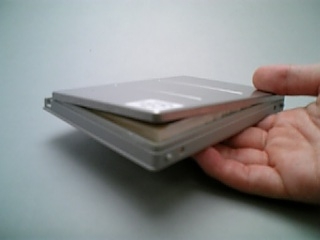
 Although this is not a recent photo of the battery that came with my MacBook Pro last June, it is an amazing simulation. A twin, if you will.
A couple of days ago I noticed that one of my business laptops had, well, a wobble. Although lying seemingly flush on my desk at my office, it had a distinct sway as I typed on it. I flipped it over and saw that one corner of the base of the battery was lifting off, creating a metallic flipper of sorts. I pressed it firmly back in place and it peeled away again. It seemed like a situation caused by glue that was no longer joining two discrete surfaces. The battery had some sort of problem requiring immediate attention.
And then I did what we all sometimes do in such situations: nothing. Because I couldn’t envision being without this laptop (which is what I thought a trip to an Apple service station would entail), I thought I’d do nothing, at least for now.
But then I dwelt on it. And realized that my entire writing and business careers (hopelessly entertwined) reside within this laptop and that not all of it is backed up. Quickbooks, yes, to my .Mac account. Same with my calendar, contacts, and so forth. Most of my creative writing has been backed up to one of the desktop machines at home. But did I have all of it stored in one easily accessed backup location? No. So I went to CompUSA and bought a Maxtor 320-GB hard drive with backup software and backed up everything from this laptop, all 116,000 documents. It took about 18 hours, and there’s the irony:
Because the backup took so long, the laptop overheated and the battery cracked nearly in half.
Imagine my reaction seeing this in the morning: the laptop battery is clearly a goner, and while I hope the laptop isn’t irreparably damaged, I do have insurance. So the real question becomes, Is my data saved?
A quick check to the Maxtor showed that it was all on there. I turned off the laptop, obverted it, took out the battery, and surveyed the extreme damage — much like the photo above, but worse. In the photo above you can’t see a complete crack of the plastic shell. You also can’t see grave concern writ large on my face.
The laptop itself is fine, it turned out — I’m writing this on it — and everything is cogently backed up. A quick trip to my local authorized Mac dealer resulted in a new battery, at a cost of $129 plus tax. I didn’t lose any data, and the battery is under warranty from Apple, so a replacement is winging its way to me. So, no harm, no foul.
But this incident has made me think what it would feel like to lose all the data I have been shuttling forward from computers for years and years and years now, dating back to stories I wrote on a IIGS in the late 1980’s. In short, it wouldn’t feel good. At the same time I thought that, though, I figured that I would get over losing all of it and would just write more, and that might even be a good development, freeing me further from the past.
So, in 2007, here’s the verdict: Despite my attempts at cynicism while I was an undergrad, and my decidedly skeptical viewpoint, I am indeed a glass-half-full sort, the kind of deranged optimist who sees the loss of all his data as an opportunity.
One day later, I see it’s an opportunity I’d rather not seize.

 On Friday night I saw “Who’s Afraid of Virginia Woolf?” at the Ahmanson Theatre with a couple of playwright friends. I’ve often heard this play referred to as a “descent into Hell” — and that pretty much sums up my feelings about this production, which over the course of three acts slid from mediocrity into the pit.
 What’s wrong with it? Well, as Terence noted drily when George (Bill Irwin) is trying to strangle his wife (Kathleen Turner) in the second act, “I don’t think this violence should be comic.” Indeed not. Act Two is called, by the playwright, “Walpurgisnacht,” which conjures a night of revels, debauchery, decadence, and abandon — a combination of a pagan rite and an unfortunate run-in with the devil (as in Faust). Here what we had was a performance that alternated between strangely muted and bizarrely affected. The last time I saw such physical action so badly executed was 13 years ago when it took
  The Academy Awards are later this afternoon. How do I know? Because much of Hollywood is impenetrable — barricaded from traffic — and has been for days and I’ve stayed well clear. If I’m not having much fun driving around when it isn’t blockaded, imagine what it would have been like the past week.