Lincoln, the beaver, and me
Monday, March 26th, 2007 I few months ago I was troubled by the bizarre Citibank ad campaign built around some master-slave relationship I didn’t quite understand.
Now I find that I can’t figure out why Lincoln and this… beaver?… are hanging out together. The online vid at theymissyou.com shows a drowsy insomniac lurching into his kitchen in the predawn hours to find Lincoln and this beaver awaiting him. “We’ve been expecting you,” Lincoln says as the beaver prepares to make a chess move.
Although this metamessage seems beyond one’s immediate grasp, I suspect that the subconscious grabs hold of it immediately. The beaver I think most of us would equate with nature’s most reliable sleep aid (what the French call “the little death”). Lincoln was kept awake many nights by the horrors of the Civil War and his own depression, although I wonder how many people associate him with that. Mostly, he probably means three things to most Americans:
- the war and emancipation
- the dollar and the penny
- an extra day off, with corresponding sales events
I don’t think one sees Lincoln and thinks about insomnia, nor do I think one sees a beaver and thinks about insomnia. (Of course, prior to “The Shining,” I never thought of oral sex with a bear as a sign of madness.) When it comes to sleeplessness, most of us think of counting sheep. So (stovepipe) hats off to whoever came up with fresh imagery for this. And on a meta level, I am confident that anyone having neurotic dreams about Lincoln and a beaver playing games in one’s kitchen would gladly take a pill that would make it stop.
When I first stumbled across this little campaign in my local CVS drug store, I peeled off a coupon for further investigation. I’m ordinarily of the take-no-drug school of self-prescription; my mother’s cure for all ailments was a shot of whiskey and bedtime. But I was curious. I’ve been suffering from various forms of sleeplessness even before the Reagan Administration (to which I originally ascribed blame). According to the website, this pill is for those “who have trouble falling asleep.” That leaves me out; I can fall asleep just fine. It’s waking up 46 minutes later that makes me crazy. Not crazy enough to want to drug myself, but all bets would be off if I were seeing dead presidents and large rodents.
 You might have thought that Pee-wee Herman was finished. But his recent splash at a nostalgia convention right here in Burbank is just part of a surprising comeback,
  Every day it becomes more clear that I should not have sold that Apple stock a couple of years ago. If anything, I should have sold it now so I could buy the new Apple products I want.
 As I
As I 
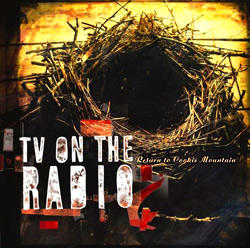 “Return to Cookie Mountain” by TV on the Radio. If “The Good, the Bad, the Queen” is a creepy clown acid trip, this album is the soundtrack to that post-apocalyptic Cormac McCarthy novel I keep talking up. I’m so taken with “Wolf Like Me,” which I had heard all of twice, that I had a dream in which I was listening to it; I guess it made an impression. I saw this band two years ago when they opened for Franz Ferdinand at the Greek, and at the time I thought this was quite possibly the worst band I’d ever seen (a distinction soon achieved by The Polyphonic Spree, who opened for Brian Wilson and who were loudly and justly hooted and laughed at by whole sections of the Hollywood Bowl). I couldn’t imagine the raves they’d earned from people like David Bowie, whose opinion always counts. Even while I thought TV on the Radio was bad, very bad, I also could see that they had probably alienated some very key people at the Greek, i.e., the people working lights and sound, because they were mostly unlit and had a sound mix so bad I felt we were listening to a band playing underwater and on a distant planet. Listening to this record proves once again that Mr. Bowie is wise in all things.
 While Pere Ubu is in no way a new band, “Why I Hate Women” is a new album by a band that continues to change. At times I find myself wondering if this may not be the best album in their 30-year history. They actually pull off what amounts to a blues song with “Blue Velvet,” featuring a haunting harmonica turn by Robert Kidney (The Numbers Band, the Golden Palominos). That song is bracketed by the atmospheric small-town ghost story of “Babylonian Warehouses” and the teenage raveup “Caroleen”; together these become a mini-suite probably never equaled in the history of the band. The rest of the album, especially “Love Song,” is just a strong. Vocalist David Thomas assays the neurotic subconscious of lost people on empty roads, but it is Robert Wheeler, playing theremin and synthesizers, whose sonic architectures evoke alien landscapes rarely explored.