Lee Wochner: Writer. Director. Writing instructor. Thinker about things.


Blog

Archive for the ‘Thoughts’ Category

The greatest swindle of our lifetimes

Sunday, August 26th, 2007

What is it? The war in Iraq. If you can stomach it, read this piece in Rolling Stone detailing the malfeasance and vast personal enrichment underlying the buildup and “rebuilding.” (In fact, please stomach it — these were our dollars, and we need to be angry.)

Compared to the profiteering on this war, the savings and loan bailout under Bush 1 is small potatoes indeed.

Arthur Miller’s play “All My Sons” now looks quaint.

As does the notion of shame.

Time changes everything

Friday, August 24th, 2007

Recently I wrote here that I’d noticed that most of my back catalog of plays have become period pieces. (That doesn’t mean they can’t be produced — dear producing gods: That doesn’t mean they can’t be produced! — that just means that some of them need to be set in recently passed time periods in order for what I hope is their trenchant wonderfulness to work.)

I’m also discovering that I’m becoming a period piece.

Last night during the welcoming ceremony for the University of Southern California MPW graduate writing program where I teach, I got a look at the incoming masters candidates. As one line that teachers share goes, “I keep getting older but my students stay the same age.” As a faculty member in our program, I’m rather young; as a member of my theatre company I have definitely become a graybeard. But what really caught me by surprise was a man roughly my age, a professor in the Marshall School of Business at USC, who came up to me and said, “Lee, I don’t know if you remember me, but my wife was in one of your plays 20 years ago.”

It took a few minutes of digging through the dusty filing cabinet of my mind, but I did remember him. And his wife.

He said, “My wife and I still really love that play. We have it on videotape and we watch it once in a while. It’s the play about the wires.”

Videotape! When was the last time I watched something on videotape! When was the last time I listened to something on cassette tape? My wife’s next preferred project for me is to digitize all our CDs and get rid of them — so who will need the CD player, either?

“The play about the wires” is my play “Guest for Dinner,” begun when I was an undergrad circa 1984. Among other things, it’s about a shrewdly intelligent man who is so consumed by his hatred of a Springsteen-like rock star with pretensions to being Joe Average that he lures said rock star to his apartment to humiliate and abuse him. “The wires,” the section that everyone who has seen this play in its various productions seems to recall with the greatest clarity, is a speech by our protagonist, “Rick” (rhymes with prick), who assembles electronic components in his day job and laments the way that the wires on the top keep pressing down on the wires on the bottom. It’s a thin metaphor for social inequality, and is just one of the things in the play that the me of almost 25 years later regrets.

When the play was done in LA, a former writing teacher of mine — ironically, from the very same program I now teach in — came to see it. I asked him what he thought, and he said blandly kind words. I then asked him what he really thought. He proceeded to tell me, taking the play apart bit by bit. (Afterward, his wife said to me, “Well, I liked it.” She was being nice; it didn’t matter.) Even at the time, his arguments were hard to refute, and over the course of 20 years I’ve grown more and more toward his opinion.

But as my dean said last night when I told her that the spouse of someone who had once starred in one of my plays came up to me to say hello, “There really is no hiding.” Certainly true, especially in an internet age (and only one reason among many that I’m sure we and our allies know exactly where Osama bin Laden is).

There’s no hiding, and there’s also no changing who you once were. We should honor the work of our younger writer selves, flaws and all, as individual steps on a long journey. Some of my old plays don’t work the way they would if I were to write them now, but most of those plays wouldn’t be written by the writer I am now. The bad science fiction stories and detective stories I started writing and sending off at age 11 haven’t improved with age either. But every one of those failed attempts carried some lesson for the future.
Forget spam. Now serving bacn.

Friday, August 24th, 2007

Prepare yourself — it’s giving way to “bacn.”

What’s bacn?

It’s email that’s not quite spam. In other words, it’s a little more permission-marketing oriented.

So I guess the Marvel Pulse email I get is bacn. That one I don’t mind. While I don’t want to help the lawyer in Nigeria receive the late king’s assets in exchange for a 10% commission, I do want to know what Dr. Strange is up to.

I hope they don’t employ children

Tuesday, August 21st, 2007

Disney World — been there, done that?

If you’d really like to subject your kids to something, maybe you should take them here.

The erratic ecstatic vision of Werner Herzog

Sunday, August 19th, 2007

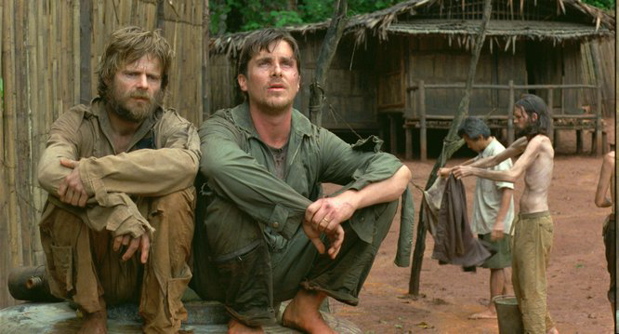
rescuedawn2.jpg

The other night I saw “Rescue Dawn” and found it, like all the Werner Herzog films I’ve seen, strangely compelling and somewhat badly made.

The film, which concerns the shooting-down of Americanized German pilot Dieter Dengler in Laos prior to the Vietnam War, was previously the subject of a documentary (also by Herzog) called “Little Dieter Needs to Fly.”

The most immediately noticeable aspect of this film is the film stock itself, which is so bad that the movie looks like a 1970’s porno flick. I kept waiting for Johnny Wad to make an appearance. One could argue that this is an attempt by the filmmaker to return us to the period of the film’s setting, but in actuality I suspect “Rescue Dawn” was shot on degraded film left over from other ventures. The effect is jarring, but after a while, your eyes do adjust — eventually, human beings can get used to anything.

There are also the usual lapses in storytelling. Before the action of the movie (our hero getting shot down in Laos), we get all of about 1 minute of his getting his flight gear specially tailored in a way that, later, plays absolutely no relevant role in the movie, and another 1 minute of his watching an Army jungle survival film that also plays no role. (None of the skills demonstrated is ever needed.)

Most disastrously, the ending is very badly considered and feels summoned from a Michael Bay movie I’m glad I missed. Dengler, having now survived the horrors of torture and survival in the jungle, is upon his return hoisted aloft by the crew of his ship and carried around, his arms upthrust in victory. I think I’ve also seen this scene in every single movie about nerdy kids who triumph at summer camp. Its awfulness is maximized by the bad shooting, the bad dialogue, and the utter lack of fresh ideas.

And yet, as is usually the case with Herzog, much of the movie is amazing.

The scenes of torture are inventive and difficult to watch. They ring with truth, especially in the self-evident and very real changes to Christian Bale’s physique. (He lost 80 pounds over time for this role.) So too with the escape of Dengler and his fellow prisoners, a plan that goes all too wrong for what can only be described as very real but very stupidly human reasons: the one prisoner simply doesn’t show up for the shoot-out. (He never gives a good explanation, and that comports with my own findings about people who don’t show up when they’re supposed to.) Bale puts his all into his performance, running barefoot over treacherous terrain, eating wriggling earthworms and even ripping into a live snake with his bare teeth. (It is either absolutely a live snake or this is brilliantly edited — which is not the hallmark of a Herzog movie.) Bale does an excellent job of capturing Dengler’s loopy optimism and blockheadedness. And, finally, the terrible and sad decline of the escapee played by Steve Zahn is a tragedy unfolding before our eyes. Zahn’s performance is harrowing.

I can think of no other director who so perfectly conveys the terrors and chaos hiding behind the beauty of unruly nature. Every scene in a Herzog film carries an implicit threat, whether it’s Klaus Kinski turning from friend to fiend frame by frame in “My Best Fiend,” or the deluded naturalist cavorting with the bears he believes his friends in “Grizzly Man.” It’s the dangerous art that’s most exciting — think Stravinsky, Picasso, the Sex Pistols — and that’s why, although I’m not terribly interested in film, I keep returning to the films of Werner Herzog.
—————-
Now playing: Brian Eno – Here Come The Warm Jets
via FoxyTunes

Categorizing via iTunes

Sunday, August 19th, 2007

I don’t care too much about how a corporate service classifies the art and culture I partake of — much of it’s too difficult to classify anyway, so it’s only mildly annoying that someone at iTunes would classify, say, “Yankee Hotel Foxtrot” by Wilco as “Country” (a classification that no one who had actually listened to the disc would ever make).

Looking at how my iTunes folder is automatically categorized by the system, it would seem that almost everything I listen to is “alternative.” Alternative to what, I don’t know. Frank Zappa is “rock,” and the Brian Wilson version of “Smile” is “pop,” while the Beach Boys versions of the same songs are “rock.” Huh?

But what I really enjoyed — and what propelled this line of thought — was how the system classified the Brian Eno tracks I’m listening to:  “unclassifiable.” That one they got right.

—————-
Now playing: Brian Eno – No One Receiving
via FoxyTunes

Begging for scraps

Thursday, August 16th, 2007

If there’s a consistent message I hear from those in the writing profession, it’s that all too often we’re begging for scraps and ought to stand up for ourselves. That’s the message that Gary Garrison puts out from the Dramatists Guild (and, indeed, in his most recent editorial he advised playwrights to “stop kissing ass.”), and that’s what goes on behind the scenes with the writers’ guild, and that was the subject of Frank Miller’s opening comment during the Petco Park screening of “300” during Comicon.

So this piece in Wired magazine caught my attention. It has to do with the WGA strike that informed sources in this town are predicting is coming in the fall. Interestingly, Nancy Miller seems to blame the writers for getting into this situation by being greedy and/or inept in their past negotiations. But most astonishingly, she quotes studio executives and producers (and, therefore, provides their point of view) — but not writers. This, in a piece written by a woman who, based sheerly upon the evidence, is a writer.

I don’t have any personal point of view in this struggle, except to say that the writers are due some participation if the actors and directors and producers are getting participation. That’s a fairness issue.

My primary point of view is that in a piece about writers’ negotiations, writers should be represented. That too is a fairness issue.

Period pieces

Wednesday, August 15th, 2007

My plays fall into three categories:

  • Those that are unproduced and better left that way (I have more than a dozen that I don’t like and don’t send out, but for which I still harbor the hope to one day “fix”)
  • Those that are unproduced because either they are recent or I wrote them and kind of lost track of them (fewer than 10)
  • And those that have been produced.

Last weekend I devoted a day to reviewing about 20 of the latter to submit them for further productions. And here’s what I discovered:

Even though they’re only between five and 15 years old, many of them have become period pieces.

There’s the play that references Johnny Carson’s show. OK, a while ago I updated that to reference Jay Leno. Now Leno is leaving in a few years. I could keep updating that one — or allowing directors to do so — but the play also references another show, popular at the time, that is long-gone and largely forgotten. Understanding that reference isn’t key to understanding the play, but it adds a large undertone throughout.

There are all the plays that seem to revolve directly around newspapers. Yes, I am an inveterate newspaper-reader. Or used to be — even I don’t read it every day any more. These plays for sure have to be staged as period pieces, because the newspaper is in some way crucial to the play and it is vanishing from our culture.

There is the play about the rock band, written before, believe it or not, “dude” became the preferred form of address between males of a certain age. The play also revolves around the Chapman stick, a cutting-edge instrument of, oh, the late 1980’s. And when the band has a fight with the bassist and has trouble finding a new one, the drummer says they have to find one because you can’t have a band with just one guitar and drums — something disproved by a little band known as The White Stripes.

There are many, many more such examples; plays that seemed to me so trapped in the moment of their time that I actually wondered if most of my “back catalog” had any further performance value. I started to understand how the Beach Boys must have felt, watching the British Invasion roll in. But here’s something that clearly I never foresaw:

In one of my plays, an unscrupulous vacuum cleaner salesman dupes a television-addled housefrau into buying a vacuum cleaner at a ridiculous price. I thought of this yesterday as I decided to buy a really good vacuum cleaner once and for all and be done with it. The ridiculous price of such a cleaner in my play? $400. The price of a good vacuum cleaner now? $400.

Zappa plays Zappa

Wednesday, August 15th, 2007

150352zappa.jpg

Here’s a show I wish I could attend (but can’t, due to a prior obligation):  Dweezil Zappa revisiting the catalog of his father, Frank Zappa, in a live performance. Dweezil says he spent a year holed up at home studying his father’s compositions so that he could not only learn the pieces, but also understand them and gain the skill to be able to play them. (Nobody has ever had to say anything like that about, say, the Ramones’ catalog.)

I had several opportunities to see Frank Zappa when I was living near Philadelphia, and never took them. Then of course I never got the chance again because he died. I also didn’t see Captain Beefheart’s Magic Band on that reunion tour of a couple years ago, which I regret. (Once, at the urging of a then-somewhat-friend, I did see a Hall & Oates concert, which I also regret.) I hope that Zappa the younger does this show again or takes it on the road.

Further proof that I’m not that smart

Monday, August 13th, 2007

Tonight I spent about 40 minutes trying to adjust these sprinklers. No matter how I set them, the head wouldn’t fully rotate. And yes, I tried “lifting the lever” as specified. Then I settled for letting it water an area, then picking it up and sticking it in the ground in a new position. I did this twice before it settled upon me how truly stupid doing that made me feel. Then I said, “Fuck it,” lit a cigar and took the dog for a walk.

Then I came back and did it all over again.

Then I turned it off and went inside and had a drink and told myself I’d fix this in the morning when at least it would be light outside. I refuse to be defeated.

It’s daily tribulations like this that keep me modest. That, and about a hundred other things.

—————-
Now playing: The Beach Boys – With Me Tonight
via FoxyTunes