Lee Wochner: Writer. Director. Writing instructor. Thinker about things.


Blog

Archive for the ‘Thoughts’ Category

There will be thud

Friday, January 4th, 2008
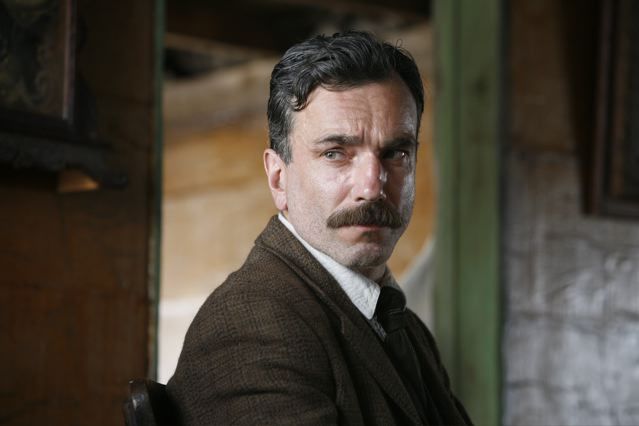
therewillbeblood.jpg

Spoiler Warning: This posting reveals several plot elements of “There Will Be Blood,” the new film written and directed by P.T. Anderson. Please go see the movie, then come back here. We’ll wait.

Thank you. Welcome back.

On New Year’s night, I invited a couple of friends, Mark and Trey, to join me in seeing an 11 p.m. showing of “There Will Be Blood” at the Arclight in Hollywood. 2007 was a good year; I want to make 2008 even better by spending more time with friends.

For the first two-thirds of “There Will Be Blood” I debated whether this was the best film I’d seen in years, or perhaps the best film I’d ever seen. The first twenty minutes in particular are an object lesson in strong visual storytelling, with nary a word of dialogue. Daniel Day-Lewis plays Daniel Plainview, a prospector in late 1800’s California whose prospects grow as he strikes first mineral deposits, then oil. Plainview and his little boy are visited by a young man who promises them the location of a rich underground oil field in exchange for $500. Most of the rest of the film details Plainview’s struggle to buy up the land necessary, convert the few people living on these barren lands to his cause, drill, erect derricks, and generally strike it rich, while staving off the predations of a tenderfoot preacher who is a charlatan determined to swindle the swindler. At various times, each outdoes the other or one-ups the other, the preacher winning converts and threatening Plainview’s enterprises, Plainview physically overpowering and bullying the evangelist, and so forth. At some point with these two, the movie seems to assure us, there will be blood.

All of this is set against a backdrop of immense physical exertion and danger. Drilling for oil was, apparently, not something to be taken lightly. There was most definitely blood there, and for sudden and horrifying reasons. The bold visuals are supported by music composed by Radiohead guitarist Jonny Greenwood that alternately evokes the time and place and sends shivers down your spine. One scene after another left me with my mouth open, completely enrapt and shocked by the story of people striving under the dirt at great personal risk and, often, at great personal sacrifice.

Then, unfortunately, the movie seems to end — before it has actually ended. The antagonist leaves town — we learn this in passing as Plainview overhears him telling a parishioner that he’s going off preaching around the country — and with him goes the movie. Suddenly, Plainview seems to have an overriding passion for family, something we’d never heard before and something that informs every action, right or wrong, he takes in the final act. Whereas the beginning of the movie was so charged it required no words, the last third languishes with long scenes of two people talking, especially one between Plainview and his brother. The movie then ends on what I can only call a camp note. The preacher returns after more than 10 years away because the Depression has hit and he seeks money from the fantastically wealthy Plainview. A besotted and bereft Plainview forces him to admit he is a charlatan in exchange for the money, acquires that confession, then bludgeons him to death with a bowling pin. When the butler returns to check on his master, Plainview looks up, the bloody bowling pin in his hand, the battered body at his side, and his now-empty serving plate on the floor, and says, “I’m done now.” This wan joke has the effect of transforming the film into a shaggy dog story.

As we three stood on the plaza, we wondered what it was all about. Trey ventured that it was about greed, but that didn’t strike me as right. We also wondered how a movie that had started with such promise could end so badly. Everyone had opening opinions, but I wanted to think further. And it was now 2 a.m. and I wanted to get home and write.

The next morning, Mark emailed me (which I’m posting here with his permission):

I thought it was interesting that all 3 of us had similar reactions/opinions about the film. How often does THAT happen?

Something that occurred to me later: While Daniel is sitting with his brother, he tells him that he doesn’t care for people. There isn’t really a lot of behavior in the film that puts this across. He doesn’t like Eli Sunday, that’s plain, and he doesn’t like that one guy from Standard Oil, but otherwise he doesn’t seem any more or a people hating grump than the next guy. This telling versus showing goes for his greed as well. He doesn’t finger his gold like Silas Marner (have I got that right?). He lives frugally ’til near the end of the film, but we don’t see him chuckling over his bank balance. The Hearst character in “Deadwood” seemed more obsessed with gold than Daniel does with oil. He obviously dotes on the boy, and he makes it a point to protect the little girl from her father in the slightly creepy scene at the picnic table, when it almost seemed as though he was sexually pawing the girl. Other than the creep factor, these are hardly the behaviors of someone who particularly hates everyone.

I think the principle problem with the film is a weak story line. It’s not that far from the sort of standard indie film “day in the life” type of story, where there really isn’t much plot, we just go along with the main character through the normal travails of their day.

Yet somehow, it’s still a really good movie. Weird.

I responded:

As I was driving home it hit me that I disagree with Trey’s thesis that the film is “about greed.” Daniel is not motivated by greed — as that scene you mention makes clear, and as his lack of interest in money makes clear. No, he’s motivated by an ambition, a seemingly self-destructive ambition. He wants to succeed — and he wants others to fail. What this has to do with his late-developing interest in family I have no idea.

The early part of the movie is about his rise to the top. That’s interesting and well-told. Complications arrive in the form of Eli — also good. It’s when Eli blithely leaves town (he’s “going on a mission,” we learn) that the movie ends: there’s no opposition. I first tipped off to this during those scenes with the fake brother, most of which work like this: two people sitting around talking. Bad storytelling. By the end, with our protagonist having bludgeoned the seemingly ageless Eli, we’ve descended into camp with the (un?)intentionally funny line “I’m done now.” I can’t remember the last time I saw a movie this promising end this badly.

Still, I had a great time. That’s because I got to go out on the spur of the moment with two good friends and just flat-out enjoy myself, uncomfortable seat and all.

(On a side note, I should mention that the Arclight is a premiere movie house with assigned seating, a restaurant and bar, stadium seating with expansive leg room, and a strict no-talking, no-child policy. Which made it all the more surprising that none of us could get comfortable in these seemingly ergonomic seats. I thought it was just me twisting and turning in my seat, but no, it was all of us.)

One of the reasons I’ve been friends with Mark for 15 years is that I appreciate his shrewd intelligence and his directness. You also have to love someone with enough security to respond that in retrospect perhaps he had fallen for the press releases:

I’m not sure it was Trey who said the film was about greed. It might have been me, and it would have been me mindlessly parroting something I read about the film. I think your notion that it’s about ambition, or at any rate it is ambition that is Daniel’s motivator, is correct. And this leads me to think that PT Anderson should have given us more information about what formed Daniel. If his prime focus is on succeeding, and equally important that others fail – what caused this? That should have been part of the story if this ambition is the central theme of Daniel’s life. I agree that Dano’s unagingness (ooo, I just invented a word) sticks out badly. And I agree that the early part of the film, covering his rise, is eminently watchable, and something like Welles’ Citizen Kane. Unlike Kane, however, there isn’t much more story after he gets there. If we’d learned more about his need not only to succeed but for others to fail, if we’d seen that come up a couple of times more, perhaps the scene with his grownup son announcing he’s setting up on his own, would have resonated better. I really like PT Anderson. And he’s an obviously gifted filmmaker. I hope he finds his way back to the quality of “Boogie Nights” and “Magnolia.” Although I think I’ll get “Punchdrunk Love” and take another look at that.

So why spend all this time — in discussion, in those emails, posting it to this blog — to analyze why a wonderful movie winds up un-wonderful? Let me count the ways:

  1. Because it was a wonderful movie for so very long and I’m glad for that and I’m disappointed how wrong it goes.
  2. Because my friend and colleague Chris Meeks spent an evening last semester screening scenes that work and don’t work, and why the ones that work work and why the ones that don’t work don’t, and he wrapped up the evening with, appropriately, movies that end badly. For this semester, he should add this one.
  3. Because there are lessons to learn. And the three lessons here for writers are:
    1. Don’t have the antagonist blithely leave — have him grow more powerful;
    2. Don’t introduce new elements too late (as with Plainview’s sudden interest in family) — it just seems desperate, and confuses the issues
    3. Remember your theme; identify it early and follow it through.

What was “There Will Be Blood” about? I don’t know. For much of the film, I thought it was about how a man’s ascension from the literal dirt to the echelon of success is driven by the same ambition that strips him bare. But maybe it was about family. Or greed. Or, unfortunately, nothing. But when it was good, it was great.
Senator who?

Thursday, January 3rd, 2008

Another indication of how little traction — or even recognition — that Senator Chris Dodd was able to get in his now-ended presidential race: When he withdrew, MSNBC.com announced the story as “Todd drops out of race.”

For a moment, I wondered if they meant this guy. But this guy makes too much of an impression.

Preparing to pack my bags

Thursday, January 3rd, 2008

My wife announced this morning that if Mike Huckabee became president we would be moving to Canada before this country turned into the Republic of Gilead. Then about an hour ago, guess who won the Iowa Caucus.

Gratitude

Monday, December 31st, 2007

Today I was reminded again just how grateful I should be for everything I’ve got.

I took my laptop out back early this afternoon to do some writing while admiring the new lawn, courtesy of our gardeners, and smoking a Christmas-present cigar and polishing off the last of the red wine from Friday night’s party. I was happily typing away for about an hour and a half when my wife came out with a flashlight and a grill lighter in her hand, looking at me as though I could possibly imagine what these might be used for at the present moment. All I could think about was the interior workings of the new play I had just begun, which was proving to be something about a man who grows infatuated with a young woman at a party and who then wrecks his life over her against the advice of everyone far more sensible, including his wife. I had 12 pages already, but now my generally sensible wife was muttering something about hot water.

As she drew closer, these odd implements in hand, she told me that the “hot water heater” was off and that the pilot light needed to be relit. I replied, “Why is it a ‘hot’ water heater? Wouldn’t hot water already have been heated? It must be a water heater.” She had the good grace to smile. Her tolerance is one reason I’m still here.

I accompanied her over to the “hot water heater” around the side of the house so that I could at least appear useful while leaning against the brick wall abutting our neighbor’s property and thinking about what Scene 4 would be — probably something further at the office, but now with the man’s friend who had brought the attractive young thing to the party. My wife twisted the pilot knob back and forth as far as it would go, peered into the blackness where a flame should be, twisted the knob again, complained that the knob didn’t turn far enough, then got up to look at me. I knew that was my cue to try to turn the knob further. To do that and to take turns shunting our five-year-old two or three feet backwards in case we accidentally blew ourselves up. I couldn’t get the knob to turn any further either, but having put in the effort I stood up and announced that it was time to call someone. Because, unsaid but clearly heard, I was now returning to writing my play.

Another 40 minutes or so later, I figured I was done and told my wife that I was going to run a couple of errands and wanted to see what she wanted to do about the water heater.

“That’s okay,” she said. “I called Mike.”

“Mike? Who’s Mike?” For the life of me I couldn’t think of any Mike in our lives aside from the dog whose ashes had resided on our mantel since this time 1999.

“Mighty Mike,” she said. Mighty Mike is the plumber who lives across the street. We call him Mighty Mike because that’s what his truck calls him: Mighty Mike Plumbing.

“Great,” I said, picking up my keys and heading off.

At my office, more money had arrived. I did what I always do – went immediately to the bank and deposited it – and then went to Reese Liquor for essentials. Beefsticks, to be precise. Thirst Quencher Liquor, which I prefer for the name, was out. Driving home and remarking to myself what a beautiful day it was to have a convertible, I couldn’t help reflecting on my good luck. 2007 seemed like a blessing in every way. Certainly catastrophe was in the offing – some unforeseen illness or accident – but it wasn’t here now, and I wasn’t allowing misfortune to elbow its way to the front of the line. I got a text message from my friend Alan sledding in snowbound Massachusetts, and we textually committed to more friendship time next year. I was making resolutions for 2008 — not to give up things, but to embrace some things more.

When I got home, my wife announced that Mighty Mike had been there and lit the pilot. The hot water heater was again heating hot water. Then she added, “Did you hear about his boy?”

His boy, it turned out, whom I recalled as a baby but who had turned three when I wasn’t looking, had been urinating blood. Tests revealed kidney cancer. He’d had one kidney out and was now in week five of chemo. My wife said Mighty Mike revealed all this when she’d asked about the boy. I don’t know much about chemo, but I know a lot about three-year-olds. I’ve personally seen three people through that age.

“Makes you realize what you’ve got, doesn’t it?” I said to her. She looked at me soberly. I pulled her to me and kissed her warmly. We have been very skilled in what we’ve achieved in 2007. We have also been very lucky. We don’t have any war, famine, disease, or poverty at our house. I say that with full recognition that many others have some or all of that. We have had some of that ourselves in the past, and no doubt will have some in the future.

In the meantime, we have the present. And, starting tonight, and starting every moment of every day, we have the future – what will come, and what we will make of it.

When asked why we are here, Brion Gysin said, “We’re here to go.” True. But in the meantime, we are here.

She served dinner and we ate it and she went to work and after a while the kids went to bed. And now I am here, telling you this.

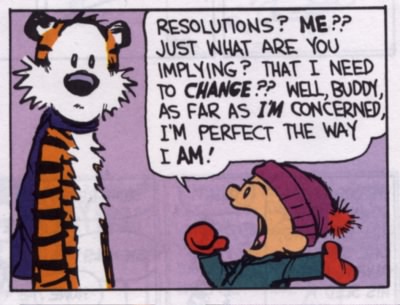
Dreading other people’s New Year’s resolutions

Thursday, December 27th, 2007

 calvinresolutions.jpg

This morning as we pulled into the parking lot at the gym, my son reminded me that starting next week this place would be jam-packed with people newly resolved to shape up and get fit. Judging from previous  years, the nearest parking spot will be in the next county over.  Based upon his having observed this trend for years, he figures that the gym will be back to normal within six weeks.

This got me to thinking about New Year’s resolutions. I don’t make them, partly because adopting the habit would seem to limit making changes to once a year. You can see where this might lead:  “I’m a fat, angry, lazy alcoholic addicted to Animal Planet and YouPorn… but it’s only March. Come New Year’s Eve, I’m gonna do something about this!” I’d rather identify my problems as they come up on the fly and fix them then.

Another lost landmark of my life

Wednesday, December 26th, 2007

The LA Times is reporting that the Virgin Megastore on Sunset in West Hollywood is closing next month. This may not seem like much of a landmark — it’s been open only about 12 years — but given the closing of Tower Records this time last year, I’m not sure where one could go to buy a physical CD in that immediate area, let alone find out about new artists by browsing racks and displays.

On a more personal note, I’ve spent many happy hours over the years picking through those displays on my lonesome or with my wife or with friends like Trey Nichols and Joe Stafford and Paul Crist, to fill time either before a movie in the Sunset Plaza complex or because traffic was impenetrable and I was hoping for a cessation.

Joe and I visited the freshly minted Sunset Plaza shortly after its opening and had an experience that resulted in one of our favorite catchphrases. Because the operation was new, there was still some doubt about how some aspects of it worked — for one parking attendant on one evening, anyway. We pulled into the underground parking structure, and he wanted to hand us a ticket. Given that an automated ticket machine was directly within reach of my hand, I asked if I shouldn’t just press the green button and get one out of there. He said I could do that, but then I’d have to hand it to him. I wondered aloud why that was, and what he would do with it other than just hand it back to me. He also seemed uncertain how validation might work, which led me to ask if he was expecting me to pay him, which would make no sense because I expected one of the vendors to validate the parking. This entire exchange was pleasant and polite and was conducted in a language that was not this man’s native tongue (which I would estimate to be Urdu). Finally he looked at me, at my car, at Joe in the passenger seat, at the ticket machine, then back to me, then said, “Do whatever it is you do.” And that’s what I did, collecting a ticket from the machine and pulling my car into the structure.

Since then, I’ve made every effort to “Do whatever it is you do,” usually not in an actual sense but in an ideal sense; in other words, Stick to the mission of your daily existence. This excellent advice applies to most things, as Joe and I have discovered. I’m sorry that Virgin Megastore will no longer provide browsing — and buying! — opportunities for me, which means that I will be visiting the Sunset Plaza even less frequently. But I’m glad it has gifted my life with this zen koan, which has a Vonnegutian clarity I like. For 12 years now as we have faced the hills and valleys of our personal and professional lives, Joe and I have reminded each other, “Do whatever it is you do.”

Envisioning the loss of the Virgin Megastore conjures up the refrain from “Cat’s Cradle”: So it goes.

Looking ahead to the New Year, I advise you: Do whatever it is you do.

Wrapping up Christmas

Monday, December 24th, 2007

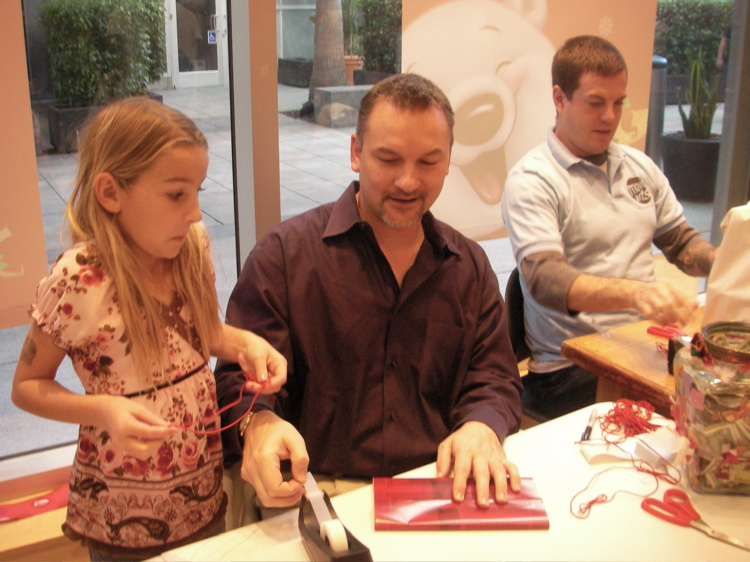
christmaswrapping.jpg

My daughter Emma and I put in a shift today wrapping presents at the Borders Books in Hollywood as a fundraiser for Moving Arts, my theatre company. It turned out to be one of the most fun holiday experiences of the year.

I have to admit, when Steve Lozier, the theatre’s newly hired managing director (that’s him, on the right), announced this mini-fundraiser during his first company meeting last week, I was leery. It seemed hastily conceived and penny ante. Wrapping Christmas gifts in exchange for donations to the theatre — was that really something we wanted to be doing now? I wanted to be supportive, though, so I checked the signup sheet against my schedule and found the one block of time I could volunteer: noon to two on Christmas Eve. Other company members thought that having my attractive and charming nine-year-old in tow would help raise money, so I dutifully enlisted her.

What I expected was a long line of irritated shoppers taking it out on us. We wouldn’t be alone. I don’t know how your Christmas season has been going, but today I got a dire holiday card from a good friend. It read:

Dear Lee, Valorie & Kids,

Stay away from the malls! People are crazier & meaner than ever this year! A coworker gave me some constructive criticism the other day: “Stop answering the phones like a fucking retard!!!” You get the idea.

(And this is from a man who loves Christmas, someone who takes to heart every moment of the Charlie Brown Christmas Special.)

Instead of that sort of experience with Christmas Eve shoppers, to my surprise what I got was a two-hour series of discussions about books with ardent book lovers. It was like speed dating for bibliophiles, and cemented for me the one key advantage book stores retain over Amazon.com: You can run into people like yourself and share your love for books.

  • I got into a discussion with one man about both Christopher Hitchens (whom I’ve read, and met) and Alain de Botton (whom I’ve read); the discussion led into the war in Iraq — which we thought Hitchens had been attractively eloquent but dead wrong about — and the relative merits of Proust versus Henry James. (I’ll take James.)
  • Someone else was buying the new Robert Plant / Alison Kraus disc as a gift. “I hear that’s good,” I said. He countered, “I have too. Surprising, because I wouldn’t buy a record by either one of them.”
  • One of the books we wrapped was a beautiful large softcover coffee table book, remaindered, that promised to share The History of Art. It was stunning. I took a break and ran to the back of the store to buy my own copy, but they were gone.
  • When I saw Steve wrapping a copy of Cormac McCarthy’s post-apocalyptic novel “The Road” for someone, I of course piped in to say that I’d read that. “That’s a cheery holiday pick-me-up,” I volunteered. The customer responded that he’d read all of McCarthy and was trying to get his girlfriend involved in the author. “If she reads it,” I said, “she won’t forget that one.”
  • Someone else bought two Dick Francis paperbacks and a how-to on plot development — these were presents for an aspiring writer of genre. The purchaser said that his friend is good with characters and dialogue, but she needs help with plot and he wanted to support her. I told him that I teach writing and in my experience, writers do need support — the image of the writer living and working in utter solitude is a canard; a good workshop with supportive colleagues provides a crucial advantage. Then I referred him to my friend Sid Stebel‘s workshop — Sid has launched many a career. The man was grateful and tipped the jar again.
  • One young man asked me to wrap an alluring deluxe hardcover of pinups by Vargas. It was, he said, for his mom. “How old’s your mom?” I asked. “Forty-one,” he said. “Oh,” I replied, “mine is 83.” And, it went without saying, wouldn’t have the slightest interest in a book of pinups. He then told me that his relationship with his mother is new; that he was adopted, but when he turned 18 he was allowed access to his adoption records and he tracked his birth mother down to Orange County. Since then, he’s found that they have a lot of shared interests, Vargas being one of them. “That’s a good story,” I said, “one I’m going to tell.” And now I have.

This Christmas season, I spent exactly 15 minutes in the mall shopping for presents — and that was to pick up a toy to drop off at my local Assemblyman’s office so he and his staff could wrap it and give it to some kid who otherwise wouldn’t have much of a Christmas. That was it. So my experience has not been the norm. But I will say this: From what I saw in two hours today at Borders Books in Hollywood, people are thoughtful and gracious. At least, if they’re passionate about books.

Oh, and they’re generous, too: Before Emma and I even started, the theatre had made almost $500. If you look at the tip jar in front of Steve, you see money rising to the brim. Many of those bills are fives and twenties. When I find out the final tally, I’ll let you know what it was.

Still on hold with iPhone

Friday, December 21st, 2007

Regular readers of this blog know I’ve been coveting an iPhone since last spring, but am awaiting three improvements:

  1. A larger hard drive
  2. pressure-sensitive touch
  3. adoption of 3G network

#1 has in essence already happened (hence the closeout sale of the lower-grade iPhone).

As a daily user of a Treo, I knew #2 would be important: The Treo has a pressure-sensitive mini keyboard that helps me feel when I’ve actually clicked a key; being without that would seem odd. The iPhone has no keyboard — it has a smooth screen. This clarified why a highly intelligent colleague of mine has been sending emails and text messages that look like she’s developed a head injury. Most of her emails read like a variation of “Glx sptzl glaah!!” I did know that the technology exists to send a small electrical feedback to the finger, creating the sensation of touching a key. Some smartphones in the Asian market have adopted this technology, so I’ve been sure it’s coming for the iPhone and wanted to wait for it.

Finally, the iPhone’s web interface is, by all reports, slow. Adoption of  3G  standards will take care of much of that as well as increase the phone’s capability. (If anything, I’m shocked that Apple has remained on 2.5G.)

So I’ve put off buying an iPhone until these issues are addressed. It looks like my wait is coming to a close, perhaps by March. (And just in time, because my Treo is truly falling apart from heavy use.) Fast Company reports on four recent Apple patents, including one for “Force Imaging Input Device and System” (i.e., pressure-sensitive keying);  and AT&T’s CEO recently let it slip that the 3G iPhone is coming. That next-model phone is the one I anticipate buying.

In the meantime, here’s my first prediction for 2008: The people who buy an iPhone now for the holidays, whether for themselves or as a gift, are going to be pissed.

The ongoing prescience of Fantastic Four comic books

Wednesday, December 19th, 2007

Even those of us who liked the second Fantastic Four movie groaned when we saw “Galactus.” That’s because we know that Galactus is a miles-high humanoid in blue and purple armor who eats planets whole, and not a dumb amorphous cloud. Based on this news item about a “death star galaxy” with qualities strikingly familiar to some of us who grew up reading Lee & Kirby, maybe we shouldn’t have been so quick to judge.

Here’s the lede in the story: “The latest act of senseless violence caught on tape is cosmic in scope: A black hole in a ‘death star galaxy’ blasting a neighboring galaxy with a deadly jet of radiation and energy.” In emailing me this piece, my wife expressed a special joy at that personification of the death-star galaxy, asking “Are black holes sentient, that this is viewed as ‘an act of senseless violence.’ Isn’t it just nature?” Nature… or nurture. The debate goes on.

Speaking of personification, my favorite quote was this one:

“It’s like a bully, a black-hole bully punching the nose of a passing galaxy,” said astrophysicist Neil deGrasse Tyson, director of the Hayden Planetarium in New York, who wasn’t involved in the research.

Just to clarify: Actually, no, it is not like a bully, a black-hole bully punching the nose of a passing galaxy. It’s also not like the oil slick laid by the car in front of yours in the Spy Hunter video game series, it’s not like the outraged chimps that fling their own excrement at gawking visitors to the zoo, and it’s not like the misdirected shot blasting from Dick Cheney’s shotgun. (It is somewhat like the deadly force emitted by the prosthesis on Klaw’s arm, though.)

An investment opportunity you can afford to miss

Monday, December 17th, 2007

Judging from the trailer, which seeks funding for this documentary…

It would be about… small-town America.

It would be about… empty houses.

And a cat on a lawn.

It would be… simplistic, yet enigmatic… like “Good Night Moon”… but less brightly colored.

It would be about… 40 minutes long, with not much happening.

And it would be about… forever… before you saw a nickel in return….