Lee Wochner: Writer. Director. Writing instructor. Thinker about things.


Blog

Archive for the ‘Thoughts’ Category

Wrapping up Christmas

Monday, December 24th, 2007

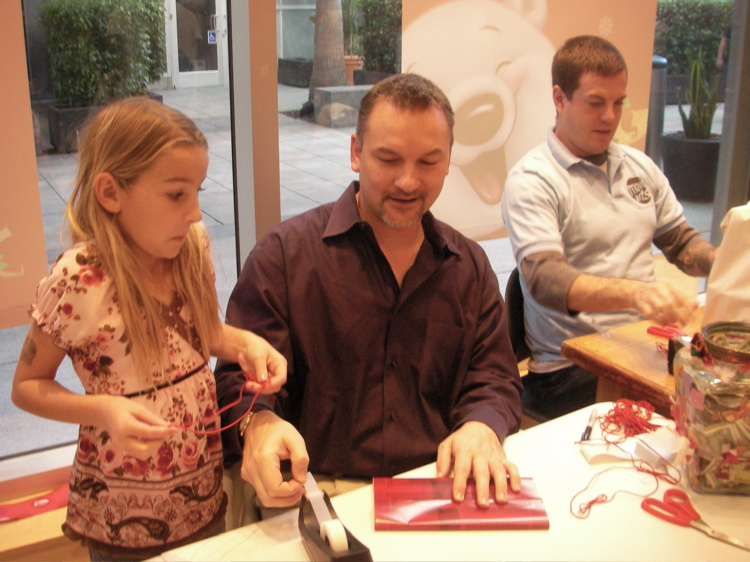
christmaswrapping.jpg

My daughter Emma and I put in a shift today wrapping presents at the Borders Books in Hollywood as a fundraiser for Moving Arts, my theatre company. It turned out to be one of the most fun holiday experiences of the year.

I have to admit, when Steve Lozier, the theatre’s newly hired managing director (that’s him, on the right), announced this mini-fundraiser during his first company meeting last week, I was leery. It seemed hastily conceived and penny ante. Wrapping Christmas gifts in exchange for donations to the theatre — was that really something we wanted to be doing now? I wanted to be supportive, though, so I checked the signup sheet against my schedule and found the one block of time I could volunteer: noon to two on Christmas Eve. Other company members thought that having my attractive and charming nine-year-old in tow would help raise money, so I dutifully enlisted her.

What I expected was a long line of irritated shoppers taking it out on us. We wouldn’t be alone. I don’t know how your Christmas season has been going, but today I got a dire holiday card from a good friend. It read:

Dear Lee, Valorie & Kids,

Stay away from the malls! People are crazier & meaner than ever this year! A coworker gave me some constructive criticism the other day: “Stop answering the phones like a fucking retard!!!” You get the idea.

(And this is from a man who loves Christmas, someone who takes to heart every moment of the Charlie Brown Christmas Special.)

Instead of that sort of experience with Christmas Eve shoppers, to my surprise what I got was a two-hour series of discussions about books with ardent book lovers. It was like speed dating for bibliophiles, and cemented for me the one key advantage book stores retain over Amazon.com: You can run into people like yourself and share your love for books.

  • I got into a discussion with one man about both Christopher Hitchens (whom I’ve read, and met) and Alain de Botton (whom I’ve read); the discussion led into the war in Iraq — which we thought Hitchens had been attractively eloquent but dead wrong about — and the relative merits of Proust versus Henry James. (I’ll take James.)
  • Someone else was buying the new Robert Plant / Alison Kraus disc as a gift. “I hear that’s good,” I said. He countered, “I have too. Surprising, because I wouldn’t buy a record by either one of them.”
  • One of the books we wrapped was a beautiful large softcover coffee table book, remaindered, that promised to share The History of Art. It was stunning. I took a break and ran to the back of the store to buy my own copy, but they were gone.
  • When I saw Steve wrapping a copy of Cormac McCarthy’s post-apocalyptic novel “The Road” for someone, I of course piped in to say that I’d read that. “That’s a cheery holiday pick-me-up,” I volunteered. The customer responded that he’d read all of McCarthy and was trying to get his girlfriend involved in the author. “If she reads it,” I said, “she won’t forget that one.”
  • Someone else bought two Dick Francis paperbacks and a how-to on plot development — these were presents for an aspiring writer of genre. The purchaser said that his friend is good with characters and dialogue, but she needs help with plot and he wanted to support her. I told him that I teach writing and in my experience, writers do need support — the image of the writer living and working in utter solitude is a canard; a good workshop with supportive colleagues provides a crucial advantage. Then I referred him to my friend Sid Stebel‘s workshop — Sid has launched many a career. The man was grateful and tipped the jar again.
  • One young man asked me to wrap an alluring deluxe hardcover of pinups by Vargas. It was, he said, for his mom. “How old’s your mom?” I asked. “Forty-one,” he said. “Oh,” I replied, “mine is 83.” And, it went without saying, wouldn’t have the slightest interest in a book of pinups. He then told me that his relationship with his mother is new; that he was adopted, but when he turned 18 he was allowed access to his adoption records and he tracked his birth mother down to Orange County. Since then, he’s found that they have a lot of shared interests, Vargas being one of them. “That’s a good story,” I said, “one I’m going to tell.” And now I have.

This Christmas season, I spent exactly 15 minutes in the mall shopping for presents — and that was to pick up a toy to drop off at my local Assemblyman’s office so he and his staff could wrap it and give it to some kid who otherwise wouldn’t have much of a Christmas. That was it. So my experience has not been the norm. But I will say this: From what I saw in two hours today at Borders Books in Hollywood, people are thoughtful and gracious. At least, if they’re passionate about books.

Oh, and they’re generous, too: Before Emma and I even started, the theatre had made almost $500. If you look at the tip jar in front of Steve, you see money rising to the brim. Many of those bills are fives and twenties. When I find out the final tally, I’ll let you know what it was.

Still on hold with iPhone

Friday, December 21st, 2007

Regular readers of this blog know I’ve been coveting an iPhone since last spring, but am awaiting three improvements:

  1. A larger hard drive
  2. pressure-sensitive touch
  3. adoption of 3G network

#1 has in essence already happened (hence the closeout sale of the lower-grade iPhone).

As a daily user of a Treo, I knew #2 would be important: The Treo has a pressure-sensitive mini keyboard that helps me feel when I’ve actually clicked a key; being without that would seem odd. The iPhone has no keyboard — it has a smooth screen. This clarified why a highly intelligent colleague of mine has been sending emails and text messages that look like she’s developed a head injury. Most of her emails read like a variation of “Glx sptzl glaah!!” I did know that the technology exists to send a small electrical feedback to the finger, creating the sensation of touching a key. Some smartphones in the Asian market have adopted this technology, so I’ve been sure it’s coming for the iPhone and wanted to wait for it.

Finally, the iPhone’s web interface is, by all reports, slow. Adoption of  3G  standards will take care of much of that as well as increase the phone’s capability. (If anything, I’m shocked that Apple has remained on 2.5G.)

So I’ve put off buying an iPhone until these issues are addressed. It looks like my wait is coming to a close, perhaps by March. (And just in time, because my Treo is truly falling apart from heavy use.) Fast Company reports on four recent Apple patents, including one for “Force Imaging Input Device and System” (i.e., pressure-sensitive keying);  and AT&T’s CEO recently let it slip that the 3G iPhone is coming. That next-model phone is the one I anticipate buying.

In the meantime, here’s my first prediction for 2008: The people who buy an iPhone now for the holidays, whether for themselves or as a gift, are going to be pissed.

The ongoing prescience of Fantastic Four comic books

Wednesday, December 19th, 2007

Even those of us who liked the second Fantastic Four movie groaned when we saw “Galactus.” That’s because we know that Galactus is a miles-high humanoid in blue and purple armor who eats planets whole, and not a dumb amorphous cloud. Based on this news item about a “death star galaxy” with qualities strikingly familiar to some of us who grew up reading Lee & Kirby, maybe we shouldn’t have been so quick to judge.

Here’s the lede in the story: “The latest act of senseless violence caught on tape is cosmic in scope: A black hole in a ‘death star galaxy’ blasting a neighboring galaxy with a deadly jet of radiation and energy.” In emailing me this piece, my wife expressed a special joy at that personification of the death-star galaxy, asking “Are black holes sentient, that this is viewed as ‘an act of senseless violence.’ Isn’t it just nature?” Nature… or nurture. The debate goes on.

Speaking of personification, my favorite quote was this one:

“It’s like a bully, a black-hole bully punching the nose of a passing galaxy,” said astrophysicist Neil deGrasse Tyson, director of the Hayden Planetarium in New York, who wasn’t involved in the research.

Just to clarify: Actually, no, it is not like a bully, a black-hole bully punching the nose of a passing galaxy. It’s also not like the oil slick laid by the car in front of yours in the Spy Hunter video game series, it’s not like the outraged chimps that fling their own excrement at gawking visitors to the zoo, and it’s not like the misdirected shot blasting from Dick Cheney’s shotgun. (It is somewhat like the deadly force emitted by the prosthesis on Klaw’s arm, though.)

An investment opportunity you can afford to miss

Monday, December 17th, 2007

Judging from the trailer, which seeks funding for this documentary…

It would be about… small-town America.

It would be about… empty houses.

And a cat on a lawn.

It would be… simplistic, yet enigmatic… like “Good Night Moon”… but less brightly colored.

It would be about… 40 minutes long, with not much happening.

And it would be about… forever… before you saw a nickel in return….

A belated apology from Mom that raises new questions

Sunday, December 16th, 2007

Last week I received a newspaper clipping from my 82-year-old mother back on the homestead in Galloway Township, New Jersey, with a brief note from her also tucked into the envelope. The clip, doubtless from the oft-mentioned “The Press of Atlantic City” (which every native of southern New Jersey continues to call “The Atlantic City Press,” as discussed here previously), reads thusly:

Collector buys valuable comic from attic cleaner

Ellwood City, PA —

Holy collectibles, Batman!

A near-mint copy of Detective COmics 27, a pre-World War II comic featuring Batman’s debut, was recently found in an attic and sold to a local collector.

The comic is considered to be the second-most valuable available and can fetch up to $500,000. The only comic considered more valuable is Action Comics 1, where Superman makes his first appearance.

Collector Todd McDevitt said the Batman issue he bought is worth about $250,000, but he won’t say how much he paid for it or who sold the book to him.

(We will leave aside for the moment the ongoing aggravation of having Every Single Associated Press Story About Comic Books a) focus on the astonishing monetary value of this seemingly worthless form and b) begin with a badly punned homage to the late and ungreat Batman TV show of, hey, FORTY YEARS AGO. I guess I shouldn’t grouse; by the time AP comes up with a new lede, newspapers will be dead anyway. )

So here’s the touching little note Mom enclosed with this breathless clipping:

Lee,

I’m so sorry I donated the comic books to my group at Elwood school. I never thought they would be valuable some day. But no one was interested at the time and we were planning to move.

Mom

So, there it is. The overdue apology every comic-book-collecting man my age awaits. Do I take any satisfaction from this? No. It was one of the few mistakes Mom ever made — and perhaps the only one.

Except….

As is so often the case, tiny recollections like this sometimes send me off onto a tear. Something about this note strikes me as, well, wrong. As in so many other memories:

  • Thinking off and on for about 30 years with regard to the pastor of my youth before saying to my mother out of the blue, “When did you realize Pastor Joecks was gay?” (She said straight off, “I guess we always knew.”)
  • Recalling the odd boy who came to play one day when I was 5. I never saw him before or after, but I remember his awkward inability to play; by the time he finally got the hang of it, his mother came to pick him up. I met him only the once, but I remember his name: Tommy Maseitis. So a few years ago, I said, “Mom, remember the time when I was 5 and that boy Tommy Masietis came over to play only he didn’t know how? I never met him before and I never saw him again. Why did he come over? What was that about?” (To which she replied initially, “Why do you do this?” before admitting that Tommy Masietis was brought over as a form of therapy — so that he could learn to play with another boy — because he had nothing at home but sisters and the mother and their pastor (a different one from mine) were worried about him.
  • The supposed “missing duck” which I and my friends and my father and his friends all shot at — and saw fall — but could never find again after it absolutely had been put into Gus Weber’s truck. The men argued over who had actually hit it while we boys stamped around and ventured guesses as well, with Gus definitively claiming it as his own. Later it was gone. It took me only a few years to figure that one out: One of the other men who was sure it was his, no doubt my father, spirited it away.

And so on. These all make for good stories sooner or later. Or at the least they reawaken me to the hidden mysteries of life human psychology. So what is it about Mom’s note?

We moved when I was nine years old. We did not have old comics around at the time, at least none that weren’t mine. Believe me, if there were hidden treasures of comic books from the 1950’s and 1960’s courtesy of my older brothers somewhere — anywhere — in our house, I would have found them. Moreover, the idea that “no one was interested” is on the face of it untrue: 36 years later here I am still writing about comic books. I did find a bare handful of treasured comics from my older brothers that I kept for years: a very nice copy of Avengers #1 — which I later sold for $365, at which point my brother Ray tried to retroactively lay claim to it (with no luck); a coverless copy of Avengers #4 (the reintroduction of Captain America); an early issue of Tales to Astonish with Giant Man and the Wasp in battle with the Human Top (can’t remember the issue number — but obviously I could pick it out of a lineup); and the only non-Marvel, an issue of the DC title Tales of the Unexpected cover-featuring Space Ranger and his bubblegum-pink alien pal Cryll. But those four were it. And believe me, I scoured that house — because I was always hearing from my brothers how many comic books they once had. And I scoured that house even though, even back then, my mother was saying, and I quote, “I gave them all to the Elwood school.” (A place I grew to hate by name.)

In my reading of advice columnists, they generally say don’t apologize for faults unfound — you just raise new issues. It’s best to let sleeping dogs lie. While I appreciate that my loving 82-year-old mother is trying to erase the guilt of having disposed of those comic books all those years ago, her apology now has me wondering if she doesn’t feel guilty about something far worse.

That’s why, when reading my mother’s note, I decided that in the passage of time she had connected two separate and previously unconnected incidents: 1) giving all the comic books, which would one day be extremely valuable, to the Elwood school; and 2) moving to Galloway Township many years later when I was 9. I have to believe that. Because to take her note at face value would be to conclude that my mother secretly kept all those comics away from me for years and then gave them to the Elwood school when I was 9 and we moved! And that’s too terrible to consider.

Can buy me lock

Tuesday, December 11th, 2007

A lock of John Lennon’s hair is up for auction. It comes with a book. No, I won’t be bidding.

The answer is, “a heart attack.”

Tuesday, December 11th, 2007

What is something Alex Trebek had today?

On behalf of my wife and kids, who watch “Jeopardy” with something akin to religious fervor, best wishes to Mr. Trebek.

Choiceless choices

Friday, December 7th, 2007

katewinslet.jpg

We’ve got more polls and surveys and pop quizzes than ever, and though the results seem more widely reported than ever, they have never been more meaningless. That’s partly because of the way these polls and surveys and pop quizzes are constructed: with variations on the “when did you stop beating your wife?” question.

If you’ve been reading this blog, you already know how I feel about political polls. They exist to build interest — and therefore viewership, and therefore advertising dollars — for the 24/7 round-the-calendar presidential race (with state and local races serving as junior versions of this dynamic). (Or, perhaps more insidiously, for the fundraising machines.)

Last night (well, early this morning), I finished watching my Netflix rental of the Jane Campion film “Holy Smoke” starring Kate Winslet and Harvey Keitel. I don’t know why the system recommended the film to me, but I do really enjoy Harvey Keitel, partly because I can’t decide whether he’s really good or really bad. (I think the latter, and so every time I see him with his stilted delivery and oafish physicality and average looks, I imagine that maybe I’ll jump into movie stardom late in life. Except, for all that, he has a weird charisma I can’t fully identify, and he has turned up in a large number of offbeat films I love, such as “Smoke” and “City of Industry” — which is a further reason I keep watching him.) “Holy Smoke” is not a good movie. It is ostensibly about cult deprogramming, Keitel’s character being hired by the family of Kate Winslet’s character to deprogram her after she falls aswoon of an Indian guru, but it isn’t really about that at all. I have great difficulty telling you what it’s about, or even how it’s about that. The supporting characters are flown in from some far zanier outback comedy (Campion is an Aussie), while the leads play an admixture of straight-on high-drama desperate need or something even further — something out of “Mommie Dearest,” with metaphoric ax and all. The movie is a mess. Early in it there are antic speedups, a la the Keystone Kops (I’m not making this up), while toward the end we get a slo-mo scene of Keitel striking Winslet. Later, when we find her in the trunk of his car I’m not sure if it’s supposed to be funny or dramatic. I don’t think the director or writers are sure, either. In fact, I’m not sure they’re sure about anything.

While slipping this disc into its sleeve to return to Netflix, I wondered what I was going to rate this in their system of one to five stars. After all, getting these ratings right is essential to their disc-recommendation system. It was that system that suggested this film — rightly so — and it is that system that will analyze my score on this and then suggest other discs. The system does a good job. On Day One of my Netflix account it suggested a Jim Carrey film, but once I entered my reaction to that and some other similar recommendations, such an outrage never recurred. I will say, though, that if there is some documentary somewhere about the horrors of the world that I haven’t seen, it’s probably waiting in my queue along with strange cinema from around the world: Korean films with one guy beating up 29 other guys in a hallway, Brazilian films about old ladies who are police informants and so forth. As my son said, “Does Netflix just keep recommending all this weird foreign shit?” Well, buddy, it beats the Cineplex.

The problem with my rating “Holy Smoke” is this: I really liked the movie. Oh, it’s undeniably bad, but in a puzzling and entertaining way. The scenes of driving through the Australian brush — of kangaroos hopping across the road at night — brought to mind the many times my truck or car was almost hit by deer where I grew up. I love the isolated halfway hut where Keitel is trying to deprogram Winslet. I like the early deprogramming scenes where he cuts away the fabric of her illusions. (If they’re illusions — I also remain unclear whether we’re supposed to believe that her “cult” is a good thing or a bad thing.) I certainly like the many shots of Kate Winslet full-bodied and naked cavorting around in the dirt, weeping, or laughing, and trying to seduce Keitel (either because she genuinely falls for him, or because she’s trying to reprogram him himself — another confusing point). Given all the enjoyment the film renders, it seems churlish to give it a bad rating. But I don’t want to confuse “Liked it” or “Really liked it” with “good.” No, it’s BAD — and I really liked it. Like The Three Stooges.

I’m not the only one with this dilemma. Here are two sample reviews from Netflix:

3.0 Stars
Roger Ebert, Chicago Sun-Times
“The film isn’t really about cults at all, but about the struggle between men and women, and it’s a little surprising, although not boring, when it turns from a mystic travelogue into a feminist parable.”

3.0 Stars
Janet Maslin, The New York Times
“As Holy Smoke moves from its early mix of rapture and humor into this more serious, confrontational stage, it runs into trouble.”

I looked at those reviews and, abetted by their both giving three stars, I followed suit. It seemed to make sense. But I do wish Netflix had options that clarified that one might Really Like a movie and believe it’s Utter Shit at the same time.

Then this morning I came across the following poll on MSNBC.com. Morgan Spurlock’s new documentary details his personal search for Osama bin Laden. The Weinstein Company snapped up the distribution rights to the film, and there have been news reports around the web strongly suggesting that Spurlock did what Bush and company have been unable to do: find bin Laden. Now, I don’t believe that Bush and company are looking all that hard for bin Laden, because most of us know where he is: in the mountains of Pakistan, well within reach of our good ally Pervez Musharraf. (And a hearty thanks to him, and here’s another $4 billion for all your help.) Finding bin Laden is akin to trying to find the last strawberry yogurt in the dairy case — it’s right there. Given what I know of the Weinsteins, I believe less that Spurlock has “found” him than that I believe their publicity machine is doing another fine job of conjuring controversy and rumor to drive box-office sales. So, hats off to them. So my inclination on the survey would be to respond that this is a publicity scheme. But here are my radio-button choices — and you’ll note that not one of them is a fair choice:

Are you intrigued enough by the possibility that bin Laden may have been found to see the documentary?

1. Absolutely. It would be a fascinating watch, regardless of whether Spurlock really finds Osama.
2. No way. This is just hype. The Bush Administration is doing all that it can to find the man.
3. It sounds interesting, but I’ll wait until the reviews are out to decide whether or not to see it.

Although I studied Logic in college, I didn’t need that training to cut these syllogisms in half. Number 1 is not true because I have no way of knowing whether or not it will be a “fascinating watch” (or even an interesting timepiece) without seeing it first. Number 2 is not true because while it IS hype, the Bush Administration is NOT doing all it can. Number 3 is not true because whether or not I see the film has nothing to do with reviews. So for me there is no good way to answer this poll. But because I wanted to see what others had said, I finally chose Number 3 because it seemed less offensive (with saying the “The Bush Administration is doing all that it can…” being most offensive). Here are the results:

Absolutely. It would be a fascinating watch, regardless of whether Spurlock really finds Osama.
48%
No way. This is just hype. The Bush Administration is doing all that it can to find the man.
21%
It sounds interesting, but I’ll wait until the reviews are out to decide whether or not to see it.
31%

Does this poll tell us anything? No.

Does the Netflix poll tell us anything? No. Not even about my preferences, in this particular case.

Do the polls popping up every day about the presidential race mean anything? No — except to the people putting them out and profiting from the system.

Newsflash warning

Thursday, December 6th, 2007

Southern California is facing a severe drought. Rainfall this year is the lowest since the 1880’s, and Los Angeles County has been sucking so much water to fill our needs that we’ve actually reversed the flow of water in the Sacramento-San Joaquin River Delta. Last month at a corporate retreat I and the other attendees were treated to a presentation on this very matter by a local city manager who stressed the severity of the situation and the lack of good solutions. In the City of Los Angeles, the “drought busters,” last seen in the 1980’s, are back in action, issuing fines to people they see wasting water — such as individuals hosing off sidewalks and restaurants serving water to diners who didn’t request it. On Monday in Burbank, Assemblyman Paul Krekorian held a briefing on local water issues. (You can read coverage of this event here.) This is a serious issue. As I told my assistant last week, I’m not concerned about oil shortages — the existing pools already identified will last long enough for the development of new, alternative energy and manufacturing technologies. Water, on the other hand, I’m worried about. Even my 5-year-old son noticed Thanksgiving weekend as we were hiking through the mountains behind Glendale and crossing what had once been practically a river and now was a bone-dry gulch: “Daddy, remember when Lex threw his backpack in the water here?” Now the remembrance was puzzling, with the event impossible.

So you can imagine my glee the other day when it started to rain. It was coming down in glorious cascades — not a torrential downfall, but a serious enough rainfall to make one wonder where the umbrella was kept. One of the scripts I was carrying into my car actually got wet and, later as a result, crinkly. There were water spots on my jacket. Some of the rain got into my car with me. It was like an old friend had returned unexpectedly.

As I got into my car, though, and thought about all that I have seen here in Los Angeles these 19 years, and the way these things have been reported, I was sure what I would hear when I turned on the radio to listen to the news as I watched the rain come down. And I wasn’t disappointed. Here’s what the local newscaster said: “Flash flood warning is in effect….”

This is why I keep saying what I keep saying about the news: Use at your own risk.

The socioeconomics of Radiohead

Thursday, December 6th, 2007

You may have been following the news that Radiohead made its most recent CD release a pay-what-you-will download. The offer expires December 10th, so if you’re of a mind to download it and pay nothing — as I did — here’s your chance. Better act now.

Much has been made in the media of this as the latest example in the wholesale revaluing of things both physical and experiential. In the late 1970’s, vinyl LP’s were about $7.98 (a rather fantastic sum at the time, especially considering the flimsy pressings that often emerged newborn out of the sleeve with scratches and pops); CD’s are now somewhere between $11.99 and $15.98 (or $9.99 if downloaded from iTunes). My first computer, a Radio Shack TRS-80 (lovingly nicknamed “the trash-80”) with separate cassette-tape player for “bloading” binary files from tape, was $800 circa 1980, while its printer, capable only of printing on four-inch-wide aluminum strips, was another $800. (The machine’s entire database held up to 40 — forty! — names and addresses. Which I could then print on the foil strips if I so wished.) Now, of course, I can communicate with the planet Antares 5 with a handheld device costing under two hundred bucks. Newspapers once cost 25 cents an issue; that is, until they cost $1 an issue; or until they went online, where they are utterly free. In addition to these changes in technology and delivery platform, and all the upset in price scaling and price conception that has resulted, there is an ever-widening margin in incomes as well as offerings to match those incomes. When I’m at Pacific Dining Car, a steak is $45 or more; tonight at Acapulco what would have been a $12 steak was free because of a promotion. A recent think piece in the LA Times detailed some of the confusion caused by these matters in the entertainment industry.

Where I think many commentators have gotten the analysis wrong is in their thinking about this new Radiohead release. In their minds, and, I suspect, in the minds of the band itself, “buyers” (including we who did not pay) have placed a value on the music and acted accordingly. From this point of view, the jury is in: 40% of buyers paid $8 for the download, and have therefore set a price. That is a capitalist perspective — and one I myself would often tend to adopt, being a capitalist. But no, I think that probably 50% of those who downloaded “In Rainbows” actually look a socialist perspective. It goes like this: “Hm. Radiohead: famous, wealthy rock stars. Me: not so much. I’m sending them… nothing.”

I could be snarky and say that I paid for “In Rainbows” precisely what it’s worth — and having listened to the disc three times today, that is indeed my opinion. Someone in their profession who cares about them might introduce them to things like, well, a beat, or the clever way that drums and bass and guitar and voice can often coalesce into that thing called a song. In all fairness, some of these elements do intrude on Track 9, but that’s either an accident or a test to see if the listener is still awake for the conclusion of the album with Track 10. (And no, I do not know the title of Track 9 or Track 10 or of any of the tracks, because I don’t believe any of said titles are sung in any of these songs. At least, not so that I can tell.) Finally, imagine “song” after song with a lead vocal remarkably similar to the piercing whine of air escaping the tightly stretched neck of a toy balloon. By comparison, Yoko Ono was Perry Como.

It’s notable that I arrived at these conclusions after downloading “In Rainbows,” and therefore after having chosen not to pay. It was entirely a socialist judgment: They don’t need the money more than I do. Thus the capitalist analysis flies out the window. Had I thought the band needed the money, I would have acted differently. Had it been a new release by Pere Ubu, so influential in music history but so notable in its tiny corner of the universe for having once sold all of 6000 copies of a release on a major label, I would have paid far more than expected: at least $25, maybe $50. But had it been Pere Ubu, I would have gotten my money’s worth.