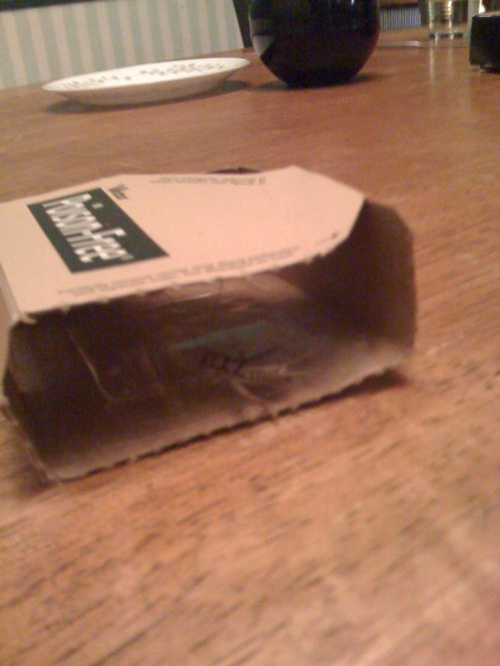
This isn’t one of them
Tuesday, December 2nd, 2008The 11 lamest blogs on the internet.
The 11 lamest blogs on the internet.
For years, I would go to Tijuana once or twice a year with friends. Whether we were drinking in the plaza or riding the mechanical bull or touring the world’s worst wax museum or attending the bullfights, we always had a great time. It’s four years now, I think, since we went. Want to know why? Here’s why. Things like decapitation in the streets kinda suck the fun right out.
Didn’t a bunch of us do whatever we could to help Barack Obama beat Hillary Clinton? I distinctly remember the California state party conventions; and watching Phil Donahue’s movie about the returning vet who fought in her war and who now can’t walk, think straight, or get an erection, and intercut into that movie scenes of Hillary so passionately advocating for that war; and my making phone calls and sending emails and sending money for Obama; and noting here and everywhere that her “experience” equals the following accomplishments: 1. holding months of secretive, Cheney-like meetings about health care, leading to a cumbersome and unintelligible mandated health-care system that no one could understand and that had few supporters, and which failed, 2. getting elected senator from New York off the strength of her husband’s name, 3. running a badly managed campaign for President, in the process lying about her accomplishments and flying through untold millions of dollars with ultimately nothing to show for it — except her new position as Secretary of State.
Say what you will about her, she’s got tenacity.
But diplomacy? Uh uh.
As for Obama, perhaps he’s taking his own comparisons to Lincoln, with reference to Doris Kearns Goodwin’s “Team of Rivals,” too seriously. Lincoln populated his Cabinet with former rivals; soon to be seated at Obama’s table: Joe Biden, Hillary Clinton, and Bill Richardson. (To quote Meat Loaf, two out of three ain’t bad.) Who will head up NASA? Dennis Kucinich saw a UFO, so maybe him.
Even after wanting so desperately for her not to be president, I like to think that Hillary Clinton will rise to the occasion and somehow show unsignaled strength in diplomacy and judgment. But at the moment, this feels like losing a presidential election after winning. One potential out to all this: There’s still a full seven weeks left for Bush/Cheney to devise some method of staying in power. Maybe Cheney’s nighttime rereading (and rewriting) of the Constitution has led him to decide that because he’s not part of the executive branch, he’s got no obligation to leave.
This semester, I’m having immense fun team-teaching a survey class with fellow writers Christopher Meeks, S.L. (Sid) Stebel, and Aram Saroyan.
I realize you may already know this, but Aram is most famous for, secondly, being the son of William Saroyan, and, firstly, being the (in)famous poet behind the poem that first got the NEA into hot water politically, almost 45 years ago. Here’s the entire poem (no need to get comfy, it’s quick):
lighght
That was it. If you need further time, go on back and read it again and we’ll wait here.
Okay. Good. For more about this poem and the controversy it stirred, here’s the full story. Let’s just say that some people were outraged that taxpayers’ dollars were funding such work, and even some well-known and highly respected poets had responses to Aram’s early work that could be best summed up as, “What the fuck is this?”
However one feels about that, here’s how I feel every Monday night: pretty fucking lucky because I get to hang out with Aram Saroyan. (And, make no mistake, Sid Stebel and Chris Meeks. But we’re talking about Aram at the moment.) Whenever Aram’s lecturing, I learn more in that hour than some people learn in their entire lives. A couple of weeks ago I stirred the pot by getting some students riled up about seemingly bad meaningless poetry just so we could see what would happen. The result was electrifying. Aram never lost his cool, proved that he knows his stuff, and didn’t bother to fall into the trap of defending poetry other people don’t like. “Maybe this isn’t for you,” was the gist of his response, but the general lesson was that he’s deeply schooled in literature and language. It was impressive.
So. Onto last Monday night.
After class, we faculty members usually go drink. (We are, after all, writers.) Somehow or other we got to talking about Aram’s name — that he’s known for these accomplishments, including the rather strong-selling “Complete Minimal Poems” (which would take less time to read than this blog post, but which will live on far far longer). Aram would have none of it. Despite his produced plays, his widely collected and awarded poetry, his biographies of the Beats, his essays, his novels, his lineage, his personal association with other important writers, Chris and I couldn’t get him to see himself the way we do. Which, no doubt, is good.
So yesterday I’m on Facebook and still thinking about this discussion and I decide to add Aram as a Friend. So I search “Aram Saroyan.” Turns out he’s not on Facebook. But there’s a group devoted to him. Here’s what it’s called:
“The GREATEST poet that ever lived”
Here’s the description:
Aram Saroyan the author of the famous award winning poem, Lighght. We come together to support this amazing man.
You can see all of his amazing work here:
No, it wasn’t started by Aram. Or a relative. It was started by a young woman in Washington, DC.
So I emailed this to Aram:
Subject: OK, Aram, TELL me you’re not so famous
On 11/29/08 12:25 AM, “lee@leewochner.com” <lee@leewochner.com> wrote:
There’s a frickin’ Facebook group DEVOTED TO YOU!
And it WASN’T started by you! (Some girl on the East Coast.)
And it’s called — drumroll please —
“The GREATEST poet that ever lived”
(Boy, you’d better NOT have started that!)
Here’s the URL: http://www.facebook.com/group.php?gid=18400632419
No, I haven’t joined the group. I mean, don’t misunderstand, I like you, but there’s this Shakespeare guy, and I kinda like Rilke, and Eliot is pretty good… I’m sure you understand.
I’m standing by my debt to Shakespeare, Rilke, Eliot, and some others (Whitman, Dickinson). But hey, as Aram jestingly suggested when he emailed back, maybe these other poets ultimately led to him.

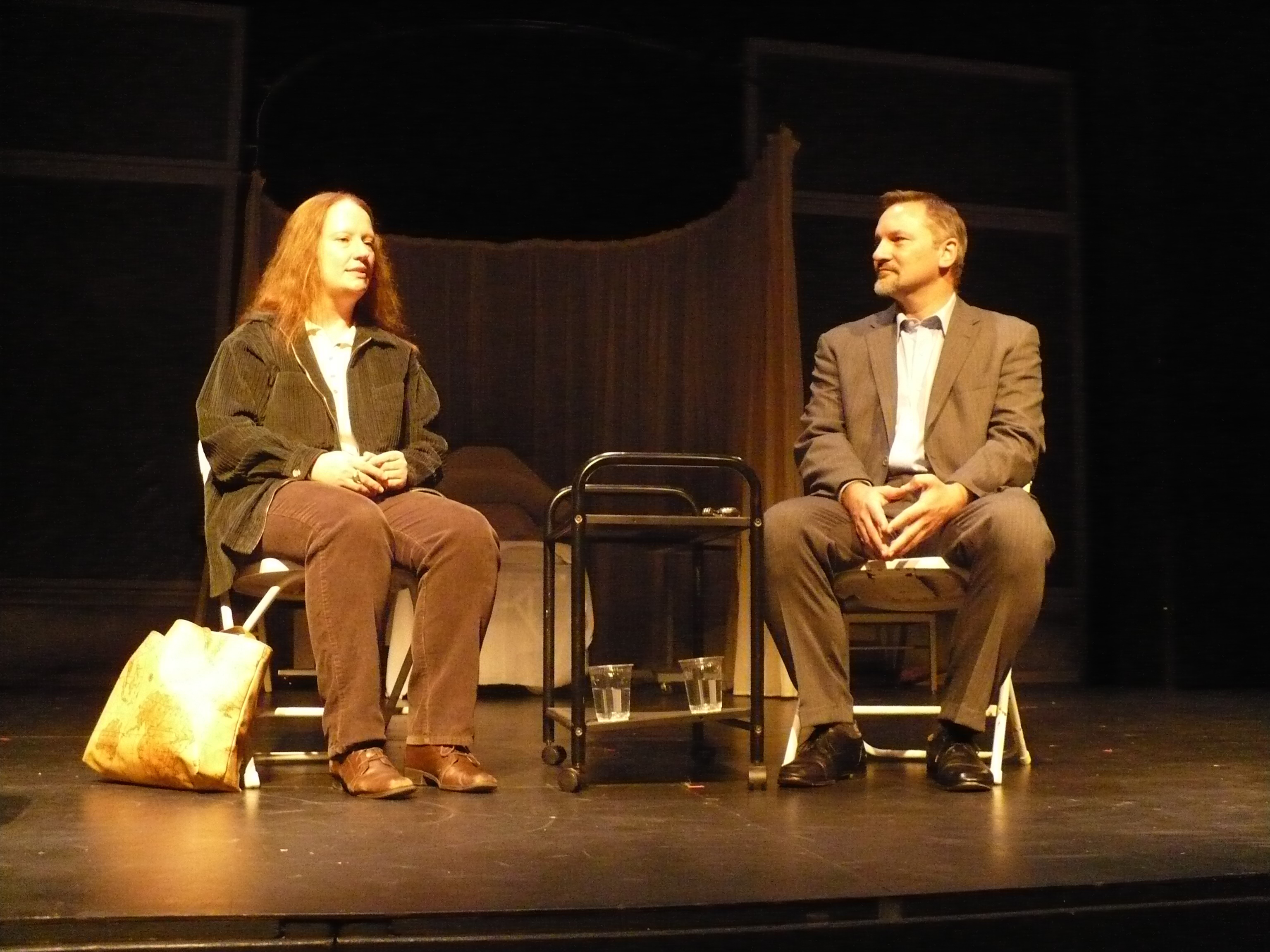
Last weekend, I did a talkback with playwright and good friend EM Lewis after a performance of her play “Song of Extinction,” which she developed in my “Words That Speak” workshop. That’s us, above, while she ponders the answer to one of my questions. It may have been this one: “Your play is about extinction, and yet even plays like ‘Waiting for Godot’ and ‘Wit’ are life-affirming precisely because they take place in this live medium. It is called ‘live theatre,’ after all. In your play, we’ve got genocide, parental death, and species extinction. Is it still life-affirming?”
(And yes, that was pretty much the question. And Ellen’s unspoken answer may have been this one: “Why did I agree to do this with him?”)
Like Ellen’s writing, her answer was thoughtful, poetic, and unexpected. Her characters are entering a new phase after the play, she said, and so are we as a species. And she is hopeful.
The producers promise me that our 45-minute discussion, including questions and answers from the audience, was recorded for podcasting and will be uploaded soon. When it’s available, I’ll let you know. In the meantime, I’m going to once again highly recommend this play (this time after having actually seen it). Ellen’s play is smart, funny, and packed with meaning, and the production is filled with terrific performances, especially by Michael Shutt, whose work always blows me away. (I have directed Mr. Shutt, and he’s directed for me — now I need to get him cast in some of my plays.) The show runs through December 14th. Info and tickets available here. I’m very proud that this production at the lovely John Anson Ford Amphitheatre is by Moving Arts, the theatre I proudly serve.
A few nights ago I had a dream in which I broke into my neighborhood comic-book store in the middle of the night because I just knew a comic book I was waiting for was finally there and I couldn’t wait any longer. So I smashed the store’s display window, gingerly stepping over the shards of plate glass jutting from the casement, and headed directly for the display bearing that choice book. And, indeed, there it was. But as I reached out to grab it, I stopped to realize what I was doing, and whom I was doing it to, and how this was in no way the person I think I am. So I left the comic, and the comic-book store, and got home as quickly as I could, my own shame following closely behind. After a sleepless night (still in the dream), I couldn’t bear it any longer and drove back to the comic-book store to confess and to offer to pay for the broken window and to throw myself onto the mercy of the store’s owner — but when entered the store I found him sitting bereft on the floor, having thrown tarps over all the comic-book displays after deciding to leave the business because he couldn’t imagine how someone who loves comic-book could have done this to him. After voicing my sympathy, I left and decided my only course of action was to mail an anonymous cashier’s check and then leave town and hope to rebuild my dignity elsewhere.When I woke up in the morning, I still felt like I had done this to the owner of the comic-book store. It was a hard feeling to shake. For almost 10 years, I’ve never done anything there except pay for comic books and engage in idle chitchat. But now I felt soiled by something I hadn’t done. To even think it made me feel grimy. Because the dream had posed the operant question: How could someone who loves comic-books do this?
Today while running errands, I saw that I was passing the comic-book store and decided to stop in. I saw Paul, the store’s owner, and decided to tell him my dream; I figured that that way, I finally would be rid of it. I shared it with him, along with Freud’s analysis that there are only two sorts of dreams: neurotic and wish-fulfillment. Clearly, this neurotic dream revealed how much the simple pleasures of comic books – so far removed from the pressure of work and responsibility associated with writing, teaching, business, and political activism – mean to me. I closed my narration of this dream with the rhetorical question he had posed in it: “How could someone who loves comic books do this to him?”
He looked at me and said, “That’s funny, because someone just did.”
A few days before, someone else in the store had alerted Paul and another worker in the store that he thought the person who’d just left had swiped two hardback collections by putting down the stack of comics he’d just purchased, looking around, then picking them back up but with these hardbacks underneath. Paul couldn’t believe it and paid no attention; after all, this was a longtime customer, someone who came in with a closeknit circle of friends, someone who came from an affluent family. But then he remembered that a month or two earlier someone else had noticed something missing at the same time this person had just left. So he and two others scoured every corner of this rather large store, looking behind every stack and every rack, nowhere turning up these two $25 hardbacks, until he reluctantly concluded they indeed had been stolen. Next time this customer came in, they asked him about it and, Paul says, his denials were so strenuous they seemed like playacting, and so this customer has been banned from the store.
In my dream, the comic-book store shuts down and I exile myself. In reality, the store catches the thief and he is exiled.
I shared all this with my wife. She often says I have low-level ESP (while I think I’m just sensitive to subtext, as all playwrights should be). Now she wondered if I were precognitive, too. If that were true, our lives would be a nightmare, given some of these dreams. But what truly interests me in this are the intertwined tales of one man afraid that through an unthinking act he will ruin something important to him, and one man who does precisely that not to save fifty bucks that he assuredly has, but to substitute for the fun of escapist fiction the real-life cheap thrill of theft.
I know: You probably think crickets are cute. Let me tell you, forget the cute association with top hats and spats — they’re a goddamn menace. I say that because there’s one in our living room that I’m looking to kill. No matter where I go or what I do on this level of the house, he is all I can hear, and all I can think about.
My eldest asked, “Dad, why does he bother you so much?”
And I thought about that. I did. And now I have a definitive answer, at least for this very moment:
Because right now I’m trying to work on my play and a scene set in a furniture warehouse and all I can think about is that goddamn cricket I have to listen to.
My wife and I have each separately torn apart the entire living room looking for this cricket, to no avail. This cricket is such a noisome nuisance that our dog won’t even lie down in that room. I have tried closing this door. I have tried going down into the family room. Like the beating of the telltale heart, I now hear him everywhere.
Tomorrow I’m going to Do-It Center to buy cricket poison. I’m looking for something irrefusably tasty to crickets that will lure him out of his crevice and leave him smack on my floor deader than Karl Rove’s permanent Republican majority. If that doesn’t work, I’m going to buy a gecko and set it loose unfed in the living room until it catches and eats its own dinner.
In the meantime, I’m taking my laptop (and a glass of wine and a cigar) outside to the back yard to write. Are there crickets out there? Sure. But I can write with them out there — that’s where they belong.
Often, we feel sorry for people who spend Thanksgiving without family. But the worst Thanksgiving I’ve ever had was with family.
For years, my wife took our children to Florida to visit her folks during this holiday. About five years ago, I decided that perhaps I should go to New Jersey and do the same. My mental picture was of the Thanksgiving I grew up with: everyone dressed up and gathered at my parents’ house, with all of us sharing in my mother’s incomparable cooking and enjoying a raucous thought-provoking discussion. (At least until someone, usually me, got into an argument with my father.) And then playing board games and card games afterward. I didn’t expect precisely this, my father having died in 1991, and the dinner now being held at my sister’s house, but I did look forward to the rest of it. The moment I stepped into my sister’s house I could see that “Thanksgiving dinner” as I understood it was out. Our extended family was now so extended that we had been broken into three groups of tables, eliminating any hope of tablewide discussion. While I and a few others had dressed for the occasion, several relatives who will go unnamed wore t-shirts and construction boots and baseball caps. (A hat at the table! I expected my father to lurch from his grave and snatch it from that head.) Worst, in the next room were relatives of relatives – in-laws and in-laws of my in-law – who were watching a football game on a large stereophonic home entertainment system with the volume turned up to 11. I couldn’t hear anything next to me, but boy I caught every bit of the football game, including the excited cheers from the people who ate their Thanksgiving dinner in there in front of the jumbo TV. After dinner I tried to put together our own game of some sort – a game involving active participation, not vicarious lassitude – but couldn’t get any two people to agree either on a specific game or to play at all. Finally I left unannounced and stomped in the dark over to my mother’s house where I read the night away and vowed never to return for Thanksgiving.
This brings me to the best Thanksgiving I’ve ever had.
On one of those holidays that my wife and children were out of town, I decided very last-minute that I would cook Thanksgiving dinner and invite some friends who had nowhere to go. This was a brief tradition for my wife and me in the late 1980’s and 1990’s because we know so many actors in particular who moved to Los Angeles to pursue fame and fortune and who didn’t have the money or inclination to go back “home” for Thanksgiving. After several years, though, my wife worked most Thanksgivings and I don’t like to entertain without her; I get either lonely or bored or annoyed or some combination of all three. But on this particular Thanksgiving, I was going to roast that turkey I’d bought, so why not invite a few people? One friend agreed quickly, but as I made other calls I learned that the invitations were too last-minute. All these people who in previous years had had nowhere but our house to go had found other houses to join once we rolled up the welcome mat. Meanwhile, I’d purchased enough Thanksgiving food supplies to feed the Norman invasion. And I’d planned to make a baked cranberry dish I’d read about in the LA Times. No way was it just going to be me and the one friend, so I dug further and further into my Rolodex and kept making calls until four others decided to join us. And then the one friend who’d RSVP’d canceled. So when the assembled crew sat down for Thanksgiving dinner it was five people who barely knew each other: myself, my friend the vegetarian, his French roommate whom I’d never met, my manic-depressive black Republican friend, and a playwright I’d once spent a month with in Arkansas in a fellowship. We were the cast of a Robert Altman movie in the scene where they all finally meet.
But here’s what happened:
Because we had had no history, we spent the afternoon actually learning about each other. I can’t remember a thing we talked about, but I know it was about art, literature, history, music, politics, and life and death. Because we weren’t family and we weren’t truly friends, we were utterly liberated to say anything, and we had an absolute ball doing so. After the wine was drunk and the food was cleared, we decided to go see a movie, and so all piled into my car and went to see a movie that wound up being “American Beauty,” which was newly released. We didn’t know anything about it, but it turned out to be about a 42-year-old man who wakes up from his humdrum life and decides to be utterly liberated. It seemed like an absolute revelation, and the best movie we’d ever seen. “What a great movie,” said the manic depressive, who on a regular basis knew a lot about great and not-great in his own life. Then we all drove up to the Castaway restaurant on the edge of the mountain and looked out over the lights of the valley in the darkness while the vegetarian and his roommate and I smoked cigars. Finally I drove us back down to my house and we all agreed that we’d had an unexpected and memorable Thanksgiving.
Like all great events, this event was not to be repeated. I haven’t seen the playwright once since that evening, although we’ve emailed a couple of times trying to get each other to come see each other’s plays, with no luck. The vegetarian and his roommate had a vicious falling out, including a fistfight with other roommates, and almost went to court. Five years ago I called the vegetarian from the rooftop of a hotel in Hollywood not three blocks from his apartment and invited him to join me at this launch party for Nike Rockstar and he said he’d come; after 30 minutes of waiting for him, I called him back and found he hadn’t left and I figured he wasn’t coming and so I said, “I can take a hint” because this wasn’t the first time, and he said, “There’s no hint,” and I said, “Goodbye” and that was that. I’ve seen the manic depressive several times since – he was positively delightful at our 2004 Fourth of July barbecue, for example – but it isn’t frequent, perhaps once every year or two. I make an effort because he is truly brilliant, an obviously original thinker (like all manic-depressives), and has at times been a very good friend to me.
So Thanksgiving is not about family, and it is not about holding onto the past. It’s about recognizing what you’ve got, especially in light of all the people who haven’t got much of anything. This year was low-key, but there were high notes: my wife unexpectedly dancing with me to a sentimental song of the 1920’s covered by Bryan Ferry; my 10-year-old daughter sharing her love of Georges Seurat then challenging me to swing higher than she could; my 6-year-old asking me to roll over him and “crush” him. I used to expect more. Now I know to expect nothing, and appreciate what comes.
We’re used to American movies giving us catchphrases and iconic scenes, from “Here’s looking at you, kid” through “Make my day,” to just about every shot of “Star Wars.” I can’t think of any scene from a foreign film that has so entered the zeitgeist as the now-famous scene in “Downfall” where Hitler chews out his senior staff for their incompetence. On YouTube, it’s so widely parodied that I’m sure it’s going to be with us for quite a while.
Here’s the latest version I’ve seen, and it couldn’t be any timelier. (Good parody requires timeliness. Great satire demands timelessness. It’s the difference between last week’s “Saturday Night Live” and “A Modest Proposal.”)
This is the first one I noted; it’s the (now-famous) “Torchwood” parody of the (now-famous) scene in “Downfall.” Note: if you haven’t seen the “Torchwood” Season 2 finale yet and you don’t want it ruined for you, don’t watch this. (Valorie, this means you.)
Next, here’s Hitler complaining about Windows Vista.
Here’s Hitler pitching a fit when he gets the Red Rings of Death on his Xbox. (In other words, the hard drive is kablooey and the system won’t boot.) I’ve seen this particular Hitlerian outburst myself in our house: It was my response when I wanted to play “Marvel Ultimate Alliance.”
Here’s one where Hitler gets banned from World of Warcraft because of his poor behavior.
I could go on and on — there seems to be an endless supply of these on YouTube, and no, I’m not going to watch them all either.
I have to admire the skill behind these. It’s not merely a matter of taking the video and coming up with a new pretext for the scene and then dropping in your new dialogue. To do it well also requires understanding how to write dialogue for this pre-existing scene that will match both the running time of the words coming out of the actors’ mouths, and also the expressions and body language they’re showing. Woody Allen did this in “What’s Up, Tiger Lily?” and at some point in the 90’s I saw a stage show were some gifted improv actors provided new dialogue for a not particularly good movie. But now we have a stampede of these built around one clip. So while I admire the skill in adapting the situation and modulating it to fit the actors, there’s nothing clever about the imitators. The first one, yes, was insanely clever (and I think that was the “Torchwood” one); great concept, done well. The imitators are to that what the magazines “Cracked” and “Sick” and “Crazy” were to “Mad.” By the mid 1970’s, the field of parody magazine ripoffs became so exhausted that one of the last launches was entitled simply “Parody,” all the other synonyms for “Mad” having been used. I think we’re at that point with Hitler in “Downfall.”