Lee Wochner: Writer. Director. Writing instructor. Thinker about things.


Blog

Archive for the ‘Thoughts’ Category

Capital offenses

Thursday, December 25th, 2008

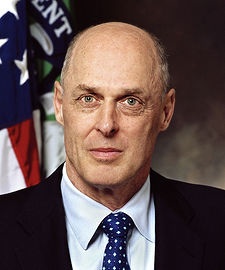
henry_paulson_official_treasury_photo_2006.jpg In response to my recent post about the Atlantic Monthly’s take on the state of the economy, longtime friend (and reader of this blog) Joe Stafford sent this  photo of Treasury Secretary Hank Paulson and this comment:

Now here is the face of a man asking “WHA HAPPEN’d?”
A bit too wide eyed if you ask me.  Maybe his contacts are worn out.

My question is:  How come in a nation built on CAPITALISM, the crime of abuse of money isn’t the CAPITAL of ALL capital crimes?
Punishable by death, live, in living color, by firing squad?
Mayhaps I’m gullible.

I suspect that in 2009 we’re going to hear more and more calls for retribution of some sort. Which would be fit against people who broke laws and gamed the system in the way Enron executives did.

But if it’s blame we’re looking to assess, most of it lies in our collective mirror. That’s something we should all remember when the next credit-card bill comes.

Merry Christmas

Wednesday, December 24th, 2008

thefatmanandlee.jpg

I just got home from a late movie on Christmas Eve and judging from the tree, the fat man has already visited us. I hope you find something good waiting for you.

A likeness too close

Tuesday, December 23rd, 2008

obama-abe.jpgThroughout the recent presidential campaign, there were numerous comparisons between Barack Obama and Abraham Lincoln, most of them originating from Obama. Like Lincoln, Obama was a relatively unknown legislator of meager circumstances from the backwoods (meaning, in this case, Hawaii and Indonesia) with a gift for rhetoric and an affinity for black people who promised to unite a divided nation. Post-election, the narrative has continued, most recently with Obama naming his own “team of rivals” to serve on his cabinet. Today, it was announced that he will take the oath of office using the Bible that Lincoln used.

The point having been made, I think it would be useful now for the president-elect to cease this simile. Because we all know how that other, earlier, story ended.

Credit plans

Monday, December 22nd, 2008

Today I finished reading two especially timely articles in the current issue of the Atlantic Monthly.

In one, a former financial insider explains why Wall Street never learns its lesson, and will always shuttle between boom and bust on about a 30-year cycle. The essential thrust is that inevitably regulations fall away because we succumb to our own greed.

In the other, the man who oversees $200 billion of China’s $2 trillion in dollar holdings lends some sage advice to those who need him most: us. It boils down to “learn that you aren’t special and you can’t continue to live this way,” and “be nice to us, because you need to be nice to us.”

I thought about these two pieces while driving home tonight from the liquor store. I would think that most Americans reading these pieces would need to stop at the liquor store.

Here’s what was awaiting me when I got home: four different “you’re pre-approved!” offers from credit-card companies. Two were for Visa cards attached to airlines, one was from American Express, and one was from Discover. The beginning interest rates ran from 9.99% to 14.99%. All four cards were adjustable-rate. Behind all these cards, in one way or another, was bailout money that we recently borrowed from the future with money printed today. I shredded all four applications.

But not before wondering if I couldn’t accept these cards and charge them up, default on the payments, use the money to buy some historically low stocks, have the government bail me out, and then stick the Chinese with the bill.

I knew he was a stooge

Wednesday, December 17th, 2008

bushzwartwit.gif

Political question of the day

Tuesday, December 16th, 2008

Q: What’s the difference between Rod Blagojevich and Caroline Kennedy?

A: He wanted to sell a Senate seat and she wants to buy one.

Good advice from Adam’s mom (and me)

Tuesday, December 16th, 2008

My friend Adam Chester is a very funny and talented man. If you saw “What’s My Line – Live on Stage” last year, you’ll remember him as the one-man band who always had the right song to cue guests on or off, and as the singer-songwriter behind such memorable tunes as the Counterintuity jingle, which I promise — promise! — we’re going to post one of these days. Adam is a gifted musician and lyricist and songwriter and singer and you don’t have to take my word for it, because Elton John and others have noticed all this as well.

Adam is gifted. But as they say, behind every gifted Jewish man, there’s his Jewish mother. And now that I’ve learned a little more about his mom, it’s no wonder Adam has turned out so well. Adam is smart, but his mother is a sage. As you can learn by reading his blog, which is over here, over the course of 27 years, Adam’s mother has written him some 600 letters advising him on the do’s and don’ts of surviving the hell that is adulthood in the big city. To wit: be careful of intruders, get new tires, beware of killer bees, and don’t eat sushi.

For me, you’re going to want to watch the video below and then click over to YouTube to comment. And you are going to want to do this, trust me.

But first, let me just add this: This wonderful video provides a fascinating look into how the other half lives. Because this is utterly counter to how my stern German Lutheran mother raised us. Example: If you were going to cry, you were told to “Go cry on the steps.” And the steps were outside. What might life have been like with Adam’s mom? And if I had saved all those letters, my mother would have said, “Why?” This video opens an entire new realm of experience to me!

Weather report

Tuesday, December 16th, 2008

I never meant to imply that when it rains around here it can’t be serious. Remember my friend I was going to have dinner with last night? (Now rescheduled for next week.) He emailed me this update:

We were right to call Seal Beach off last night. I heard on the news that
Sunset Beach was flooded, with PCH closed down. That’s only a mile south of
Seal Beach. And there were plenty of accidents on the freeways.

Hope for better weather on Dec. 23.

So see, the rain can be a serious matter. I just don’t think it is all the time.

(And by the way, it’s raining again now. Given the hyperbole of local reporters, I’m expecting forecasts that the coast will shear off into the ocean, helping Las Vegas recoup its real estate values by transforming it into beach front property.)

Whether weather

Tuesday, December 16th, 2008

When it comes to the weather, Los Angelenos are profoundly schizophrenic. Most of us, it seems, come from elsewhere, a situation that undergirds our viewpoint, giving rise to four recurring comments:

  1. “There’s no weather here.” (Said proudly over the phone to people elsewhere suffering snow and ice.) There are many variations of this — the most popular being “Really?” It’s 72 here.”
  2.  “There’s no weather here.” (Said sadly as one rhapsodizes over romanticized snowbound adventures like snow days off school, building snowmen, coming up from subway stations to discover your neighborhood blanketed with snow, and so forth.)
  3. “I wish it would rain. We need the rain.” (Said semiannually, when the hillsides are on fire.)
  4. “Oh, God. It’s raining.” (Said every time it rains — like last night.)

Yes, it rained last night. Actually, it started the night before and rained almost continually for 24 hours. Typically, Angelenos greeted the news that there was water falling from the sky like it was the apocalypse. Surely we’d already had the rain of frogs and just hadn’t noticed.  I grew up in plenty of rain, and that was rain that at times of the year actually froze and clustered around trees like a deadly exoskeleton snapping branches, splitting trunks, and felling power lines, so the LA version holds little terror for me. Around here it seems different.

Yesterday morning at 8:59 when I was trying to regain some lost hours of sleep from the night before, my cellphone rang. I let it go to voicemail, but when I checked it later found it was an esteemed friend and colleague I’d planned to have dinner with that night in Seal Beach, 35 miles away. His message:  “It’s raining. I’m not sure you can make it.” I looked out the window:  While I didn’t see the rainy version of, say, “The Day After Tomorrow,” I could see that it was indeed raining. Two hours later he called again to say that it was still raining, although more lightly. Again, this was inarguable. Still no plague of locusts, though. I watched the weather, too, and after consulting with my business partner decided to call my friend back and reschedule. Not precisely because of the rain, but because of what that rain would do psychologically to everyone on the 5 freeway southbound. I envisioned miles and miles of cars crawling along in fear. The 45-minute drive would surely take two hours.

Before I left the house in the morning, my wife confided that she was worried about our son driving in the rain. It’s natural for a mother to worry — in fact, beware of mothers who don’t worry, even secretly — and her worry created in me one that hadn’t been there just one moment before, but then I thought about his solidly made car with four new tires and the unlikelihood of a truly terrible collision and decided that this wasn’t rational worry. So I put it out of mind.

Whenever I was in the car yesterday the radio stations were filled with panic about the rain. What is this massive precipitation in the sky that is falling on us? What have we done to deserve this? “Wherever you are, you should stay there!” a local public radio host said breathlessly. I wondered if this was radioactive rain sent by the Soviets of 20 years ago.

When it’s too hot, we implore the heavens for rain; when it rains we are the people of Pompeii desperately seeking shelter. Lord knows what would happen if we ever had snow. The effect of all this freefloating anxiety is predictable. Angelenos, who skew toward the neurotic already, fret about the weather even when there isn’t any.

Fourplay

Saturday, December 13th, 2008

Today I did something I haven’t done in at more than 15 years: I signed up for someone else’s playwriting workshop. This one-day affair was run by a very good friend and former student who confessed to me the other night that she was a little unsettled when she found out I’d signed up for it. (And I had thought she’d be hurt if I didn’t. Which shows why we shouldn’t make assumptions.) I assured her that I just wanted to be “anonymous playwright #7.” “I signed up for your workshop,” I told her, “because I already know what I think and I already know how I write plays, and I’m actually pretty tired of me, so I’d like to be putty in someone else’s hands.”

Which I was, and which I was glad to be. This workshop turned out to be just what I needed to do today:  unwind artistically, using someone else’s methods. It reminded me of fly fishing the first time under the tutelage of my friend the skilled master. And, as you’ll see, I got something else out of this workshop, something I hadn’t expected.

The workshop started in typical fashion for most things: waiting for the people who are late. Which always annoys me. Perhaps in 2009, I’m going to be consistently late so that people can wait for me. I was determined to be as unannoyed as possible by anything all day, so I checked email while pretending to be blase about waiting. (And the last person didn’t arrive until 10:52 — almost a full hour late. Glad we didn’t wait for her.) We got going by introducing ourselves and why we were here. Everyone had their own reasons, none of them far from mine: to change the workout routine. When it came to me, I volunteered that I was writing three plays at the same time and that I think they’re coming along well enough, but that I wanted to do something different for the day to get out of my head.

After a brief intro, we got the first writing prompt, which was: “Write an action. A single action: changing a lightbulb, changing a tire. Step one, step two, step three, step four.” “Plays are about action,” the workshop leader said (and I agree — good ones are, at least). Here was mine:

Starting my car:

Pick up my keys with my right hand. Put them into my pocket for some reason even though I’m going to fish them back out within a minute. (That reason being that I’m still afraid I’m going to drop them down a storm drain as I did once in 1984.) Find the car. If it is parked inside a parking garage, this is easier than ever because for five years and two cars in a row now I’ve made a point of buying a red car, having once lost a common grey-blue colored car in a parking structure in Pittsburgh for no fewer than two hours. Press the button on the key remote to unlock the car. Open the door, clutching those keys tightly so that, again, I don’t drop them onto the street or otherwise lose them. Throw my jacket onto the passenger seat. Get in. Close the door. Insert the key into the ignition. Hear music or the news as it comes on and if George W. Bush is on the news, immediately switch to a CD. Turn the key. Look in the rearview mirror. Look in the side mirror. Put the car into drive. Drive. Think about how much I love this car while driving.

(Just after I finished reading this aloud, that last late-arriving person arrived. Fifty-two minutes late, as I said, and now she had missed hearing what we’d read as well. “I’m so sorry,” she said, seeming not very sorry at all and, in fact, sounding rather casual, as though this were her routine. The way she said “So sorry” sounded like “Sue Sorry.” Later in the day we had a disagreement about what an unreliable narrator is (because, I think, she doesn’t understand the term), and I couldn’t help thinking that she exemplified one: saying she’s sorry when she isn’t.)

In any event, this little piece of unconscious writing clarified for me why I do that odd key thing: picking up the keys, putting them in my pocket, then removing them from the pocket less than a minute later when I’m near the car rather than simply carrying in my hand all along. I knew why I had the red car — to find it and because I like the color red and I like it on that car — but I hadn’t realized I’d internalized the 25-year-old lesson of how not to drop your keys down a storm drain. It’s unfortunate to be reminded just how self-programmed you are.

The next three prompts were drawn randomly over the course of the day from an envelope that the workshop leader had brought. We were to write a scene for each. The first prompt I drew said: “One of the characters is naked.” That stopped me for a few seconds, in which I conjured then rejected these three ideas:

  1. My former roommate Gary’s story about a boy they used to call “Puddin’ Pop” who lived across the street and who would run naked into the woods; I couldn’t see what to do with that
  2. someone who has been vomited all over and gotten locked into a bathroom while changing; again, it didn’t seem alive with possibility to me, and additionally drew forth in my head an image of Jim Carrey, a surefire creativity killer for me
  3. a couple having had sex and the one partner refusing to hand back the clothing of the other; this seemed too close to play I already wrote some time last decade.

And then I had it — something I liked that I could run with. It was a story I’d read long ago about two famous men, one that has lived with me ever since. And so I had great fun writing that scene for about 10 minutes.

We were then told to write a scene while thinking about “compression of time,” i.e., a ticking clock — an imminent deadline that drives the action. I drew the prompt “one of them has a gun.” As soon as I saw it, I realized it could work with the scene I’d already written. So I just kept writing that scene, but now introduced a gun, which took me to a very fun place.

Now we were told to write a monologue. I immediately had a monologue in mind for one of my characters, in which he could pass judgment on the other man to us, without fully realizing his own declining situation. (Which would again provide an opportunity to display unreliable narration.) I drew my last writing prompt, which was “father and daughter” and I remembered that the other character had had a daughter, and so now each of them would have a monologue.

By now, having completely tossed out the instruction to write separate scenes, I realized I was writing a play that I would indeed be writing to completion, I said to the workshop leader, “Damn you. I came here with three plays I’m writing. Now I’m writing four.”

Every one-day writing workshop should work like this.