Friday night at the gym while exercising my triceps on a machine, I found myself looking at a colorized episode of The Dick Van Dyke Show. “Looking at it” because I wasn’t precisely watching it — instead, I was admiring how much better colorization had gotten over the years (it looked quite natural) and wondering how I felt about this and whether or not it would be somehow better if it were still in black and white. Had this colorization damaged the original, or had it opened up its possibilities for younger generations?
Just then, a voice next to me said, “Excuse me, sir, are you watching this?” It was the fit young black woman from the front desk.
“Oh, no,” I said truthfully, determined not to show my awkward delight at her nearness.
“What is this?” she asked.
“It’s the Dick Van Dyke Show,” I said. “Colorized.”
She looked at me blankly.
“It used to be in black and white. From the 1960s. That’s Dick Van Dyke,” I pointed. “And that’s Mary Tyler Moore.”
No recognition.
“And that’s Carl Reiner. I met him a couple of times. He died recently.”
“Oh.”
“He was a major comic actor. And movie director.”
No recognition.
“Rob Reiner is his son.”
Nothing. Now I understood how my father felt when he would point out old timey actors from the 1800s or something in old movies.
“Rob Reiner. He was a major sitcom star, does a lot of character acting on TV still. Pretty significant film director….” I was fishing, then landed on it! “He directed The Princess Bride.”
“Oh! Cool!”
Finally, even though separated by 35 years, we had a shared cultural understanding. She asked if she could change the channel.
“Sure.”
While I resumed my workout, she flicked around every single one of five thousand and six channels, not finding anything.
“See, this is why I canceled cable,” I volunteered. “Five thousand and six channels, and still nothing you want to watch.”
Finally she landed on something. It was a cooking show with a celebrity chef — probably the celebrity chef.
“My company is doing a project that involves him,” I said.
“REALLY?!?!?” she asked in a hushed but exclamatory tone. “Are you going to get to meet him?”
“Maybe,” I offered honestly. I mean, there were no such plans, and he wasn’t flying in for his bit, but one never knows, right?
“I love him!” she said.
Catching a glimpse of myself in a mirror, I increased my weights. Now I had somehow assumed my father’s role in pointlessly naming faded stars from distant ages. Meanwhile, I regularly use the Shazam app on my phone to identify every song that gets played at this gym.
This encounter also cleared up for me a mystery: why every single TV in the damned place is always tuned to the Cooking Channel. Until now, I’d thought it was intended as perverse motivation: that we should look at all these fattening foodstuffs and work out harder!
Now I realized it was the reflection of a young woman’s ardor.
So, no, I can’t end April with only one post. So here we are, with the end-of-the-month post.
I remember the years when I used to post here every day. Maybe I’ll get back to that. If it gives you any comfort* — because I’m sure you no doubt want comforting about what I’m up to — I will tell you that I’ve been very productive during our little global pandemic.
I wrote three full-length plays**, and one of them is headed into production now with an opening targeted for June. (More about that soon.)
I also devoted a lot of time to listening to, and interacting with, and researching even more about, the world’s greatest rock band.*** Time well-spent indeed!
I bought about eleventy-billion more glorious old moldering comic books from the 1940s through 1980s and carefully curated them right into my collection.
And I’ve been doing a lot-lot-lot of reading, and I’ve been working on some exciting projects and initiatives at my company, and I’ve even occasionally had friends over to sit in the back yard and smoke cigars and drink bourbon and talk about writing and the theatre.
And somewhere in all that, I went and got vaccinated. I hope you do that too, if you haven’t already.
And we’ve had lots of repair work done around the house and yard, even up until today, and even more scheduled, and… ugh.
I thought I’d just catch you up somewhat obliquely on some of these things before May hits us smack in the face in the morning. And at some point — perhaps this weekend? — I’ll write one of the two longish posts that have been floating around in my head for literally months now, one of which I’ve actually written notes for, and one of which I’ve taken a photo for. The former one involves the Bee Gees, while the latter one involves Philip K. Dick and Adam Strange.
Stay tuned!
* It actually gives me comfort, as someone raised very German Lutheran, and therefore tied to work. Work is my joy. My people, when we die, say, “I wish I’d worked more.”
** When asked how many of his plays were full-length, Edward Albee famously replied, “All of them.” (Even his 10-page ones.) But in this particular case, I mean a running time of 75-120 minutes.
*** Pere Ubu, of course! There’s always something great going on over here!
The post I was going to write was going to have a beginning, a middle, and an end, and would be thematically unified.
But this isn’t that.
When I was at the gym earlier, I had a different post in mind to be writing right now. But even as I think about that, what I’m really thinking is this: Dear God, it felt glorious to be back at the gym! Hooray for reopened gyms! No this wasn’t the gym that had shit in the showers — I quit that gym — this is the new gym, new to me and new to everyone, that had to close last year because you-know-why. And now it’s reopened, because you-know-what is subsiding. I was so happy to step across that threshold that if they’d charged a “convenience fee” at the door I just would’ve handed it over. I had a terrific workout, admittedly far superior to the one accomplishable in the setup in my garage, and thanked everybody there on the way out.
The gym’s been open for a week. Why did I wait? Well, on Friday morning, I got the Johnson & Johnson COVID-19 vaccine. The tradeoff: You only have to go once (perfect for me, because I’m generally impatient), but the reported incidence of side effects is greater. Then, very late Friday night, I started to feel strange. Like, somehow I couldn’t make any sense of what was happening in “Godzilla versus Kong,” and I mean even more than the “plot” and “dialogue.” When the big battle ended with them joining forces against a common enemy — so unexpected! — and I was trundling off to bed, I started shivering hard, and then had a very flu-like not-great time all night, resulting in my not feeling great on Saturday. I don’t think I could even tell you what I did on Saturday. Oh, wait, I finished one game of Civilization VI (playing Trajan) and then immediately started another as Saladin. That was about what I could accomplish.
But today? Today I sprang awake, ready to do stuff! Like: get over to that gym! Finally put things away, for God’s sake! And write a perhaps-one-day-print-worthy blog entry, something with pith and insight and clever word play. (This is what I aspire to, anyway.)
Four minutes before I got home from my workout, my wife texted me to say that “the painter” that I didn’t know would be coming would be at our house any minute now and did I want to talk to him. I suspected even then that she meant, “Do you want to grill and flambé him?” because that’s how she thinks I go about hiring contractors. That’s not my method at all. I just want to know what we’re getting, what our options are, how long it’ll last and for God’s sake how much it’s going to cost. I did take a liking to Robert, who spent a cool two hours on Easter Sunday detailing for us his 43-year-history as a house painter, starting with his emigration from Korea, then work in Colorado Springs, followed by Texas, and since 1987 Southern California. At age 29, he realized that he needed a wife “to cook and keep house” and so he got married. (At age 25, I got a wife because I liked her company. But people’s reasons vary.) He also volunteered that Koreans are reliable and hard-working. I actually think that many (most?) people are reliable and hard-working irrespective of nationality, but I may be in the minority on this one. Robert (not his birth name) will be getting me a bid, and we’ll see what it looks like.
(At one point, the post I was going to write was a litany of household improvements and repairs. I was already tallying it in my head: the tree service was $4225, the plumbing was about $2,000, the new dishwasher and sink came in just under $1,000, the new fence will be $8,000 to $15,000, lord knows how much Robert will want… maybe I’m lucky and his kids’ college is already paid for. But I decided that I’d rather not think about it, let alone write about it.)
Danny from the neighborhood also came over. Danny from the neighborhood is a short solidly built man originally from the nation below us who worked for the studios for years. I’ve been watching in fascination the past two weeks as he erected and stained a new fence on the property across the street. I’ve seen many, many fences in my life, around this country and in others, and Danny’s fence may be the nicest-looking one I’ve seen. So I called him over to give us an estimate on ours. The last bid we got was that $8,000-$15,000 one, and you would be right if you sense my hesitation at contracting that fellow, but it’s immaterial because he never returned our calls afterward anyway. The other unspoken pandemic problem: finding available contractors. So many people have turned to home improvement as entertainment in lieu of actually going anywhere and doing anything that these guys are booked up.
By the time Robert and Danny left, two-and-a-half hours had slipped by. So it seemed like time to pull out some of that wine we bought last week on that tour of wineries.
Free tip: If you ever want to get into the habit of spending a lot more money, one great way to go is to finally discover the difference between shitty wine and good wine. Shitty wine can be had for less than ten bucks, and sometimes for as little as two or three bucks. Our local liquor store ran a sale on cases of Spanish wine at $1.99 a bottle because it wasn’t moving, and most of it was corked. That is, after you could even get it open, and that would be with destroying the cork, the wine inside was bad. Meanwhile, the fabulous wine that rolls down your gullet and reminds you that there is love and light in the world, and that other delights await you? That wine costs many multiples of the cheap shitty wine. How do I know that? Because now I’ve bought it. And now that I’ve bought it, it’s already proving difficult going back to the cheap shitty wine.
After that one glass of the delectable pricey wine today, I switched back to water. Really trying to make this bottle last….
After that, I took our two neurotic uncontrollable dogs for a nice long walk. On that walk, I thought a lot about the post I was going to write. Now it was going to be about wine. As I watched the male dog urinate at length on his favorite bush, I wondered if I’d made a mistake sampling really good wine. Just how much was this going to cost me? Were we going to be offering this to guests? I was balancing these questions against my impulse to go online and order a case of that one red of which we already have only one bottle left!
When the dogs and I got home from our walk and our run, I decided that I didn’t want to think about the wines either and I certainly didn’t want to write about them and that’s when I pulled the water out of the refrigerator.
Next project, after dinner, in this day of projects: putting hundreds of comic books safely and securely into plastic bags with nice firm acid-free cardboard backings in them, and then organizing them in their storage boxes. Noted: these boxes of comics have gotten a lot heavier over the past 40 years. They certainly didn’t weigh this much when I was 18!
And then, because it’s Sunday night and that’s when you’ll find the best auctions ending, going on eBay to source more of these heavy comic books. And then, also because it’s Sunday night and that’s one of my nights to clean up the kitchen, cleaning up the kitchen.
So now it’s almost 11 p.m. and no, I’m not going to write the post I was going to write. What am I going to do? Do some reading, and probably get back to Civilization VI and converting the German cities to my religion; no, Frederick Barbarossa doesn’t like it, but if wants to do something about it, hey, have at it, pal.
Tomorrow’s another day. Maybe then I’ll write the better post.
The big news is that, according to the Wall Street Journal, “Ship Blocking Suez Canal Is Partially Freed“! This is great news for people who were actively concerned about this, and also of some note to all the rest of us who were sure it wasn’t going to take long to resolve. At the same time, I confess that I don’t know what “partially freed” means — isn’t something freed, or not? — but I’m not so animated about this to register a red alert.
In other news, ever since my post bemoaning the hit-or-miss delivery schedule to my doorstep of the WSJ Weekend edition, the paper has reliably been there on Saturdays. While I prefer to believe that after seeing my post, which I tagged them with on Twitter, they swung into action, the realist in me thinks they’re just continuing their mind games by lulling me into false reassurance.
The City of El Paso de Robles, also known simply as Paso Robles, has a well-earned reputation as a deserving destination for a brief relaxing jaunt, someplace ideal to take your wife who is a healthcare professional and has spent a year tending those sick and ailing with COVID-19 and other misfortunes when you can see that she needs to restore and recuperate. The city is home to olive groves, hot springs, and more than 200 wineries; with only 32,000 Paso Roblens living there (and that’s counting what one hopes are non-wine-drinking children), tourism is clearly a necessity for consuming all those libations.
While everyone talks about the wineries, far less is known about the extent of the dining choices in Paso Robles. In an attempt to fill even a gill of this oversight, I offer this list of dining establishments sampled in our four-day trip this past week, in descending order from best to worst.
Catch Seafood Bar & Grill
For the first time in a year, something you’ll want to catch
With the lamentable recent demise of Farallon in San Francisco, the unassuming Catch Seafood Bar and Grill represents perhaps the world’s only seafood restaurant that offers absolutely everything one could ever want in seafood, but done even better. YES, they have buckets of steamers — but theirs come with some buttery vegetable admixture you’d never considered, one that makes you pale when you see it, but which teaches you that the people at Catch know better than you do, and so after sampling these minuscule clams surrounded by diced tomatoes, garlic, and some greenery you cannot identify, you know you will never again think of clams unadorned in this way without a wistful sense of loss. YES, Catch proffers an oyster platter, one of mollusks so delectable that your oyster-hating wife, bowing to pressure, will not only try one, but will also exclaim a la Sam I Am, “Oh! I DO like oysters!” and then have another. Catch’s non-seafood offerings excel as well: the garlic toast is crisp but moist, the green salad is simple but reassuring, the nutrient-rich escargot, perhaps plucked off nearby vines by angry farmers, simmer deliciously on the tongue. My wife, a contrarian, ordered a steak but relished that, too. Also noted: your server will do absolutely everything within the law to accommodate your every wish.
Awarded: Top Honors
2. Impromptu picnic at Graveyard Winery
A bucolic setting with lake, wildlife, and grassy hillside — all of it outside this frame.
Graveyard Winery is called such because of its location up the hill from an abandoned graveyard, and not because it’s “spooky,” to the chagrin of your reviewer’s wife. The winery’s owner and her assistant will offer you a tasting of six very good wines for the cost of $15, which is discounted to free when purchasing wine. The economics of this did not escape me, and so we purchased wine — amply so. Because we arrived at about noon and were still happily imbibing the liquid of the grape two hours later in the lakeside shade, I inquired if there might be “nibbles” available in some way. Directed to the appropriate location inside the winery, I snatched up crackers, a block of French cheese, Italian olives, and a sampler of uncured meats, buoyantly suggesting that it all be added to our tab as I returned to our table with it all in tow. It beggars description just how good this impromptu picnic was. Free of the need to do anything or be anywhere except right there, remarking upon the tern on the lake or the squawking ducks, one is able to sink into the rustic pleasures of such a simple yet sophisticated repast. The atmosphere, the wines, the repast, the atmosphere, the servers, and the company all receive the highest rating.
Awarded: Best al fresco dining
3. Negranti Creamery
Yes, one can order a flight of ice cream samples. Heavenly indeed.
Eons after animal husbandry was invented, humankind has stumbled upon the ultimate purpose of sheep: to provide the milk needed to formulate this delectable iced treat. Less fatty than cow-milk iced cream, yet flavorful and providing an excellent base for a wide range of flavors, the sheep’s milk ice cream at Negranti Creamery adds a surprising crisp bite to an old favorite. The confectioners here are not so hidebound as to reject mixing in, say, basil with strawberry, or lavender with blueberry, and you shouldn’t be either. “Half the fat, all the flavor,” their tagline proclaims, and while it’s nice to see their desire for truth in advertising this is, if anything, too humble by half.
Awarded: Most surprising in a good way
4. Paso Robles Inn Steakhouse
Inside this unassuming exterior lurks an unassuming meal.
The Paso Robles Inn Steakhouse is not only associated with the Paso Robles Inn, it also shares a roof. Similar to the general hilly terrain of Paso Robles, the meal has its ups and downs. Your rib eye will arrive appropriately seasoned but not quite as you’d requested, while your baked potato will be intemperately cold. Your wife, again a contrarian, now that she’s in an actual steakhouse will order a salad, which she finds serviceable. The vodka gimlet is excellent, the pinot noir commendable, and the service willing and able, as when you pointedly tell both the hostess and your waiter that there’s a nice tip in it for each if they’ll just move you away from the fucking swinging doors that allow repeated blasts of cold air to suck the life from your lungs.
5. Templeton Market & Gas
When queried “Where is the best fried chicken in town?” those in the know locally respond, “Templeton Market & Gas.” And they are right to do so. Templeton Market & Gas is what used to be called a “food & fuel,” a small establishment that serves petrol and also some comestibles in an adjacent shack. Templeton Market & Gas, bearing a notable deli, also fries up its own fried chicken. The skin is crispy, the meat moist, and the seasoning perfection. Diners are encouraged to eat this chicken hot from the Styrofoam while sitting outside in their parked car. The accompanying “potato logs” are thick and dull inside, akin to actual logs, and are not to be discarded casually where unsuspecting animals might attempt to eat them. It is the chicken that one comes here for. The chicken, and perhaps the gas.
6. Buttonwillow Truck Stop Popeye’s
While technically en route to Paso Robles and not within its confines, I would be remiss not to recommend this truck stop for having the best Popeye’s chicken to be found anywhere. I speak from authority, having sampled Popeye’s chicken both hither and yon; none can compare. The service may be surly, with Hector behind the register only very desultorily providing your order or, later, a spork with which you can eat your mashed potatoes with Cajun gravy, but the meal itself is everything you ever hoped a Popeye’s box would contain. Although this is the best Popeye’s chicken found anywhere, I would be remiss if I failed to note, again, that Templeton Market & Gas serves the better chicken.
7. McDonald’s in Paso Robles
A noontime Egg McMuffin? No problem, at McDonald’s in Paso Robles! Ordered appropriately after the mad rush of earlier hours, God’s gift to breakfast food is served freshly made and steaming. Beware, though! Connor, the gangly youth who fixes your coffee for you, unexpectedly doses it with unrequested and undesired Splenda, resulting in a sticky sour taste you’ll discover miles later.
8. Yanagi Sushi & Grill
At Yanagi, the appetizers and beer will arrive instantly, but your main course waits in anticipation of the Japanese new year. The gyoza with finely minced shrimp are delectable, but the pungent clotted salad dressing earns a mixed opinion. As your beer slowly warms, the sushi is finally served, and is fresh yet somehow tasteless. If if you choose to dine outside, you will find that small groups with rambunctious children waiting for your table will look at you with menace for taking so long.
9. Homemade popcorn with beefstick
Decades of experience have left this seasoned traveler wary of unexpected interruptions in the food chain. Foreknowledge being fore-armedness, one learns to travel with “just in case” snacks, in this case liquor-store beefsticks and a quart-size baggie of homemade popcorn. The beefsticks, when still within their sell-by date, are tender and filling and mix well with bourbon or even water, while the homemade popcorn, popped to perfection in a recipe that includes carefully apportioned extra virgin olive oil, butter, and Himalayan sea salt, beats any and all comers. This meal, coupled with hot coffee from a Keurig, was devoured on the morning of the second day by your travel writer on the patio of his room as his wife slept until noon until finally he couldn’t bear it any more and gently (opinions differ) awakened her. He was admonished that in future such situations, he could make his way to a breakfast of his own elsewhere.
10. Leftovers from the only breakfast place still open
These are leftovers from the only breakfast place still open (see below), which turned out to be serviceably better than the same breakfast when it was newly placed on the plate. Now reheated via your room’s microwave oven, the eggs are better because you’re just glad to have something to eat, and because you’ve left the butter out in the room, therefore ensuring that it’s actually spreadable on the toast.
11. Park Cinemas
After almost a year-and-a-half’s absence from any cinema, you will find yourself enchanted upon entering Park Cinemas on opening night of “Nobody,” starring Mr. Bob Odenkirk in an improbable role. The cinema, with doors open and lights on and two accommodating young women behind the snack counter, will seem like a veritable wonderland, like a Brigadoon you never expected to see again. Unfortunately, Park Cinemas offers only Pepsi products and not Coke, and although the unsweetened iced tea will suffice, the popcorn, evidently popped those 18 months ago when last they were open, will not.
12. The only breakfast place still open
With more than 200 wineries, one might be hoodwinked into thinking that Paso Robles is a cultural metropolis, when actually it is closer to a scale reminiscent of Egg Harbor “City,” New Jersey. Accordingly, the town has odd hours and shibboleths of behavior; there is no need to roll up the streets at night, because there is nothing to do if one finds oneself on them. After dark, visitors are left to wander aimlessly, conjuring up visions of what might be possible another time. This also means that some places close on odd days, some on odd hours, and many have hours taped to their windows that in no way match up with the hours given on Yelp or their own websites. So, at 1 p.m., one counts oneself damn lucky to come across the only breakfast place still open, after hitting up every other potential dining spot only to discover that each of them closes at 1 p.m. for reasons that seem obscure yet somehow obvious to the locals. At the only breakfast place still open, you and your companion will agree that sometimes it is better not to find what you seek, and that neither of you has ever had a worse breakfast. The biscuits and gravy are served cold and congealed; the eggs with diced ham, although ordered lightly scrambled, will arrive with the consistency of drywall spackling; and even the grits, which seem impossible to fuck up, are dense and overcooked. Your companion may offer cheerily, “The pancake isn’t so bad,” leaving you to wonder just how one could make a bad pancake. The coffee, for an unfathomable reason, is terrific. “It’s Farmer Brothers!” your waiter will announce cheerily. Ah: the only thing not made here.
13. The Arby’s outside Tejon Outlet Mall
Technically, this is not in Paso Robles, but you may find yourself tempted, on your way away from Paso Robles, to stop at this Arby’s. Do not do it. Do not do it even though your wife has exclaimed that “There’s an Arby’s!” and that she has been craving Arby’s. (Who says advertising doesn’t work?) Whomever Arby was, and whatever he or she did, Arby in no way deserved the lasting ignominy of having this establishment named after him. Your “roast beef” (please note the quote marks) sandwich will be so heavily processed as to arouse newly fond and undeserved memories of Subway. The “horsey sauce” will turn out to be watered-down horse radish with, probably, a heavy dose of high fructose corn syrup. The curly fries have curled from shame. Carlos, your server who occupies every square inch of the window he works from, will only reluctantly take your order, give you something that resembles what you’ve purchased, or hand over that horsey sauce. Not only that, the area turns out to be a full-on dead spot for internet reception, resulting in your total loss of GPS direction. Carefully scanning the horizon and all access points to identify the entrance back onto the freeway, your wife will sadly say, “I can’t believe I remembered this fondly” as she pitches the majority of this seeming-lunch back into the bag it came in.
I hope you’re found this helpful. In a future installment, we may investigate “best seafood somehow available in distant landlocked localities.”
Back in the olden days, when Barack Obama was president, I decided to subscribe to the Wall Street Journal. I did that because I like to get a variety of opinions and insights, especially from people who are influential but consistently wrong. If their wrongness is going to influence my life, I’d like to know as soon as possible.
My preferred format for reading material is paper. Because I write most of the day every day, and do that on screens, I like to restrict reading, when possible, to paper. So I subscribed to the Wall Street Journal on paper, with delivery to my office.
And thus began my yearlong battle with the WSJ.
Because many days, it wouldn’t show up.
Oh, some days, it would be there. I’d arrive at my office, and there it’d be waiting for me on the doorstep, ready for perusal while I downloaded my coffee and breakfast. But then the next day, it wouldn’t be. So I’d notify people at the paper via their online customer complaint window, or whatever they call it, and someone there would cheerily notify me in return that they’d add another day to my subscription.
Except I didn’t want another day added to my subscription. I wanted the newspaper for that day. I actually wanted the news.
This may be the place where I’ll pause and state just how much I love the news. (Even when it’s terrible.) My parents always got the newspaper, and I started reading it at an early age. When I was 14, my sister noticed an ad in the Atlantic City Press (later renamed as “The Press of Atlantic City” in, I suppose, an effort to baffle people) for a part-time, after-hours classified ad agent. I called three times, with my 14-year-old squeaky boy voice, and finally persuaded the gentleman answering the phone and doing the hiring to at least see me. My mother drove me into Atlantic City to the newspaper’s offices, where I flawlessly passed a typing test, confidently fielded a couple of phone calls, typed up sample ads with aplomb, and against all odds became a 14-year-old boy hired to work alongside women in their 30s and 40s in an after-hours advertising department. All through high school, I worked 5 to 9 p.m., Monday through Friday, and thus always had plenty of money to take girls out. (Thanks, A.C. Press!)
While I was in college, I became editor of the college newspaper and also started freelancing for the newspaper chain Gannett. I wrote for the Mainland Journal, the Vineland Times-Journal, the Egg Harbor Journal, the Atlantic County Record, another paper that I can’t remember the name of, and often got distributed among the chain, so that my work appeared in the Detroit News (at the time the 7th largest newspaper in the nation) and other dailies and weeklies around the country. This was an exciting time for this 20-year-old.
After college, I was hired again by The Press of Atlantic City, this time in editorial, as a copy editor. The job entailed arriving at 4 p.m. (oh, the glory of a late shift for someone who has always hated mornings!), reading the newspaper front-to-back for a couple of hours, having dinner, and then editing copy and writing headlines for the next day’s edition. I loved that job, got promoted quickly, and only gave it up to move to Los Angeles and enter grad school. (The then-managing editor and my boss, Bob Ebener, very much in the cranky-but-lovable Lou Grant mold, was sure that I was lying and that the Philadelphia Inquirer was grabbing me up, and tried everything to keep me. Bob also never minded my ever-changing stylings, as I went from very long hair, to very long hair dyed red and me wearing blue suede shoes, to skinhead with combat boots, although he did say, “What is it with you, Wochner?”)
After moving to Los Angeles, in 1988, I started freelancing for magazines and newspapers, including the Press once again, the Los Angeles Times, the Arkansas Democrat-Gazette, and others.
Throughout all of that, and ever since, as you may have guessed, I have read newspapers. I love newspapers. I love turning the pages, I love the comics and the puzzles and the advice columns, I love reading the letters from infuriated readers, I love admiring the captions and headlines written to fit the space (the Press used to have a weekly contest for best caption and best headline, each prize winning $25; I made it my aim to win those every week possible to supplement my income), and I even love looking at the sports section although I don’t follow sports.
So you can imagine my fury at the Wall Street Journal not delivering my newspaper. Especially given that I was paying for it and it was ungodly expensive and they weren’t delivering it.
As I said, I would complain online in the sanctioned place to do so. I also called them — more than once; more like twice weekly. I even took to reading the masthead, figuring out how email addresses were constructed, and emailing the publisher, a senior editor or two, certainly everyone named in circulation, and I think even someone with the last name of Murdoch.
Nothing worked, and delivery remained intermittent at best, as every day my chest would tighten as I approached the office and wondered if the paper would be there. Finally, I canceled my subscription. Fuck them.
(As an aside: What does the WSJ most frequently bemoan? Poor management. ‘Nuff said!)
In all the years since, the Wall Street Journal has sent me a letter almost weekly begging me to come back. But I wasn’t yet over my upset.
Finally, almost six weeks ago, they emailed me an offer: Would I like just digital access for $4/month?
You know what? I would.
Because many times, they’ve got some piece I want to read, but it’s all blockaded. And $4/month seemed a paltry sum to be able to read those pieces. So, I clicked and, yes, for the first time in more than seven years, I was a subscriber to the Wall Street Journal! It was purely digital, I was only doing it to read pieces that I’d come across that I wanted to click to read, so I didn’t need to get all worked up about a print edition they weren’t delivering, and it was only $4/month. Done!
Then they emailed me and said, pretty much, “Hey! As a digital subscriber to the Wall Street Journal, you’re entitled to our Weekend print edition — free! Do you want it?”
The Weekend print edition, I thought? That’s with their arts section, which I’d always liked — with lots of books reviewed, and pieces about architecture and museums and paintings. Sure! I’d like that! So I clicked on the little “Yes!” button.
And that Saturday, when I walked outside to pick up my freshly delivered Los Angeles Times, there it was like a leprechaun sitting on my lawn: the Wall Street Journal Weekend edition! I picked it up, took it inside, and slowly read my way through it over the next three weeks.
Three weeks because: They didn’t deliver it the next week.
Or the week after.
My wife said, “I thought you were getting the Wall Street Journal Weekend edition now.”
Determined not to gnash my teeth, I simply said, “They’re not delivering it.”
“Why not?” she asked. Knowing me, she was ready for me to swing into action on this.
“Just not,” I said. As calmly as possible, I recounted for her my previous hostage drama with the WSJ.
Having relived it for her, I was determined now to let it go. I had arrived at a place of inner peace. This time I was not paying for the delivery of the Wall Street Journal Weekend edition. I was paying for digital access. They had offered to deliver the Weekend edition for free, and while it may have been their nasty little plan to snub me yet again, I wasn’t falling for it, because I refused to feel anything about it. I was getting what I was paying for — digital access — and their playing gotcha with print delivery was not going to have any effect on me.
And that’s how it stayed. Me, reading bits of the paper here and there online, and setting aside any feelings about the Weekend edition. Pure inner peace, well in control of what I could control, which was myself.
Then, yesterday, I went out to get my L.A. Times — and there was the Wall Street Journal Weekend edition lying next to it.
I brought it inside.
My wife saw it and said, “Oh! There’s your Wall Street Journal! I thought they weren’t delivering that!”
I just looked at her.
Lissen up, Murdochs. I know when I’m being gaslighted.
One night last week, after about 20 years, I had a guy I know over for drinks and cigars and to talk about theatre and writing and books and music.
One thing about the pandemic: Suddenly we both had time. The social options normally available have telescoped down into almost nothing.
We already knew we had some things in common: We’re both playwrights and stage directors, we’ve both done work with Moving Arts (which is how we know each other), I’ve seen his plays and he’s seen mine, we both have wives and kids, and we both live in Burbank — within walking distance of each other. I learned the latter fact some time last year when he told me that whenever he’s at his kids’ school, he sees the fundraising tile my wife and I sponsored some years ago. More recently, he and his wife bought one too, so that’s something else we have in common.
Over the course of two-and-a-half hours in my back yard under a glowing patio heater and during half a bottle of bourbon, we took turns shooting references at each other that, yep, the other would actually get. When I compared the Stan Lee / Jack Kirby dynamic with the Edison / Tesla dynamic, both of them revolving around a genius largely unrecognized during his life, he was armed and ready with the tragic details of Tesla’s last years. We shared our admiration for the work of Ayad Akhtar. When we wandered into music, and the role of noise, and John Cage, and I inevitably brought up Pere Ubu, and he offered his love of their songs as songs, and then added Wire, I just about fell over. How often can one find someone equally capable of discussing Marvel comics, brilliant 19th century inventors, particular contemporary playwrights, semi-obscure postpunk bands, the practice of being a writer, Fran Lebowitz, and, especially dozens and dozens of books you’ve read?
What are the odds of this, and with regard to the books in particular? Not to put too fine a point on it, but it takes time to read a book. Most Americans read four books a year. In 2020, I read 33 books; my average is 26 books a year (I just checked; thank you, GoodReads), which I think is pathetic. Although it’s possible to read 100 books a year, distractions like eating and sleeping and other functions get in the way. So finding that you’ve both read Paul Auster and Joan Didion and Julian Barnes and Cormac McCarthy and Joyce Carol Oates and Philip Roth and some of the Russians and Fitzgerald and Hemingway and on and on while also having all those other interests in common is a bit… disconcerting. Wasn’t the final grandmaster chess tournament in “Queen’s Gambit” like this?
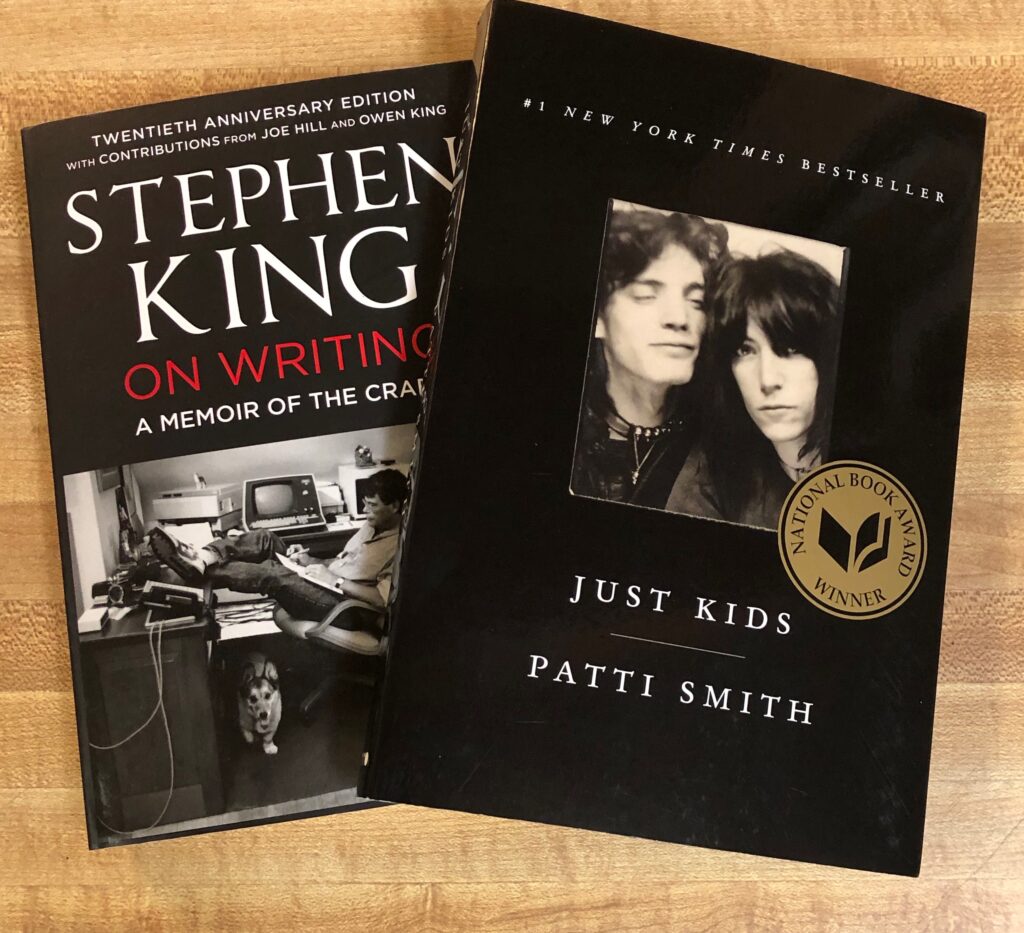
It did turn out, though, that there were two books I’d read and heartily endorsed that he hadn’t read, and two that he swore by that I hadn’t read. The next day, still thrilled and knocked off-kilter by the experience of having someone walk over to my house and have that sort of conversation with me over bourbon and cigars for almost three hours, I went on Amazon and sent him the two books I love that he hadn’t read: The Sense of an Ending by Julian Barnes, and Writing Down the Bones by Natalie Goldberg.
He texted me two days later to thank me and to say that he’d already gobbled down the Barnes book, adding a few salient points about it. And then the other day, when I opened my front door to see why my annoying dogs were raising high holy hell this time, I found a package from Amazon on my own doorstep: He had sent me the two I hadn’t read, pictured above.
After I read these, we’ll have four more books we can discuss. And this time, we won’t wait 20 years. We’ve already set the date.
A close friend back East serves as the volunteer meteorologist for our old college crowd, invariably posting on Facebook what the weather is, or will be, in his immediate neighborhood. Whether rain or snow or even clear blue skies, he provides a daily dose of dire warnings. If there’s even the barest hint of a potential calamity via hurricane or ice storm or meteor shower, he is on the digital scene first. Yes, we have access to weather.com, but traditional services such as that in no way compare. And, hey, forewarned is forearmed, especially coming from a trusted old friend.
Here in Los Angeles, we have someone else who provides a similar service. That person is David Lynch.
Here’s his weather report for today, delivered in a manner redolent of William S. Burroughs, but slightly less creepily.
You are currently browsing the archives for the Thoughts category.
Recent Comments:
Mark Chaet 2026-02-28 19:59:38 Internet stuff is not infrequently great and also stinks so much of the time. Tech stuff combined with human stuff is more likely to stink than be great. Human stuff on its own is a bit of a mixed bag. I could offer examples, but since you see my FB posts, you've probably already read all of them.
Richard Roesberg 2026-02-28 19:58:37 The upside of those bad situations is that, when you do get positive results, it feels SO good.
Richard Roesberg 2026-02-28 19:56:23 Also true of movies. I love Robert Altman's work but O.C. AND STIGGS is far from his best.