Fowl play
Wednesday, December 7th, 2011My friend Larry Eisenberg writes about trying to put a live hen into his new production. Ultimately, he was too chicken (and so was she).
My friend Larry Eisenberg writes about trying to put a live hen into his new production. Ultimately, he was too chicken (and so was she).
One of the great pleasures of being a delegate to the state Democratic party is personally getting to see John Burton in action. John brings the drama; John brings the comedy. Here he is, unvarnished as usual, explaining to the Daily Show just why California is F$#&*!d.
| The Daily Show With Jon Stewart | Mon – Thurs 11p / 10c | |||
| California’s Direct Democracy Troubles | ||||
|
||||
I’m not an aficionado of pole dancing (last time I was in a strip club was 15 years ago, for a friend’s bachelor party), but I’m finding it hard to imagine we’ll ever find one to top this. This one is erotic only insofar as the human body is naturally erotic; her strength and inventiveness are astonishing. This girl should audition for Cirque du Soleil.
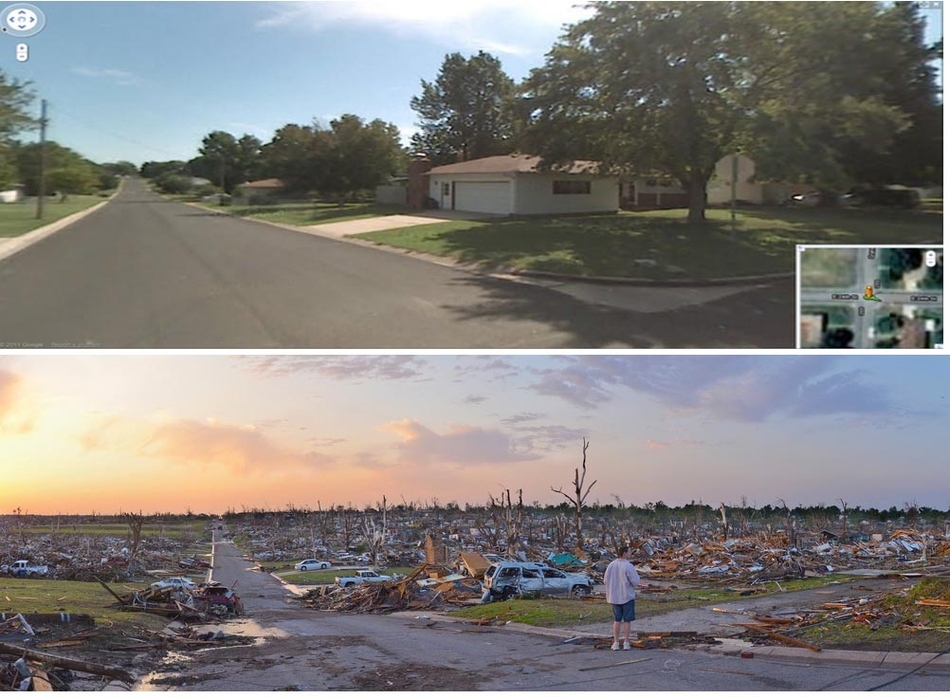
The 45 most powerful images of 2011. Almost every one of them makes you glad you’re not in it. By way of example, here’s the same street corner before and after the May 22 tornado in Joplin, Missouri.

The other night, I saw one of the most widely acclaimed movies of the year, “The Descendants.” It’s got a 90% “fresh” rating from Top Critics on rottentomatoes.com. It’s been hailed by most of the major critics, and The Wall Street Journal’s Joe Morgenstern calls it “the movie of the year.” And I hated every minute of it.
I am not alone in my opinion — two friends, whose informed opinions I trust, agree with me — but we are vastly outnumbered by the people on the bandwagon. I’ve been on the smaller side of critical opinion plenty of times, but I honestly can’t understand the praise for this film, not for the writing, the direction, the acting — none of it. Here are a few key points I feel compelled to make:
I could go on about this — and have, in person, with other people (and, at times, with myself, narrating in my head Clooneyesque, but with a stronger sense of urgency) — but why would I do that? It’s because I’m still trying to figure two things out: 1) why all the acclaim; and 2) what has happened to Alexander Payne? “Sideways” and “Election” were terrific small-life movies, completely the opposite of this film. It’s difficult to reconcile those two satisfyingly funny and wrenching movies with this dud. Yes, everyone has an off day, but judging from “The Descendants” it’s difficult to believe that this writer-director once had an on day.
I do have one more thing to say: Not every novel should be a movie. I haven’t read the novel, but I know that Payne did, and that he tries to be as faithful in his adaptations to the source novel as possible. In this case, I’m betting that that’s the key mistake. If the narration was lifted from that novel, it shouldn’t have been, and if Clooney’s character has no friends in that section of the novel — to show how isolated he is — then either we needed a different way to show that, or he needed to gain a friend for the movie.
If you see “The Descendants” and are with the critical mainstream on this, please comment. I’m curious to see your reply. If you haven’t seen it… you’ve been warned.
Driving home from auditions for my play in Hollywood today, I passed Darth Vader and Elmo walking together down Highland Blvd. Darth Vader had his helmet off and was carrying R2D2. Elmo waved to me. This was not a pairing I expected to see, but at the same time, none of it seemed unusual. So I guess I really have been out here for almost 25 years.
Please watch.
I just found out about a great new music podcast, Sound Opinions, in which two very knowledgeable taste-makers bring a lot of insight to an hour-long discussion about music. Their range is wide and their taste is informed. On the most recent show, they discuss music with economist Paul Krugman, who notes that given the dire state of the world economy he needs music more than ever. Other discussions cover the music of Bob Dylan, R.E.M., Neil Young, and others.
Here’s a link to the page about their recent show with Brian Eno. Eno, it should be noted, is not in the studio with them — they’re in the U.S., and he’s speaking with them from England — but these guys are so natural, so comfortable, that it sounds like they’re all sitting together talking over tea. In this particular interview, Eno is given just credit as an early pioneer of important musical trends (new wave; sampling; spoken word over music; ambient music; using the synthesizer as an instrument; and many more), and is asked smart questions about how he chooses collaborators (David Bowie; David Byrne with or without Talking Heads; Robert Fripp; Devo; Bryan Ferry with or without Roxy Music; as well as a couple of bands I don’t care about, such as U2 and Coldplay). The interview is played against the backdrop of music they discuss, from Eno’s vast repertoire, in such a way that every bit creates a new and better understanding of connections and influences across his 40-year career. (In the process, teaching me something new about “America is Waiting,” a song of his with David Byrne that I’ve been listening to with great appreciation for 30 years.) If you’re at all interested in music — and musical trends — of the past 40 years, I highly recommend this interview.
Here’s something that’s never going to get old: that little lancet of joy when I learn that something I’ve written has been accepted. I just had a short play chosen for a festival in San Diego in February. (More about the particulars of it another time.)
Let’s be honest: most successes, when you dig deeper, are countervailed by many, many failures. If I’ve never been quite as dogged as Thomas Edison (“I have not failed. I’ve just found 10,000 ways that won’t work.”), I nevertheless got used to rejection early on. At age 11, I started sending short stories off to magazines such as Ellery Queen’s Mystery Magazine, Alfred Hitchcock’s Mystery Magazine, Asimov’s, Analog, Magazine of Science Fiction & Fantasy, and the like, and just as quickly, they’d come back, but even then my response was akin to: “Wow! They wrote back!” I was thrilled when some assistant would scribble a note onto the form rejection letter, as the time some kind woman wrote, “But thank you.” I still think about her. (Thank you, unnamed kind woman.) I never got rejected at school dances, because I just liked to dance, and would dance with all the girls — the big ones, the small ones, the pretty ones, the homely ones, the popular ones, the shy ones — in sixth grade, it just seemed wrong to leave any out. When I started actually dating, girls felt freer to reject me if they liked, and that seemed fine because there were others to ask. I wasn’t emotionally invested in it; I just wanted to go out with a girl and see how far I could get. (Results varied.)
When I started to get published, first in fan publications, and then with non-fiction and fiction in magazines and newspapers, it was thrilling. I liked opening a newspaper and seeing my byline. I liked getting some obscure little magazine in the mail and seeing my story (or, gasp, poem!) in there. Then I fell into the theatre and here’s what I discovered: that live audience response trumped printed byline. How could seeing my name in print in a magazine — perhaps read, perhaps not, by unnamed and unknown people far away — possibly compare with actually being there when a live audience laughed out loud or was visibly moved by my play? One night, during a performance of my play Happy Fun Family, a woman literally Fell Out Of Her Seat laughing. To this day, I love her. Night after night, when women would sob at the end of About the Deep Woods Killer, I felt golden.
Rejection has never really bothered me. If it stings, it subsides almost instantly. I’m fortunate all around: I’ve got a strong family, terrific friends, and the trappings of a pretty interesting life that I’ve snared and dragged back into my den. But acceptance is obviously preferable, especially acceptance of a play, which means that there’s going to be another audience experience with one of my plays, and if I’m even luckier, I can be there for it.

This is the latest Facebook post from my friend Liesel Kopp. That’s her on the right, and her father Merv on the left.
I don’t post that often, but because Facebook seems to be the best way to reach out to a large number of people all at once, I’m very compelled to post right now.
After a very long and painful battle with cancer, my Dad passed away last Wednesday evening, November 16, 2011. I always loved my Dad, but we had a difficult relationship, and we were very different people. However, his steady decline over these past 3 months afforded me an opportunity I never thought possible: I was able to help my Dad through the most difficult struggle he ever faced, and in doing so, I finally found the dad/daughter relationship I always longed for. I was thrust into a role I never thought I’d have—I became his caregiver/primary health care advocate, and the more I settled into this role, the more fervidly I fought. My Dad also gave me durable power of attorney in his Advanced Directive and named me as Successor Trustee on his trust (two things that every adult on this planet should go create for themselves immediately), and while terrified at first (and then again many times after), I ended up wearing the titles proudly and lovingly. This has become the most important thing I’ve ever done.
Since August, my Dad had been in and out of the ER and hospital, and for the last month he was at a skilled nursing facility as well as on Hospice. I have learned more than I ever thought possible about life, death and everything in between, such as the failings of our healthcare system; the wonderful parts of the same system (yes, they actually exist); how you always need to be a respectful yet exceedingly squeaky wheel if you want anything done and especially when it’s literally a life or death matter; how you can change Hospice providers if you feel that something is not right (thank you, Buena Vista Hospice, from the very bottom of my heart for your compassion and wonderful help, I only wish I had hired you sooner); and that skilled nursing facilities in general are nightmares, though there are some absolutely wonderful nurses and staff members at every facility. I also learned how death defies all reason and understanding as it latches on to a person both slowly as well as extremely rapidly; how forgiveness, compassion, love, regret, anger, sorrow and joy can all exist in your brain simultaneously; and most importantly, I learned that I’m stronger and more proud of myself than I ever thought possible.
This experience has been as wonderful as it was terrible, and if you’ve lost a loved one, and especially if you’ve been there for the final steps of their journey, you’ll know exactly what I mean. The gratitude and love I now have for my Dad are absolutely amazing; I only regret that it took his death to bring us so close. The last conversation I had with him two weeks before he died will live forever in my head and in my heart. He lay on his bed in the nursing home while I kneeled next to him, we held hands while crying, and we told each other how thankful we were for each other, how we regretted letting life and our own pettiness keep us apart, that we were extremely proud of each other, and that we loved each other so very, very, very much.
A few days after that conversation, his cognition completely left him. A few days after that, he stopped eating. Then he stopped drinking. Then it became difficult to rouse him from sleep. Then he couldn’t form words anymore, and began moaning and gesturing to communicate. Then he slipped into unconsciousness, and remained that way for three more days. Then he was gone.
I’m writing this now, the week of Thanksgiving, to implore those who have difficult or stormy relationships in their lives to take a step back, breathe, then try to find ways of forgiving and finding love for the people you never thought you could or would be able to do that for. I hope that they can then do the same, as it takes both people to commit to truly plug in and push insecurities and ego aside to navigate an unsteady relationship. My objective in writing this is not to be preachy, but instead to be honest and open and share my own experience in hopes of affecting others for the better. I’ve been through a very difficult yet exceedingly rewarding experience, and I am so very grateful for everything I’ve learned. But I do regret not being open enough to learn it sooner, and I have a very heavy heart that I’ve lost my Dad and was only was able to bond with him and feel the purest feelings of love, protectiveness, and gratitude for him in the last months of his life.
Much love and appreciation this Thanksgiving, holiday season, and beyond to all friends and family, near and far.
Liesel
— with Merv Kopp.
There’s a great deal of wisdom and empathy here. I’m proud of Liesel, and glad I once got to meet her dad at one of our shows. I also love the photo. It’s a beautiful photo — she’s leaning in to get every last bit of their relationship while she can, and he’s greatly amused by it. The photo tells its own story, as all great photos do. I told Liesel that I’m sorry for her loss, but glad that she can note her gain: the best sort of final reckoning between a parent and child, one that allows a good transition for each.
Yesterday was Thanksgiving, in some ways our most obdurate holiday, one in which it’s demanded that we give thanks on at least that day, even when we sometimes don’t want to, even when its founding is shrouded in ironic myth (that of the European-Americans serving a bountiful feast to the natives, when the probable actuality was the natives taking pity on the starving whites). And yet I found myself thinking about Liesel and her father, the wisdom she so obviously showed in taking advantage of the time she had to get what she wanted, and then in giving her father the best going-away present imaginable. And so I found myself completely grateful for my family and friends who came over, for the wine and food and good times, for the dog who must be let in or out every 60 seconds and who must argue with every other dog on every walk, and for the hours and hours we spent laughing uproariously while eating and playing board games, just grateful for each other’s company. I reminded my wife before bed of my longstanding opinion that Thanksgiving is the dumbest holiday, one where we’re asked to eat too much to prove our good fortune, but then I added that this year it was indeed a feast, filling and satisfying in all ways. And that next year, I’d cook.