Tickets to Ride
Monday, August 17th, 2009There are two games coming out next month that I’m eagerly awaiting. One is, of course, Marvel Ultimate Alliance 2. In which, finally, I will have to choose sides in the Marvel superhero civil war. Until now I had been an innocent bystander. One of the differences between video games and comics: the former makes you an active participant.
That, naturally, is the main lure of video games, which takes me to the other game I’m anticipating, The Beatles: Rock Band. I play Rock Band often. Just last week my adult niece Lisa was in town, and she and I and my three kids formed The All-Wochner Band. We broke up even faster than Milli Vanilli, and were about as talented (especially when I was on drums). The highlight was watching my 6-year-old son, microphone in hand, unhesitatingly belt out “Eye of the Tiger.” The lowlight was me crashing and burning on one of my beloved Nirvana songs. My failure was so complete that after three abortive attempts I blamed the song. I carry the shame with me. This is all great fun, but in no way compares with the vicarious thrill of reimagining yourself as one of the Beatles. This is as close as almost all of us will get (some others of us form Beatles cover bands, sentencing themselves to a lifetime of out-of-date haircuts). I long to sing “I Am the Walrus,” a song that I once theorized, in a paper I presented to the right-wing evangelical religious high school I attended, was an indictment of God. I’m also interested in taking a whack at “Why Don’t We Do it in the Road.” I hope they’re both in the game. (Kinda doubt it about the latter.)
If the main attraction to this game is the idea of sitting in as a faux fab four, I have to wonder two things: 1) Who would choose to be Ringo? On its face, this seems unanswerable. It’s almost a twist on the old Groucho Marx line: You wouldn’t want to play with anyone who would want to be Ringo. And 2) Given that these remain almost assuredly the most famous four faces of the past 50 years, why aren’t their avatars a better resemblance? George looks close, but Paul and John don’t. Judge for yourself. Here’s the “Ticket to Ride” video from the game, coming out on the cute release date of 9/9/09.
And here are the human versions lip-synching to the same hit video. You’ll note how much more like the real Beatles they look here. And by the way, check out John’s mug to the camera at 1:39, as he lets us in on the little secret that they’re lip-synching, or George’s knowing look later on. That sort of clowning was essential to the Beatles, and I hope it made it into the game too.
 Inside was the other object (image imported on the left), made of a similar substance to the sleeve, except what I take to be the front of it has a wild array of colors. The interior is completely filled with black impressions — words, but they’re not on a screen. And on the first inside paper screen, it looks like your avatar script, but I get the sense that you somehow did this by hand: “Lee, saw this and thought of you. Enjoy! Doug.” Am I right that this is only on this version of this object? So it’s mass-produced, but individualized, like the inscribed iPods from some years ago? How did you do this? Can you please tell me what tool you used? I would be curious to know.
 They
They 

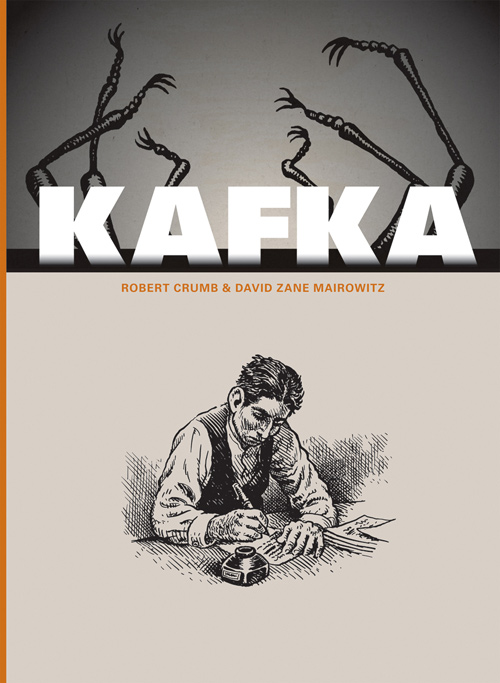 Here’s something that I wonder if having clear bookcases — so I could actually see the spines of the books — might help. Last night I was reading Kafka by Robert Crumb and David Zane Mairowitz. Crumb provides wonderful illustrations to summaries of Kafka’s great works, with introductory-level biographical text by Mairowitz. Recently on this blog, a friend suggested that I get this and read it, and I almost did buy it two weeks ago at my local comics store. Then I stumbled upon it in the last stack of unread books from last summer’s San Diego Comic Con. So I had already bought it and completely forgot. I dived right into it two nights ago and was thoroughly enjoying it and was surprised, given that I’m a fan of both Kafka and Crumb, that I hadn’t already bought it when it first came out, in 2004. As it was, some of it seemed familiar, but I just figured I’d seen chapters in Weirdo or other magazines with Crumb work.
 I Tweeted a tiny rave about the book today and resolved to write an appreciation here tonight. In so doing, I Googled for images and found this. First thought: “Crumb did two books about Kafka? He must be a huge fan!” Second thought: “This is an earlier edition of the same book.” The cover looked hauntingly familiar. As in, familiar from my bookcases. I went to the “K” section of the first living room bookcase, moved aside two stacks of books, and found “Introducing Kafka” by David Zane Mairowitz and Robert Crumb right where I now thought it would be. The same contents, but in a 1994 First Edition from Kitchen Sink Press. So I’ve now bought and read this book twice (and almost bought it thrice). That’s the downside. The upside: It’s been a great first read — twice. Because in the 15-year interim I’d forgotten I’d read it.
 End note: My Google investigations turn up yet another Kafka book illustrated by Robert Crumb and with text by David Zane Mairowitz. This one is called R. Crumb’s Kafka, “with text by David Zane Mairowitz.” I’m thinking this is the same book. (And given the title, I’m guessing it’s Mr. Mairowitz’s least favorite edition.) The cover is different, but they’re right when they say you can’t judge a book by its cover.