Credit where credit isn’t due
Friday, August 6th, 2010For the past couple of hours, I’ve been having a discussion over on Scott Shaw!’s Facebook page about the relative merits of Stan Lee, not as an influential cultural force, but as a person. It started with this wall post from Scott: “I’m beginning to perceive many similarities between Stan Lee and William Shatner.” People started enumerating the similarities:
- toupee
- did his best work with a partner
- has become a media joke, but at least he’s in on the joke & has a sense of humor about it
- gives great interview
- is treated as a demi god, or royalty, by fans
- still getting big projects in their 80s. (sic from Lee: the Shat is only 79.)
And then we came to this one, from Scott: “Apparently unaware of former co-workers’ resentments of ’em.” This was after Scott had mentioned working with Stan. So here was my reply:
“Scott, did Stan later take your work, sign his name to it, and sell it? Just checking.”
Which elicited the thread I’m going to quote from, below. Note everyone’s discomfort. We all feel beholden to someone who was an essential force in giving us the Marvel universe we love — and at the same time we’re hoping he makes amends of some sort while he’s still here.
-

Scott Shaw Lee, no, Stan did not “take my work, sign his name to it and sell it”. And I don’t think he did that to anyone else, either. Stan is no angel, and I’m not in agreement with some of the things he’s done — or has failed to do — but he’s made plenty of valuable contributions to comics, that is a fact.
-

Lee Wochner Scott, specifically what I’m referring to are the prints by Kirby or Joe Simon, without their signature, that Stan is signing for money. I had heard about it — and then I saw them at the Con. It just doesn’t feel (or look) right.
-
Scott Shaw I was completely unaware of that, Lee. I’d like to learn more, if you could please direct me…
-
Lee Wochner Scott, I just sent you an example. It doesn’t feel good to criticize Stan Lee — one of the formative writers of my life (with Jack Kirby) — but the relentless profiteering and the diminished recognition of the contribution of others doesn’t feel very good either.
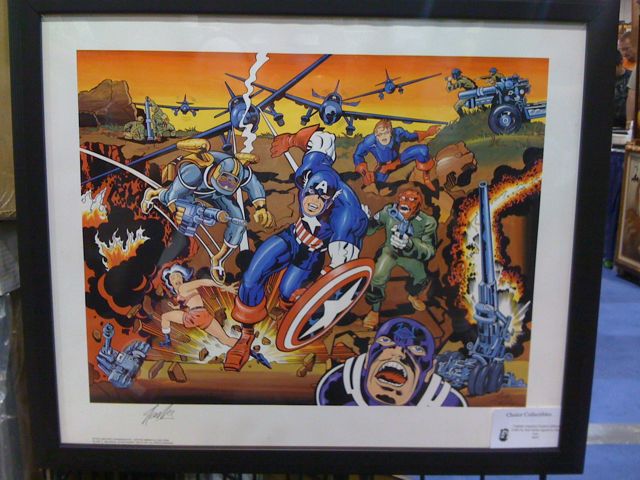
Here’s the image I sent to Scott. Note the “Official Certification” of Stan Lee’s signature. See anyone else’s name on there — like Jack Kirby’s?
-

Lou Mougin Stan may not be perfect…who is?…but by all standards, he seems to have been a heck of a good guy to work with, and when you compare him to guys like Mort Wienieburger, Jim Warren, and some of the others of that time, who would probably have had your b*lls for breakfast if you disagreed with them…he comes off pretty well.
about an hour ago ·
-

Dean Griffith Stan Lee seems like a okay guy..I just don’t like the fact that he acts and gets treated like he is the only one that created EVERYTHING at Marvel
about an hour ago ·
-

Thomas Shim He really should give more credit to less self-promoting talent, tho. Then again, history is rife with this kind of dichotomy: Disney & Iwerks, Ruth & Gehrig, Jobs & Wozniak, Gates & Allen. The list goes on (in various degrees of analogous appropriateness.)
about an hour ago · · 1 personLoading…
-

I read an interview with John Romita Sr once, and he came off as a very honest & even-handed fellow. He said something like, in regards to Kirby/Lee creations, that it was impossible to overestimate the important contributions of both men, …that the one couldn’t have accomplished what he did without the other. Same goes for Ditko. And then when you think of the not-too-shabby work with Heck, Everett, Romita, Colan, Buscema, Severin, Kane, Trimpe, etc etc (names that were never hidden), I think it’s silly not to regard Lee as a great creative figure in comics or pop cultureSee More
54 minutes ago ·
-
I know this sounds weirdly ass-kissing, but I truly believe that Stan doesn’t realize the damage he’s contributed to in regards to his creative partners over the years. Maybe it’s living in the Depression, maybe it is unethical, but I find …it hard to believe that such a nice, talented guy would intentionally screw his partners. Yet I wince (or worse) every time I see he’s allowed someone to give him sole credit for a character or concept rather than correcting them. On the other hand, I’ve never seen Stan so pressed for a straight answer about the creation of Spider-Man in IN SEARCH OF STEVE DITKO, and he seems absolutely honest in his opinion…one I wouldn’t agree with, by the way. Stan is a real enigma, but I find it impossible to vilify him completely. I guess I just want Stan to become the TRULY good guy he thinks he is…because I know that deep inside he really IS a good guy who’s let his “survivor” instincts get out of control. I just can’t help but admire Stan Lee on creative and personal levels.
50 minutes ago ·
-
Lee Wochner I don’t think that anyone here is minimizing the contribution of Stan Lee. The operant question is: Are the contributions of his collaborators being fully recognized? Kirby seems to have created an entire cosmos (or three) on his own, without any assistance from Stan Lee. Could Stan Lee have (co-)created the Silver Surfer, Galactus, the Inhumans, Asgard, Wakanda, etc. etc., without Jack Kirby?
49 minutes ago · · 1 personLoading… ·
-
Lee Wochner And I agree with everything Scott just posted.
48 minutes ago · ·
-
And would add: Just because someone truly, really, believes something to be so — that doesn’t mean it is so. Stan is in denial. The recurrent picture of Stan Lee in Dan Raviv’s book “The Comic Wars” is of someone blissfully ignorant of how he’s accepted credit he shouldn’t have — and even of how people sometimes act badly. Sample line: “Even though he was a master of heroes and villains, Stan Lee was reluctant to think of anyone in the bankruptcy fight as the bad guy. ‘I liked (Ron) Perelman and I liked Bill Bevins,’ he said. ‘I really wanted it to work out for them. … Bevins asked me, ‘How much money are you getting now?’ I told him, and right then and there he made it three times as much!'” Read between the lines: Bevins is a good guy — because he offered Stan three times as much right off the bat. No other consideration came into effect — including which owner would serve Marvel (and Stan Lee’s legacy) better. Does this make Stan Lee a bad person? No. Does it make him someone with an unknowingly self-serving point of view? You be the judge.
40 minutes ago · ·
-
Lee Wochner And now I guess I’m done. Because I’m really not having any fun coming off as trashing Stan. I love comics, and Marvel comics, and I personally feel I owe Stan Lee a great deal. It’s just some of his behavior that deeply saddens me. I still like Picasso’s work, and evidently he was a real SOB….
39 minutes ago · ·
-
Scott Shaw It’s even harder when you know and immensely like Stan, who is never less than generous whenever we’ve dealt with each other. He really is a friend!
33 minutes ago ·
This isn’t the first time I’ve complained on this blog about Stan Lee’s blissful ignorance — here’s a representative post — and it probably won’t be the last. (And it’s well worth reading the comment on that post as well.) Why do I keep coming back to this? Because of my conflicted feelings. Since moving to the West Coast 22 years ago, I have run into Stan Lee probably a dozen times. Each time, even when, say, just passing by him at the Beverly Center, I feel a little twinge: equal parts excitement and regret. Two weeks ago when I was down at the San Diego Comic-Con, I was hurrying into the Marriott for a taping. (I was a scheduled interviewee for Morgan Spurlock’s forthcoming documentary about the Comic-Con. We’ll see if I make the final edit.) There was a clutch of excitement and security downstairs in the lowest level. An excited boy who looked to be about 16 turned to me and said, “Stan Lee was down there! Right there! It was Stan Lee!” I looked at him and remembered sharing that level of excitement when I was that age… and said nothing.