More about online TV
October 27th, 2006What was I just saying — about watching “TV” without actually watching TV?
Here are some stats, from a new survey.
What was I just saying — about watching “TV” without actually watching TV?
Here are some stats, from a new survey.
 Just came back from an after-event client/prospecting event in Santa Monica thrown by one of the sponsor-vendors of the Digital Hollywood event here in town this week. Over a succession of drinks (three vodka gimlets for me — and no driving) and way-too-large entrees, we discussed where media — and specifically “television” — might be going.
A little backstory:
In 1980, fresh out of high school, I somehow found my way to Alvin Toffler‘s book “The Third Wave.” Toffler was writing about the epochs of human civilization, and disruption, and niche marketing, and counterintuitive solutions, and, most importantly and on a grand scale, change. Twenty-six years later it’s more obvious than ever what an enormous impact the book had on me (especially having read it after “Nine Chains to the Moon” by R. Buckminster Fuller).
So tonight, as the gentleman charged with overseas ads for Sony programs on foreign-language stations in emerging markets wondered what the future would be, my response was: smaller and smaller niches, and more and more interactivity, with content seeking the correct viewer rather than viewers seeking the correct content, a la Netflix, Amazon, etc. While my train of thought was certainly hurtling down the tracks, fueled by good company and good vodka, I know Toffler was there first — and a long time ago.
Which brings me back to the title of this post. This past week I watched TV several times without watching it once. While I was out of town, I caught up on the show “Jericho” thanks to CBS’s absolutely terrific online viewing portal. (To my eyes, the best one yet; by comparison ABC’s is slow and jumpy and has too many commercials breaks of too long a length.) When I got back, having missed “Battlestar Galactica,” I popped two bucks for the iTunes download. And before leaving, my daughter Emma and I watched “Lost” on ABC.com.
You’ll note the absolute lack of “television” while watching television.
What will be the determinant of what formats and offerings succeed? As best bud Grant put it, “Convenience.” Yes, price will play a role, and content of course, but in an age where commodity prices fall precipitously every day, and where so much “broadcast” content is better than ever before, it’s ease of use — the flexibility that busy people demand — that will rule.
Good news for people who provide convenient good content at a fair price (or free).
Bad news for people who provide so-so content that is inconvenient and over-priced. This should be a wakeup call to all my friends and colleagues in the performing arts: Your work had better be as good as you think it is, and you’d better be thinking about how (or whether) peope can get there, let alone afford the offering.
And now I’m going to bed. To watch the third disk of “Elizabeth R,” from my Netflix queue. (Is there something on a “network schedule?” I guess.)
Updated: 1:17 p.m. PT Oct 23, 2006Even healthy men may benefit from a drink or two daily to help lower the risk of heart attack, medical researchers reported on Monday.
“Our results suggest that moderate drinking could be viewed as a complement, rather than an alternative,” to lifestyle interventions such as regular physical activity, weight loss and quitting smoking, said the study from Beth Israel Deaconess Medical Center in Boston.The report said previous studies have linked moderate drinking to a lower heart attack risk, compared to the risk run by those who do not drink at all. The apparent protective effect may be that alcohol appears to raise the level of so-called “good” cholesterol in the bloodstream.
Between 1986 and 2002, 106 of the men had heart attacks, including eight out of 1,282 who downed about two drinks daily, compared to 28 of another 1,889 who did not drink at all.
Maybe the reason drinkers have fewer heart attacks is beause you actually have to slow down and ease up a few minutes to have those two drinks — and who wants to run around after having them, either? Wonder if they thought of that.
 Let me just add to the day’s festivities by saying “Happy Creation Day!”
Yes, it was a mere 6009 years ago today that God created the Universe, as revealed in the 1600’s by Bishop James Ussher.
It might have been a Tuesday.
For the Mayans, and converting the esteemed Bishop’s research, this great work occurred on 2.5.3.14.0 13 ‘Ahaw 8 Yaxk’in. (Today being 12.19.13.13.7 13 Manik’ 0 Sac, but you knew that.)
But while calendars can read the date differently — and while some would call the whole thing into question claiming that the “fossil evidence” refutes the entire claim — none of us should take such a day lightly.
So what have we learned in the past 6009 years?
We’ve learned this about God:
These seeming contradictions are self-clarifying when you give them enough consideration. Skeptics may have a hard time reconciling people who, say, narrowly escape the wrath of Hurricane Katrina and “Thank God” for their rescue, while never “blaming God” for the hurricane in the first place. The hurricane was a test — which they passed — and those didn’t pass may have been part of the lesson for those who did.
We’ve learned this about Creation:
So today is a day for celebrating. If you’re reading this: You’ve made it!
At least so far.
 A nifty little piece in today’s LA Times about Battlestar Galactica and its fictive relationship to the Iraq war (and others). There’s nothing revelatory in it — and you’d have to be flatlined not to get the obvious parallels in the storylines — but it’s worth reading if, like me, you’re drawn to the basic survivalist theme of the show: How much will you sacrifice to survive, and what must you never sacrifice in order to save your humanity?
Friday night’s episode was especially gratifying for two little bits of character work: Tigh’s poisoning of his own collaborationist wife, and Thrace’s reaction when she learns that her “half-Cylon daughter” isn’t actually hers at all.
The former was expected; the resistance had provided exactly what the colonel needed (an obstructionist mission that kept him off the sauce and on-goal). But Michael Hogan’s portrayal was beautiful and moving in depicting just how much the colonel was giving up by putting down his leggy blonde wife: given that his post-torture character is now a lame one-eyed old wretch, it’s doubtful there are many romantic relationships in his future.
Perhaps even better was Katee Sackhoff’s response when someone else on Galactica thanked her for having rescued her child, which Sackhoff’s character had thought was her own. Her expression in handing over the little girl was a rolling tableau of shock, hurt, and humiliation. I used to see that face on people in bars just before they threw up in the parking lot.
I’m beginning to think we’ve lost all sense of proper accountability and justice.
On the one hand, no one can seem to convict Robert Blake or O.J. Simpson or what seems like a host of other celebrities charged with murdering their spouses or companions by express design. (And we’ll see how Phil Spector makes out, when that finally goes to trial in January 2007, almost four years after the incident.)
On a larger scale, we have a civilian administration that appears to have deeply lied to the military, from top to bottom, and which is responsible for the death and damage of thousands of U.S. troops — not to say hundreds of thousands of civilians overseas. This same administration routinely overturns or subverts or rewrites either the Constitution directly or any number of underlying principles, habeas corpus being only the most recent example. And yet at least so far there seems to be little direct prosecution of these actions and not enough outrage.
On the other hand, a jury in Los Angeles yesterday convicted an 89-year-old man of felony manslaughter for “running down and killing 10 people at the Santa Monica Farmers’ Market.”
From the Times:
UCLA law professor Peter Arenella said the jurors’ difficulties suggested that they simply could not accept that ‘human life can be lost in a tragic accident where no one is at fault. The jury finds it hard to believe there might be a noncriminal explanation for this.’
I wasn’t on the jury, but I have a noncriminal explanation for this: mistake. Confusion. Accident.
If I had been the mother whose three-year-old child flew from her arms and to her death, I’m sure I would feel differently. But I can’t bring myself to believe that George Weller intentionally sped through the marketplace with the intention of taking out as many bystanders as possible. In fact, as someone whose van was grazed last week in the parking lot at Albertson’s by a thoroughly distracted and seemingly stone-deaf mummified husk of a woman who didn’t see us and didn’t respond when I blared the horn and tried to get out of the way, I think the true culprit is the system that licenses the elderly and performs no further checkup.
Of course, applying that logic, the true culprit of the malicious malfeasance in Washington would be the people who allowed them into power.
On the cover of TV Times, beneath a photo of Sam Neill, scowling and unrecognizable in some PBS period piece, the caption reads “Veteran actor Sam Neill stars in…”
When did Sam Neill become “veteran actor” Sam Neill? He just turned 59. What does “veteran actor” mean? And is this particular “veteran actor” happy about this designation?
I seem to recall “veteran actor” being euphemistic for “grizzled old character actor we’ve all come to respect.”
Yesterday while in San Diego I decided to get an ice cream cone at Ben & Jerry’s. While I was figuring out which overpriced and undertasty flavor to order, the college-going ice-cream scooper leans over to see the title of the book I’m reading.
“World War Z: An Oral History of the Zombie War,” he reads out loud. Then he turns to me and says, “Is that fiction?”
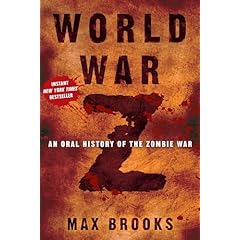 Ninety-nine pages in, and the zombie war is not going well — at least for me. As an “oral history,” the book constantly shifts interviewees — we’re listening to a former Pakistani now in Iceland, or a mercenary who high-tailed it out of Long Island, or a doctor in mainland China. This makes for a travelogue of adventures you weren’t invited to. With every new interview, I wish the book had been written as a straightforward novel, so that we could follow a handful of people and not only witness the events from their perspective — but also grow to know them through their experiences. Instead, this book is like speed dating: Just when you get to know someone, the bell rings.
If you’d like to see if you disagree, click here.
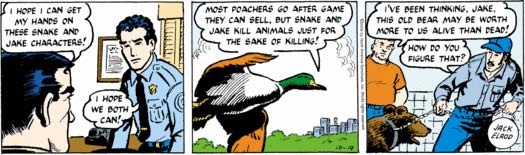
If only there were disaster movies about giant talking ducks! (As seem to exist in “Mark Trail.”) What city is that being attacked? Will Jake and Snake be able to evacuate that bear in time? Who is “Jack Elrod” and why is his name on a bowling ball?