 This morning I went to vote, as I have done without fail in every election since I came of voting age.
There was a polling place directly across the street from our house at the Burbank Adult School, so naturally I walked over there. They couldn’t find my name on the list, though, and so told me that my polling place was “the school.”
So I got into my car and drove to Luther Burbank Middle School, where I have voted a few times. I parked and walked all around and could see that it wasn’t a polling place.
Then I decided that by “the school,” perhaps they meant Bret Harte Elementary School. So I got back into the car and drove over there. By now, I was about a mile away from my house — notably farther away than, say, the polling place across the street from my house.
I walked in and a, well, let’s put it charitably, hippie, said, “Are you here to vote at the Green table?” This sort of electioneering is illegal — and whether or not I’m going to vote Green (which I’m not), it’s none of his business. So I said, “I’m here to vote.”
He asks my name and address, I tell him, and he scans the rolls and says, “You’re not registered to vote.”
I said, “WHAT?!?!?!?!” What I should have said is: Tell that to the 1000 prerecorded callers who have bombarded our home phone and my cellphone, let alone the seemingly hundreds of organizations that have emailed me, all of them seeking money and my vote. They all sure think I’m registered to vote.
He said, “Are you sure of your address?”
I said, “Given that I live there, yes.”
At this point, an older man came over and said, “You have the wrong polling place.” I said, “This is my third one.” (Counting “the school” that was no longer a polling place.) He takes me outside to look at a map taped on the exterior wall. It is a zigzag of district lines, with rarely a street name or number. He says, “Where do you live?”
I give him my address and he says, “Where is that on this map?”
Looking again at the map, which looks like a spectrographic survey of the Earth’s core and nothing like a map of Burbank, I say, “If you can’t find it, I sure can’t.” Then I spot the Burbank Adult School on the map. (Big letters: “BURBANK ADULT SCHOOL.” The one thing on the map that seems to deserve being named.) “Wait,” I say, “I live across from that.”
Now he’s staring at the map quizzically again and trying to determine just which polling place would cover that. Then someone from inside the building yells, “Wait! We found him!”
A woman comes outside and tells me that I should be voting at the ORANGE table. Evidently, there’s a “green” table and an “orange” table, hence the hippie’s question. I forestall the obvious question: What the Hell is this, and why are there “green” and “orange” tables at the same polling place, what could that possibly mean, and how is someone expected to know that?
A little background here: I have lots of education, I am a local political activist, vote in every election, and read lots of newspapers and magazines. So it’s not like I’m uninformed.
Now I enter the school’s auditorium just in time to hear the woman admonish the hippie: “You have to check the master list.” (Oh, of course: The master list. Don’t check the junior list, or slave list — whatever he’s got.) How many people have already been sent away?
Sure enough down front at the apron of the stage there is another table area set up, this one manned by someone I know: Lisa, the mother of one of my daughter’s friends. Since I know her, I take the opportunity to vent, making it plain that I’m not holding her personally responsible.
“In the past three years, I have voted at Bret Harte, Luther Burbank, the White Chapel church, the Burbank Adult School, someone’s home, another church, and, most recently before today, an auto body shop,” I say. “Why is my polling place constantly moved? Why is there a polling place ACROSS THE STREET FROM ME that is NOT MY POLLING PLACE? A suspicious person would reason that a game is being played here! This isn’t Florida and I’m not black, but I’m starting to think there’s active disenfranchisement at work here!”
She seeks to reassure me by saying, “You work here just once as a poll worker and you see how things can go wrong.” This in no way reassures me.
I get my ballot and go vote. Then I see — wait for it — that the little inking stamper is not correctly blotting out every circle I choose. In most cases, I have to stamp it two or three times for it to work.
I go back to Lisa. “The inking stamper isn’t working properly. I had to do it two or three times. It doesn’t work.”
“Oh, I know,” she says. “The same thing happened to me.”
Now, she’s been there all day. I can only assume she voted four or five hours before me. So… how many ballots didn’t get marked? How many people noticed?
By the end of all this, I felt like I’d been polled all right — right where it hurts.
Is it really this complicated to vote?
And while we’re busy “exporting Democracy,” are we exporting this voting system?
 Re the Paul McCartney divorce saga:
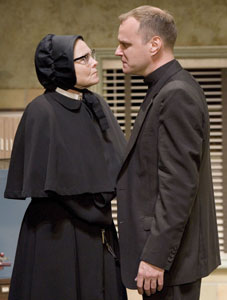 A couple of weeks ago I went to see “Doubt” at the Ahmanson Theatre with two friends. The play was well-written, funny, surprising — and a bit of a cheat.
 Last week in my Saturday playwriting workshop we were talking about how to identify the protagonist. Ellen immediately piped up: “I usually look at who wants something.”