Lee Wochner: Writer. Director. Writing instructor. Thinker about things.


Blog

Waiting for Godot to end

November 18th, 2006
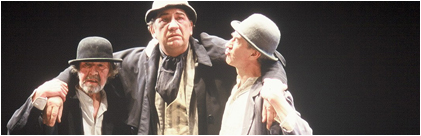
gategodot.jpg

At this point, having seen probably 10 productions of “Waiting for Godot,” having read the play several times, thought about it, weighed the various merits of differing performances, and having gone so far as to give my son the middle name Beckett, I think I’m qualified to discourse on the play.

The acclaimed Gate Theatre production currently at UCLA Live! is no good.

I say this with no glee, mirrored only by my absence in glee seeing it.

Although the play is many things, one thing it is not or should not be is ponderous. But that’s what we have here. In fact, here’s how ponderous: It started around 8:10, and wrapped up just shy of 11 p.m., with a 20-minute intermission. Given that Act Two was 55 minutes (I clocked it), that puts Act One at about an hour and a half. Tooooo… slowwww….

My companion, the fiercely smart playwright and performer Trey Nichols, said that it was lacking in existential dread. Absolutely true. It was also lacking in comic rhythm. Beckett modeled the characters of Gogo and Didi after Laurel and Hardy; while I don’t expect Laurel and Hardy, I expect the comic spirit necessary to the parts. I also expect something to be at stake. Several years ago at The Matrix theatre in Hollywood, the late David Dukes, in addition to being a wonderful clown alongside co-star Robin Gammell, closed Act Two with a wrenching depiction of a man desperate to understand his place in the universe. The current Didi, played by Barry McGovern, seemed more like a man learning he might have to wait for the next bus.

Whom do I fault? Oddly enough, the memory of Samuel Beckett. Evidently his determination of how this play must be performed has been cast in stone at the Gate Theatre and with this director and at least two of the actors, all of whom he had personally worked with. This situation sounded hauntingly familiar, so when I got home I dug out my edition of Kenneth Tynan’s Letters , and there it was. (At the time, Tynan was the literary manager of the National Theatre.)

31 March 1964

To George Devine, copies to Laurence Olivier and William Gaskill, The Naitonal Theatre

Dear George:

Forgive me for writing, but I feel I must try to explain more clearly to you and Larry what is worrying me about “Play.” I wouldn’t do so if I didn’t feel that many of my qualms were shared by others.

To recap: before Sam B[eckett] arrived at rehearsals, “Play” was recognizably the work we all liked and were eager to do. The delivery of the lines was (rightly) puppet-like and mechanical, but not wholly dehumanized and stripped of all emphasis and inflections. On the strength of last weekend, it seems that Beckett’s advice on the production has changed all that — the lines are chanted in a breakneck monotone with no inflections, and I’m not alone in fearing that many of them will be simply inaudible. I suspect that Beckett is trying to treat English as if it were French — where that kind of rapid-fire monotony is customary.

The point is that we are not putting on “Play” to satisfy Beckett alone. It may not matter to him that lines are lost in laughs; or that essential bits of exposition are blurred; but it surely matters to us. As we know, Beckett has never sat through any of his plays in the presence of an audience: but we have to live with that audience night after night!”

Please understand me: I trust the play completely, and I trust your production of it, — up to the advent of the author. What I don’t especially trust is Beckett as co-director. If you could see your way to re-humanizing the text a little, I’ll bet that the actors and the audience will thank you — even if Beckett doesn’t!

Why have I seen “Godot” so many times? Because done well, it is an astonishing experience. The first time I saw it was as an undergrad, in a college production featuring my friend Joe Stafford as an imperious Pozzo. That was 20 years ago, but the performance has stuck with me — Joe embodied the comic boorishness of the role. And at the end, when the moon has risen and Godot has yet again not come, the lights drew down and pinlights of white emerged in the flies, signifying stars, and for a moment I lost my place in the universe. That’s an effect I’ve been swiping ever since, as with “Two Men Losing Their Minds” at Moving Arts in 2000.

Done right, with verve and with stakes, featuring characters who yearn for answers, “Waiting for Godot” is a transformational experience. Performed as a museum piece pregnant with significance, it’s a crashing bore.
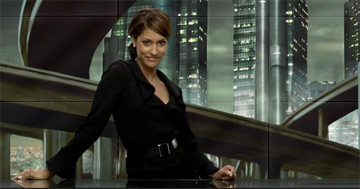
The cutest search engine around…?

November 17th, 2006

msdewey.jpg

…Or the most aggravating chick on the internet? You decide.

Rewriting from the house

November 17th, 2006

Just because playwrights are sometimes asked to participate in “talkback” sessions after a developmental reading doesn’t mean they should heed any of the suggestions.

The other night I went to the staged reading of a friend’s play. Good play, good reading. It’s amazing what you can learn about a play when you see it on its feet, performed in its entirety, and by good actors under the capable guidance of a good director.

In this case, all of the strengths of the play became clear: an arresting subject matter, strong characters, deft transitions, sparkling dialogue. It also became clear to me (as well as to the audience, it later turned out) that we need a little more insight into why one character committed the heinous act that catalyzes the play. I’m confident that that additional bit of clarity will complete the play.

I was impressed by the feedback from this audience; this is a developmental theatre, and most of the people speaking are playwrights with productions under their belt and actors used to working on new plays. By and large, when it comes to what makes a play work or not, they seemed to know what they’re talking about.

This hasn’t always been my experience, either as the playwright or as a member of the audience. I go into these things figuring that if they could have written the play better, they already would have done so. More than 10 years ago I decided that my personal mission in these instances was to be funny and entertaining, so that the theatre was glad it had invited me and so that no matter what anyone thought of the play they would at least see that I could be fun to work with. (Because, by and large, who comes to such readings? Actors, directors, producers, writers — people somehow or other connected with producing plays.)

This particular play deals with a court case — although, as one astute attendant noted, refreshingly, it does not take place in a courtroom and thereby avoids the procedural scenes we’ve seen cooked up on television six nights a week. My least favorite idea from the house the other night was this one: to remove all question of guilt or innocence, begin the play with a declamation of guilt, and work backward to investigate motive, a la “Equus.” An intriguing idea — but not for this play, not at this stage. This play is finished (almost).

When I was a teenager I remember reading a thick collection of Isaac Asimov’s stories, each with an introduction by Asimov (modeled perhaps after the Dangerous Visions series edited and interminably introduced by Harlan Ellison). Asimov said that after he had written a story, while he might do light revisions, that story was done — and to rework it and rework it would be like chewing second-day gum. It was an image that stuck with me.

Rewrites are necessary. Almost always. In every first production I’ve had, I’ve wound up doing at least minor rewrites because in working with good actors and a good director I’ve found new things — things that work, things that don’t, and sometimes opportunities that were missed. Twice, I’ve found new and better endings, but I went into each of those productions knowing that each play needed a new grace note to truly finish it.

To rewrite is good. To get stuck in rewrite and restructuring would mean not only not completing your present project — it also means not working on your next one.

Restructuring an entire play, one that already works? That sounds like chewing second-day gum.

Sheeit

November 16th, 2006

New episode of Orlando’s Joint just went up this morning. The funniest ep yet (even if I do have only one line).

Franz Kafka: too representative for some

November 15th, 2006

kafkarepresentative.jpgThe premise of the biography Franz Kafka: Representative Man is that more than any other individual, Kafka truly represented the 20th century in his personal alienation and with his portrayal of the faceless menace of bureaucracy. A fascinating viewpoint and one that becomes more compelling daily, given stories like this one (forwarded to me by good friend Tom Boyle):
Feds Want To Keep Torture A Secret

“If you feel you must give the Bush administration credit for its latest legal pivot in the war on terror, give it credit for having the cojones to actually tell a federal trial judge that the “interrogation methods” (what some reasonable people call “torture”) it has used on terrorism suspects is so vital to “national security” that the recipients of it may not tell their own attorneys what’s been done to them. ”

Click here for the rest.

Max Brod wrote that when Franz Kafka read his own stories aloud, he howled with laughter.

Whether or not he was a humorist, he was certainly a prophet.

Acting, or being?

November 14th, 2006

tom-bell.jpgFor me the most thrilling part of Prime Suspect 7 last night was not Helen Mirren, although for quite some time she has figured mightily in various fantasties of mine. No, it was the reappearance of the actor Tom Bell as Detective Sgt. Bill Otley.

In the series’ launch back in 1991, Otley was the sort who blocks the way of anyone trying to get something done, in this case Jane Tennison (Mirren), newly promoted to being his boss. Otley undermined her at every turn until two things happened: Tennison confronted him (which I recall as “Well, I’m not going to have it,” or something like that), and Tennison began to get results. Both the threat and the effectiveness gained his respect, and the character began to change.

In last night’s episode the character returned after a 10-year absence, far worse for wear. Jane Tennison may be a drunk, but she looks relatively well-tended; Bill Otley looks like he was set afire with lighter fluid and a blowtorch. His hair is badly dyed and plastered to one side, his face mottled, his appearance skeletal, his voice a light wind from the grave. (The photo at top is not recent.) It appears that Bell was ill at the time of filming — he died shortly thereafter — so were it not for the impression his earlier performances made on me, my first assumption would be that it’s easy to be a sick and dying man playing sick and dying. Every indication is that in this case life informed art and vice versa.

In the show, Otley makes a point of breaking through the crowd at an AA meeting to grab Tennison and buy her a coffee. He apologizes for his earlier actions. He hadn’t forgotten them and had wanted for a long time to own up and apologize. Tennison is quite moved by his confession and later calls on him when she finds herself in need and with no one else to turn to. It’s a remarkable and heartfelt journey for both characters. And it reminded me of the determined efforts of a former friend years ago to make her way through the amends demanded of her by AA.

Like Mirren, Bell is utterly watchable. Charisma isn’t for sale at any shops I know of; one has it or one doesn’t. Bell had said, “If you act you need to have threat. Without threat, nobody notices you.” Mirren certainly has that quality. I don’t think that is the quality Steven Rea or Reg E. Cathey bring to their roles, but there’s something — something — that they do that makes them stand out as well. Cathey made an enormous impression on me in his initial run on “Oz,” so much so that I never forgot him. The same with Bell in the first “Prime Suspect.”

Who are the other actors playing characters in the police station? I have no idea. Is it because they’ve been given little to do, or is it because they’ve done little with it?

Not Steve Allen

November 14th, 2006

shearer.jpgClick here for a nice profile on Harry Shearer in today’s LA Times. (And do it fast, while the paper is still in business.) I’ve been a Shearer fan for a long time. I can’t think of anyone who qualifies as the Steve Allen of this generation, but Shearer probably comes closest in having the ready wit and penetrating intellect. (But not, I understand, the avuncular charm.)

The end of Howards End

November 11th, 2006

When the movie “Howards End” came out, my response to the question “How’s ‘Howards End?'” was this:

“Howards End is fine. It’s Howards beginning and middle I didn’t like.”

That may have been clever for the time (you be the judge). But having just seen it again on DVD, I now find that I don’t like the end, either.

Not having read it, I have no idea of the quality of the novel. I will say that if the film intends to deal with the irreconcilability of class differences, it doesn’t do a very good job of it.

The beginning: Vanessa Redgrave dragging the train of her dress through the wet grasses surrounding Howards End. I kept wondering, “What is she dragging along with her into the house, and who will clean it up?” Although I could guess. To the untrained eye, it may have looked romantic. As someone who when growing up had to mow acres of that dewy lawnage, I know it’s filled with bugs and chaff. Oh, those uppercrust people!

The middle: Much comings and goings, not all of it clear. Anthony Hopkins starring in one of his two overall Anthony Hopkins roles, this time remounting his diffident English gentleman in the form of Mr. Wilcox. I suppose we’re supposed to think he’s hiding his feelings; I just think he hasn’t any. Helena Bonham Carter playing someone who is or isn’t irresponsible or daft: She swipes umbrellas and she frets about the lower class, but I simply have no idea what she does the rest of the time, except, it turns out, get knocked up during a fateful rowboat voyage. Nor do I know what her sister, played by Emma Thompson, does before she lands upon the emotionally stranded Mr. Wilcox. There is a lot of tea drinking.

The end: A bookcase falls upon the lower class in an accident that to me looks eminently survivable, but which in this case is deadly. It misses Mr. Bast’s head — in fact, said head is strategically safely to the side — and yet he perishes. We see the perpetrator, who had the temerity to chase Mr. Bast into said bookcase, being led into a carriage in a gauzy slow-motion, which I believe signifies a long prison term. No more is spoken of it. Given the bookcase incident, the prison term, and such forth, Ms. Thompson will now have nothing to do with Mr. Hopkins, although once he agrees to deed over Howards End to her, she kisses him twice, so I’m not altogether sure where the film leaves them. And Ms. Carter’s character has now had an illegitimate son by the unfortunate bookcase victim.

So… what is one to make of this? Class differences, or just plain bad luck? Is it clever plotting, as when Mr. Wilcox discovers that the drunken low-class woman at his son’s wedding is not only Mr. Bast’s wife but also his own former mistress — or is it ridiculous coincidence that doesn’t survive the light of reason? I think in each case the filmmakers intend it to be the former; to me, it’s clearly the latter.

Two things I did enjoy:

1. The radiant Emma Thompson, who goes from light and gabby to crestfallen and dreary while remaining completely enchanting

2. Her hat, which Napoleon would only wish he had found first.

Let’s never forget: Just because it looks like quality, doesn’t mean it is. Just because it says, for example, “Merchant/Ivory,” doesn’t mean it’s any good.

Best opening line

November 10th, 2006

The best opening in contemporary drama is this one, from “True West”:

“So, Mom took off for Alaska, huh?”

Look how much it tells us:

  1. Because we see two men on stage, and the one refers to “Mom,” they must be brothers.
  2. This character who says it, Lee, didn’t know Mom was gone, and now he’s asking about her. So clearly, he’s been away.
  3. Not only was he away, he’s been out of touch with Mom. In general, middle-aged women don’t take off for Alaska on a moment’s notice. Lee knew nothing about it, so, unlike many of us, he doesn’t give Mom a courtesy call once a week.
  4. He’s also been out of touch with his brother, Austin. Austin knows Mom’s gone, so he probably knew Mom was going, too. Yet Lee didn’t.
  5. Because she took off for Alaska, Mom’s probably not coming back soon. It’s far away. (Although she does show up unexpectedly late in the play, we are led to believe that she won’t. This provides backdrop for her sons’ actions throughout the play. If she were coming home any minute, they might behave very differently.)
  6. Mom’s gone, and Austin is there in the house. Everything seems in order. This tells us that he probably has a good relationship with Mom. She trusted him.
  7. It also tells us that she was probably right to do so. Everything looks to be in order. It seems that Austin is a responsible person, so Mom’s trust is warranted.
  8. Lee, on the other hand, seems belligerent, right from this opening line. There’s something snotty about the way the question is framed: Mom didn’t “go” to Alaska, she “took off” – as though someone or something is being left behind. And the “huh?” hardly seems casual.
  9. Lee’s resentment is palpable, both at Mom because she’s not there…
  10. …And at at Austin because he is. Lee went looking for Mom, and instead found Austin in her place. Or, more appropriately given what we know of sibling rivalry, in Lee’s place.
  11. Given his upset at finding Mom missing, Lee probably came seeking Mom or help of some sort. Why is he there? Because he needed something.

Did Sam Shepard know all this before he wrote the line? Probably not. Was this the first line as he wrote it, or did he find it later in the rewriting process? I have no idea. But this one line achieves a near miracle in launching the play. It sets up a stark conflict between two very different men, united by blood but divided by need, still waging their sibling war decades into adulthood against the placid backdrop of Mom’s kitchen and, later, the unseen terra incognita of Dad’s desert wasteland.

I think “True West” is a masterpiece. Not a word I toss around lightly.

That first line tells us a great, great deal, without any resort to exposition. It seems effortless. Moreover, because it’s clearly the response to a previous line – one we don’t get to hear because it happened before we got to enter their universe – we feel that we’re dropped directly into the action of the play. This play doesn’t just start when it starts, it starts a moment before it starts. That would be a problem if our initial reaction were one of confusion – who are these guys? Where are these guys? What’s going on? – but Shepard addresses all that with this very first line.

Unlike “True West,” too many plays start long after they start.

Further down “The Road”

November 10th, 2006

My wife, who originally hooted at my admiration at The Road (and my preference for it over “World War Z”), now says that she keeps thinking about it and “may have to read it again.”

And one of my grad students, Lindsey, took my recommendation to read it and said she thought it was stunning but that it “gave me nightmares.”

I think this book is going to be with us for a long time.