A clarification from the Jeni family
March 14th, 2007He wasn’t “down,” he was ill.
He wasn’t “down,” he was ill.
 One evening about 10 years ago I was walking outdoors down 3rd Street in Santa Monica with my two brothers, who were in town. We had just had dinner and were going to go see a movie called “Big Night,” which stars Tony Shalhoub, Stanley Tucci, and Minnie Driver and which concerns two brothers trying to save their Italian restaurant. All around, it was a warm, mildly festive night.
As we walked down the street, which had almost a carnival atmosphere with sidewalk vendors and various little things going on, we came across a man doing some sort of on-camera interview. He was doing what looked like a small on-location hosting segment.
“That’s Richard Jeni,” I said.
My brother Ray said, “Who?”
“Richard Jeni,” I repeated. “Stand-up comic. You know. He’s on TV a lot. You’ve seen him.”
Ray didn’t believe he had. I remain convinced to this day that indeed he had, but despite the numerous credits I rattled off, Ray just couldn’t picture him. Neither could my brother Michael. Even while they were both looking at him.
And that was kind of Richard Jeni’s career problem. Was he funny? Hell, yes. Was he memorable? Somehow… no. Although I’m not an expert on his act, I still can’t tell you what his “act” was: What was his character?
Now he’s killed himself. No one knows why for sure, and I’m not convinced that even the suicides themselves ultimately know why. But Elayne Boosler hints in this remembrance on the Huffington Post that it was frustration that other, lesser-gifted, comedians rose to prominence that Richard Jeni never quite achieved. To me, it sounds like a good theory. Because no matter how I tried, I couldn’t convince my own brothers that they recognized him.
Marvel Editor-in-Chief, Joe Quesada, is interviewed here along with Stan Lee about the death of Captain America.
Cap’s co-creator, Joe Simon, is still among us. He’s been quoted as saying that the death is a shame, because “we need him now more than ever.” Given that Mr. Simon lived through World War I, World II, the Cold War, McCarthyism, the Depression, and so many other assorted horrors and atrocities of the 20th century, this is indeed a troubling statement.
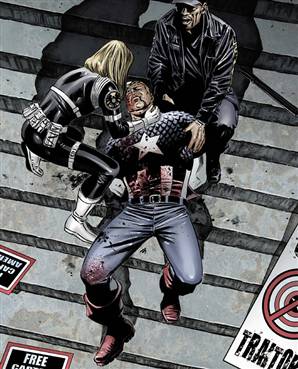 Someone close to me died and only now has it started to sink in.
That’s right, I’m talking about Captain America.
Cap and I go way back. We first met in the late 60’s, when, according to my father, hippies were attacking the country. That didn’t sound like a good thing, but it didn’t seem to affect Cap too much — he was always fighting Hydra or the Red Skull, and when he did interact with hippies or “minorities” it seemed like he was able to bridge the gaps in culture and generation. (And remember, Cap was an enlisted man in during World War II, so the gaps were huge.) He teamed up with the Falcon and learned some things about an outsider’s view of the system and what it felt like to be non-white and suspicious of the Man. And then, famously, Cap had a falling out with the Nixon administration, discovered that it was the president who was behind the vast conspiracy attacking the country from within, and quit being Captain America.
I was 12. It seemed impossible that Captain America — who set such a personal example of tolerance, yet, like Churchill, was able to spot evil early when he saw it — wasn’t going to represent us any more.
He came back later, after a number of other people tried to be Captain America. They knew the value of the symbol, and if he wasn’t going to wear it, others would. And that was the point when I realized that Captain America had never symbolized the United States of America — that he symbolized an ideal that we hoped to get to.
Now he’s dead. Will he be back? According to my subscription form — sorry to blow the surprise — after five months or so of downtime, someone named “Captain America” will be back with a new title. But if it is not this character, Private Steve Rogers, who surrendered to the government recently after waging an all-out war against what sounds to me suspiciously like The “Patriot” Act (quote marks courtesy of me), it won’t be the same. Steve Rogers turned himself in when he found that he’d lost the support of the people in the streets; evidently they liked the idea of registration for people with powers. To me, this is suspiciously close to “registering” the artists, the writers, the musicians, the philosophers, the scientists — anyone who thinks differently — and the relative quiescence of the majority of us speaks volumes.
Yesterday this nation’s Inspector General released a report documenting the extent to which the FBI has misued the “Patriot” Act in securing private information about individuals, all with no warrant. Today we have a minor hoohah over this; tomorrow, the “Patriot” Act will continue.
I’m sorry Captain America died, especially now. It seems like one more indication that we’ve lost the ideal, and that we aren’t deserving of the symbol.
Insomnia may be a blessing in disguise, especially for creative types.
At least, that’s what the writer of this feature in the Washington Post would have us believe.
I hope I feel this good about it tonight when I’m pounding the pillow, but I suspect I won’t.
I’m always asking students about the characters they’ve created, “What’s their motivation?” Although at some point or other most of us will act irrationally at least once, most behavior is defined by our pursuit of objectives. Asking what someone was trying to do, and therefore why they acted in the way they did, usually tells the tale.
Along a similar line, Deep Throat advised Bob Woodward during the Watergate investigation, “Follow the money.” If you follow the money, and track who benefits, you find the culprits.
Which brings us to Scooter Libby. Hard as it is for me to imagine, I find I’m spending some part of my thinking yesterday and today feeling sorry for Mr. Libby, who faces up to 30 years in prison. That’s because I can’t understand why he would have gone down the path of exposing one of our own spies, because I can’t track his motivation for having done so. That is, unless he was ordered to do so by someone higher up in the chain of command.
I’m not alone in that theory, as this news report shows. The jury that convicted him — comprised of what sound like very smart and highly trained people, including a former reporter for the Washington Post — also believe that Mr. Libby was acting under orders.
That makes sense.
What doesn’t make sense is that our court process doesn’t appear to be headed further up the chain of command.

The person in the above photo is comic legend Shelley Berman. I don’t think I need to go into his credits, but just in case, here’s his bio from his website. Let’s just say that for more than 50 years, Shelley has been acknowledged as a comedy legend and now, unbelievably to someone who grew up watching him on television, I get to call him a colleague. We both teach in the Master of Professional Writing program at USC.
Shelley teaches humor writing. You wouldn’t think this could be taught, except the evidence is that maybe it can: Shelley is very, very funny, and so are several writer friends of mine who are former students of his. Shelley is effortlessly funny. Last month at a faculty luncheon he said, “I want to ask a question, and that is, ‘You call this a salad?'” Indeed, the “salad” consisted of two stalks of lettuce-like things. “Maybe a little tomato,” he went on, “or a cucumber?” His real problem at lunch was being serious. “I’m not joking now, I’m being serious,” he said when he was trying to be serious, but even then not all of us were sure.
Tonight, as I was standing at the copy machine violating Harold Pinter’s copyright (sorry, Hal — just a few pages, I promise), Shelley came by and started sharing the advice he gives his class. The essence is this: shorter sentences are funnier, and beware of actors who add extra words to your lines. Whether or not you already know these things to be true, they sound truer coming from the mouth of Shelley. For 10 minutes I felt that I was getting a private lesson in comedy writing from an expert. Some of us see Shelley every week and we don’t think twice, and I understand that. But just this once it occurred to me that I was talking to Shelley Berman.
Almost 20 years ago, I studied screenwriting with Robert Pirosh. The name won’t mean much to most people, but among other things, Bob was a writer on two Marx Brothers films, “A Night at the Opera” and “A Day at the Races.” I never got to meet the Marx Brothers, but I got to study with one of their screenwriters. It was a fleeting chance. At the end of the semester, he died.
The past few years, Shelley’s career has been back in bloom. It’s been a wonderful thing to watch. He was in “Meet the Fockers,” he’s a regular on “Curb Your Enthusiasm,” and he does numerous charity gigs. And, if you’re lucky, he does a private bit now and then on Monday nights.
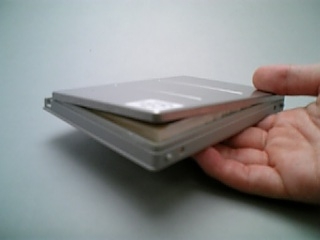 Although this is not a recent photo of the battery that came with my MacBook Pro last June, it is an amazing simulation. A twin, if you will.
A couple of days ago I noticed that one of my business laptops had, well, a wobble. Although lying seemingly flush on my desk at my office, it had a distinct sway as I typed on it. I flipped it over and saw that one corner of the base of the battery was lifting off, creating a metallic flipper of sorts. I pressed it firmly back in place and it peeled away again. It seemed like a situation caused by glue that was no longer joining two discrete surfaces. The battery had some sort of problem requiring immediate attention.
And then I did what we all sometimes do in such situations: nothing. Because I couldn’t envision being without this laptop (which is what I thought a trip to an Apple service station would entail), I thought I’d do nothing, at least for now.
But then I dwelt on it. And realized that my entire writing and business careers (hopelessly entertwined) reside within this laptop and that not all of it is backed up. Quickbooks, yes, to my .Mac account. Same with my calendar, contacts, and so forth. Most of my creative writing has been backed up to one of the desktop machines at home. But did I have all of it stored in one easily accessed backup location? No. So I went to CompUSA and bought a Maxtor 320-GB hard drive with backup software and backed up everything from this laptop, all 116,000 documents. It took about 18 hours, and there’s the irony:
Because the backup took so long, the laptop overheated and the battery cracked nearly in half.
Imagine my reaction seeing this in the morning: the laptop battery is clearly a goner, and while I hope the laptop isn’t irreparably damaged, I do have insurance. So the real question becomes, Is my data saved?
A quick check to the Maxtor showed that it was all on there. I turned off the laptop, obverted it, took out the battery, and surveyed the extreme damage — much like the photo above, but worse. In the photo above you can’t see a complete crack of the plastic shell. You also can’t see grave concern writ large on my face.
The laptop itself is fine, it turned out — I’m writing this on it — and everything is cogently backed up. A quick trip to my local authorized Mac dealer resulted in a new battery, at a cost of $129 plus tax. I didn’t lose any data, and the battery is under warranty from Apple, so a replacement is winging its way to me. So, no harm, no foul.
But this incident has made me think what it would feel like to lose all the data I have been shuttling forward from computers for years and years and years now, dating back to stories I wrote on a IIGS in the late 1980’s. In short, it wouldn’t feel good. At the same time I thought that, though, I figured that I would get over losing all of it and would just write more, and that might even be a good development, freeing me further from the past.
So, in 2007, here’s the verdict: Despite my attempts at cynicism while I was an undergrad, and my decidedly skeptical viewpoint, I am indeed a glass-half-full sort, the kind of deranged optimist who sees the loss of all his data as an opportunity.
One day later, I see it’s an opportunity I’d rather not seize.
Click here to watch a video that forecasts where we’re going with videoscreen technology. You’ll be glad you’ve watched this. Then come back here. We’ll wait.
What was the inciting incident for this new tech? This is an example of life imitating art imitating life imitating art.
The film “The Minority Report” was based on a short story by Philip K. Dick (one of my favorite writers, whom we’ve been discussing here and here ). As you’ll recall, there are many shots of Tom Cruise and others manipulating holographic images by hand. The filmmakers researched cutting-edge technology, got wind of research into this particular idea, and decided to incorporate it into the film. Here’s what happened next: Some entrepreneurs saw the movie, decided that that looked like really great tech that they could get into early, and found venture capital money to start the further research and development. Then it was reported in Inc. magazine, where I saw it.
To people like me — interested in science, but working in arts and entertainment — the story of art influencing science and vice versa is thrilling. All of us who are writers tell ourselves that we are changing the world, or at least trying to.
And while I’m on the topic, the most obvious recent example of that phenomenon, of course, is a little movie called “An Inconvenient Truth,” which has utterly changed the political climate in the U.S. (And, perhaps ultimately, the world climate.)
When I first moved to Los Angeles to go to grad school at the University of Southern California, I checked into taking the bus down to campus. Sure, the distance is only 16 miles and I had a car, but I figured that if taking the bus made sense, I could do that and read or write.
The first time I checked — in 1988 — the one-way trip was calculated at about 3 hours.
Lately I’ve been hearing from various pundits that bus service and connections have improved, so I thought I’d check again.
The pundits were right: Now the trip will take only 2 hours 40 minutes. To go 16 miles.
Moreover, based upon the transit authority’s calculations, while driving will cost me $8, public transit will cost me $5. So I’ll save three bucks, for an investment of two extra hours of my time.
And here some people can’t figure out why more people don’t ride the bus.