Lee Wochner: Writer. Director. Writing instructor. Thinker about things.


Blog

Blowin’ in the wind

March 28th, 2007

Yesterday afternoon I heard a staccato shredding sound outside my office here in Burbank, opened the door to look out, and saw that we had a sudden hailstorm. Actually, it looked like hail, rain, and snow. And that’s what it was. (Here’s a report about it.) From nowhere, on what had been just previously a crisp clear Los Angeles day. Five minutes later it was gone and the day became crisp and clear again. Deciding that this was a warning from God to free the Israelites, I went back into my office and awaited the plague of locusts and the rain of frogs.

All night long last night the wind howled outside my bedroom window at home and I wondered what the state of our trees, both long-standing and recently planted, would be. This morning revealed various small branches and bits of shrubbery blown into odd piles, but no major damage. There will be figs this summer.

But here was my truly favorite part of this unseasonable — and ungeographical — weather, and please note that in the classically American sarcastic style when I say “favorite,” I mean the opposite. Today when driving my youngest child to his preschool we came across a gardener clearing a residential corner. What was he using to clear the sidewalk? A leaf blower. And as quickly as he was blowing the leaves and other small debris into the street, using the large fume-spewing gasoline motor strapped onto himself, the wind was blowing it all back. When I see things like this I actually relish a real energy crisis that would force everyone to reconsider his true energy needs.

When I was a kid, we had state-of-the-art machinery that handled this sort of job quickly, efficiently, and with little to no use of fossil-fuel energy. We called these tools:

  • a rake
  • a bag

I was at Lowe’s just this past Sunday, and these implements are still available. I wish more people used them.

Jay Kennedy, R.I.P., and the untold history of The Screw Iran Coloring Book

March 26th, 2007

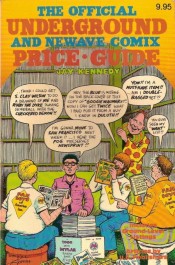
kennedy_guide1_thumb.jpgWhile I’m on a roundup of “internet death” (finding out through the internet that people you know have died), I should mention the demise of Jay Kennedy, a comics historian and comic-strip editor of major importance who, among other claims to fame, helped launch both “Mutts” (my friend Paul’s favorite strip) and “Zits,” my son Lex’s favorite. Kennedy died recently during a riptide incident while vacationing in Costa Rica. His obit is here.

While I’m not sure I ever met him in person, I do know I spoke with him on the phone in what had to have been late 1981. He was compiling the information for the book at left, “The Underground and Newave Comix Price Guide,” and having decided for some reason that my self-published masterpiece “The Screw Iran Coloring Book” was an “underground,” he had tracked me down for information.

About “The Screw Iran Coloring Book” (and yes, of course I still have copies for sale. Email me.):

In 1980 as the Iran hostage crisis went on and on, I hit upon a great idea: a coloring book, modeled after Neal Adam’s Jimmy Carter coloring book, to be called “The Screw Iran Coloring Book.” Every page would be something rip-snorting fun about the hostage drama, making the ayatollah and the captors look bad, and lining our own pockets with the immense sales prospects. A friend and I set out to execute this plan, hiring an artist, conceptualizing the jokes and writing the captions. As with many things done in youth, this project now seems like a very bad idea — so bad that even Rolling Stone magazine, where we had envisioned advertising and securing the bulk of our sales, a magazine that found ways to advertise drug paraphernalia, sex aids, nudist colonies, and God knows what else, wouldn’t take our ad. In fact, they sent us a terse note advising us that the idea of profiteering off hostages was not cool. And although we hadn’t realized, in our late teenage years, that this could be construed as profiteering off hostages, they were right. I just thought that bad taste was in, and given what was going on in National Lampoon and all and sundry “Newave” and underground comix, that was most definitely the case.

In any event, no one would take our ads and no matter how we tried I don’t think we sold more than 10 copies of “The Screw Iran Coloring Book.” I have no idea how Jay Kennedy heard of it, and I believe that was one of my questions to him, but I can’t remember the answer. Given that he grew up in New Jersey (as did I), maybe he saw or heard of it at a convention in that period when I was a comic-book dealer and was trying to unload them. The fact that he tracked me down to Ocean City where I had moved in September 1981 after the coloring-book debacle, and somehow got my home phone number is a testament to his diligence. You can imagine that I was initially skeptical — someone who was doing a “price guide” of underground comics must have been an unrepentant hippie, right? — and then flat-out thrilled that my printed offering, no matter how pathetic a failure, would be enshrined in history. (Like most writers, I love all my literary children, even the deformed ones.) Kennedy asked me a few questions for his records, and then said he needed a copy of the coloring book to attest that it did indeed exist. I offered to mail him one and he insisted on paying for it. He may have been our fifth sale. Or first — I may have given away the other four.

I enjoy “Mutts” and “Zits” and I’m grateful that a long time ago someone for some reason decided to include my wrong-headed little satire in his book. That makes it all the more real. Even at the time, I felt that having it listed as item “1754. SCREW IRAN COLORING BOOK, THE.” added to its value. If in no other way than this: The coloring book had a published value of 50¢. Kennedy listed it as being worth 50¢ — but he had actually paid for it. And you cannot imagine the joy it gave me to see my own name listed in the “Underground and Newave Artist Index” in the back; to someone whose entire world revolved around comic books it felt like I had some tiny personal share of history. I remain grateful to Mr. Kennedy.


Marshall Rogers, 1950-2007

March 26th, 2007

rogersbatman.jpg

Comic-book artist Marshall Rogers, best known for his definitive work in the 1970’s and 80’s restablishing the gothic nature of Batman in “Detective Comics,” died Saturday, Newsarama is reporting.

I always loved his work, and reading of his death just now reminded me that I met him once about 25 years ago at a comic-book convention. But then I seemed to recall something else, and picking through the cluttered attic of my brain finally helped me stumble across the lost memory I was seeking: I interviewed Rogers over the phone in 1985 for The Comics Journal. I pulled down the relevant issue — #100 — and there it is. And here it is transcribed online if you’d care to see it.

Rereading it just now resulted in these immediate observations:

  1. I was a really bad interviewer. At least this time, and at least at first. The beginning of the interview is, well, flat-out rude: “First off, what have you been doing for the past few years?” That’s information I should have already known — and I suspect I did — but there is a better way to get it. My followup, “So more or less, over the past few years, one strip has been your job,” has a similar attitude that I regret. In retrospect, Rogers was nicer than I would’ve been.
  2. I suspect I was also picking up Journal editor Gary Groth’s pugnacity. I recall his recurring snipes to me about Denny O’Neil (whom I also interviewed in this issue) for being a heavy drinker; later, after the interview, I made nice with O’Neil and we wound up having a very pleasant Chinese lunch in Manhattan on the Marvel expense account. I also remember that I discussed with Groth the angle he wanted for each of the five pieces I have in this issue. Why he assigned me to interview Harvey Kurtzman, the creator of both “Mad” when it was a comic book and “Little Annie Fannie” in Playboy, I’ll never know, because I was completely unqualified — something Kurtzman glommed onto instantaneously, threatening to hang up.
  3. The interview, like all things from 1985, is incredibly dated. In the wake of “Shatter,” the first comic book done on a computer, I ask him if he’s afraid computers will supplant artists. Twenty years later, all mainstream comics are done on computer. You can also see how much the field was in transition in the mid-80’s, with the shift to creator-owned vehicles and profit-sharing.
  4. Hey — I too am one of the people whose intellectual property is being stolen on the internet. I say that because I sold one-time rights to the Journal for this interview, and here it is on the web for free. I guess we’d all better get used to that, if we’re not already. Either that, or I can emulate David Thomas of Pere Ubu and countless others who spend long hours hounding people around the globe to take things down. (And I’m linking to the interview — which I hadn’t even remembered conducting — so how put out am I truly?)

Please pardon my bringing these things up in what is, to some extent, a death notice; I just feel like a part of my life from more than 20 years ago came knocking.

Rogers’ work on Batman was clean and moody at the same time (and at its best when inked by Terry Austin); his Mr. Miracle had a sharp plastic snap to it that made it ping off the page. I’m not well-versed enough in the technique behind these tricks to explain how, but Marshall Rogers’ covers always stood out on very crowded newsstands. They belonged to what was a highly plastic era, but had a rigor and a punch that a lot of comics were missing. I’m sorry I won’t be seeing any more of that work, or any more of him at conventions.

All politics is yokel

March 26th, 2007

Think this presidential race won’t get uglier than ever (Obama be damned)? Check out what’s happening with the (non-partisan) Burbank, California city council race.

I too received the “sleazy mailer” that my friend David is writing about here. One of the things it slams candidate Gary Bric for is serving alcohol to intoxicated people, without ever explaining that the man owns a bar and restaurant and has been charged something like three times in probably 20 years. How many people does he (or his bar) serve in a night? 100? Times 365 days a year, times 20 years? I’m not endorsing serving intoxicated people, but sometimes it’s a tough call — particularly when you’re in the business of selling intoxicants. The police don’t seem too concerned about his behavior — they’re endorsing him — and both the chief and the deputy chief are well aware of who is a problem (like other local bars they talk about constantly) and who isn’t.

My immediate response to said mailer was to vote by mail for the two candidates being attacked.

Richard Jeni remembered

March 26th, 2007

A nice piece in today’s LA Times about a remembrance for the comedian at The Laugh Factory.

Lincoln, the beaver, and me

March 26th, 2007

lincolnbeaver.jpgI few months ago I was troubled by the bizarre Citibank ad campaign built around some master-slave relationship I didn’t quite understand.

Now I find that I can’t figure out why Lincoln and this… beaver?… are hanging out together. The online vid at theymissyou.com shows a drowsy insomniac lurching into his kitchen in the predawn hours to find Lincoln and this beaver awaiting him. “We’ve been expecting you,” Lincoln says as the beaver prepares to make a chess move.

Although this metamessage seems beyond one’s immediate grasp, I suspect that the subconscious grabs hold of it immediately. The beaver I think most of us would equate with nature’s most reliable sleep aid (what the French call “the little death”). Lincoln was kept awake many nights by the horrors of the Civil War and his own depression, although I wonder how many people associate him with that. Mostly, he probably means three things to most Americans:

  1. the war and emancipation
  2. the dollar and the penny
  3. an extra day off, with corresponding sales events

I don’t think one sees Lincoln and thinks about insomnia, nor do I think one sees a beaver and thinks about insomnia. (Of course, prior to “The Shining,” I never thought of oral sex with a bear as a sign of madness.) When it comes to sleeplessness, most of us think of counting sheep. So (stovepipe) hats off to whoever came up with fresh imagery for this. And on a meta level, I am confident that anyone having neurotic dreams about Lincoln and a beaver playing games in one’s kitchen would gladly take a pill that would make it stop.

When I first stumbled across this little campaign in my local CVS drug store, I peeled off a coupon for further investigation. I’m ordinarily of the take-no-drug school of self-prescription; my mother’s cure for all ailments was a shot of whiskey and bedtime. But I was curious. I’ve been suffering from various forms of sleeplessness even before the Reagan Administration (to which I originally ascribed blame). According to the website, this pill is for those “who have trouble falling asleep.” That leaves me out; I can fall asleep just fine. It’s waking up 46 minutes later that makes me crazy. Not crazy enough to want to drug myself, but all bets would be off if I were seeing dead presidents and large rodents.

More bad reporting

March 24th, 2007

As they say in the movie trailers, “This time, it’s personal.” That’s because it’s about me.

Over at The Burbank Leader (owned by, you saw it coming, the LA Times), they’re reporting this story:

Burbank Democrats elect officers

The Burbank Democratic Club has selected its officers for the 2007 year. Club member Janet Reynolds was elected president and David Dobson was elected vice president.

Club secretary Larry Nemecek and treasurer Ken Ahern will retain their posts. Outgoing president Lee Wochner is taking a seat on the executive board.

Wochner and club member Dana Ragle will travel to the 2007 state Democratic Convention in April.

The club’s next meeting on March 28 at the Hill Street Café will feature former Assemblyman Dario Frommer, who will speak about his career and future plans. For more information, call (818) 288-2649.

Before this story ran, I sent an email to my fellow members of the executive board wondering what the Leader would get wrong and offering a few ideas. Well, I was way off-base; the Leader found a unique way to get far more wrong than I suggested. Here’s what they got wrong:

  1. I’m not “taking a seat” on the executive board — I was already on it, as president. Now that I’m the immediate past president, I still have a seat. I believe we told them this.
  2. They have misspelled Ken Ahearn’s name. Yet again. Remember that first rule of journalism I keep quoting? “Get people’s names right.”
  3. While it is technically true that “Wochner and club member Dana Ragle will travel to the 2007 state Democratic Convention in April,” it isn’t because of an election by the Burbank Democratic Club. We were elected by Democratic voters in the 43rd Assembly District. (Which I believe we told them.) This is a huge distinction. Dana and I aren’t representing the club, which is comprised primarily of Democrats in Burbank — we’re representing 190,000 Democrats in a large chunk of Los Angeles County. This reporting is doubly wrong — both in implying that it was a club election, and in not making it clear that we’re delegates to the convention rather than “travelers.”

With regard to my election as delegate, I previously covered some of this ground here.

I show up in the media only occasionally and I don’t generally have time to correct the errors. (And by “errors,” I mean factual errors, not opinions. I mean verifiably erroneous reporting, the sort that should not be reported by reporters, or should be caught by editors or fact-checkers.) What must life be like if you’re an actual media presence? The Burbank Leader isn’t out to get me, they’ve just made mistakes; but what if you find yourself on the wrong side of The Drudge Report, or Fox News, or a producer at CNN or 60 Minutes? What must it feel like to wake up every morning and hear your name on the radio, on television, see it in newspapers and magazines, and feel to the core of your being that that is not you? And the only thing you have to back it up with is facts, and facts just aren’t that interesting any more.

10 Things You Never Knew About the Apple iPhone

March 24th, 2007

11. That five minutes after you get it, the newer one will be out.

For nos. 1-10, click here.

I know you are, but what is he?

March 24th, 2007

pee_wee_herman-2.jpgYou might have thought that Pee-wee Herman was finished. But his recent splash at a nostalgia convention right here in Burbank is just part of a surprising comeback, as reported here in the LA Times. The print edition had a terrific photo of the 54-year-old Pee-wee, who has aged rather gracefully; unfortunately the photo isn’t online.

(And you’ll note, in typical Times fashion, that it takes six decidedly unclever paragraphs to get to the point.)

If or when the new Pee-wee Herman movie actually happens, the line to see it starts right here.

A good sign of the Times

March 24th, 2007

The LA Times’ Tim Rutten lauds the decision to kill the questionable edition of Opinion to have been guest-edited by Brian Grazer, which we talked about here. The gist of Rutten’s piece:

  • Because the editorial section is a statement from the paper to its community, it should not be guest-edited. I agree.
  • That over the past decade, various checks and balances have disappeared and firewalls come down. It would seem so.
  • That he’s made it onto the resigned opinion editor’s enemies list and while he can’t figure out why, he doesn’t mind.
  • Whereas I said the personal lives of newspaper editors are not the usual domain of high drama, Rutten does me better with this graf:
    • Like most of my colleagues at The Times, I’m fundamentally uninterested in other people’s personal lives, but I’ve always subscribed to the late Abe Rosenthal’s standard for journalists: I don’t care whether my colleagues sleep with elephants, so long as they don’t cover the circus.

While I’ve been distressed by the paper’s various lapses, you can’t say they aren’t at least covering their own mistakes — and Rutten, the media critic, does a fine job. I know a number of people who work at the Times and everybody seems aware of the enormous problems within the paper. But what I haven’t heard — aside from wild outside schemes for making newspapers either non-profit or entirely digital partnerships — is a plan to fix them.