Lee Wochner: Writer. Director. Writing instructor. Thinker about things.


Blog

Cloud Cuckoo Land

September 5th, 2007

Just in case you were part of the 19% of the country who don’t think the quote unquote president is dangerously naive, read this brief excerpt from “Dead Certain,” the much-talked-about new biography of Bush. You’ll get a close look at his “leadership” style, as when he tries through the sheer power of his own personality to wish Iraqi Prime Minister Nouri al-Maliki into doing a better job. This is a style often associated with little girls and boys. In separate news coverage, Bush admits he “cries a lot.”

In this piece, Bush also says that if he decides that Maliki is “deceptive,” then we’ll change course, because deception is an unfit characteristic for leaders. (Clearly, Dick Cheney missed this lesson.) Deception, by the way, is the hallmark of leadership according to Sun Tzu and Macchiavelli. To Bush, who operates from the heart and can scry an opponent’s full character simply by looking in his eyes, a la Vladimir Putin, such things are demonic.

It’s distressing to be ruled by a naif, especially when he’s doing it so badly.

How the GOP plans to win the Presidency in 2008

September 4th, 2007

Same way as the last two times — by stealing it.

Here’s the latest scheme: a ballot measure that would shift California’s electoral votes into “proportional representation,” which would have had the effect in recent elections of shifting 22 votes to the Republicans. This measure is entirely funded by Republicans for the benefit of Republicans. The name of the “committee” behind this? “Californians for Equal Representation.” It would be laughable if its goals weren’t so potentially achievable.

If we really wanted “Equal Representation,” we would either abolish the Electoral College — something I note that the GOP is not clamoring for, given their result in 2000 — or we would enact this reform across the country rather than simply one state.

One child left behind

August 28th, 2007

Miss Teen South Carolina answers a question. Kinda. Sorta.

(This is in marked contrast to the lecture my colleague Aram Saroyan gave last night, effortlessly discoursing on William Blake and “shapely mind” with regard to writing, but that’s a topic for another post.)

Thanks to Rich Roesberg for sending this in.

The greatest swindle of our lifetimes

August 26th, 2007

What is it? The war in Iraq. If you can stomach it, read this piece in Rolling Stone detailing the malfeasance and vast personal enrichment underlying the buildup and “rebuilding.” (In fact, please stomach it — these were our dollars, and we need to be angry.)

Compared to the profiteering on this war, the savings and loan bailout under Bush 1 is small potatoes indeed.

Arthur Miller’s play “All My Sons” now looks quaint.

As does the notion of shame.

Time changes everything

August 24th, 2007

Recently I wrote here that I’d noticed that most of my back catalog of plays have become period pieces. (That doesn’t mean they can’t be produced — dear producing gods: That doesn’t mean they can’t be produced! — that just means that some of them need to be set in recently passed time periods in order for what I hope is their trenchant wonderfulness to work.)

I’m also discovering that I’m becoming a period piece.

Last night during the welcoming ceremony for the University of Southern California MPW graduate writing program where I teach, I got a look at the incoming masters candidates. As one line that teachers share goes, “I keep getting older but my students stay the same age.” As a faculty member in our program, I’m rather young; as a member of my theatre company I have definitely become a graybeard. But what really caught me by surprise was a man roughly my age, a professor in the Marshall School of Business at USC, who came up to me and said, “Lee, I don’t know if you remember me, but my wife was in one of your plays 20 years ago.”

It took a few minutes of digging through the dusty filing cabinet of my mind, but I did remember him. And his wife.

He said, “My wife and I still really love that play. We have it on videotape and we watch it once in a while. It’s the play about the wires.”

Videotape! When was the last time I watched something on videotape! When was the last time I listened to something on cassette tape? My wife’s next preferred project for me is to digitize all our CDs and get rid of them — so who will need the CD player, either?

“The play about the wires” is my play “Guest for Dinner,” begun when I was an undergrad circa 1984. Among other things, it’s about a shrewdly intelligent man who is so consumed by his hatred of a Springsteen-like rock star with pretensions to being Joe Average that he lures said rock star to his apartment to humiliate and abuse him. “The wires,” the section that everyone who has seen this play in its various productions seems to recall with the greatest clarity, is a speech by our protagonist, “Rick” (rhymes with prick), who assembles electronic components in his day job and laments the way that the wires on the top keep pressing down on the wires on the bottom. It’s a thin metaphor for social inequality, and is just one of the things in the play that the me of almost 25 years later regrets.

When the play was done in LA, a former writing teacher of mine — ironically, from the very same program I now teach in — came to see it. I asked him what he thought, and he said blandly kind words. I then asked him what he really thought. He proceeded to tell me, taking the play apart bit by bit. (Afterward, his wife said to me, “Well, I liked it.” She was being nice; it didn’t matter.) Even at the time, his arguments were hard to refute, and over the course of 20 years I’ve grown more and more toward his opinion.

But as my dean said last night when I told her that the spouse of someone who had once starred in one of my plays came up to me to say hello, “There really is no hiding.” Certainly true, especially in an internet age (and only one reason among many that I’m sure we and our allies know exactly where Osama bin Laden is).

There’s no hiding, and there’s also no changing who you once were. We should honor the work of our younger writer selves, flaws and all, as individual steps on a long journey. Some of my old plays don’t work the way they would if I were to write them now, but most of those plays wouldn’t be written by the writer I am now. The bad science fiction stories and detective stories I started writing and sending off at age 11 haven’t improved with age either. But every one of those failed attempts carried some lesson for the future.
Forget spam. Now serving bacn.

August 24th, 2007

Prepare yourself — it’s giving way to “bacn.”

What’s bacn?

It’s email that’s not quite spam. In other words, it’s a little more permission-marketing oriented.

So I guess the Marvel Pulse email I get is bacn. That one I don’t mind. While I don’t want to help the lawyer in Nigeria receive the late king’s assets in exchange for a 10% commission, I do want to know what Dr. Strange is up to.

I hope they don’t employ children

August 21st, 2007

Disney World — been there, done that?

If you’d really like to subject your kids to something, maybe you should take them here.

The erratic ecstatic vision of Werner Herzog

August 19th, 2007

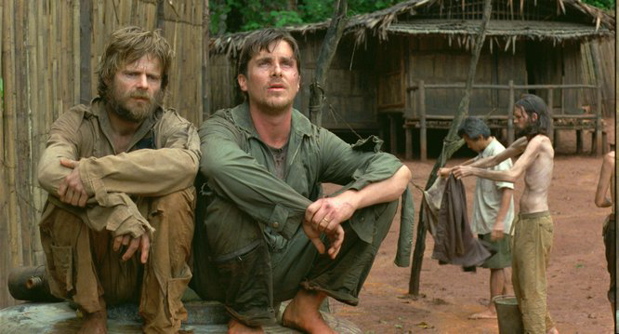
rescuedawn2.jpg

The other night I saw “Rescue Dawn” and found it, like all the Werner Herzog films I’ve seen, strangely compelling and somewhat badly made.

The film, which concerns the shooting-down of Americanized German pilot Dieter Dengler in Laos prior to the Vietnam War, was previously the subject of a documentary (also by Herzog) called “Little Dieter Needs to Fly.”

The most immediately noticeable aspect of this film is the film stock itself, which is so bad that the movie looks like a 1970’s porno flick. I kept waiting for Johnny Wad to make an appearance. One could argue that this is an attempt by the filmmaker to return us to the period of the film’s setting, but in actuality I suspect “Rescue Dawn” was shot on degraded film left over from other ventures. The effect is jarring, but after a while, your eyes do adjust — eventually, human beings can get used to anything.

There are also the usual lapses in storytelling. Before the action of the movie (our hero getting shot down in Laos), we get all of about 1 minute of his getting his flight gear specially tailored in a way that, later, plays absolutely no relevant role in the movie, and another 1 minute of his watching an Army jungle survival film that also plays no role. (None of the skills demonstrated is ever needed.)

Most disastrously, the ending is very badly considered and feels summoned from a Michael Bay movie I’m glad I missed. Dengler, having now survived the horrors of torture and survival in the jungle, is upon his return hoisted aloft by the crew of his ship and carried around, his arms upthrust in victory. I think I’ve also seen this scene in every single movie about nerdy kids who triumph at summer camp. Its awfulness is maximized by the bad shooting, the bad dialogue, and the utter lack of fresh ideas.

And yet, as is usually the case with Herzog, much of the movie is amazing.

The scenes of torture are inventive and difficult to watch. They ring with truth, especially in the self-evident and very real changes to Christian Bale’s physique. (He lost 80 pounds over time for this role.) So too with the escape of Dengler and his fellow prisoners, a plan that goes all too wrong for what can only be described as very real but very stupidly human reasons: the one prisoner simply doesn’t show up for the shoot-out. (He never gives a good explanation, and that comports with my own findings about people who don’t show up when they’re supposed to.) Bale puts his all into his performance, running barefoot over treacherous terrain, eating wriggling earthworms and even ripping into a live snake with his bare teeth. (It is either absolutely a live snake or this is brilliantly edited — which is not the hallmark of a Herzog movie.) Bale does an excellent job of capturing Dengler’s loopy optimism and blockheadedness. And, finally, the terrible and sad decline of the escapee played by Steve Zahn is a tragedy unfolding before our eyes. Zahn’s performance is harrowing.

I can think of no other director who so perfectly conveys the terrors and chaos hiding behind the beauty of unruly nature. Every scene in a Herzog film carries an implicit threat, whether it’s Klaus Kinski turning from friend to fiend frame by frame in “My Best Fiend,” or the deluded naturalist cavorting with the bears he believes his friends in “Grizzly Man.” It’s the dangerous art that’s most exciting — think Stravinsky, Picasso, the Sex Pistols — and that’s why, although I’m not terribly interested in film, I keep returning to the films of Werner Herzog.
—————-
Now playing: Brian Eno – Here Come The Warm Jets
via FoxyTunes

Categorizing via iTunes

August 19th, 2007

I don’t care too much about how a corporate service classifies the art and culture I partake of — much of it’s too difficult to classify anyway, so it’s only mildly annoying that someone at iTunes would classify, say, “Yankee Hotel Foxtrot” by Wilco as “Country” (a classification that no one who had actually listened to the disc would ever make).

Looking at how my iTunes folder is automatically categorized by the system, it would seem that almost everything I listen to is “alternative.” Alternative to what, I don’t know. Frank Zappa is “rock,” and the Brian Wilson version of “Smile” is “pop,” while the Beach Boys versions of the same songs are “rock.” Huh?

But what I really enjoyed — and what propelled this line of thought — was how the system classified the Brian Eno tracks I’m listening to:  “unclassifiable.” That one they got right.

—————-
Now playing: Brian Eno – No One Receiving
via FoxyTunes

Dickering over Philip K. Dick

August 17th, 2007

This week’s New Yorker has an excellent appraisal of Philip K. Dick by Adam Gopnik. You can read it here.

Dick, for those who’ve only recently tuned into this blog, is a writer whose work I’ve been following closely for 30 years. I’ve read almost all of his books (I’m still trying to get through the excruciating mainstream novel “Voices from the Street” — if “trying to get through” means “allowing it to collect dust on my nightstand.”), as well as a few biographies. Gopnik does a good job of looking at Dick’s body of work, correcting some strongly held bad judgments or misperceptions by Dick’s ardent admirers, and placing him where he more aptly belongs. Among other salient points, he:

  • locates Dick as a satirist, alongside Swift, identifying “The Three Stigmata of Palmer Eldritch” as a take on middle-class escapism, “Clans of the Alphane Moon” as a take on the Johnson-Nixon years, and “Ubik,” most hilariously, as a perverse cultural wish-fulfillment dream, one where people can actually speak with the dead, “but, when you go to speak with them, there is static and missed connections and interference, and then you argue over your bill.”
  • downgrades “The Man in the High Castle” (“the book that made Dick famous”) in favor of “his masterpiece,” “Ubik.” I concur, but would add a masterpiece: “Confessions of a Crap Artist.”
  • corrects the notion that Dick was somehow neglected in his lifetime. “You can find unfairly neglected writers in America; Dick, with a steady and attentive transatlantic audience, was never one of them.” Let me just say that, somehow, in a house in the woods of southern New Jersey far from any bookstore and in the early 1970’s before the creation of Amazon.com, that house somehow had dozens of Philip K. Dick books. So he couldn’t have been that obscure.
  • and, finally, he concludes that while “all this remains thrilling and funny … the trouble is that, much as one would like to place Dick above or alongside Pynchon and Vonnegut — or, for that matter, Chesterton or Tolkien — as a poet of the fantastic parable he was a pretty bad writer. Though his imagination is at least the equal of theirs, he had, as he ruefully knew, a hack’s habits….” While I disagree that Dick won’t be ranked alongside Vonnegut (he already is), or, for some of us, above Tolkien, I will repeat what I said years ago to a friend: “Nobody reads Philip K. Dick for the writing.”

Perhaps Gopnik’s most salient point, in an essay that is overall very smart about its subject and filled with insight, may be this, from his opening:

“There’s nothing more exciting to an adolescent reader than an unknown genre writer who speaks to your condition and has something great about him. … The combination of evident value and apparent secrecy makes Elmore Leonard fans feel more for their hero than Borges lovers are allowed to feel for theirs. … Eventually, enough of these secret fans grow up and get together, and the writer is designated a Genius, acquiring all the encumbrances of genius: fans, notes, annotated editions, and gently disparaging comprehensive reviews.”

Guilty as charged, your honor. But… what is the downside? All readers hope to find writers who “speak to their condition.” In adolescence it may be Philip K. Dick; in college it may be Chaucer and Beckett. In middle adulthood, heaven help us, we may light a pipe and start reading Updike seriously. If we want writers who don’t speak to us, I’m sure we can find them. Personally, I could start reading Mitch Albom, or all those people who write books about their dog.

Philip K. Dick never believed anything directly in front of him. I don’t know why, but neither have I. I wish the bad writing were better, but I can overlook it because the rest of the view is so eye-opening. I’m glad Gopnik doesn’t hold Dick’s science fiction genre against him. As I remind my students, Samuel Beckett, darling of existentialist artists, was a fan of detective fiction. Just because it’s genre doesn’t mean it isn’t worthy.