The Buk stopped here
January 29th, 2008If you’re in LA and feeling out of sorts, like what you really need is to go off on a bender and tear through the town, you could do worse than studying from the master.
If you’re in LA and feeling out of sorts, like what you really need is to go off on a bender and tear through the town, you could do worse than studying from the master.
The House of Representatives and the quote unquote president want to give my wife and me a check to help “stimulate” the economy. Depending upon the final details, we could get something like $2100 by May. The thing is, we don’t want it. And neither does anyone else we’ve asked about it.
Nobody at the recent Chamber of Commerce board meeting wanted it. There, it was widely viewed as an election-year ploy, and one probably favoring Democrats.
At the Chamber mixer the other night, nobody I spoke with there wanted it either. Except they said it was intended to help Republicans retain the White House.
At the barber shop on Thursday none of the three barbers, nor any of the patrons, wanted it. Between barbers (one female, two male) and patrons, there were youngish and oldish, white and Hispanic, and several variations of the above — and nobody wanted the refund.
Nobody in my playwriting workshop is demanding it. No one said they’d send it back, but they don’t actually want it. And someone I know who really needs the money summed up what everyone I’ve discussed this with is saying: This refund is a bad idea, because the country can’t afford any more debt. He and his wife would rather not have the check if the government would commit instead to balancing the budget.
I don’t think the refund is a clever ploy for either the Republicans or the Democrats. What I think it is is a bailout of lenders who have made very bad loans, as well as some icing for retailers. Yes, I expect that everyone who gets that check is going to perhaps make one extra house payment, or one more credit-card payment, or buy that iPhone that the guy interviewed in the L.A. Times last week said he’d been drooling over and could now buy with his government economic-stimulus refund check. And then the $300, or $600, or however much, will be gone, with no lesson learned by anyone.
And where will it go? Onto the ledger for my children and their children and all the other children who will be paying for it and for all the other excesses and mistakes of the last seven years. It will also go onto the ledger for the people of China, who will be paying for it until they start to shift their investments from dollars into euros — in other words, only for a little while.
So… if it isn’t a good idea to further mortgage the nation to hand out freebie checks to cover other mortgages on houses people shouldn’t have bought from people who were paid to sell things they knew people couldn’t afford, what would be a better idea?
Perhaps a public works project that actually results in needed improvements while feeding the economy.
Perhaps letting banks bear the brunt of their bad decisions. We privatize the income — note the hundreds of millions of dollars in bonuses paid during the housing bubble — but we socialize the bailout. Let’s not bail them out. Let’s let the housing market find its natural landing place, creating an opportunity for the millions of people around here at least who couldn’t ever afford to buy a house before.
Perhaps passing along a hard but necessary lesson for all of us: that there are no free rides, that ultimately someone always has to pay — and this time, it should be us.
A friend forwarded me an email from someone saying, with regard to Ronald Reagan, “Didn’t realize just how much he’s missed, until I read and remembered some of the stuff he said… and stood for.” Here are the Reagan pearls of wisdom included:
‘Here’s my strategy on the Cold War: We win, they lose.’
‘The most terrifying words in the English language are: I’m from the government and I’m here to help.’
‘The trouble with our liberal friends is not that they’re ignorant; it’s just that they know so much that isn’t so.’
‘Of the four wars in my lifetime, none came about because the U.S. was too strong.’
‘I have wondered at times about what the Ten Commandments would have looked like if Moses had run them through the U.S. Congress.’
‘The taxpayer: That’s someone who works for the federal government but doesn’t have to take the civil service examination.’
‘Government is like a baby: An alimentary canal with a big appetite at one end and no sense of responsibility at the other.’
‘The nearest thing to eternal life we will ever see on this earth is a government program.’
‘It has been said that politics is the second oldest profession. I have learned that it bears a striking resemblance to the first.’
‘Government’s view of the economy could be summed up in a few short phrases: If it moves, tax it. If it keeps moving, regulate it. And if it stops moving, subsidize it.’
‘Politics is not a bad profession. If you succeed, there are many rewards; if you disgrace yourself, you can always write a book.’
‘No arsenal, or no weapon in the arsenals of the world, is as formidable as the will and moral courage of free men and women.’
‘If we ever forget that we’re one nation under God, then we will be a nation gone under.’
– Ronald Reagan
That got me to wondering what I would add for Ronnie, if I could:
“When I was a kid, we didn’t have homeless people — so as president, I created them.”
“Trading guns for hostages is a good way to arm the enemy and reinforce their bad behavior.”
“Mr. Gorbachev, tear down that wall. And help us run up our debt.”
“Bailouts for the rich. It was good then, and it’s good now.”
Yes, I’m on deadline with a large writing project. But now the script is finalized and we tape on Friday and Monday, so the smoke is lifting. And so look for more posts here.
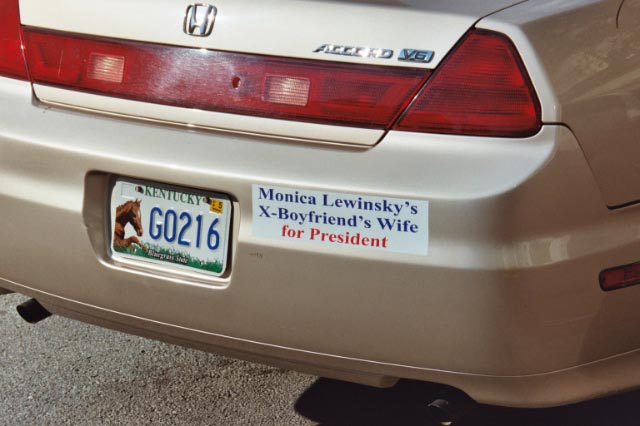
At least, that’s what Chris Matthews thinks.
p.s. to the previous post:
So how many more delegates does the annointed frontrunner, Hillary Clinton, have over Barack Obama? (After all, this is a race for delegates — not the opinions of campaign reporters.)
None. They’re tied.
Democrats | Polls
Candidate Delegates
won to date / Super delegates committed / Delegates needed
Hillary Clinton 37 0 1,988
Barack Obama 37 0 1,988
John Edwards 18 0 2,007
Joe Biden 0 0 2,025
Chris Dodd 0 0 2,025
Mike Gravel 0 0 2,025
Dennis Kucinich 0 0 2,025
Bill Richardson 0 0 2,025
While we’re at it, here’s what it looks like on the Republican side:
Candidate Delegates
won to date Delegates needed
Mitt Romney 59 1,132
Mike Huckabee 34 1,157
John McCain 17 1,174
Fred Thompson 5 1,186
Ron Paul 4 1,187
Duncan Hunter 2 1,189
Rudy Giuliani 1 1,190
Sam Brownback 0 1,191
Tom Tancredo 0 1,191
You’ll note that one of that race’s “frontrunners,” Rudy Giuliani, has half the number of delegates as Duncan Hunter (or, as we like to call him, “Who?”). Mr. Giuliani’s number of delegates is: 1.
Still, that’s 1 more than Dennis Kucinich has. Bear that in mind the next time you see or hear from him.
Hillary Clinton just won the Nevada caucus, and to judge from the news reporting she’s now the clear front-runner and Barack Obama is an abject failure. Maybe. Maybe not. Here are the actual numbers:
Hillary Rodham Clinton 5,284 50.8%
Barack Obama 4,684 45.1
John Edwards 389 3.7
Uncommitted 31 0.3
Dennis J. Kucinich 4 0.0
So here’s the real story:
1. In a state with 2.5 million people, and almost 400,000 registered Democrats, only about 11,000 Democrats voted.
2. Of those 11,000 (out of the 400,000, out of the 2.5 million), only 600 — SIX HUNDRED — more voted for Clinton than Obama. So, advice to Mr. Obama: No need to bail just yet.
3. Finally, out of all those squiddillions of people, only 4 voted for Dennis Kucinich. Given what I’ve been witness to there, I would have thought that Las Vegas alone had a larger lunatic fringe than that, but I guess not. Clearly, Mr. Kucinich enjoys running for president; very few others are as enthused about it.
to bring Mark Chaet home with you and put him on your wall.
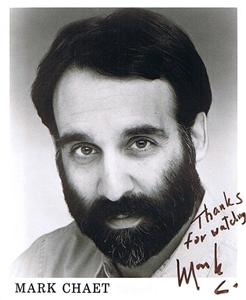
Remember my friend Mark Chaet? Of course you do. His mug was seemingly everywhere last year in a major print campaign. And a couple of years ago, every time I walked past a television, he was on-screen in some show or movie or other. (Which no doubt makes Mark wish I’d walk past more televisions.)
Living where I do, and leading the life I do, I have a high level of access to Mark. I could call him right now on his cellphone, if I so chose. You may not be so lucky. But nevertheless, you can own a precious piece of classic Chaet memorabilia, thanks to eBay.
That’s right, here’s your chance to own a piece of collectible Chaet memorabilia: a signed photograph of the actor from his “General Hospital” days. It’s priced to move, with an opening bid of just 49¢. A little background on this priceless collectible, courtesy of the subject, who was alerted electronically that this rare offering had been posted by an anonymous investor:
By the way, the 49¢ opening bid request is less than it cost me to have the photo printed, and probably less than it cost me to mail it to the General Hospital fan who requested it. I did 13 episodes in 1989 as Serge, a brainwasher disguised as an ice cream man, pushing a little freezer cart with bells – the bells were the Pavlovian device I used, having brainwashed Colton to kill Frisco. I was supposed to be Greek, and in one episode, I ad libbed a few words in Greek that I’d learned for that purpose. In Greek, I called another character a bastard. Take that Standards and Practices. Ever the rascal.
So there you have it: the provenance behind this piece, irrefutably certifying its authenticity. You won’t want to let this one get away.
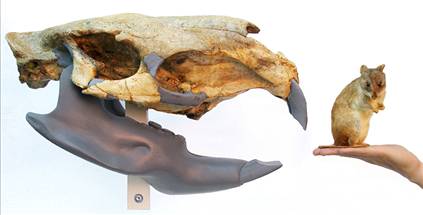
You may recall that yesterday my daughter volunteered that the world’s largest rodent is the capybara. (And if you can’t recall that, please see your doctor.) She was correct.
But as this news report shows, that wasn’t always the case. In fact, there were once rodents even larger than the rats encircling one of the theatres in New York where I’ve been produced.
(On a side note, the above image looks like some sort of entrance test that most of us wouldn’t pass. Like the GRE’s, which I barely skated through.)