Lee Wochner: Writer. Director. Writing instructor. Thinker about things.


Blog

I’m curing AIDS single-handedly

July 10th, 2008

Well, no. I can’t do that.

But with your help, I can help to raise money that provides medical and dental care (and other services) for people suffering from the disease. I’m doing that by running in this year’s AIDS Marathon, and I’m asking you please to sponsor me.

Yes, I’m going to run 26.2 miles in October. (I’m already up to 8.)  But the sense of accomplishment in crossing the finish line will in no way compare with the feeling associated with knowing where the donations (mine included) will go:  to providing care for thousands of people with no health insurance and few alternatives.

Please click here to sponsor me in this marathon or to learn more.

Which is the serious art?

July 10th, 2008

wraypainting.jpg

Painter William Wray is opening his latest showing this Saturday night at a gallery in Monrovia, here in Southern California. Here’s information on the gallery and its friendly and knowledgeable owner, Laura Segil, and here’s info on the artist, and above is one of his paintings.

Some of us are more familiar with some other William Wray art. It’s the art he signs as Bill Wray, and includes animation and print work on Hellboy, Batman, and Ren & Stimpy. Here’s that Wray’s site, and here’s a representative illustration. (Although when he does, say, Bugs Bunny, it’s with a gentler touch.)

bbb1.jpg

So I ask you: Which is the serious art?

The answer is: both.

I like that William Wray is both a fine-art painter and a commercial/comic illustrator. I like that my friend Gerald Locklin writes accessible poems that are also packed with meaning. I write marketing copy as well as plays, and I enjoy them both (although in different ways). Shakespeare wrote for the masses, but somehow wound up being artistic. Samuel Beckett, the doyen of litterateurs, loved detective thrillers (and I’m sure if he could have written one, would have).

We have this false notion that there is “low” art and “high” art. I don’t think so. I think there’s “good” art and “bad” art, and there’s art that’s more accessible (because the references are more easily understood by more people) and there’s art that’s less accessible. Moreover, I often wonder if the advocates of “high art” aren’t a little too interested in keeping more people from scaling their towers and gaining access.

Recently a colleague from USC came to see one of my plays and told me afterward how glad he was to see so many people laughing. (Intentionally: It’s a comedy.) For decades, he’s suffered the slings and arrows of a certain slice of the academy, where lighter material is frowned upon, and to be funny isn’t to be any good. (And we wonder what happened to the audience for poetry.)

So I celebrate William Wray and his alter ego Bill Wray. And early this Saturday evening I may drive out to Monrovia to meet them.

A gift from Jesse Jackson

July 9th, 2008

If Jesse Jackson wanted to do something nice for Barack Obama — which he didn’t — I can’t think of a nicer thing he could’ve done than this:  say on Fox’s “O’Reilly Factor” (of all places), with regard to Obama, “I wanna cut his nuts off.”

Now if only Osama bin Laden would endorse John McCain, the day would be complete.

Surveying the wreckage

July 8th, 2008

Nothing has been left undamaged by presidency Bush.


Bush Tours America To Survey Damage Caused By His Disastrous Presidency

Face front, Pilgrim!

July 7th, 2008

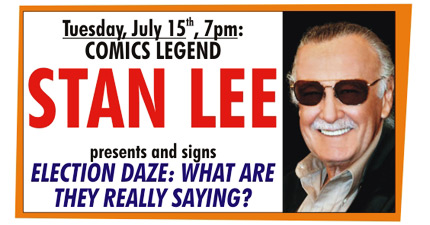
 stanleebook.jpg

Stan Lee is signing his new book next week at Book Soup.

‘Nuff said.

Always new

July 6th, 2008

Imagine if you read this and then moments later looked at it and it seemed brand new, like you hadn’t read it before.

Imagine if you read this and then moments later looked at it and it seemed brand new, like you hadn’t read it before.

Imagine if you read this and then moments later looked at it and it seemed brand new, like you hadn’t read it before.

That’s a taste of what it’s like being Clive Wearing, as profiled in this New Yorker piece by Oliver Sacks. Twenty years ago when in his mid-forties, Wearing was struck by a brain infection that affected his memory. Since then, he has been reduced to a memory span of only seconds. This means that for Wearing, every experience no matter how often repeated is new.

It also means that Wearing lives his life on the surface. He has to. It takes time, and thought, and experience, to delve. Wearing is capable of only snap judgments (and these he would have to make again and again), and so his best adjustment to the terror of instant experience is to deal only with the surface of things. He is an everflowing fount of jokes, puns, and wisecracks. Like the obnoxious jokester most of us avoid in life, Wearing is doing his best to mask a deficiency.

When Wearing was first struck by this malady, he took to keeping a journal. The entries, a page of which is provided in the magazine but sadly not online, provide a terrifying look into the abyss. “I do live!!!!” reads one entry. Another from the same day on the same page reads, “Hurrah [times infinity] — I DO live. (First time known.)” There are endless repetitions of this theme: that for Wearing every moment is not just a waking moment but a birthing moment.

I am interested in this story for several reasons. There is of course the obvious bizarre subject, and the relief at not being that subject myself. Much of what passes for our entertainment is relief that we are not as bad off as those entertaining us. (Comedy is nothing if not savoring the thrill of others’ pain and misfortune.) I’m also enchanted by the way Oliver Sacks interacts with Wearing with all the objective expertise of a neurologist; our profession often prescribes our behavior. Sacks ascribes Wearing’s jokiness to “a weakening of the usual social frontal-lobe inhibitions.” As a playwright concerned with character and motivation, I would focus on Wearing’s moment-to-moment actions — how he copes with a daily life too similar to a needle skipping over the groove — and what that says about human experience, and our existence. Most (or all?) of my plays ask who are we, and how do we fit? If for Clive Wearing every moment is like being born, every moment before must be like being not-born, or dead.

Imagine the terror.

Happy Independence (from Jesse Helms) Day

July 4th, 2008

Wherever it’s written that it’s wrong to speak ill of the dead, that writing is wrong.

I’ve come not to praise Senator Jesse Helms, who died today, but to bury him. Which is only fitting, given how many people indirectly buried by his actions.

During the emergence of the crisis, Helms led the fight against AIDS funding. He voted no on civil rights, no to the United Nations, no to arms reduction treaties. He eviscerated the National Endowment for the Arts.

That Helms died on the 4th of July, and with the knowledge that a black man is about to be nominated for president by a major party, gladdens my heart. The latter could not have sat well (despite the encomium today from Senate Republican Leader Mitch McConnell, who said despite all evidence, “Senator Helms certainly was no bigot.”) The former gives us a wonderful opportunity to contrast Mr. Helms with two previous U.S. leaders who also died on July 4th.

John Adams: Led the independence effort. Negotiated a loan with the Dutch that financed the war for independence. Wrote the Massachusetts Constitution, which served as the basis for the U.S. Constitution. Created the U.S. Navy.

Thomas Jefferson: Wrote the Declaration of Independence. Doubled the size of the nation, in effect sparing us land wars at home. Founded the University of Virgina. Protected the rights of — and from — religion.

What will go on Mr. Helms’ tombstone?

“Against blacks, and gays, and peaceable assembly, and intellectual pursuits, he gave us Ronald Reagan.”

Better news

July 1st, 2008

It seems to me that two news stories I’m following must be missing half the coverage. So I thought I’d supply what surely must be true, but somehow isn’t getting reported. And I’d put it in italics.

First, a little foreign news:

June 29 (Reuters) – Veteran Zimbabwean ruler Robert Mugabe has won the country’s single-candidate presidential run-off election, electoral authorities declared on Sunday. President George W. Bush on Saturday ordered U.S. sanctions against the “illegitimate” government of Zimbabwe, and called Friday’s run-off a “sham”.

In a related move, Mugabe called the 2000 and 2004 U.S. presidential elections “shams” and demanded an investigation into tampering and fraud in Florida and Ohio. He also ordered sanctions against the “illegitimate” U.S. government of “President” Bush.

And now, for something domestic (but with international implications):

Associated Press, July 1, 2008, SAN FRANCISCO — On his book-promotion stopover here, former White House Press Secretary Scott McClellan was squired around by a “literary escort,” a pleasant woman named Naomi who drives visiting authors to their speaking engagements in a blue convertible. There were no motorcades, no street closures, no Secret Service.

McClellan slept at a Marriott Hotel, a couple of notches down from the Beverly Wilshire, where he, President Bush and the rest of the White House entourage stayed when in Southern California.

It is a long way from the Oval Office, where McClellan once basked in the confidence of the president, to the book circuit, where he is delivering a sharp critique of that president.

But nearly a month after the explosive book’s release, McClellan seems comfortable in his new role, polishing his one-liners about Dick Cheney, relishing largely sympathetic audiences and accepting his exile from certain ex-colleagues.

From the lectern, McClellan is looser and funnier than he was in the hot glare of the White House press room.

It probably helps that his book tour has taken him to such “blue” cities as Santa Monica and Austin, Texas. In Seattle, a sold-out crowd of 850 gave him a standing ovation. In San Francisco, a liberal city Bush has never visited as president, McClellan was drowned out by applause as he said, “The war in Iraq was not absolutely necessary.”

McClellan has incorporated some crowd-pleasing titles of books he imagines his former White House comrades writing:

“The Lies I Told, to Whom and Why,” by Karl Rove.

“Well, Paaaaaardon Me!” by Scooter Libby.

The jokes loosen up a crowd of 550 San Franciscans in the middle of a workday — and appear to crack McClellan himself up. Then he moves into the serious part of what has become his “stump speech,” an overview of the book, “What Happened: Inside the Bush White House and Washington’s Culture of Deception.”

The book accuses Bush of orchestrating a “political propaganda campaign to sell the war to the American people,” trying to make the “WMD threat and the Iraqi connection to terrorism appear just a little more certain, a little less questionable than they were.”

Reading at times from prepared notes, McClellan acknowledges, as he does in the book, that he was swept away by trust for the president and the intelligence he assumed top national-security aides must have had.

After reflecting for many months after leaving the White House, “I realized how badly misplaced my trust was,” McClellan said.

McClellan then looked at his actual reflection in the mirror and imagined in one hand a check for $4 million, and in the other hand the blood of innocents from around the world. This did not crack himself up, but the money made it easier to ignore.

How to lose the presidential election

June 29th, 2008

By going where the votes aren’t — like Canada, Colombia, and Mexico. That’s what McCain is doing.

What I’ve learned about DC

June 28th, 2008

This isn’t my first trip here (it’s my fourth; the first, back in college, changed my life when at a party here I took up poker and cigars). But I do have some fresh observations:

  1. It’s hotter than Hell. Or at least as hot as Hell. No amount of showering or antiperspirant-application or anything in any way prepares oneself for the wall of heat awaiting one when exiting any building. Even at 10 p.m.
  2. It’s humid.  Which further compounds #1, above.
  3.  If you go running, no matter which route you plot, it is uphill both ways. I’m not sure how this is possible, but it’s true. It does lend credence to the saying, though, that “Washington, DC is 10 square miles, surrounded by reality.”
  4. Every building in the distance looks closer than it really is, especially the town’s chief obelisk, the Washington Monument. Here’s the effect:  “Oh, look, [where we’re heading] is just over there. C’mon, we’ll walk.” I’ve fallen for this again and again. In actuality, [where we’re heading] is far, far off in the distance. We’ve taken the Metro often, but I do like to walk, and so I keep getting suckered by the city’s mirages. Which, again, lend to the unreality. And to walking all 10 square miles in blistering heat, rolling humidity, and one’s own leaking torso.

Now we’re off to the International Spy Museum. If I see a Bush/Cheney closed-circuit camera trained upon the entrance, that will just provide further irony.