My wife’s review of the new Sparks album, which I got for Christmas and which she can hear from her sickbed
December 27th, 2008“This sounds like Tiny Tim, Monty Python, and some horrible bubblegum pop band got into an accident and spewed this out.”
“This sounds like Tiny Tim, Monty Python, and some horrible bubblegum pop band got into an accident and spewed this out.”
Her older brother having taught her the art, my 10-year-old daughter is now texting people. I have it on good authority that she exchanged several texts the other day with a 44-year-old man. (Who turned out to be her godfather.) Obviously, I’m going to be getting a little more involved in this.
Today she started texting me, and if these texts are any indication, I can see the run-up into adolescence and then womanhood. Because while she may start out by saying hi, essentially she just wants things, and quickly gets around to asking for them. This is not unknown to me from my dating days.
One text read, “Yeah kid castle”. I had offered to take her and her little brother — he of the hair — to the indoor gaming center Kids Castle, and this was her epigrammatic way of agreeing. But by now I was onto her and texted back, “Okay. Are you paying?” Her reply: “What um no”. And that’s where I’d like to spend a moment.
“What um no” at first sounds like bad Indian dialogue from an early John Wayne movie, or perhaps the name of a sinister Asian in a 1930’s pulp thriller. But it strikes a further chord with me. Look how simple but expressive the phrasing is! “What um no” conveys tone and timing in a way that would thrill Harold Pinter, but goes even further by eliding the punctuation and calling up comparison to Cormac McCarthy. And in the subtle wordplay, where “What um no” may be purposely conjuring up our forebears’ unfortunate racial misconceptions, this text brings to mind the wordplay of later James Joyce, but with the added bonus of being intelligible.
When Samuel Beckett finally boiled his writing down to two-or-three-word phrases with lots of space in the margins, critics decided he was at a dead end — and then Beckett proved them right by dying. Looking at “Yeah kid castle” and, especially, its sequel “What um no,” I’m left to wonder sadly how much more work Beckett might’ve produced if only he’d had a cellphone.
My 6-year-old son has an unfortunate cowlick that leaves his hair looking like Eddie Munster’s. You know:

My kid has other fine qualities, but today I couldn’t take any more of looking at that downward dagger of hair, so I took him to Supercuts, where I pointed out the problematic fibers to what I naturally assumed was a hair-cutting professional. She promised she could help, but then asked the question I always find impossible to understand: “What number should I use?” As in, which numbered attachment should she slip onto the electric trimmer. To which I always reply: “I don’t know. You’re the hair-cutting professional.” If I knew how to do this, I wouldn’t need her, and could save $13 and having to make some elaborate bargain with my 6-year-old to get his hair cut. (Today it involved my buying extra darts for his Nerf gun.) She told me she would do her best to make it look nice and I sat down to play poker on my iPhone, looking up intermittently to see that the kid was, indeed, shedding hair but not blood.
Several minutes later, the woman called me over to consult. She fingered the offending hair pattern, lifting it to display whorls on each side that result in the defiant inverted pyramid. There is no way to eliminate it, she told me, without shaving that section of his forehead. Imagining how badly this could go for me back at home, where my bedridden wife wasn’t cheery to begin with, I demurred. The Supercuts woman finished off the rest of the haircut, I gave the kid a glance over, paid, collected his two siblings, and off we were to buy spongy darts to be shot at me.
It was at Toys ‘r’ Us that I really took a look at the haircut. I thought I was hallucinating. The entire head of hair was cut across in uneven straight lines of varying depths. I couldn’t decide if my son’s hair looked more like a display of carpet samples, or a textbook example of crop rotation.


I told the kids not to say anything to my wife. “Let’s see if she notices,” I said. Later at home when I heard her shriek from the bedroom, I called in response, “I’m taking him back tomorrow!”
But here’s where I learned two things — and this ultimately is the point of this story.
First, my wife’s insight: “You can’t just drop in to Supercuts. You have to know who’s working that day.” If this is true, then either my wife or I or Supercuts has a real misunderstanding about their business. Because when my wife is saying that, for example, Julie is good at cutting hair at Supercuts but Magda isn’t, she’s saying that Supercuts has specialists. But I believe Supercuts to be in a commodities business, one where there are only so many different shapes of heads, and only a few basic models of haircuts, and everything can be standardized into the equivalent of the black rotary telephone. Hence the customary demand for the customer to name the numbered attachment. Hence the ability to render a haircut in only the time it takes most of us to go to the refrigerator. If Supercuts is not the tonsorial equivalent of Jiffy Lube, and it is also clearly not the chic gay salon I pass on the way to the theatre, then it is somewhere in the middle — and I don’t think that’s where they want to be. And yet I cannot deny that just last week I myself got a haircut at this same Supercuts, performed by Julie, and it has worked out just fine. So based upon the evidence, it does help to get the right person, and one shouldn’t just drop in and let the sausage-maker wield the scissors. Lesson learned.
Second, my own insight: This episode provided me with another reminder that just because one person says something can’t be done, that doesn’t mean that someone else can’t do it. (And, relatedly, we should never confuse elevated status with actual expertise. Case in point: Any number of world leaders throughout history.) Just because Magda, as I’ve named her, couldn’t fashionably level the pyramid, that doesn’t mean that someone else couldn’t have.
The haircut is a disaster of 7.0 on the Richter scale, and while taking my son to get it provided a mild diversion, taking him back for correction (or full head-shaving) is an infuriating time suck. But it may have been worth that, plus the purchase price, to be reminded that respect for expertise must be earned.
I think most of us know what “no taste” means: a preference for paneling in the rec room and Kenny Rogers on the stereo.
“Poor taste” is somehow more licentious than “bad taste,” and often implies something sexual that is misaimed. It shows poor taste to make double entendres to middle-schoolers.
“Bad taste” is summed up by Rush Limbaugh’s song “Obama the Magic Negro.”
I’m not sure what to call a candidate for Republic National Committee chair having sent that record out as campaign collateral for himself. It’s surely a combination of all above, and more: poor taste, no taste, bad taste, and sheer stupidity.
Most people know the John Lennon song “Happy Xmas (War Is Over).” What’s less well-known is that in 1974 George Harrison put out his own Christmas song, “Ding Dong Ding Dong.” This isn’t quite it.
That’s what we hope for President-elect Obama and for the rest of us. The sooner the better.
There was a time that being a pop-culture fan was frowned upon. I remember when as a senior in Stephen Dunn’s fiction class I wandered into class early and found a largish student reading a magazine. “What are you reading?” I asked, because it looked familiar. None-too-pleased but caught in the headlights, he lifted it up for me to see, and it was indeed the Comics Journal. “Oh, I write for that,” I said. I watched the strain of being seen in flagrante delicto drain away and a friendship was born. In the 1970’s and 80’s, being a comic-book or fantasy or science-fiction or horror fan meant exchanging secret signals like the early Christians.
All this has drained away as the pop cult has grown from clandestine conclaves into the megachurches of Comic Con and the global multiplex. And being of this generation that did that, Barack Obama is revealed, unsurprisingly, as a “Star Trek” fan. This will delight my friend Larry Nemecek to no end, and rightly so: Like Obama’s election, “Star Trek” has always represented hope. Jesus had it almost right: It’s the geek who shall inherit the earth.
Now it’s the elitists I feel sorry for. This results partly from my usual siding with an underdog, and largely from my deep gratitude to great artists with small fan bases. Increasingly, we live in a post-text age. (As I often tell corporate writing clients when reviewing their existing efforts, “This is too texty. Nobody’s reading Great Russian Novels any more.”) As Wallace Shawn noted in “The Designated Mourner,” soon no one will grieve for the loss of John Donne.
As liberating as it is to publicly carry around a “graphic novel” (really just an overpriced and beautifully printed comic book, one that won’t decay into brittle but beautifully aromatic pulp), I continue to hope for a dialectical synthesis, one where a discussion of Tony Stark’s roiling inner conflict can glide effortlessly into references to “Hamlet” and onto Jung, and necessarily back to Joseph Campbell on Darth Vader, an unformed man hiding in an encasement of his own making. Mr. Obama holds hope for us in that arena as well, because while “Star Trek” inspired him, it’s a lifetime of heady reading that’s driving his policy efforts. So maybe that’s it: High culture rules the head, while pop culture holds our heart.
Nothing much to say.
Yet.
(Pause.)
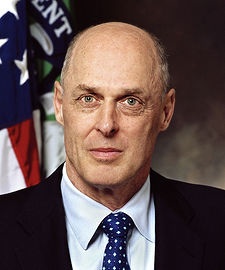 In response to my recent post about the Atlantic Monthly’s take on the state of the economy, longtime friend (and reader of this blog) Joe Stafford sent this photo of Treasury Secretary Hank Paulson and this comment:
Now here is the face of a man asking “WHA HAPPEN’d?”
A bit too wide eyed if you ask me. Maybe his contacts are worn out.My question is: How come in a nation built on CAPITALISM, the crime of abuse of money isn’t the CAPITAL of ALL capital crimes?
Punishable by death, live, in living color, by firing squad?
Mayhaps I’m gullible.
I suspect that in 2009 we’re going to hear more and more calls for retribution of some sort. Which would be fit against people who broke laws and gamed the system in the way Enron executives did.
But if it’s blame we’re looking to assess, most of it lies in our collective mirror. That’s something we should all remember when the next credit-card bill comes.

I just got home from a late movie on Christmas Eve and judging from the tree, the fat man has already visited us. I hope you find something good waiting for you.
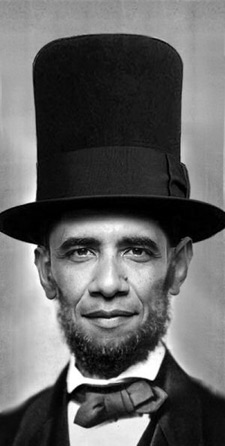 Throughout the recent presidential campaign, there were numerous comparisons between Barack Obama and Abraham Lincoln, most of them originating from Obama. Like Lincoln, Obama was a relatively unknown legislator of meager circumstances from the backwoods (meaning, in this case, Hawaii and Indonesia) with a gift for rhetoric and an affinity for black people who promised to unite a divided nation. Post-election, the narrative has continued, most recently with Obama naming his own “team of rivals” to serve on his cabinet. Today, it was announced that he will take the oath of office using the Bible that Lincoln used.
The point having been made, I think it would be useful now for the president-elect to cease this simile. Because we all know how that other, earlier, story ended.