Question for the day
July 14th, 2009Where were all these “judicial restraint” Republican Senators when the last guy nominated Roberts and Alito? Because basically undoing the last 50 years doesn’t seem so restrained.
Where were all these “judicial restraint” Republican Senators when the last guy nominated Roberts and Alito? Because basically undoing the last 50 years doesn’t seem so restrained.
I have to admire The Second Pass. While everyone else (including me) has been compiling lists of books we believe you should read, their contributors have compiled a list of 10 highly regarded novels they want chucked from reading lists and academia.
I am particularly pleased to see “Absalom, Absalom!” on the list. (Which they misname, omitting the all-important exclamation mark from the title.) No, I still haven’t been able to read it. And I’ve been trying for more than 20 years. Similarly, still unsure why its sloppy lazy prose has been so exalted, I felt a frisson of glee at seeing “On the Road” on the list. I’ve seen the ecstasy it spins some people into, but to the rest of us it’s just a bad trip.
I don’t remember “One Hundred Years of Solitude” being as bad or as arrogant as it’s made out to be here. But I read it about 25 years ago, so who can say with authority? I can say that some of the scenes of magic realism that I so enjoyed then — when, for example, a woman simply floats away — now seem to me to be, well, cheats. (In much the same way that most of Dali’s paintings now seem.) But I’d have to reread the book to formulate an informed opinion, and I don’t see that happening.
The title that I think they’re deeply mistaken about is “The Road.” I’ve written about that novel often enough here that I’m not going to go into it again (this link sums it up, and provides links to a few other references here). I’ve read the other Cormac McCarthy books mentioned by Second Pass (“All the Pretty Horses” and “The Crossing), and they are necessarily different tales told differently. In these books, young men are experiencing the challenges and responsibilities and wonders of adulthood for the first time, and doing it in a foreign land; these books are adventures. “The Road” is told from the opposite point of view: that of a man desperate to shepherd his eight-year-old son somewhere safe after what appears to be a nuclear holocaust. Like the terrain, like his psyche, the language is accordingly stripped bare. It’s a book with deep resonance, one that sticks deep in the subconscious and leaves readers more aware. At least, that’s how it left me: feeling far more glad for everything I have, and far more aware of how easily it could all be lost. That’s the power of a truly good novel; complaining about the stripped-down prose seems like beside the point.
I’m sad to see “The Corrections” on this list, though the criticisms enumerated in the essay ring true. To me the novel’s core achievement is in the way the family history is gone over repeatedly from the different points of view of individual family members, until finally the father’s seemingly inexplicable behavior is revealed and with it the extent of sacrifice he has made for his children. That’s the “moving last section” that the critic mentions here. Something else merits mentioning: Despite all the books flaws, it was tremendous good fun to read. That’s worth noting.
The Wall Street Journal documents the astonishing sales that follow every appearance of comics’ foremost new hero: Barack Obama. (Thanks to Doug Hackney for apprising me of this.)
No, I don’t like this sort of hero worship. To quote another hero, “With great power comes great responsibility.” Without oversight and skepticism, that great power is too often used irresponsibly. And yes, there is enormous opportunism going on here (it would be hard to believe that other publishers didn’t take notice when Marvel grossed more than a million bucks on Obama’s appearance in “Spider-Man.”).
But there are two other factors going on as well: 1) Obama benefits by comparison with the quote-unquote president he succeeded; and 2) Obama is a self-confessed comics fan, especially of Spider-Man. (Which helps explain how he got so many votes. Just counting everyone at Comic Con, that’s more votes than several key Western states combined.)
I just came back from two weeks in my original stomping grounds: southern New Jersey, the area east of Philadelphia stretching down to become a peninsular shadow of Delaware. It’s an area of rivers, beaches, swamps, rednecks, amusement parks, many many trees, and high weirdness. (Like the famously supernatural Indian Cabin Road, which you can read about here and here — newly haunted by an endearingly odd friend of mine who moved there.) It’s where I spent my salad days.
Much remains as it was when I left 21 years ago. I went fishing (to no avail) on the Great Bay, shooting out in the woods (four pistols: a 357, a 45, a 9mm and a 22, as well as my late father’s double-ought thirty side-by-side shotgun), canoeing, riding rides on the boardwalk and jumping waves in Ocean City, and of course spent lots and lots of time eating clams. (Just to pass this along: The perfect nutritionally balanced meal is four dozen clams and a beer. You heard it here first.)
But of course much has changed since I left 21 years ago, and since my boyhood. Rich Roesberg, a friend and reader of this blog, sent some photos of lost landmarks of the area that I thought I’d share.
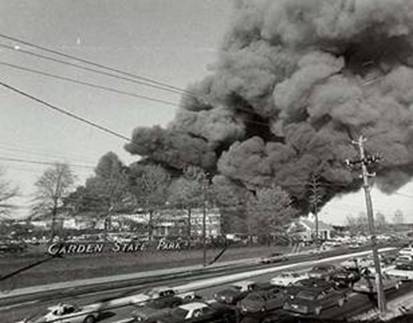
This photo shows the infamous Garden State Park fire of 1977. As you can imagine, this was huge news at the time. (I was 15.) Garden State Park was a horse-racing track. The success of this attraction pretty much created the boom in surrounding Cherry Hill, giving birth to the Cherry Hill Mall, the Latin Casino (which booked A-level stars like Sinatra and Liberace), and numerous other developments. When I was a kid, Cherry Hill Mall was like Xanadu. I hate malls (now), but at the time I couldn’t wait to see what wonders awaited me at Cherry Hill Mall. It’s about 45 minutes from the house I grew up in, but it may as well have been halfway across the globe. The fire above polished off the Garden State Park; it was competition from casinos that pretty much ended race time at the Atlantic City Race Course.

This is Olga’s Diner, which was on the Marlton Circle, one of those nexus points between Philadelphia and South Jersey. I just learned that it closed in 2008. When I was a young man, I had business that often brought me to this area (either selling comic books in Philadelphia, or delivering auto parts in the area later on). I can’t tell you how many times I ate at this diner. Last month when I was driving my wife and kids down from JFK for our vacation, I looked everywhere for a family-style diner like this at which to eat. I couldn’t find one. Finally we settled on an Applebee’s, one of the ubiquitous casual-dining chains that advertise constantly on TV. I’m still scrubbing the sodium from my teeth.
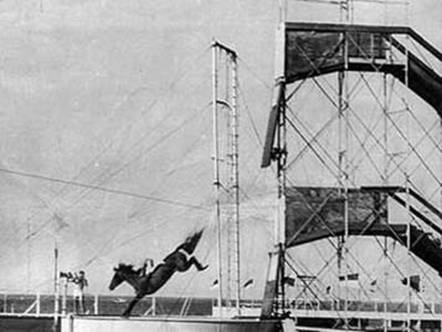
Yes, this is one of the famed Steel Pier diving horses shown in action. I got to see this act when I was a kid. The horse was trained to dive 60 feet through the air, a beautiful young woman on its back, landing in 10 feet of water. Cruel? Yes. (There were accusations that the horse didn’t “dive,” but fell when a trapdoor was sprung.) But it was an amazing thing to see, back when we were less enlightened about animal welfare. (I remember liking the young woman, too.) The act ended for good when Resorts International casino bought the pier.

This is Zipperhead, on South Street in Philadelphia. Not sure why this was included as a lost treasure in Rich’s email; last I checked — Rich in tow, last summer — Zipperhead was still there. And Lord knows I hope it is indeed still there. Zipperhead is where my then-girlfriend (now wife) and I would get some of our punk and new-wave accoutrements. (She was punk; I was new wave. I don’t think there’s anything remotely punk about her any more, and given that my music of choice now serves as easy listening at airport terminals, I am feeling very old wave. When I went to see the Psychedelic Furs last month, I found myself wondering “What are all these fat old guys doing here?” Then I realized.) If Zipperhead is now a Polo store, someone must mount a charge.

The Sweetwater Casino was a somewhat-upscale (for the area) restaurant deep in the heart of the Pine Barrens where I grew up. It hugged the Mullica River that I grew up canoeing. I remember never wanting to go there as a kid because I didn’t want to eat anything on the menu. (My tastes have changed.) My parents would order something called “Clams Casino,” which I recall seeming especially repellent. The restaurant burned down in 2008, but the owners just re-opened the deck, and plans are underway to rebuild the restaurant. When my wife and I were first dating, my future mother-in-law insisted that we go to the Sweetwater Casino. I have no idea why. (At the time I thought she just wanted to see me spend some money on her daughter. In retrospect, I was pretty cheap.) She said that all we had to do was mention her father’s name (my kids’ now-great-grandfather) and we would get superior service. He was a local bank executive and a founder of another well-known local business and evidently a great patron of the Sweetwater Casino. So we went to the Sweetwater Casino and mentioned that name and got… blank stares. And then when we got inside I had to deal with the menu prices.

No, this isn’t rural Arkansas today. This is Pennsauken Mart, in Pennsauken, New Jersey. (The similarity in terrain and culture between Arkansas and where I grew up is striking. Except Bill Clinton would not have been corrupt enough for the Atlantic City area.) Yes, Pennsauken Mart was a grimy indoor flea market, but to a kid on the outlook for cheap back-issue comics, this was a mecca. (Berlin Farmers Market was even better.) The Mart was razed in January 2006 to give way to a redevelopment project including condominiums, shopping and, I’ll bet, paved parking.
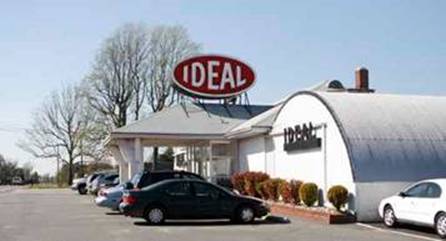
Not everything that is gone should be viewed with regret. And so, finally, we have Ideal. Ideal was a woman’s clothier located in Hammonton, NJ for more than 50 years in the markedly unstylish quonset hut shown. I remember my mother and sister going there and my insisting on waiting (endlessly) in the car, comic books at the ready. (Whenever my 6-year-old boy doesn’t want to go to this sort of place, I do understand, believe me.) So what hold could a woman’s clothing store possibly have on my memories? It wasn’t the fashion, it wasn’t the location, it wasn’t the store, it wasn’t anything that ever happened to me there. It was their jingle. Anyone who ever heard it never forgot it — and I’m convinced it was the secret to their 50 years’ success in business. The song was everywhere, all the time, on television and radio. Take whatever pop song you think was overplayed, and then multiply by the nth degree, and you have the play record of the Ideal jingle. Which I can quote from memory:
“If you’ve got a passion for fashion
And you’ve got a craving for savings
Take the wheel
Of your automobile
And swing on down to… IDEAL!”
Thank God this place finally closed in 2008. Now women in the area are safe to be more fashionable (truly fashionable), and everyone is safe from this disturbing brain-infesting jingle. Some time hence, when the last song of my life goes through my brain as it shuts down, that song won’t be “Hey Jude,” even with its million la-la-la’s, or “The Star Spangled Banner,” or even “Happy Birthday.” No, I’ll be mentally humming “If you’ve got a passion for fashion….” And I’ll smile knowing it’s no longer there, and no little boy is waiting impatiently in the car outside.
A little tip that I thought I’d share with other parents of small children. Sometimes the best response to a child’s complaint is this: “Knock it off.” I have found this to be useful. (Even today.)
The classic musical, updated for now.
(Thanks to Mark Chaet for making me aware of this.)
Two stories about how to tarnish your image:
#1.
This afternoon I took my three kids down to South Coast Plaza for an event marking the 40th anniversary of the Apollo moon landing. The newspaper promised “a Lunar Rover and Apollo 10 space suit along with a Sojourner Mars Rover will be on exhibit.” Well… maybe. Neither the suit nor the Mars Rover looked like they had ever seen action, and they were conspicuously unguarded on a raised platform behind velvet ropes. (As we approached, one man had already stepped over the stanchion to have his picture taken with the items. I doubt Smithsonian-level relics would be left so untended.) And the Lunar Rover looked like a replica — big plastic tires with no wear on them, and the body of the vehicle emblazoned ever in an odious manner with the logo of Omega, the sponsor. Quelle dommage. This was our only scheduling opportunity to note a signal anniversary, a giant step that makind made and should have kept making further and further out, and this is how we spent it: at a mall, looking at ads for a watch slapped all over a fake lunar vehicle. It was a sad reminder of how far we’ve gone in 40 years — in reverse. I now think less of Omega, less of South Coast Plaza for false advertisement, and certainly less for the nation as a whole for letting our space program sink into the tarn.
#2.
While there, I decided to visit the Montblanc store. I was out of ink cartridges for my fountain pens, and when my younger son and I visited the Montblanc store in Glendale on Friday we discovered that it had closed, in what I thought was another sign of the economic recession. The four of us located the Montblanc store in South Coast Plaza. I told the sales clerk, a man probably in his late 20’s, that I needed some ink cartridges for my fountain pens, and bought a box (ten packs of six). I took the opportunity to bring up the closure of the Montblanc store at the Glendale Glendale Galleria.
Clerk: “That store was actually doing well. The company closed it because they didn’t want to serve a lower class of customer.”
Me: “I bought three fountain pens there, an injector, two ink wells, and lots of cartridges. I’m sorry people like me weren’t classy enough.”
Now, mind you, that’s about $1500 in pens and supplies. The clerk did his best at backpedaling, blaming the closure now on the mysterious ways of corporate owners in Germany unmotivated by strong sales to obviously valued clients like me. But by then I was looking to go some place where the lower class are more welcome.
And by the way, what precisely would be wrong with looking at an attractive young woman? (Other than getting yourself compared to more foolish members of your profession.)
Given what’s been going on with the tail end of this political season — with Nevada’s Senator John Ensign and South Carolina Governor Mark Sanford admitting to chasing tail — I understand the eagerness of people like Matt Drudge to find and transmit what appears to be an image of President Obama admiring a 17-year-old’s back side. Like so:
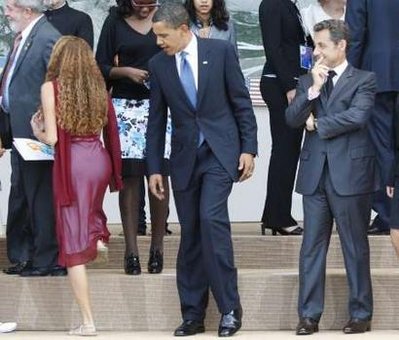
But now watch the full video — in, not out, of context — and you’ll see that Obama was helping a woman on the steps. Helping, not having. Will there be a retraction coming from Drudge or the New York Post? No. Will this ridiculous image show up in some campaign, or provide lore for the right-wing fringe? (“Sure, the mainstream media come down on the GOP for sexual impropriety, but they didn’t do anything when it was their president.”) You bet.
Visit msnbc.com for Breaking News, World News, and News about the Economy
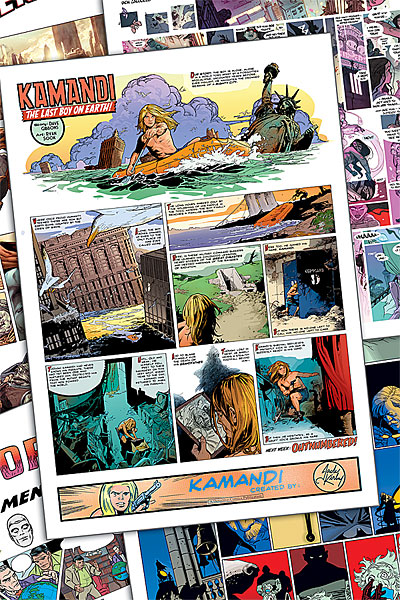
So here’s DC Comics’ bold new idea: a return to Sunday newspaper-style comics.
It’s called “Wednesday Comics,” and the uncleverness of that title presages the bad idea behind all this: recapturing an era that reached its peak 50 years ago or more. Yes, every Wednesday for 12 weeks, DC is putting out a folded newspaper-print section of comics. Note to DC: There have been a few developments in the years since newspaper adventure strips were big. We call them television, and video games, and the internet. While you may find some geezer somewhere willing to wait an entire week to get one more page of story, you won’t find a large clan of people clamoring for a return to slow. My kids sneered at your first Wednesday Comics release today — “Why would anybody want that?” asked my 11-year-old daughter the avid comic-book reader — and I pointedly did not plunk down $3.99 for a series of one-page stories that will conclude months from now as we enter the holiday season. I can barely stay off my iPhone for 15 minutes and you think I’m going to spend 12 weeks crawling through a comic book one page at a time?
Meanwhile, I got my weekly email newsletter from your rivals at Marvel today. They always focus on comics that you can now read online for a small subscription fee (a model that works well; I have friends who are subscribers and who love it). You do that with that internet thing you may have heard of. Do you have anyone under the age of Methusaleh working for you? If you do, I have to think they’ve been huffing too much funnybook ink, because the idea of launching weekly one-page comics strips at the precise moment when comics strips and their host newspapers are dying is, well, dopey.
I’m sorry for your lame packaging model, because the contents look great. Paul Pope doing “Adam Strange,” “Hawkman” by Kyle Baker, “Sgt. Rock” illustrated by Joe Kubert, and especially “Metamorpho,” by the inspired pairing of Neil Gaiman with artist Michael Allred. But when I read the list of the artists and writers involved, I just got more annoyed. Why not print these as eight 24-page comics, with two stories in each? I have little doubt that around the end of the year you’ll repackage these comicitos into a hardback or two, and for a price that’s competitive with spending $48 to get all this in a format and timeframe I just don’t want. In the meantime, I would remind the comics shops that get stuck with these that newsprint is recyclable.